The Definitive Guide to Ayurvedic Hair Oils for Hair Fall Control
What hair fall actually is on an Indian scalp, how classical Ayurveda reads it, what a medicated oil supports and what it does not, and when the answer is a dermatologist.
Most of us start oiling seriously only after the drain says something. The comb holds more than last month, the parting looks wider in a tubelight photograph, and every bottle on the shelf is promising you an outcome. Type baal jhadna kaise roke into a search bar and you will get a thousand answers with a deadline attached to each one.
This guide does the slower thing: what hair fall actually is on an Indian scalp, how classical Ayurveda reads it, what a well made medicated oil supports and what it does not, how to oil properly, and when the answer is a dermatologist instead.
Key takeaways
- Shedding and thinning are two different problems. Shedding means more strands are leaving on a normal cycle. Thinning means the strands that return are finer than the ones that left, and that pattern deserves a doctor’s opinion rather than a new bottle.
- Classical Ayurveda reads hair fall as Khalitya, usually as a Pitta and Rakta pattern seated in the scalp: Pitta is one of the three doshas, the biological energies of Ayurveda, and Rakta is the blood tissue. Vata dryness and Kapha congestion, the other two doshas, show up as recognisably different presentations.
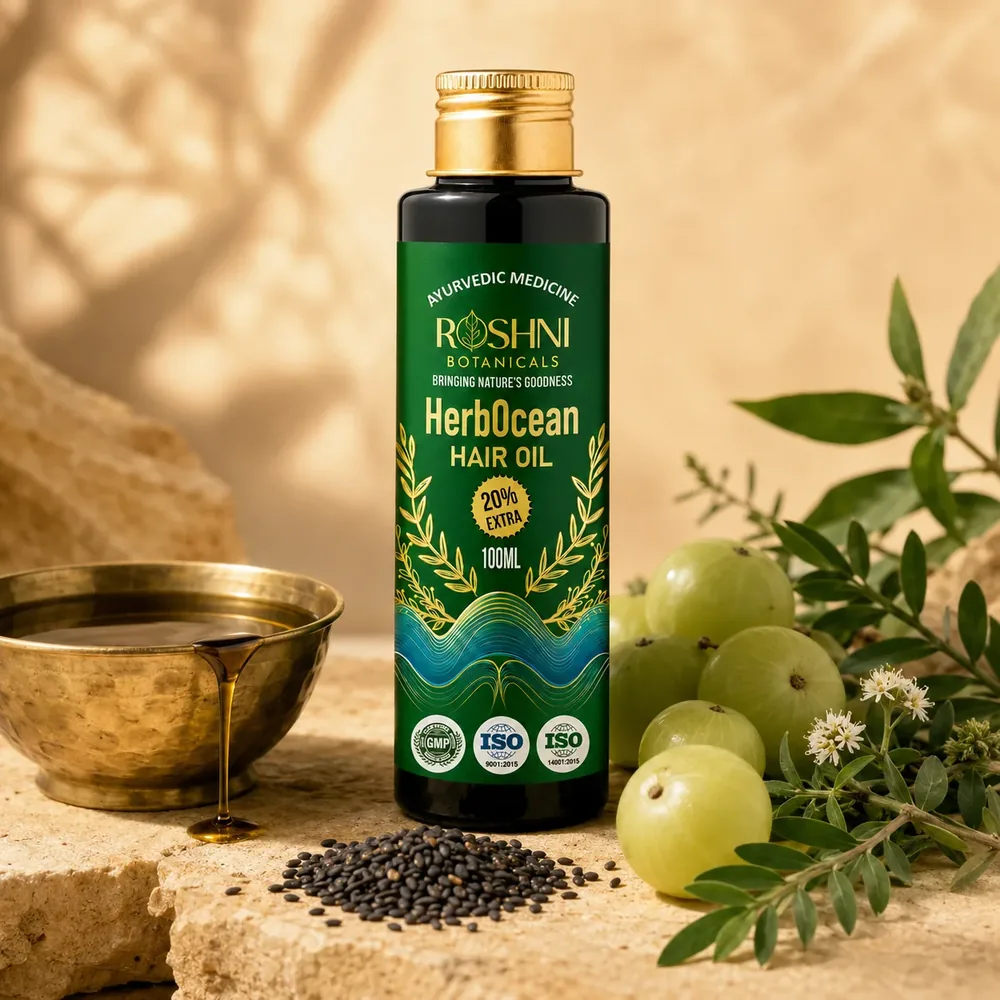
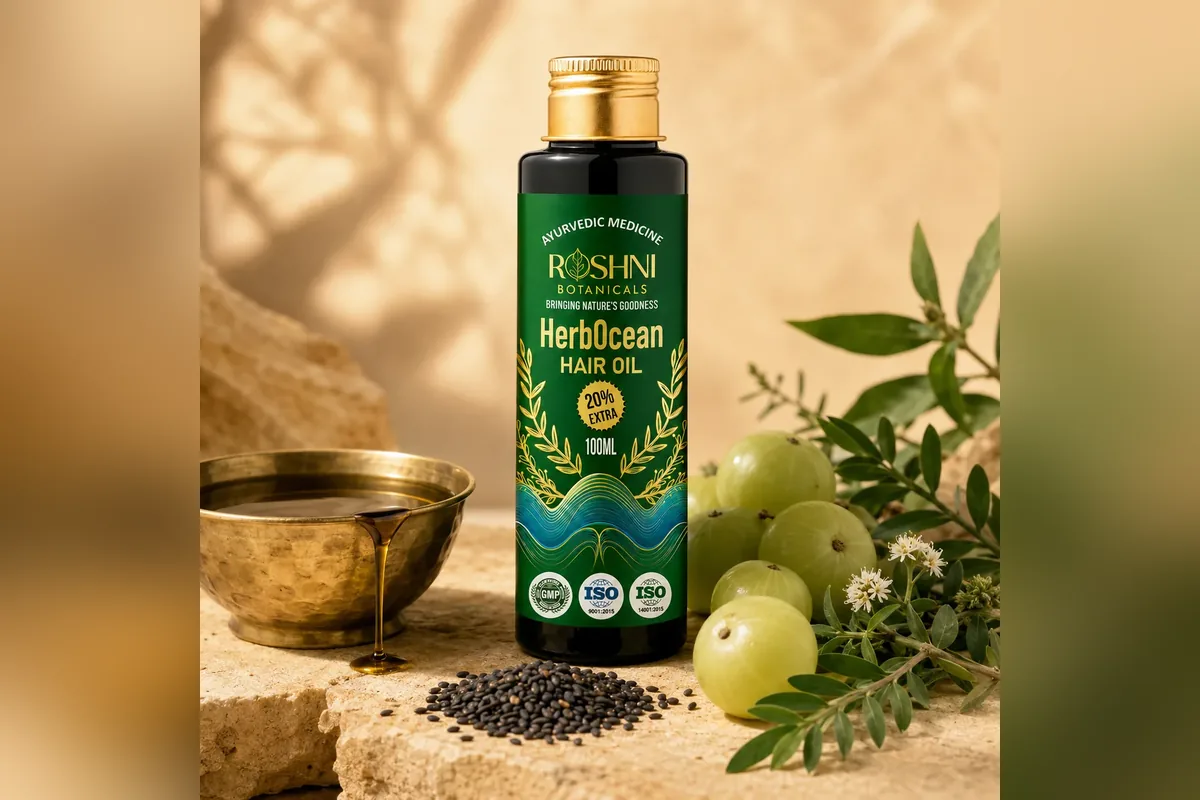
- A classical hair oil is a Taila (medicated oil), which means the herbs are processed into the base rather than stirred in at the end. HerbOcean Hair Oil is built from sixteen botanicals, the sesame oil (Til tail) base among them.
- No oil, herb, massage or ritual changes the speed at which a strand grows; that rate is set at the follicle. No oil re-joins a split end, and grey hair stays grey until it is cut off.
- Judge whether a routine suits you over three to four months at two or three sessions a week, not over three weeks. Sudden loss, smooth coin-shaped patches of hair loss, a parting that widens month on month, a scalp that hurts or scales, or shedding alongside marked fatigue belong with a doctor.
Shedding or Thinning: Which One Are You Seeing?
Start with the distinction almost every hair fall page skips. Shedding is about quantity: more strands are leaving than you are used to seeing, but the ones that grow back arrive at their usual thickness. Thinning is about quality, because the strands that return come back finer over successive cycles, so the parting widens even on days when the drain looks calm.
Both feel identical in the bathroom. Over a year they behave nothing alike. A shedding phase usually settles once whatever set it off has passed, while thinning follows a slower, more stubborn arc, often runs in families, and deserves a specialist opinion early.
Why does a bad month show up in your comb a season later? Every follicle works on a cycle: a long growing phase, a short resting phase, then release, after which it starts again. Most of the scalp is growing at any moment; a small minority is resting. A stressor, whether a fever, a crash diet, a surgery or weeks of broken sleep, can push a larger than usual share of follicles into that resting phase together. Release comes weeks later. So the shedding you are watching now is usually reporting on something that happened two or three months ago, which explains most of the bathroom panic and most of the blame landing on last week’s bottle.
Give yourself a baseline before you change anything. Photograph the parting in the same spot at the same time of day, once a week, in daylight. Watch the ponytail: has the band gone around one more turn than it used to? Then look at the strands themselves, because breakage mid shaft collects in a comb exactly like hair fall but has a different cause and a different fix. Four weeks of your own observation beats four hundred pages of advice, this page included.
Khalitya: How Ayurveda Reads Hair Fall
Classically, hair fall is discussed as Khalitya, and Ayurveda reads the scalp before it reads the strand. Hair (Kesha) is understood as a by product of deeper tissue processes, so when hair leaves the root the classical eye turns to Pitta and to Rakta, the blood tissue Pitta sits closest to. Charaka Samhita, Sushruta Samhita and Ashtanga Hridaya all treat the care of Kesha within head oiling and the daily routine, and all three leave you the same practical inheritance: a settled scalp comes before a settled strand.
Three presentations are worth learning. Read them as tendencies rather than as a diagnosis, because they route you to different habits, not to different promises. Dry and brittle, read as Vata: a rough scalp with fine flaking that is not greasy, strands that snap mid shaft, splits and frizz, all of it worse in dry wind and hard winter water. Heat at the root, read as Pitta with Rakta involvement: strands coming away cleanly with the pale bulb attached, a scalp that feels warm or tender, sensitivity to sun and to spice. Heavy and clogged, read as Kapha: a scalp greasy by the second day, sticky flaking, itching, strands leaving in clumps at the wash rather than through the day.
You may well recognise two of them at once. What the classical framing hands you is a way to match a routine to a scalp: more oil and less washing at one end, less oil and a same day wash at the other. What it does not hand you, and what this page will not pretend to, is a switch for shedding. A classical Taila is traditionally used in the care of hair fall (Khalitya) and of the scalp and the strand. That is a real claim, and it is a different claim from the ones that come with a deadline attached.
What the Indian Year Does to a Scalp
The turn out of the monsoon is a transition for North Indian scalps. Weeks of trapped damp give way to dust and dry wind, and early autumn arrives before the scalp has adjusted. Through the humid weeks a scalp stays wet longer after every wash, sweat sits under thick hair, and flaking and itching climb. Many households answer by washing more and oiling less, which is understandable in the moment and unhelpful once the air turns dry and the same scalp wants the oil back. If your shedding spikes in the rains every year, our post on hair fall in the monsoon takes that seasonal pattern apart properly.
Hard water is the quiet one. Across much of urban India the water carries a heavy mineral load, and those minerals deposit on the strand and the scalp at every wash. You notice hair that feels rough rather than clean, a lather that never quite arrives so you use more shampoo, tangles that pull at the root. Hard water does not pull hair out by itself. What it does is add mechanical stress exactly where a strand is most likely to break, which is why the piece on hard water and hair fall is worth reading before you blame the season.
City air adds its own load. Dust and exhaust settle into oiled hair across a Delhi commute, so keep a session to an evening at home rather than wearing oil out all day. Tight styles matter more than people expect: a high ponytail worn daily, a school braid pulled hard, extensions, a bun pinned in the same spot every morning. All of them drag at the hairline, and traction along the temples is one of the few hair fall patterns that answers to simply changing the habit, provided the habit changes before the skin scars over. Once a patch turns shiny and smooth, that is a dermatologist question, not a looser ponytail. Curls and waves carry extra risk, since they tangle and dry out faster, and our guide to curly and wavy hair care in India covers that routine in full.
Diet earns a mention, with the caveat that it is oversold. Very low calorie dieting and sudden weight loss often sit behind a shedding phase, and low iron status is common enough among Indian women to be worth a blood test rather than a guess. Past that the evidence thins quickly. Dairy, refined sugar and late dinners deserve your attention for digestion and for skin, and Ayurveda would frame all three through Agni (the digestive fire), but no page worth reading will tell you that giving up sugar restores a hairline.
Stress, Illness and the Months That Follow
Stress is the trigger readers name most often and understand least. A long stressful stretch, an exam season, a bereavement, a job loss, months of broken sleep, tends to run ahead of the resting phase shift described earlier, which is why the comb reports it a season late. Ayurveda situates that connection in Pitta and in Dinacharya (daily routine) rather than in a single herb, and the classical answer is a steadier day before a stronger bottle. Brahmi comes up constantly here and sits in our own formulation, so we have written separately on whether stress can cause hair fall, and where Brahmi fits.
An illness announces itself in the hair long after it is over. A high fever, dengue or typhoid, a hospital stay, a surgery, or a hard course of medication can push a wave of follicles into rest together, and the shedding typically declares itself around two to three months later, by which time the person is well and the connection invisible. That kind of shedding is usually self limiting and settles once the cycle rebalances, though it feels alarming while it lasts. The detail sits in our post on shedding that follows a fever or illness, including how long it usually runs.
Shedding after delivery follows the same logic on a different clock. Pregnancy holds a larger than usual share of follicles in the growing phase, and after the birth that share releases together, so many women meet a heavy stretch that begins around the third month and peaks near the fourth or fifth. Nothing has gone wrong, and it generally settles over the months that follow. Oiling through this period is about comfort and about keeping the length manageable on very little sleep, and our post on hair fall after delivery covers what to expect, the jaappa weeks, and how to keep the routine small. If you are nursing, keep oil away from the breast area and off the baby, and run anything you are applying past your doctor.
Reading a Hair Oil Label, and What Sixteen Botanicals Are Doing
Most of the difference between hair oils is settled before any herb is named, so look at the base first. A classical Taila is made by processing herbs into the oil itself, so the finished liquid is the medicine. A great many bottles on the shelf are a refined or mineral base with a little extract and fragrance stirred in at the end. That is a different kind of product, and the label will usually tell you which one you are holding. Check whether the pack carries a manufacturing licence number, since an Ayurvedic medicine carries a drug licence and a cosmetic hair oil does not. Then read the list: are the botanicals named one by one, or gathered under a vague herbal blend? Our comparison of Ayurvedic and chemical hair oils works through that reading in detail, and the piece on onion oil compared with a classical taila applies the same test to the format everybody is selling this year.
HerbOcean Hair Oil is built on the older method. Sixteen botanicals make it up: twelve herbs, namely Bhringraj, Jatamansi, Brahmi, Shikakai, Amla, Nagarmotha, Chharila, Sugandhbala, hibiscus (Gudal), Tulsi, rose (Gulab) and Neem, the sesame oil (Til tail) base they are processed into, and three essential oils, lavender, curry leaf and rosemary. No single botanical leads this formula; the twelve herbs sit in equal measure. There is no henna in it and no onion.
It is made in-house at our GMP-certified unit in Bawana, Delhi under AYUSH Licence No. DL-474 A&U, an Ayurvedic medicine for external use.
What a few of the better known botanicals contribute is best stated carefully. Bhringraj is the herb classical hair care returns to most often, and we have set that tradition out in our piece on Bhringraj. Jatamansi brings its own settling character and that unmistakable smell; the classical record places it as a mind-and-sleep drug rather than a hair drug, which is the subject of our page on Jatamansi for hair. Amla is the one Indian households know best, and what oil-processing actually carries from the kitchen fruit into the bottle sits in our post on amla for hair. Shikakai brings the gentle cleansing character families know from ubtan days. You will find confident lines online about which of these is heating and which is cooling. We do not attach a potency to any botanical in this formulation on this page, because we will not state as settled what we have not checked against a printed classical source.
Henna deserves its own word, because it is the other thing every Indian family reaches for. There is none in this oil. Henna behaves as a dye and a coating rather than as a Taila, and it interacts with chemical colour in ways worth knowing before you combine the two, which is why we published an honest guide to henna for Indian hair instead of a paragraph.
What an Oil Cannot Do
Now the part the roundups leave out, and most of the reason this page exists. No oil, herb, massage or ritual changes the speed at which a strand grows; that rate is set at the follicle, it varies with genetics, age and general health, and nothing you apply moves it. If you have been told to expect a particular number of inches by a particular month, you have been sold a timeline rather than a formulation, and our post on how fast hair actually grows gives you the arithmetic instead.
Two more limits belong here. Once a strand splits, no oil re-joins it. Oils and conditioners can smooth the shaft and may slow the split travelling further up the length, and our honest guide to split ends and breakage sets out what a trim actually does; scissors do the rest. Colour is the second limit: grey hair stays grey until it is cut off, whatever a listing implies, because pigment is laid down in the follicle while the strand is forming. A strand that emerged without it stays as it is.
We would rather say all of that plainly than sell around it. The HerbOcean formulations are built on the 40-year Ayurvedic formulation legacy of Vaidya Shri Ram Prakash Ji, and the point of a legacy like that is a formulation you can describe accurately, not an outcome you can promise. What a well made Taila supports is the condition of the scalp and the strand: a calmer scalp, less mechanical breakage along the length, and a routine you can keep for months instead of weeks.
The Champi Method, and When a Dermatologist Is the Answer
A champi (the everyday head massage with oil) is worth doing properly, because most of what goes wrong with oiling is technique rather than the bottle. Warm the oil to a little above room temperature, never hot. Do not oil a scalp that is broken, weeping, inflamed or infected, and if you have a known allergy to sesame or to any listed botanical, do not use it without medical advice. Patch-test on the inner forearm before the first full application. Then part the hair into four or six sections with a comb so you can reach the scalp instead of the length, and apply along each parting with your fingertips or a dropper.
Massage with the pads of the fingers in small circles for five to ten minutes, moving the scalp over the skull rather than dragging the hair or scrubbing with nails. Work from the hairline back and from the nape up. Comb through afterwards with a wide toothed wooden comb, leave the oil on for an hour or two before you wash, and wash with a gentle cleanser. Our guide to a step by step scalp abhyanga (the classical name for oil massage) at home walks the same sequence with fuller timings, and is the page to follow if you want the longer version.
Two or three sessions a week suit most scalps. Dry, Vata type hair can take three and can hold the oil overnight in winter; skip the overnight session altogether if the scalp is itching, flaking or sore. A greasy or flaky scalp in humidity does better with a smaller quantity, thirty minutes and a wash the same day, and that shorter session is deliberate. The mistakes that waste months are remarkably consistent: oiling only the ends and never the scalp, leaving oil on for two days because more must be better, scrubbing with nails until the scalp stings, tying wet oiled hair into a tight bun, and changing the bottle every three weeks so that nothing is given the time a follicle cycle asks for.
Expectations, plainly. What tends to change first is comfort rather than count: less itching, less tightness after a wash, softer lengths, easier combing. How soon that shows varies from scalp to scalp. Beyond that, a routine changes condition rather than arithmetic, and shedding itself keeps moving with the season and with whatever happened to you two months earlier, on no timetable an oil can set. Three to four months in, you are far enough to judge whether the routine suits you at all. No week by week table can promise more than that without inventing numbers, and we are not going to invent them.
Some patterns need a doctor rather than a routine, and the sooner the better. See a dermatologist for shedding that starts suddenly or worsens quickly, for smooth, coin-shaped patches of hair loss, or for a parting that keeps widening month on month. Go sooner for a scalp that is painful, scaling, weeping or bleeding, and for a shiny scarred area where follicles seem to have gone. See your doctor rather than a skin specialist if the hair fall arrives with marked fatigue, breathlessness, or a known thyroid or iron concern, since those are questions a blood test answers. Go too for shedding after an illness that is still heavy past six months, for shedding after a delivery that is still heavy at a year, and at any point for shedding that is worsening rather than settling. Any noticeable hair loss in a child is a doctor’s question before it is an oiling question. Take a blood test seriously if one is suggested. An oil is a good habit alongside all that, never a substitute for it.
The Short Version
An oil is one input among several. The reader who softens the wash water, loosens the ponytail, sleeps and eats steadily for a season and oils twice a week for four months is likely to get further than the one buying a new bottle every month. Pick a Taila you can describe, use it on the scalp, give it the months a follicle cycle asks for, and get the sudden or painful patterns looked at by a doctor. The rest of the range sits on our Ayurvedic hair care page. If you want the oil described above, it is HerbOcean Hair Oil, sixteen botanicals with sesame oil among them.
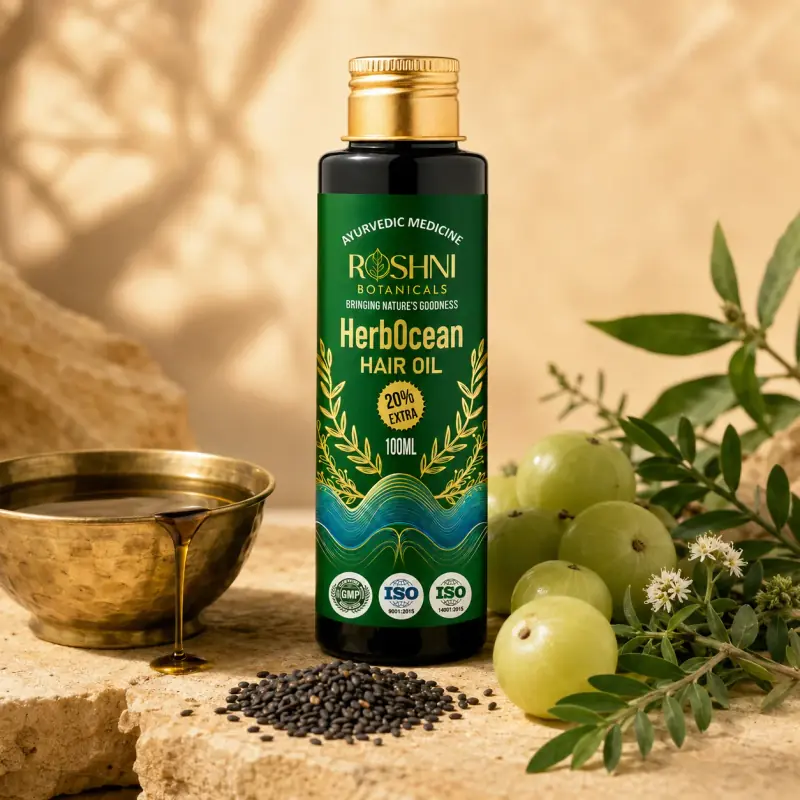
HerbOcean Hair Oil
A classical Taila for hair fall, dullness and a flaky scalp, with sixteen botanicals like Brahmi, Jatamansi, Amla and Neem in a slow sesame base.