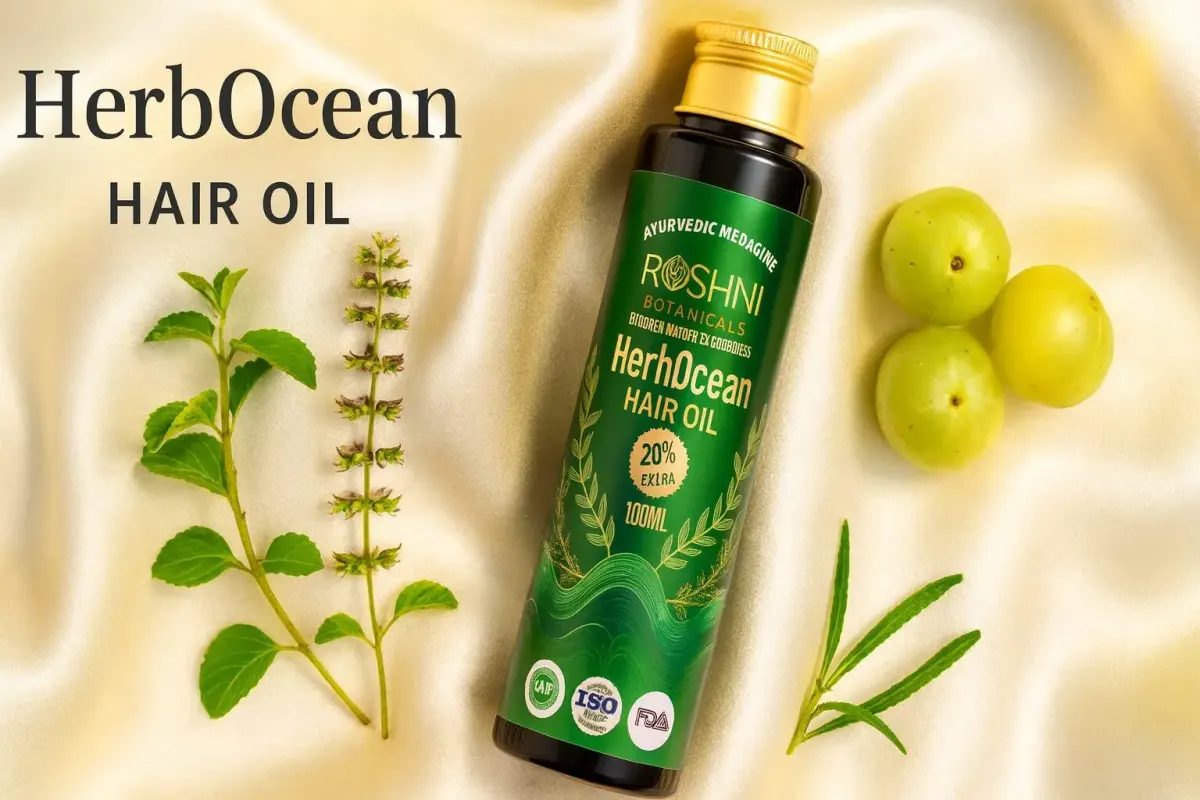
Choosing a Hair-Fall Oil: How HerbOcean Approaches Everyday Shedding
What to look for in an Ayurvedic hair-fall oil, what is realistic to expect, and how HerbOcean Hair Oil is built on Vaidya Shri Ram Prakash Ji’s classical Taila approach.
Search for a hair-fall oil and you will drown in superlatives. Everything is the best, everything is clinically something, and every bottle promises a number. Hair fall is genuinely stressful, which is exactly why it attracts loud claims. Here is a calmer way to choose, and an honest account of how we make HerbOcean Hair Oil.
What actually matters in a hair oil
Look past the marketing and a few real things separate a serious oil from a fragranced one. Is it a true Taila (medicated oil), with herbs processed into the base, or just essential oils dropped into a carrier? Is every ingredient declared, or hidden behind “proprietary blend”? Is the base a nourishing oil like sesame, or cheap mineral oil that only coats the strand? And is the fragrance load sensible? Those questions tell you more than any percentage on the label.
The herbs in the blend
HerbOcean layers sixteen botanicals, and the supporting cast is chosen with care: Tulsi for a comfortable scalp, Gulab (rose) for softness, Gudal (hibiscus) for body, Neem to keep the scalp clean, and Brahmi alongside the classical hair herbs Bhringraj and Amla. Each is traditionally used in classical hair care, and they sit together in a slow sesame base rather than competing.
How it is made
The oil is prepared in the classical slow-infusion way and made in-house in Delhi on the forty-year formulation lineage of Vaidya Shri Ram Prakash Ji, our master Ayurvedic formulator, under AYUSH Licence DL-474 A&U. There is no mineral oil and no heavy added fragrance. That is a deliberate choice, not a shortcut avoided.
The making: a slow infusion, not a quick mix
What separates a serious Taila from a fragranced oil is the process. The classical way is a slow infusion, the herbs cooked patiently into the base over days rather than stirred in at the end, so the oil itself carries them. It is unglamorous and it does not scale easily, which is rather the point. HerbOcean is made this way in small batches in Delhi, with every botanical declared on the label and nothing hiding behind the words proprietary blend.
The things an oil cannot fix
Honesty cuts both ways. Plenty of everyday hair fall in India has causes an oil was never going to touch: low iron, which is very common, especially in women; thyroid shifts; the heavy shedding that follows childbirth or a fever; crash diets short on protein; and the slow grind of stress and poor sleep. Hard water and over-styling add their own toll. A good oil supports the scalp through all of this, but it works alongside sleep, diet and, where needed, a doctor, not instead of them. If your shedding is sudden, patchy or simply not settling, that is a cue to get a blood test rather than a bigger bottle.
What is realistic, and what is not
This is where honesty earns its keep. Regular oiling is traditionally used to support a healthy scalp and ease everyday shedding, the ordinary hair fall most of us see. It is not a remedy for medical hair loss, and we will not put a percentage on it. If your shedding is sudden or rapidly worsening, if you have patchy bald spots, if the scalp is painful or scarring, or if hair fall after childbirth or an illness has not settled in a few months, see a doctor. A simple blood test and a scalp check often find something fixable, like low iron or a thyroid issue, that no oil was ever going to solve. For the full picture, read our definitive guide to hair oils for hair fall.
So, the “best” oil?
The best oil is the one you will actually use, made honestly, with nothing to hide on the label. Match it to the right job, give it weeks of steady use, and pair it with the basics of sleep, diet and stress. That is the unglamorous truth the louder bottles leave out.
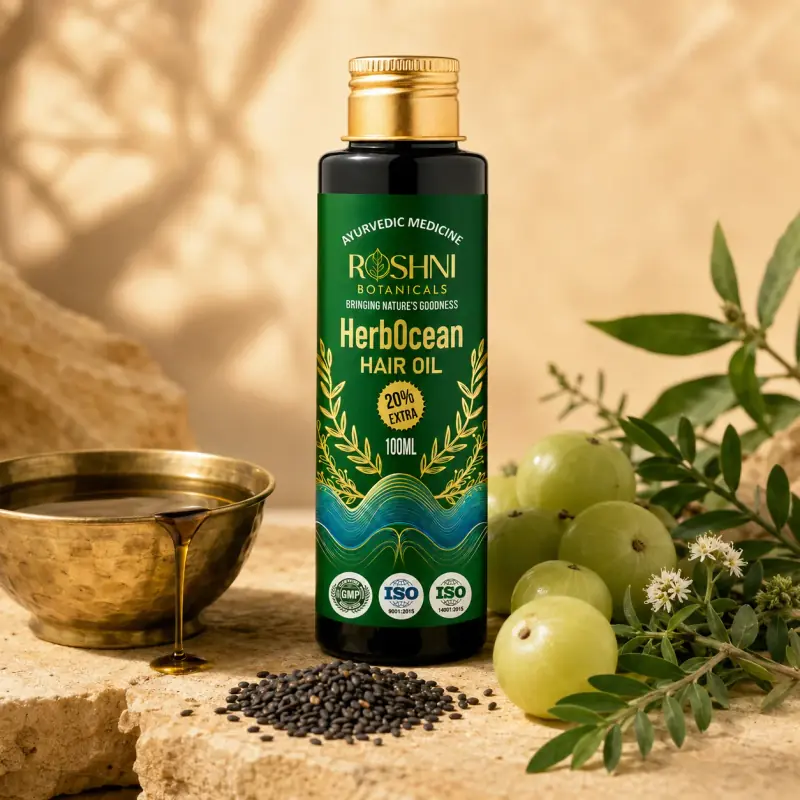
HerbOcean Hair Oil
A classical Taila for hair fall, dullness and a flaky scalp, with sixteen botanicals like Brahmi, Jatamansi, Amla and Neem in a slow sesame base.