
Hard Water and Hair Fall: What Your Tap Water Does to Your Scalp
Hard water rarely pulls hair from the root; it snaps it mid-length. Home tests, near-free fixes, and why the pre-wash champi is India's original hard-water defence.
If your hair feels rough within minutes of a wash, your shampoo may not be the culprit. In most Indian cities, borewell and tanker water carries enough dissolved calcium and magnesium to leave a fine mineral film on every strand, the same film that leaves white scale on your taps. That film is why wash day so often ends in a tangled comb and a small heap of broken hair. Here is what hard water genuinely does to hair, what it does not do, and the low-cost habits, one of them as old as the champi itself, that protect your strands from your own bathroom.
Key takeaways
- Hard water rarely causes hair loss from the root; dermatologists are clear on this. Its calcium and magnesium roughen the outer cuticle so strands turn dull, tangle and snap mid-length, which reads as hair fall on the bathroom floor.
- The self-check takes ten seconds: a snapped strand has no bulb at its end, while a strand shed from the root carries a tiny white bulb. Hard-water damage produces the first kind.
- You can test your water at home in two minutes with a soap-and-bottle shake test; chalky scale on taps and geyser elements is the everyday confirmation.
- Pre-wash oiling is India's original hard-water defence: in a laboratory study of three oils, only coconut oil reduced protein loss from washing, and the classical champi-before-bath rhythm long predates that finding.
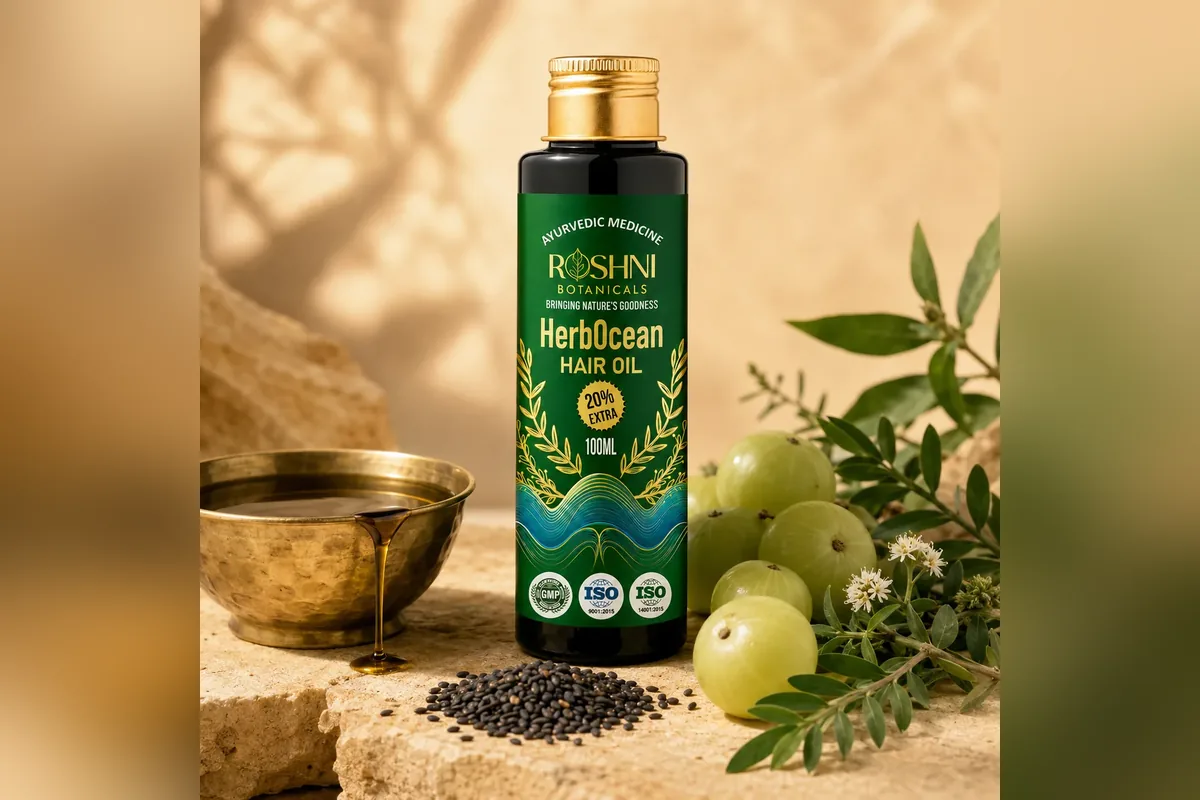
- HerbOcean Hair Oil, a sixteen-botanical classical medicated hair oil (Taila) in a sesame base, is traditionally used in the care of hair fall (Khalitya, the classical term) and dullness, and pre-wash is exactly how the tradition used such oils.
What Hard Water Actually Does to Your Hair (and What It Does Not)
Let us settle the scary version first, because the internet profits from it. Hard water does not reach into your follicles and switch them off; dermatologists interviewed on exactly this question call root-level loss from hard water a myth, and the pattern of loss people fear, a receding or thinning from the root, has hormonal, nutritional and medical causes that water cannot produce. What hard water genuinely does is humbler and very visible. Its dissolved calcium and magnesium bond to the strand during washing and dry into a microscopic mineral film. The film stiffens the hair, lifts the flat outer scales of the cuticle, and makes strand rub against strand like unwaxed thread. Rough strands tangle; tangled strands snap under the comb; and the snapped halves on your floor get counted, understandably but wrongly, as hair fall. It is worth being precise about the damage: when researchers soaked hair in hard water and measured it against distilled water, the fibre’s own tensile strength did not change, so hard water does not weaken the hair itself. What it changes is the surface, and a rough, tangling surface is what breaks under a comb.
Which is why the ten-second check matters more than any product decision. Pick up a few fallen strands and look at the ends. Snapped mid-length, no swelling at either end: that is breakage, the hard-water signature, and everything in this post helps it. A tiny white bulb at one end: that strand shed from the root, which is a different story with different causes, and if bulbed strands dominate your floor in growing numbers, the section on seeing a doctor is yours. Honest diagnosis first; the fixes are cheap but they should be aimed at the right problem.
The Classical Lens: Why the Champi Came Before the Bath
Classical Ayurveda never analysed calcium carbonate, but it lived with Indian water for a few thousand years and built its hair care around a telling sequence: oil first, wash after. Daily head oiling (Murdha taila) sits in the classical daily routine described in the Ashtanga Hridaya, and the practical grammar of the tradition, the Sunday champi an hour before the bath, survives in most Indian households to this day. Hair fall itself carries the classical name Khalitya, and the texts read it through depleted tissue and aggravated doshas (the biological energies of Ayurveda); but the pre-wash oil was never only about the follicle. It coated the strand before water touched it.
Read with modern eyes, that sequence is a technology. The thinking is that a lipid layer applied before washing gives the wash-water something to strip that is not your hair, reduces how much water the shaft swallows, and lets the comb glide afterwards. The tradition arrived at a sacrificial protective film centuries before anyone could name one, and it matters that the practice is pre-wash: oil applied after washing conditions the day’s hair, but oil applied before washing is armour for the one event, wash day, where hard water does most of its damage.
Is Your Water Hard? The Two-Minute Home Test Kit
Before blaming your shampoo or buying anything, test the water; it costs nothing. Take a clear bottle, add a third of tap water and a few drops of plain liquid soap, cap it and shake hard for ten seconds. Soft water throws up a thick head of foam and stays clearish underneath; hard water gives a thin, reluctant lather and turns cloudy with soap scum. Your house has already been running this test for years anyway: white, chalky crust on the tap mouth, kettle floor and geyser element, soap that never quite lathers in the bucket, and stiff towels are all the same verdict in different rooms.
Two refinements save you from over-measuring. A TDS meter is a tempting purchase because it gives a number, but TDS measures all dissolved solids while hardness is specifically the calcium and magnesium share, so the two are related but not the same; take a TDS reading as a rough guide, not a diagnosis. And remember the supply itself moves: many colonies switch between municipal, borewell and tanker water through the year, and especially through the monsoon months, which is why hair sometimes behaves differently in July than it did in March with no change in routine. India’s drinking-water standard (BIS IS 10500) sets an acceptable limit for hardness of 200 mg/L as calcium carbonate, relaxed to 600 mg/L only where no better source exists, but the bathroom truth is simpler: if the bottle test and the kettle agree, your hair is washing in hard water.
Workarounds That Cost Almost Nothing
The cheapest fix is the last mug. Keep a jug of filtered, RO or boiled-and-cooled water in the bathroom and pour it slowly over your hair as the final rinse, so mineral-heavy tap water is not what dries on the strand. Some articles dismiss the jug as inconvenient, and for a full soft-water bath it would be; as a one-litre final rinse it takes twenty seconds and changes what your cuticle spends the day wearing. A basic shower filter is the next step up and helps through the whole wash, with a realistic expectation attached: filters reduce the mineral load, they do not turn Gurugram borewell water into rainwater, and nothing reverses damage already done to a strand; the gains arrive on the new centimetres.
The remaining workarounds are handling, not hardware. Wash with slightly cooler water, since heat bakes mineral film on faster, exactly as it does in your kettle. Do not pile on extra shampoo to chase a lather that hard water is suppressing; use the normal amount and rinse longer instead. Keep an occasional deeper-cleansing wash for buildup weeks rather than daily use. And handle wet hair like the fragile version of itself that it is: blot, part-dry, then a wide-toothed comb from the ends, because a mineral-stiffened strand snaps twice as readily when it is also swollen with water.
Pre-Wash Oiling: The Protective Layer, and Its Limits
One well-ranked article on this topic states flatly that oiling does not prevent mineral buildup, and it deserves an honest answer rather than a slogan. Strictly read, the sentence is true: oil does not soften water or stop minerals existing. But preventing buildup was never the claim of the champi tradition. The pre-wash oil works on the other side of the equation, the strand, and there the published evidence is narrower than it sounds: in one laboratory study of three oils, coconut oil applied before washing reduced the protein a hair strand loses during the wash, while sunflower and mineral oils did not, and sesame oil was not tested. Less stripped, less swollen hair is hair that survives the comb, which is the entire hard-water problem in one sentence.
This is the slot HerbOcean Hair Oil was built for: a classical medicated hair oil (Taila) in a sesame (til tail) base, applied as a pre-wash champi once or twice a week. The sesame carries twelve hair-supporting (Keshya) herbs, led by Bhringraj, the classical Keshya rasayana (rejuvenative tonic), with Amla, the vitamin-C-rich Pitta-pacifier (Pitta being one of the three doshas), Jatamansi and Brahmi for their calming classical character, Shikakai from the cleansing tradition, and Neem and Tulsi from the scalp-hygiene tradition, finished with lavender, curry leaf and rosemary oils. It is an AYUSH-licensed Ayurvedic medicine (Licence No. DL-474 A&U) for external use, formulated by Vaidya Shri Ram Prakash Ji, the master vaidya (a classical Ayurvedic physician and formulator) whose 40-year formulation legacy the HerbOcean line is built on, and made in-house at Roshni Botanicals’ GMP-certified unit in Bawana, Delhi. The method: warm oil on a dry scalp and through the lengths an hour or two before washing, five minutes of fingertip champi, then a gentle wash with the final-rinse jug waiting. For external use; patch-test on the inner forearm before first use.
When It Is Not the Water: See a Dermatologist
Hard water explains rough, dull, breakage-prone hair. It does not explain everything, and pretending otherwise wastes months. See a dermatologist or trichologist for a widening parting or a visibly receding hairline edge; for coin-sized patches; for shedding where most fallen strands carry the white root bulb, especially if the count keeps climbing; for a scalp that is persistently painful, itchy or scaly despite gentle care; and for hair fall that arrives alongside fatigue, feeling cold or unexplained weight change, which deserves thyroid and iron blood tests rather than a new filter. Our fuller guide to what causes hair loss in Ayurveda covers the patterns worth knowing, and a correct diagnosis makes every later step, classical or clinical, work better.
Make Peace with Your Taps
You cannot choose what flows into your building, but the counter-moves are almost free: the ten-second bottle test, the last mug of clean water, cooler washes, gentler combs, and the pre-wash champi your household probably never stopped doing anyway. If you want a classical Taila purpose-built for that ritual, HerbOcean Hair Oil carries the full Keshya tradition in a sesame base, and our definitive guide to Ayurvedic hair oils for hair fall control maps the larger practice it belongs to. Fix the water’s exit, protect the strand’s entry, and let the new growth arrive into better habits than the old growth had.
References: Ashtanga Hridaya, Sutrasthana, Chapter 2 (Dinacharya Adhyaya), on daily head oiling (Murdha taila) within the classical daily routine. Rele AS, Mohile RB. Effect of Mineral Oil, Sunflower Oil, and Coconut Oil on Prevention of Hair Damage. Journal of Cosmetic Science. 2003;54(2):175–192 (a laboratory study on human hair tresses; coconut oil applied before washing reduced hair protein loss; sunflower and mineral oils did not, and sesame oil was not tested; the authors worked for an Indian hair-oil manufacturer). Srinivasan G, Srinivas CR, Mathew AC, Duraiswami D. Effects of Hard Water on Hair. International Journal of Trichology. 2013;5(3):137–139 (small study, 15 volunteers; found no significant change in hair tensile strength or elasticity from hard water). Bureau of Indian Standards, IS 10500:2012, Drinking Water Specification (total hardness acceptable limit 200 mg/L as CaCO3, permissible 600 mg/L in the absence of an alternate source).
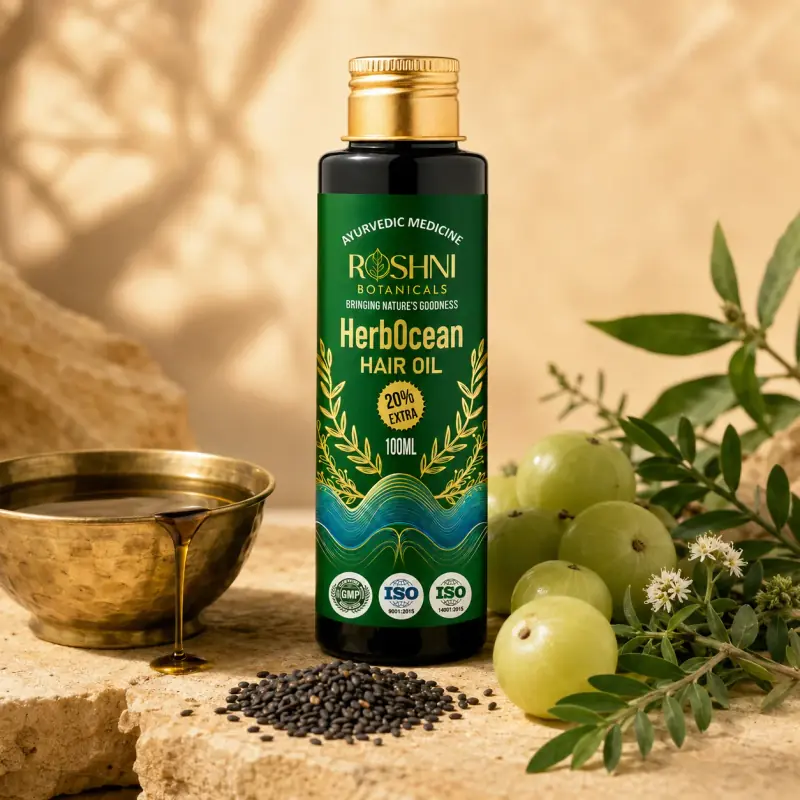
HerbOcean Hair Oil
A classical Taila for hair fall, dullness and a flaky scalp, with sixteen botanicals like Brahmi, Jatamansi, Amla and Neem in a slow sesame base.
Part of our guide: The definitive guide to Ayurvedic hair oils for hair fall.