Hair Fall in Monsoon: Why Shedding Rises in the Rains and How to Steady It
Shedding rises in the rains, and most of it is breakage, not loss from the root. Why monsoon hair fall happens and a steady, classical way to hold it.

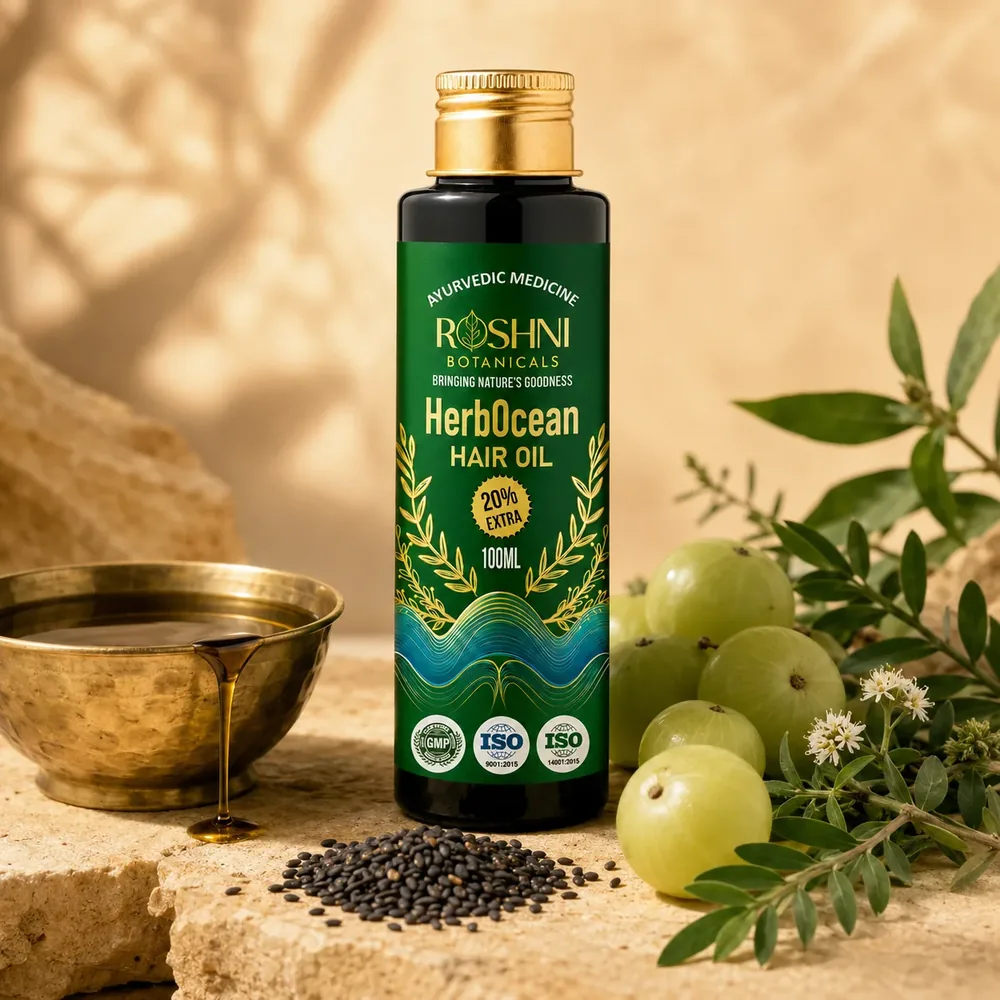
If your comb looks fuller every July, you are not imagining it. Shedding genuinely rises in the rains, and most of it has simple, physical causes: damp air that weakens the hair shaft, the habit of combing hair while it is still wet, and a scalp coated in sweat and hard-water residue. The reassuring part, and the part the panic-driven articles rarely say plainly, is that the monsoon asks your hair for a steadier routine, not a drastic one. A weekly champi (the warm-oil head massage you likely grew up with) using a classical medicated hair oil (Taila) such as HerbOcean Hair Oil is often the single most useful habit you can hold through the season.
Key takeaways
- Losing 50 to 100 strands a day is normal, and the monsoon can push that count noticeably higher for a few weeks; this seasonal rise usually eases on its own as the weather dries.
- Most monsoon hair fall is breakage from a humidity-weakened, over-handled shaft, not loss from the root. A quick self-check: a snapped strand has no bulb at its end, while a strand shed from the root carries a small white bulb.
- A larger share of hairs sits in the resting (telogen) phase over the summer months, so shedding tends to rise in the weeks that follow before settling again.
- In the classical seasonal routine (Ritucharya), the rains are a Vata-rising season that calls for gentler, more grounding hair care, which is exactly why a steady oiling rhythm suits this time of year.
- A sesame-based medicated hair oil such as HerbOcean Hair Oil, used as a weekly pre-wash champi, is traditionally used in the care of hair fall (Khalitya) and dullness.
Why the Rains Actually Make Your Hair Shed More
Start with the strand itself. Hair is built to absorb moisture, and in humid monsoon air it absorbs a great deal of it. The shaft swells slightly, the flat outer scales of the cuticle lift, and the surface turns rough. Rough, swollen strands tangle against each other, stretch when you pull a comb through them, and snap more easily than they would on a dry June morning. Much of what collects on your bathroom floor in July is not hair leaving the root; it is hair breaking somewhere along its length.
Sitting underneath that is a slower, quieter rhythm. Every hair on your head moves through a long growing phase and then a shorter resting phase (the telogen phase) before it lets go and a new hair pushes it out. These phases are not perfectly staggered across the year. A study of 823 women in Zurich who complained of hair loss (Dermatology, 2009) found the highest share of resting-phase hairs in summer, so the shedding you notice in the monsoon and early autumn is partly a seasonal wave set in motion weeks earlier. This is why the rise feels sudden even when nothing in your routine has changed, and why it settles on its own for most people once the season turns.
The practical takeaway is the self-check in the key takeaways above. Look at a few of the strands you are losing. If the ends are simply snapped, with no pale swelling, you are dealing mostly with breakage, and gentler handling plus a stronger, better-lubricated shaft will help. If most strands carry a tiny white bulb at the root end and the loss is heavy and persistent, that points to true shedding, and the later section on when to see a doctor matters more for you.
The Classical Lens: Monsoon, Vata and Khalitya
Classical Ayurveda organised the year into seasons with their own routines, and it did not treat the rains as a neutral time for the body. The monsoon (varsha ritu) is read as a season when Vata (one of the three doshas, the biological energies, this one governing movement and dryness) rises and the digestive fire (Agni) runs low. When Vata is aggravated and the body’s channels are sluggish, tissues are less well nourished, and the classical texts saw hair, a by-product of the deeper tissues, as quick to show the strain.
Hair fall has a classical name, Khalitya, and the classical response to it was never a single heroic remedy. It was Ritucharya: adjusting daily habits to the season. In the rains, that meant routines that were gentler, warmer and more grounding, and regular oiling of the head sits squarely within this tradition. The Ashtanga Hridaya describes seasonal regimens and the daily practice of head-oiling in its opening chapters. You do not need to accept the classical physiology on its own terms to notice that its practical advice, steady oiling and a calmer routine when the weather turns, lines up neatly with what a swollen, fragile monsoon hair shaft actually needs.
Scalp Buildup: Sweat, Hard Water and Humidity Working Together
The monsoon does not only work on the strand; it works on the scalp underneath. Humid weather means the scalp sweats more and stays damp for longer, especially when hair is tied up under a dupatta or a helmet before it has fully dried. That warm, moist surface holds on to sweat, oil and the day’s dust, and left alone through the week it turns into buildup that dulls the hair and unsettles the environment the roots sit in.
Hard water quietly makes this worse in most Indian cities. Borewell and tanker water carries dissolved calcium and magnesium, and those minerals leave a fine film on the scalp and along the shaft, the same film that leaves chalky scale on your taps. Layered over monsoon sweat and sebum, it leaves hair feeling coated, stiff and harder to rinse clean. The answer is not to wash more aggressively, which strips the scalp and prompts a rebound of oil; it is to wash gently but thoroughly, two to three times a week, with a proper final rinse. Where hard water is a known problem, a last rinse with a mug of filtered or boiled-and-cooled water helps limit what dries on your strands. The classical cleansing herbs Shikakai and Amla, both present in the HerbOcean Hair Oil, belong to exactly this tradition of cleaning the scalp without stripping it bare.
The Keshya Herbs That Steady Seasonal Shedding
Ayurveda groups the herbs that support hair under the term Keshya, literally the hair-supporting class, and it is worth knowing what each one is understood to do rather than treating them as a single green blur. HerbOcean Hair Oil is built on this group, formulated by Vaidya Shri Ram Prakash Ji, the master vaidya whose 40-year formulation legacy the HerbOcean line rests on, in a sesame-oil (til tail) base that carries the herbs into the scalp.
- Bhringraj is the classical Keshya rasayana (a rejuvenative tonic for the hair), the herb most associated with hair in the texts, traditionally used to support the scalp and the look of fuller, healthier hair.
- Jatamansi is calming and cooling, valued where stress and heat sit behind hair trouble, a fitting companion for a Vata-rising season.
- Brahmi is another classical scalp-and-mind herb, traditionally paired with Bhringraj in hair formulations.
- Amla is rich in vitamin C and is classically a Pitta-pacifier, traditionally used to support strength and lustre.
- Neem and Tulsi carry the scalp-hygiene tradition that matters most in humid, buildup-prone weeks, while Gudal (hibiscus), Nagarmotha, Chharila, Sugandhbala and Gulab (rose) round out the classical blend, finished with lavender, curry leaf and rosemary oils.
The point of a formulation like this is not that any one herb performs a trick, but that a considered, multi-herb Taila is designed to nourish the scalp and support the shaft against exactly the fragility the monsoon creates. It is an AYUSH-licensed Ayurvedic medicine (Licence No. DL-474 A&U) for external use, made in-house at Roshni Botanicals’ GMP-certified unit in Bawana, Delhi, and it is traditionally used in the care of hair fall and dullness rather than sold as a cure for either. If you want the full classical picture, our definitive guide to Ayurvedic hair oils for hair fall control sets out how these herbs work together.
How to Run a Steady Monsoon Champi (and the Wet-Hair Mistakes to Drop)
Most competitor articles stop at “apply oil to your scalp”. The technique is where the benefit actually lives, so here is the whole of it. Warm the oil until it is comfortably warm to the touch, never hot. Part your hair in sections and work the oil into the scalp with your fingertips, not your nails, in slow, small circles for five to ten minutes; the massage itself supports circulation and is half the point of a champi. Do this as a pre-wash ritual, the night before or an hour or two before you wash, once or twice a week.
The one honest caveat for the rains: do not leave heavy oil sitting on a damp, sweaty scalp for days together. In humid, buildup-prone weeks a long overnight soak can leave the scalp too moist for too long, so a one-to-two-hour pre-wash application, thoroughly washed out, suits the season better than leaving oil in until the next wash. Our step-by-step guide to the Ayurvedic hair-oiling routine walks through the method in detail.
Then there are the wet-hair habits that undo all of it, because hair is at its weakest when it is soaking wet. Do not drag a fine-toothed comb through wet hair; blot gently with a soft cotton or microfibre towel, let it part-dry, then detangle with a wide-toothed comb starting from the ends and working up. Do not rub hair roughly with a towel, do not tie it into a tight bun or braid while it is wet, and do not pull a helmet over a wet scalp on the commute. Each of these snaps fragile monsoon strands or traps moisture against the roots, and dropping them alone visibly reduces the breakage you see through the season.
When Monsoon Shedding Needs a Doctor, Not a Routine
Seasonal shedding that tracks the weather and settles by October is normal, and a steadier routine is the right response to it. Some patterns, though, are not seasonal, and it is worth knowing them so you neither panic over ordinary shedding nor ignore something that deserves attention.
- A parting that is visibly widening, or coin-sized bald patches, rather than a general, even thinning.
- Heavy shedding that continues well past the season, into October and beyond, instead of easing as the rains end.
- A scalp that is persistently painful, itchy, red or scaly despite gentle, consistent care.
- Hair fall alongside other body signals, such as unusual fatigue, feeling cold, or unexplained weight change, which can point to thyroid or iron issues worth a blood test.
Any of these is a reason to see a dermatologist or trichologist rather than to reach for another bottle. Classical care and clinical care are not rivals; a correct diagnosis simply makes every step that follows, herbal or medical, work better.
A Calmer Monsoon for Your Hair
The rains reward restraint, not force. Dry your scalp before you tie your hair, comb gently and only when hair has part-dried, wash two to three times a week with a good final rinse, and hold one steady weekly champi through the season. If you would like a classical medicated oil built for exactly this weekly rhythm, HerbOcean Hair Oil layers twelve Keshya herbs in a sesame base and is traditionally used in the care of hair fall and dullness. Let the season pass through your hair without taking more of it than it should, and most of what you are shedding now will quietly grow back as the weather turns.
HerbOcean Hair Oil
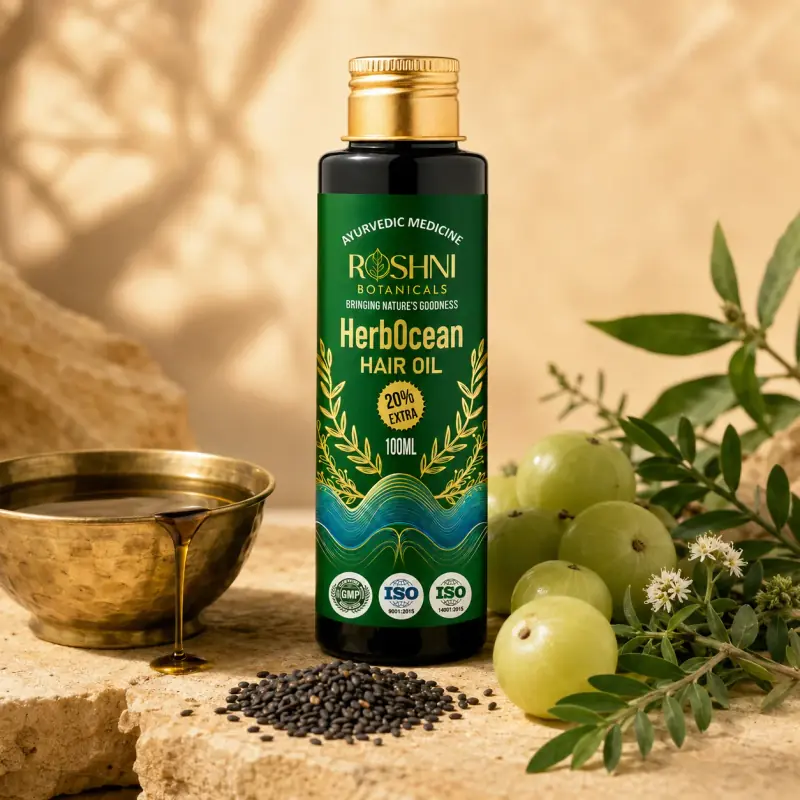
A classical Taila for hair fall, dullness and a flaky scalp, with sixteen botanicals like Brahmi, Jatamansi, Amla and Neem in a slow sesame base.
Part of our guide: The definitive guide to Ayurvedic hair oils for hair fall.