
Hair Fall After Fever or Illness: Why the Shedding Starts Two to Three Months Later
Shedding after dengue, typhoid or a viral fever usually begins two to three months later. Why the delay happens, when it settles, and when to see a doctor.

You had typhoid in May. The fever cleared, your appetite came back, and life carried on. Then in August, hair starts turning up in the comb, on the pillow, in the bathroom drain. Nothing about this month seems to explain it. Most people never connect the two, because the shedding arrives long after the illness has gone. That gap of two to three months is the whole story, and it is worth understanding properly.
Key takeaways
- Hair fall that begins two to three months after a fever, dengue, typhoid or COVID is usually telogen effluvium: a diffuse, all-over shedding rather than patterned baldness.
- The delay is why nobody connects the two events. The illness pushed an unusually large batch of hairs into their resting phase at once, and that whole batch releases together months later, long after you felt better.
- The follicles stay in place, and for most people this settles on its own. Published descriptions put the shedding at roughly three to six months before it eases, with the fullness you had before taking a good deal longer to return.
- Six months is the line worth knowing. Shedding that continues past it is no longer the ordinary self-limiting kind, and it deserves a dermatologist rather than more patience. Go sooner for a bald patch, a scaly or painful scalp, or shedding alongside breathlessness on stairs, unusual fatigue or heavy periods.
- Oiling supports scalp comfort and makes hair easier to separate during the recovery months. It does not act on the resting-phase cycle driving the shedding, and no oil shortens it.
Why Hair Fall After Fever Begins Two to Three Months Later
Your scalp hair does not grow all at once, and that is the key to the whole thing. At any moment most hairs are in a long growing stretch that runs for years, while a smaller share sits in a resting phase. A resting hair does not drop the day it stops growing. It stays put, quietly, until a new hair starts pushing up underneath and finally displaces it.
A serious illness changes the proportions. Dengue, typhoid, chikungunya, malaria, influenza, pneumonia or COVID can push an unusually large batch of growing hairs into that resting phase at the same time. Nothing visible happens for weeks. That batch simply sits there, resting in unison, and then releases together roughly two to three months later. By the time you notice, the illness is a memory and the connection is invisible. Worth saying plainly: what determines whether this happens to you is not well established, and it does not appear to be simply a matter of how ill you were. Do not assume a mild illness rules it out.
The published account of the timeline comes from general dermatology rather than from anything specific to Indian fevers. A review in the Journal of Clinical and Diagnostic Research in 2015 describes shedding beginning about two to three months after the trigger, taking roughly three to six months to cease, and cosmetically meaningful regrowth arriving over twelve to eighteen months. No comparable study has been published in an Indian population, so treat those figures as the shape of the pattern rather than a timetable your own recovery must follow.
The Indian calendar makes this useful to know right now. Early August is the height of the monsoon and the start of the viral fever, typhoid and dengue season across much of the country. So if you are shedding this month, think back to May or June rather than to this week, and check what happened to you then before blaming a new shampoo or the humidity. If you fall ill this season, expect the same two-to-three-month gap before anything shows up in your comb. Surgery, childbirth, a crash diet and severe emotional stress are documented triggers of the same pattern.
Diffuse Shedding or Patchy Loss: How to Tell What You Are Seeing
Post-illness shedding has a recognisable shape. Hair comes away evenly from all over the scalp rather than from one area. Your parting looks a little wider, the ponytail feels thinner in your hand, and there are visibly more strands in the comb and the drain. Note down the date the shedding began and judge it week by week against that date. Counting strands in the drain only feeds the anxiety without telling you anything useful.
Other patterns need a doctor's eye rather than patience. A smooth, coin-sized bald patch with no hair in it at all. Scaly or inflamed areas, crusting, or pus. A scalp that hurts to touch. Any patch that looks shiny and smooth with the pore openings gone, which suggests scarring and is not what post-fever shedding does. Thinning concentrated only at the temples and crown, which points to a different, patterned process. See a dermatologist if the shedding continues past six months, if any of the above appears, if you started a new prescription medicine around the same time, or if the hair fall arrives alongside breathlessness on stairs, unusual tiredness or heavy periods. Those last three are the everyday signs of anaemia, and they are worth acting on rather than waiting out. These are separate conditions managed in completely different ways, and months get lost to self-diagnosis in this category.
Two other things get mistaken for this. Seasonal shedding tracks the weather and the humidity rather than an illness three months back, and our guide to why hair fall picks up during the monsoon covers that properly. Then there is hard water: in cities like Delhi, Gurugram, Chennai and Jaipur, what looks like hair fall is often breakage along the shaft rather than release from the root, which our piece on how hard water roughens the shaft explains in detail.
What Ayurveda Says About the Weeks After a Fever
Classical Ayurveda treats the period after a fever as its own phase, and the guidance is more specific than most people expect. Charaka Samhita, Chikitsa Sthana 3, the chapter on fever, closes by describing the person released from fever. It lists the signs of genuine recovery, then sets out what to avoid while strength is still returning: heavy, incompatible or unsuitable food, over-eating, sexual activity, over-exertion and bathing. It warns that resuming too early brings the illness back.
The part worth carrying into a modern week is the stopping rule. The text does not count days. It says wait until bala, your strength, has genuinely returned, and let that decide when normal life resumes. Convalescence is treated as a stage with its own needs rather than a switch that flips when the fever breaks.
What you eat over these weeks matters too, even though it will not rescue the batch already shedding. Most Indian readers eat largely vegetarian, so the practical sources are the ones already in your kitchen: dal, rajma, chana, ragi, til and green leafy vegetables, paired with a vitamin C source such as amla, lemon or tomato at the same meal, since vitamin C improves absorption of iron from plant foods. Tea and coffee taken with meals work against that absorption, so shift them to between meals if that is your habit. Add curd and paneer for protein, drink enough water through a humid August, keep sleep consistent, and do not crash-diet or fast straight after an illness, which simply re-triggers the same strain the fever already caused.
One caveat, because it saves disappointment. Eating well will not shorten the shedding phase already underway. Those hairs have already been released at the root and will keep coming until the cycle resets. What good nutrition supports is the hairs growing in behind them, which is the part that actually determines how the next year looks.
Gentle Scalp Care While You Recover
Start with the boundary, because it is the most useful thing on this page. Oiling will not change what is happening inside the follicle. Shedding after a fever is a resting-phase reset, it runs its own course, and no oil, ours included, shortens it. What oiling offers is smaller and still worth having: it softens a scalp left dry and tight after weeks of illness, and it makes hair easier to separate, so detangling is less of a fight. Treat that as comfort and easier handling, not as less hair fall.
The HerbOcean Hair Oil is an Ayurvedic medicine for external use, traditionally used in the care of a dry, stressed scalp. Sixteen botanicals go into it, and the count is worth stating accurately: twelve herbs, the sesame oil (til tail) base, and three finishing oils. Bhringraj, Jatamansi, Brahmi and Amla lead the formula, working alongside Shikakai, Nagarmotha, Chharila, Sugandhbala, Gudal (hibiscus), Tulsi, Gulab (rose) and Neem. Lavender, curry leaf and rosemary come in as finishing oils rather than herbs. It is formulated by Vaidya Shri Ram Prakash Ji, the master Ayurvedic formulator (a classical vaidya) whose forty-year formulation legacy the HerbOcean line is built on, and made in-house at Bawana, Delhi under AYUSH Licence No. DL-474 A&U in a Schedule-T GMP certified and ISO 9001:2015 certified facility.
Test it properly before the first use, and give that more time than you think. This oil carries lavender, rosemary and curry leaf oils, and reactions to fragrance components are typically delayed rather than immediate. In a French study of 328 repeat application tests, every positive reaction appeared within ten days, with a median of three (Amsler and colleagues, Contact Dermatitis, 2022). So apply a small amount to the same patch of inner forearm twice daily for ten to fourteen days and stop at the first redness, itching or small bumps. This matters more than usual just now, because a scalp shedding after a fever is often already tender, and a new reaction is easy to misread as part of the hair fall.
Our step-by-step oiling guide covers the full method, so here is only what changes during a shedding phase. Warm the oil to body temperature, never hot. Apply along the scalp with flat fingertips in slow circles, never scrubbing with the nails, because a scalp full of resting hairs gives them up easily and rough handling loosens more of them in the short term. Twice a week is plenty. Leave it thirty to forty-five minutes, then wash gently. We would not leave it overnight while shedding. Detangle with a wide-tooth comb from the ends upwards, and keep ties loose.
Two situations where you should keep oil off the scalp entirely. If you have dandruff, flaking with redness, or diagnosed seborrhoeic dermatitis, use the oil on the lengths only and leave the scalp alone: the yeast involved feeds on lipids, and dermatologists writing in Skin Appendage Disorders in 2023 (Mayo and colleagues, a clinical letter rather than a trial, with no patient cohort) advise applying oils to the hair shafts rather than the scalp in that situation. Their observation was made in Black patients rather than an Indian group, but the caution is a sensible one for any scalp that is flaking or inflamed. And skip oil altogether over broken, weeping or crusted skin, or any active scalp infection. For the wider picture of where this fits among the other patterns of hair fall, our complete guide to Ayurvedic hair oils for hair fall sets it out.
The Timeline, Honestly
This shedding began months before you noticed it, and for most people it settles months after you stop watching the drain. Look after the scalp gently in the meantime, eat like someone rebuilding, because that is exactly what you are doing, and let your strength rather than the calendar decide when you go back to normal. If it is still going strong at six months, that is the point to stop waiting and see a dermatologist. The hairs coming in behind this batch are the ones that decide how next year looks, and they are already on their way.
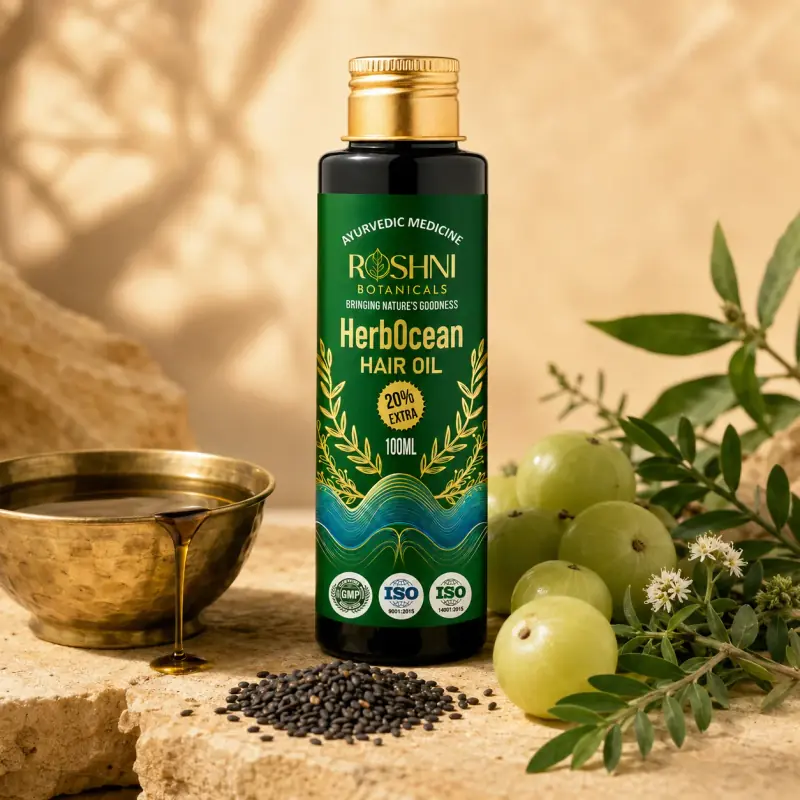
HerbOcean Hair Oil
A classical Taila for hair fall, dullness and a flaky scalp, with sixteen botanicals like Brahmi, Jatamansi, Amla and Neem in a slow sesame base.
Part of our guide: The definitive guide to Ayurvedic hair oils for hair fall.