
Hair Fall After Delivery: A Gentle Ayurvedic Guide for New Mothers
Postpartum hair fall peaks around month four and settles for most within a year. A gentle Ayurvedic guide for new mothers, built around a ten-minute champi.

Somewhere around the third or fourth month after your baby arrived, the shower drain probably started telling a worrying story, and a handful of hair in the comb can feel frightening in a body that already feels unfamiliar. Take a breath. Nobody warns you about delivery ke baad baal jhadna, the hair fall that arrives after a delivery, and the fright it brings is out of all proportion to what is going on. This shedding surge is one of the most common experiences of new motherhood, a hormonal rebalancing that settles on its own for most women within the first year. It is not a sign that your hair is failing you, and there is gentle, realistic care that fits even a newborn’s chaotic schedule.
Key takeaways
- Postpartum shedding is telogen effluvium: pregnancy’s high oestrogen held extra hair in the growing phase, and after delivery those strands shift to resting and shed together, usually starting around month three and peaking near month four or five.
- For most mothers it settles on its own within six to twelve months, and density largely recovers; this is a normal reset, not a disease and not something you caused.
- Breastfeeding does not itself cause the shedding, the oestrogen drop does, though longer breastfeeding is associated in research with a higher likelihood of noticeable shedding; either way, gentle care and patience are the response.
- A ten-minute champi (a warm-oil head massage) twice a week is realistic self-care for a new mother, and the joint-family tradition of an elder giving that massage echoes the classical care of the new mother (sutika).
- See a doctor if loss is patchy or coin-shaped, continues heavily past a year, or arrives with fatigue, feeling cold or weight changes, which point to thyroid or iron issues worth a blood test.
Why Hair Falls Around Month Three (and Why It Usually Settles)
The reassurance deserves the mechanism behind it, because understanding what is happening is the fastest way to stop fearing it. Through pregnancy, high oestrogen keeps an unusually large share of your hair parked in its growing phase; hair that would ordinarily have shed simply stayed, which is why so many women remember thick, glossy pregnancy hair. After delivery, oestrogen falls, and all that parked hair is released into its resting phase at once. A few weeks later it sheds together, in a wave rather than a trickle, and that synchronised wave is what you are seeing in the drain. Dermatologists call it telogen effluvium, and postpartum is its most predictable trigger.
The timeline is kinder than the panic suggests. Shedding typically begins around three months after delivery, peaks near the fourth or fifth month, and eases for most mothers by six to eight months, with density largely back by your baby’s first birthday. This is a reset, not a loss; the hair is being replaced, just on a visible schedule. A few months in, you may start to notice a fringe of short, wispy new hairs along the hairline and parting; unruly as they look, they are the reset visibly working, the next crop already on its way up. In the classical vocabulary, hair fall carries the name Khalitya (the classical Ayurvedic term for hair fall), and the postpartum months sit within the classical care period for the new mother, which frames everything below: gentleness, warmth and nourishment, not force.
Does Breastfeeding Cause It? An Honest Answer
This is the question that circulates in every new-mother group, so let us be accurate rather than alarming. Breastfeeding does not itself cause postpartum shedding; the trigger is the fall in oestrogen after delivery, which happens whether or not you nurse. What research does suggest is that longer breastfeeding is associated with a higher likelihood of noticeable postpartum shedding, in one Japanese questionnaire study of 331 women; the reasons are not fully established, though a nursing body’s higher nutrient demands may well contribute. It is a correlation to expect, not a reason to stop, and never a sign that feeding your baby is harming your hair.
The honest takeaway is freeing: nothing about your feeding choice is damaging your hair, and there is no hair reason to wean earlier than you wish. If your shedding runs a little longer while you nurse, it is following a known pattern and still, for the overwhelming majority, resolves. Keep the focus where it helps, on nourishment, rest where a newborn permits it, and gentle care, and let the hormones complete their reset on their own clock.
A Ten-Minute Champi, Twice a Week: Care That Fits a Newborn’s Schedule
New motherhood does not offer hour-long rituals, so this is deliberately small. Twice a week, warm a little oil until it is comfortably warm to the touch, part the hair in a few sections, and massage the scalp with slow fingertip circles for about ten minutes; leave it an hour or two, or overnight if that is easier, and wash it out gently. The massage supports scalp circulation and, just as valuably for a frayed new mother, offers ten quiet minutes that are only yours. It does not speed the telogen timeline or force anything to regrow, and it does not need to; its job is to keep the scalp comfortable and cared for while your body finishes its own work.
Let the family help, because the tradition already knew this. The image of a saas, a mother or an aunt warming oil and giving the new mother a champi is not sentimentality; it is the living form of sutika care, the classical attention paid to a woman in the weeks after birth, and it doubles as rest for arms that have been holding a baby all day. Accept the massage when it is offered. The oil for it can be a classical medicated hair oil (Taila) such as HerbOcean Hair Oil, a sesame-based blend of sixteen botanicals, twelve of them herbs in equal measure, among them Bhringraj, Jatamansi, Brahmi and Amla, traditionally used in the care of hair fall and dullness, formulated by Vaidya Shri Ram Prakash Ji, the master vaidya (a classical Ayurvedic physician and formulator) whose 40-year formulation legacy the HerbOcean line is built on. It is an AYUSH-licensed Ayurvedic medicine (Licence No. DL-474 A&U) for external use, made in-house at Roshni Botanicals’ GMP-certified unit in Bawana, Delhi. Because you are nursing, keep it strictly external, patch-test on the inner forearm for 24 hours before first use, and run any new routine past your doctor first.
Jaappa and Malish: Making the Champi Work in a Newborn Household
The champi above is not a new idea in an Indian house. The roughly forty-day confinement after delivery, jaappa across much of North India, comes with its own architecture. The mother stays in. Food arrives warm and already cooked. Someone else’s hands do the work. Sitting inside all of that is the daily malish (oil massage), and the champi that goes with it, given by a mother, a mother-in-law, a dai or an aunt who has done it for a dozen women before you.
Whatever else the oiling does, what surrounds it is substantial in its own right: enforced rest, unhurried touch, and a household that has agreed, for once, to look after the mother and not only the baby. That is not folklore. That is postpartum care, and much of the world has had to invent programmes to imitate it.
What deserves an update is the hygiene around the practice. Decant a little oil into a small steel bowl instead of dipping fingers into the bottle. Use a freshly washed towel each time, and keep the cloth that goes over your pillow separate from the baby’s things, particularly if the baby sleeps next to you.
The one part of the tradition worth quietly dropping is the obligation. The house fills up with visitors, and a new mother is somehow expected to be both patient and presentable while running on four hours of broken sleep. If the daily champi becomes one more thing you are failing at, it has stopped being care. Twice a week is a routine. Once every two weeks is also a routine. Skipping a month because the baby had colic costs you nothing at all.
Be clear about what the oiling is for. It is care for your scalp and for you. It does not shorten the shedding, which runs its own course.
Five to seven minutes is plenty. Warm a small quantity of oil by standing the bowl in hot water, never over a direct flame, then work it into the scalp with the pads of your fingers rather than the nails, in slow circles from the parting outward. Sit wherever you can settle comfortably, on the floor with the baby on a mat beside you, or in a chair if getting up from the floor still pulls. Or take the twenty quiet minutes after a feed, when somebody else is holding her. Our guide to an ayurvedic hair oiling routine sets out the full method, including how long to leave the oil on.
Skip it if the scalp is sore, broken or infected. Treat a fever, or feeling faint when you sit up, as more than a reason to skip the champi: after a delivery both are worth a call to your doctor the same day. After a caesarean, ask the doctor who handled your delivery before you resume anything, especially if you are early in recovery or the stitches still pull. Sitting comfortably matters more to you right now than the oiling does, so hand the job to somebody else if reaching overhead is uncomfortable.
The oil is finished with lavender, curry leaf and rosemary oils, and that is worth naming here. Three plain cautions, because vagueness would not be fair to you. Patch-test on the inner forearm before first use. Wash your hands after oiling and tie your hair back at a feed, and keep the oil off your breasts: LactMed, the lactation database maintained by the United States National Institute of Child Health and Human Development, advises that topical lavender be kept away from the breast area. And never use it on the baby: it is made for an adult scalp, not for a newborn’s malish. Nobody has studied medicated hair oils in nursing mothers, in either direction, so raise it with your own doctor before you start, and with the paediatrician for anything that touches the baby.
Washing is the harder half. Line up the person who will hold the baby before you start, and get everything within reach first: the mug, the towel, a change of clothes. Keep it to one wash rather than two, use water that is warm rather than hot, and let the lather sit on the scalp instead of scrubbing at hair that is already shedding. If your supply runs hard, a mug of stored or filtered water for the final rinse takes the edge off the mineral film that makes shedding hair tangle; our post on hard water and hair fall covers the rest. Dry the scalp properly before you lie down. A damp head at night is its own small misery.
Eating for Recovery While Nursing: Iron and Protein the Vegetarian Way
A nursing body is feeding two, and the tank runs low on exactly the nutrients hair is built from, iron, protein and the B vitamins. The Indian vegetarian kitchen already holds the answers: dals and rajma and chana for protein and iron, paneer and curd for protein, til and ragi for minerals, and a squeeze of lemon or a side of amla or citrus at the same meal to help your body actually absorb the plant iron. None of this speeds the shedding timeline, and it is not meant to; it supports the recovery your body is already running, and it keeps the next season of growth well supplied. Keep chai a little away from your iron-rich meals, since tea hinders plant-iron absorption, an easy win in a routine already short on time. An everyday plate does the job without any special effort: a bowl of dal or rajma, a portion of paneer or curd, a vegetable, and something tangy alongside; the citrus with the meal is the small trick that lets the iron actually land.
The traditional postpartum kitchen deserves a warm word and an honest one. Gond laddoo, methi in the food, sonth and the other nourishing preparations pressed on new mothers across India are genuine, thoughtful nutrition for a depleted body, and there is every reason to enjoy them as the caring customs they are; they are not, and need not be sold as, hair treatments. And one firm line: do not self-prescribe supplements while nursing, including iron. If you suspect a deficiency, ask your doctor to test and to guide the dose, because the right amount matters and some supplements are best timed and measured under advice.
Monsoon Comfort and the Gentle-Handling Rules
Two seasonal and handling notes round out the care. Through these humid monsoon weeks, dry the scalp and hair fully before tying or braiding, since damp roots tied up tight through a sticky day make shedding look and feel worse and keep the scalp uncomfortable; go lighter with the oil in peak humidity, a shorter pre-wash session rather than long overnight soaks. And handle the hair you have as the fragile thing it currently is: a wide-toothed comb only, and only once hair has part-dried; loose, low ties rather than tight ponytails, because a scalp already shedding does not need traction added to it; and no vigorous towel-rubbing. These are small mercies, but through the peak-shedding months they visibly reduce the breakage that piles on top of the hormonal shedding.
When Postpartum Shedding Needs a Doctor
Most postpartum shedding is textbook and self-resolving, but a few patterns should take you to a doctor rather than a routine, and knowing them is part of caring for yourself. See a doctor if the loss is patchy or coin-shaped rather than a general, even thinning across the head; if heavy shedding continues well beyond your baby’s first birthday instead of easing; or if it arrives alongside other signals, persistent fatigue, feeling cold, low mood, or unexplained weight change, which together point toward the thyroid shifts and iron depletion that are genuinely common after childbirth. Simple thyroid and ferritin blood tests can check for both, and postpartum thyroiditis in particular is both common and treatable. This is not a reason to worry pre-emptively; it is a reason to get the right test if the pattern fits, so that care, classical or medical, is aimed correctly.
One more thing belongs here. Low mood, anxiety that will not settle, or not feeling like yourself is common after a delivery, and heavy shedding tends to travel with it. It is not weakness and it is not vanity. Tell your doctor at the same visit. And if you ever have thoughts of harming yourself or your baby, that is not something to sit with until an appointment: get help the same day.
Patience, and a Little Ritual
The shower drain will quiet down. For most mothers the shedding that frightens them at month four is easing by month eight and forgotten by the first birthday, and the density returns without heroics. Until then, the plan is small and kind: nourish the body that is feeding your baby, accept the champi when it is offered, handle the hair gently, and see a doctor only if the specific red flags appear. If a ten-minute weekly ritual is the pause you need, HerbOcean Hair Oil was made for exactly this kind of gentle, unhurried care; our definitive guide to Ayurvedic hair oils for hair fall control maps the wider practice, and our guide to what causes hair loss and how Ayurveda can help sits ready for when you have both hands free. Be as patient with your hair as you are learning to be with everything else right now.
References: Hirose A, Terauchi M, Odai T, et al. Investigation of Exacerbating Factors for Postpartum Hair Loss: A Questionnaire-Based Cross-Sectional Study. International Journal of Women’s Dermatology. 2023;9(2):e084 (n = 331, Japan; the average start, peak and end of shedding fell at about 2.9, 5.1 and 8.1 months, and longer breastfeeding was associated with a higher likelihood of postpartum hair loss; figures approximate, non-Indian population). Charaka Samhita, Sharira Sthana 8 (Jatisutriya), on sutika-paricharya (postpartum care of the mother), and Ashtanga Hridaya, Sutrasthana 2 (Dinacharya), on daily head-oiling (Murdha taila). Stagnaro-Green A. Approach to the Patient with Postpartum Thyroiditis. Journal of Clinical Endocrinology & Metabolism. 2012;97(2):334–342 (a review; postpartum thyroiditis affects roughly 5% of women, is usually transient, and is treatable).
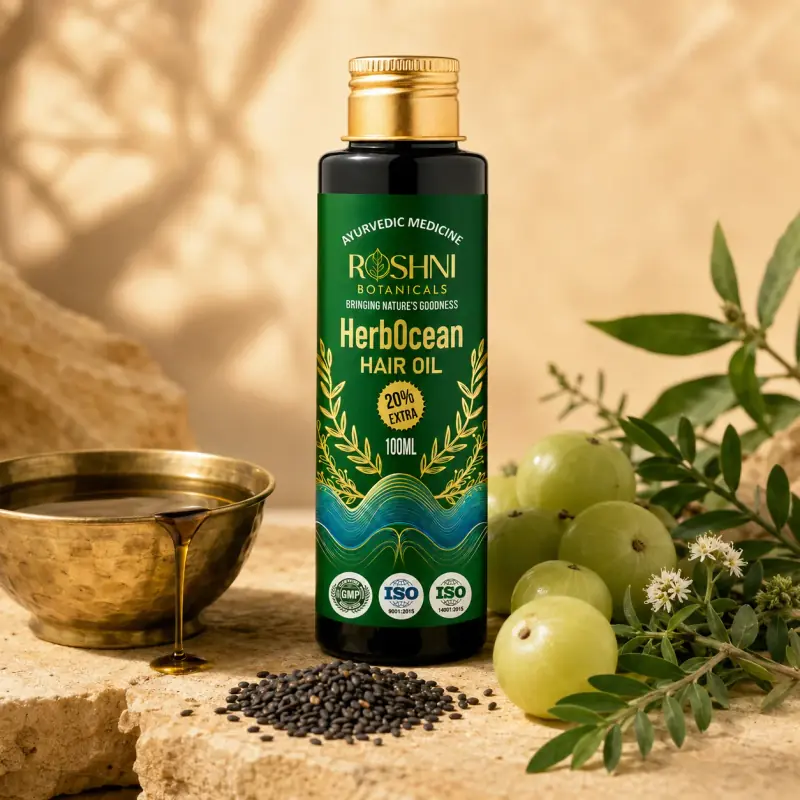
HerbOcean Hair Oil
A classical Taila for hair fall, dullness and a flaky scalp, with sixteen botanicals like Brahmi, Jatamansi, Amla and Neem in a slow sesame base.
Part of our guide: The definitive guide to Ayurvedic hair oils for hair fall.