
What to Eat for Stronger Hair: 9 Everyday Indian Foods Ayurveda Recommends
Strong hair is built at the end of the nourishment queue. Nine everyday Indian foods, the iron-and-vitamin-C pairing, the chai timing trick, and where a weekly champi fits.
Your dadi was right about the amla. Long before hair supplements arrived in shiny bottles, Indian kitchens were quietly feeding hair from within: til in winter laddoos, methi tempered into dal, curry leaves crackling in the morning tadka. Ayurveda holds that strong hair begins on your plate, because every strand is built from the nourishment your food provides, and this post walks through nine everyday foods that do that work, plus the two absorption tricks that decide whether the iron on your plate ever reaches your roots.
Key takeaways
- In the classical bodily-tissue (dhatu) chain, hair (kesha) is nourished late in the sequence, which is why a thin or hurried diet shows up in dull, weak strands before it shows up almost anywhere else.
- The three nutrients this list keeps returning to are protein for the shaft, iron for oxygen supply to the follicle, and vitamin C, which decides how much vegetarian iron your body actually absorbs.
- Pair iron with vitamin C at the same meal (dal with a squeeze of lemon, methi with amla) and keep chai an hour away from iron-rich meals, since tea compounds hinder plant-iron absorption.
- Classical practice takes curd at midday rather than night, when it is considered heavier to digest; fresh homemade curd is preferred over sour.
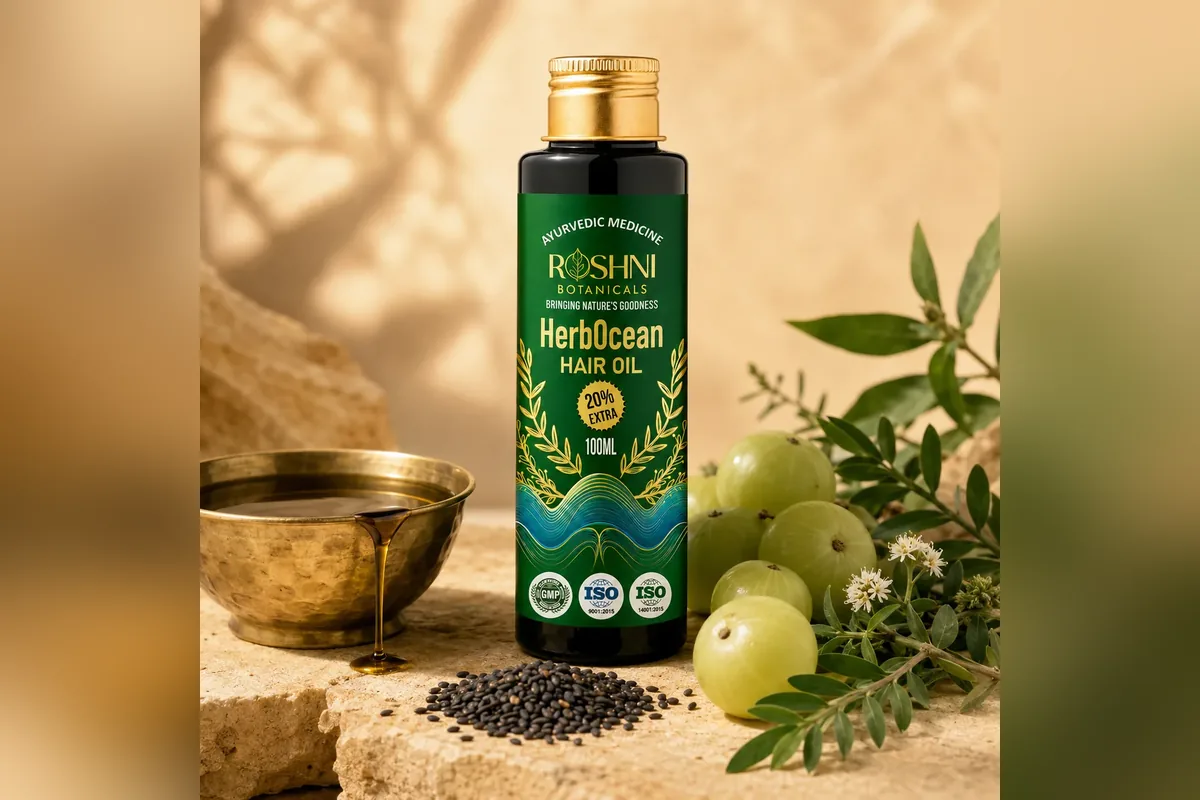
- Food supplies the building material; a weekly champi with a classical medicated hair oil (Taila) such as HerbOcean Hair Oil supports the scalp from outside. Inside and outside are partners, not rivals.
Why Ayurveda Starts With Your Plate, Not Your Shampoo
Classical Ayurveda describes nourishment as a relay. Food, once digested, feeds the body’s tissues in sequence, each tissue passing refined nourishment onward to the next, and this bodily-tissue (dhatu) chain ends in the by-products the body builds last, hair (kesha) among them. The Charaka Samhita’s chapter on the transformation of food into tissue regards diet (ahara) as the first nourishment for exactly this reason. The practical translation is blunt and useful: hair stands at the end of the queue. When the plate is thin, hurried or endlessly repeated, the body quietly protects its vital organs and shortchanges the queue’s tail, and the tail is your plait.
This is also why no oil, ours included, can out-perform a poor plate. A medicated oil supports the scalp and shaft from outside; the strand itself is assembled from protein, minerals and vitamins that only the kitchen supplies. The nine foods below are not exotic; most are already in your dabba. What is usually missing is not the food but the pairing, which is where the next section earns its place on this page.
The Three Nutrients, and the Absorption Trick Nobody Mentions
Three nutrients run through this whole list. Protein, because the strand is almost entirely keratin, a protein your body builds from what you eat. Iron, because follicles are among the hungriest tissues you own and iron carries their oxygen; low iron is one of the most common findings behind diffuse hair fall in Indian women, and anaemia remains widespread among us, with the National Family Health Survey putting it at about 57% of women of reproductive age. And vitamin C, the quiet kingmaker, because vegetarian iron is poorly absorbed on its own and vitamin C taken in the same meal multiplies what your body actually keeps.
Which yields the two cheapest upgrades in Indian nutrition, worth more than most supplements. First, pair iron with vitamin C on the same plate: a squeeze of lemon over dal, amla alongside methi, seasonal citrus after a rajma lunch. Second, move the chai. Tea’s tannin compounds bind plant iron and hinder its absorption when drunk with meals, so the lunchtime chai quietly undoes the iron in the lunch. Keep chai to an hour before or after iron-rich meals, and the same thali starts delivering more. Nothing new to buy; only the clock moves.
The Builders: Five Everyday Foods That Supply the Raw Material
- Amla. The tradition’s favourite hair fruit is also the pairing trick in a single package: intensely rich in vitamin C, classically a Pitta-pacifier (one of the three doshas, the biological energies in Ayurveda), and the reason a spoon of amla with an iron-rich meal is more useful than either alone. One fresh amla, a spoon of unsweetened amla preserve, or amla churna stirred into water mid-morning all work; the habit matters more than the format.
- Curry leaves. Eat them, do not pick them out of the poha. Kadhi patta brings iron and beta-carotene in a form the everyday tadka already delivers, and a fresh handful crackled into dal, poha or upma several times a week adds up across a season. If the leaves always end up on the side of the plate, grind them into chutney and let the flavour do the persuading.
- Til (sesame). The classical winter laddoo was mineral therapy wearing jaggery. Sesame carries iron, zinc and copper alongside good fats, and classical texts hold the seed and its oil in unusual regard for hair; a spoon of roasted til over salad, dal or curd, or the traditional til-gud combination in cooler months, is the easiest mineral top-up in the Indian kitchen.
- Moong dal. The gentlest protein in the pantry, light on digestion even by classical standards, which matters because protein you digest comfortably beats protein that sits heavy. A bowl of well-cooked moong, khichdi on tired days, or sprouted moong with lemon (the pairing again) gives the strand its keratin raw material without asking anything of your stomach, which is exactly why it is the default recovery food of every Indian home.
- Methi. Fenugreek brings iron and minerals with a long place in household hair lore, from soaked seeds at dawn to methi dana tempering in winter sabzi. A teaspoon soaked overnight and chewed in the morning, or methi leaves cooked as saag, covers both the nutrient and the tradition; pair the iron with something vitamin C rich in the same meal to collect it properly.
The Nourishers: Four Habits That Help the Building Material Land
- Ghee, in moderation. Classical Ayurveda regards good fat as the carrier of nourishment, unctuous (snigdha) fare that helps fat-soluble vitamins travel to the tissues that need them, and a spoon of ghee on dal or a phulka is that principle at kitchen scale. Moderation is the entire instruction: a spoon, not a ladle, and daily rather than occasionally heroic, because the fat-shy plates of strict dieting starve hair of exactly this carrier.
- Coconut. Everyday South Indian wisdom the rest of the country can borrow: fresh coconut in chutney, coconut slivers in poha, or coconut milk in a curry brings cooling character and steady fats that classical thinking pairs naturally with a Pitta-heavy climate. It is also the gentlest way to add richness to a vegetarian plate without leaning harder on fried snacks, and it travels easily into chutneys the whole family already eats without noticing the upgrade.
- Curd, timed well. Curd offers protein and supports the digestion that the whole dhatu relay depends on, and classical practice takes it at midday rather than night, when it is considered heavier to digest. Fresh, homemade and only mildly sour is the standard; the late-night sweetened dahi after dinner is the version the tradition would politely decline, and buttermilk (chaas) at lunch is the lighter cousin worth knowing on hot days.
- Seasonal fruit. The seasonal-routine (ritucharya) instinct applied to the fruit bowl: jamun, plums and litchis in these monsoon weeks, citrus through the winter, melons in summer. Seasonal fruit keeps vitamin C arriving all year, which quietly services the iron-absorption pairing, and adds hydration through humid months when frequent washing and sweating tax the scalp. A bowl a day of whatever the season sells cheapest is the entire prescription.
Feed It Inside, Oil It Outside: The Weekly Pairing
Now put the plate and the bottle in their right relationship. Food supplies the building material for the strand your follicle will spend months assembling; a weekly champi supports the scalp that does the assembling. HerbOcean Hair Oil carries the outside half of this pairing: a classical medicated hair oil (Taila) in a sesame (til tail) base, its herbs led by Bhringraj, the classical hair-supporting (Keshya) rasayana (rejuvenative tonic), with Amla and Shikakai from the same food-adjacent tradition this post has been walking through, Jatamansi and Brahmi for their calming classical character, and Neem and Tulsi keeping the scalp-hygiene tradition, finished with lavender, curry leaf and rosemary oils. It is worth noticing how much of the formula could be found within arm’s reach of the kitchen shelf; the tradition never separated food and hair care as sharply as the shampoo aisle does.
It is an AYUSH-licensed Ayurvedic medicine (Licence No. DL-474 A&U) for external use, traditionally used in the care of hair fall and dullness, formulated by Vaidya Shri Ram Prakash Ji, the master vaidya (a classical Ayurvedic physician and formulator) whose 40-year formulation legacy the HerbOcean line is built on, and made in-house at Roshni Botanicals’ GMP-certified unit in Bawana, Delhi. The rhythm: warm oil, five minutes of fingertip champi, an hour or two before wash day, once or twice a week; patch-test on the inner forearm before first use. If clearer skin is on your mind alongside stronger hair, the same inside-first logic runs through our Ayurvedic diet for clear skin, and the two plates overlap more than they differ.
What Food Cannot Fix: When to See a Doctor
Keep the claim honest, because the honest version is still excellent: food supports healthy hair growth over months, building better strands than the ones being replaced. What food does not do is reverse a medical cause. Sudden diffuse shedding, hair coming out in clumps, patchy or coin-shaped loss, shedding that persists past a season, or hair fall arriving with fatigue, feeling cold or menstrual changes deserve a doctor and simple blood work, thyroid and ferritin first, before any dietary project. This is especially true postpartum and after illness, when timelines have their own logic. A month of methi cannot argue with a thyroid; get the diagnosis, then let the kitchen support the recovery.
Nine Foods, Two Tricks, One Weekly Ritual
Strong hair is not built in the shampoo aisle; it is built at the end of the nourishment queue, from whatever your plate sent down the line. Feed the queue well, pair the iron with its vitamin C, move the chai an hour away, take the curd at noon, and let the season fill the fruit bowl. Then, once or twice a week, let a champi with HerbOcean Hair Oil look after the scalp from the outside while the kitchen works from within. For the full picture of how the outside half works, our definitive guide to Ayurvedic hair oils for hair fall control is the companion read. Your dadi ran this system without naming it; the naming is just for us.
References: Charaka Samhita, Sutrasthana, Chapter 28 (Vividhashitapitiya Adhyaya), on how food (ahara), once digested, nourishes the bodily tissues (dhatu) in sequence, with hair among the last-formed by-products. Disler PB, Lynch SR, Charlton RW, et al. The Effect of Tea on Iron Absorption. Gut. 1975;16(3):193–200 (a radioiron-absorption study in adult volunteers, South Africa; tea reduced non-haem iron absorption through the formation of insoluble iron-tannate complexes). National Family Health Survey 5 (NFHS-5), 2019–21: 57% of Indian women aged 15–49 are anaemic.
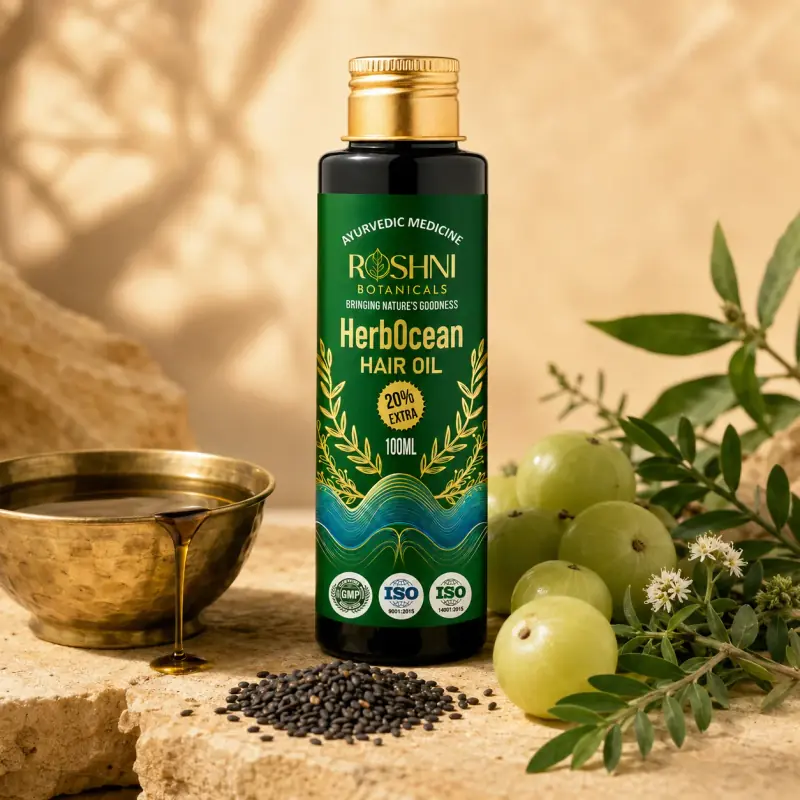
HerbOcean Hair Oil
A classical Taila for hair fall, dullness and a flaky scalp, with sixteen botanicals like Brahmi, Jatamansi, Amla and Neem in a slow sesame base.
Part of our guide: The definitive guide to Ayurvedic hair oils for hair fall.