Food and Pigmentation: An Ayurvedic Diet for Clearer Skin
Which food and skin links the research supports, where diet meets pigmentation and where it does not, and the Ayurvedic rules of diet (Ahara) beside them.
Food and skin get linked in all sorts of ways. Some of those links are real and well studied. Others get passed on because they sound sensible. Sorting one from the other is the useful part, and once you do, the classical idea of Ahara (diet, and the discipline of eating) sits quite comfortably next to the evidence.
No one is going to ask you to give up dairy tomorrow or buy a supplement. If pigmentation is your worry, the short answer is that food cannot shift a patch that has already settled, but a steadier plate can mean fewer new marks, and sun matters more than either. What matters is the pattern of your week, not any one meal, and the plate supports the routine that does the visible work on your skin rather than replacing it.
Key takeaways
- Among the food links to acne, the best supported is a high glycaemic load, and a 2022 systematic review calls the dairy evidence mixed.
- No food makes a settled patch of melasma (Vyanga, the classical term for facial pigmentation) or an old post-inflammatory mark go away. Sun matters far more to a dark patch than anything you eat.
- Ayurveda reads food as Ahara. For heat-aggravated skin it favours sweet, bitter and astringent tastes, and it counts when and how you eat as part of the instruction.
- Anaemia and B12 deficiency are common in India and can show on the skin: anaemia can leave it looking pale and dull, and a marked B12 shortage can itself darken it. That is a blood test for a doctor, not a reason to start supplements on your own.
- HerbOcean Radiance Cream is the daily care step the plate sits beside: an AYUSH-licensed Ayurvedic medicine classically indicated for facial pigmentation (Vyanga), used morning and night, with sunscreen by day.
What the Research Actually Says About Food and Skin
Start with acne. A 2022 systematic review that pulled together 34 studies found that a high glycaemic index and a heavier daily glycaemic load went with acne, and that the dairy picture is mixed and may depend on sex, ethnicity and what people usually eat. The authors talk about a route through insulin and insulin-like growth factor 1 (IGF-1) to the sebaceous glands. That is a proposed pathway, not a demonstrated one.
The caveat matters more than the headline. Only one of those 34 studies was done in India, a 2019 trial of 84 patients in which both groups improved and the low-glycaemic-load diet made no clear difference. A link measured in one population is not a dose anyone can hand to a reader in Delhi. It points in a direction. That is all it does.
On an Indian plate the finding is less dramatic than it sounds. Roti and dal are not the problem. Where the glycaemic load piles up is white bread, biscuits with evening chai, sugar stirred into the cup, a cold drink with lunch, and gift-box mithai. For the breakouts themselves, our complete guide to Ayurvedic treatment for acne covers the classical reading, spot care, the marks acne leaves and when to see a dermatologist.
Dairy, in Proportion
The same review calls the dairy evidence mixed, with the clearer signals coming from populations eating a Western diet. The largest study in that review, a 2005 cohort, asked more than 47,000 American women to recall what they ate in high school, and among the milks, the link with severe teenage acne was strongest for skimmed milk, with no clear link for whole milk. Yoghurt has been looked at too, and two pooled analyses disagree on it: one found a link with acne and the other found none.
The explanation on offer is that milk proteins, and the same growth-factor response, may nudge the sebaceous glands. There is some support behind it, but it is not a settled mechanism.
So, practically: if acne keeps coming back and milk intake is genuinely high, try cutting down for eight to twelve weeks and watch what happens. Do that with a doctor if the person is a teenager, pregnant, or already restricting food. And there is no good evidence that dairy drives melasma or settled dark patches at all. Ghee, in small amounts, belongs on the classical plate.
A skin question should not add shame to food, or hand anyone a reason to drop a whole food group on a hunch.
Where Diet Meets Pigmentation, and Where It Does Not
The unpopular part first. No food makes a settled patch of melasma or an old post-inflammatory mark go away.
The research here is thin. A 2025 study of 194 women in Brazil, 97 with facial melasma and 97 without, found no difference in their dietary antioxidant intake. A 2025 case-control study of 150 patients in China reported alcohol as a risk association with a very wide confidence interval, and, oddly, a protective association for soft drinks. Treat that as one hedged signal and nothing more.
Outside a real deficiency, diet touches pigmentation sideways. A lower glycaemic load goes with fewer fresh breakouts, and fewer breakouts means fewer new marks on melanin-rich skin, where post-inflammatory hyperpigmentation (PIH) is more common and more marked than on paler skin and can take months or longer to settle. That is the everyday link. For the herbs themselves, Manjistha and turmeric for pigmentation looks at two of them closely.
Sun and heat matter far more to a pigmented patch than anything on your plate. Daily sun sense stays its own habit, and nothing you eat stands in for it.
The Classical Reading: Ahara, Agni and the Cooling Plate
The tradition reads the same ground in its own way. Charaka counts Ahara as one of the three supporting pillars of life, beside sleep and self-restraint, and it comes with rules of its own.
Heat-aggravated skin is read through Pitta (one of the three doshas, the biological energies in Ayurveda) and through Rakta dhatu (the blood tissue). When Agni (digestive fire) runs unevenly, Ayurveda speaks of Ama (undigested metabolic residue) building up. So the pattern is this: favour sweet, bitter and astringent tastes, and ease off the very sour, the very salty, the very hot and the deep-fried. Ease off, not ban.
On the plate that means lauki, tori, cucumber, amla, pomegranate, barley, moong dal, a little ghee, coriander and fennel. A cooling plate is not an ice-cold one, though. Charaka lists both eating before the last meal is digested and cold water taken straight after sun or hard work among the causes of skin disease, and the rules of eating, ahara vidhi, set out in Charaka Samhita, Vimana Sthana 1, open with eating food warm. They are as much about how you eat as about what.
Then there is timing. Settled hours. No meal piled onto one your stomach is still working through, and no eating in a hurry standing at the counter. The same texts read the plate differently by season, lighter and cooler when the heat is up, heavier and warmer when the cold sets in, and they carry that as Dinacharya (daily routine) and Ritucharya (seasonal routine).
Hydration, Chai and the Things That Get Oversold
About eight glasses a day, other drinks included, is the ICMR-National Institute of Nutrition figure for a healthy adult, with more in hot weather or with hard exercise. Drinking more water than you need does nothing for a pigmented patch, and it will not shrink a pore either.
What water does do is ordinary and useful. It keeps you comfortable, and if you usually drink little, more water may help skin that feels tight as the North Indian air dries out in the weeks after the monsoon. Thirst is a decent guide. So is the colour of your urine. More than water shifts in those weeks, and the post-monsoon skin reset walks through the routine side, from lighter textures to barrier care.
The other favourites get the same answer. No single superfood carries that kind of weight. Detox water is water. Jeera-nimbu is a pleasant way to start the morning, and nothing ties it to a pigmented patch. Chai is not the villain either. For your skin, the sugar stirred into it is the part that counts.
Iron, B12 and Thyroid: When the Plate Is Not the Answer
Sometimes the plate is not the question at all. Anaemia and vitamin B12 deficiency are common in India, especially among women and adolescents, and B12 is harder to get enough of when you eat little or no animal food. Both can leave you tired and pale, and a marked B12 shortage can itself darken the skin. Hair shedding or dark circles that will not settle belong in the same conversation with your doctor.
That is a blood test, read by a doctor. Do not start iron on your own, because self-supplementing carries real risk and iron overload is not a theoretical problem.
What food can offer is context. Pair dal or rajma with something rich in vitamin C in the same meal, a squeeze of lemon, a side of amla or tomato, because that helps the body absorb plant iron, and keep chai at least an hour away from that meal, since tea binds iron. Keep green leafy sabzi in the week while it is in season. For Indian portions, go straight to the ICMR-National Institute of Nutrition dietary guidelines. And if hair is the bigger worry, the same question asked about hair is answered in what to eat for stronger hair.
Thyroid belongs with your doctor too. If your patches arrived with pregnancy, PCOS or the pill, hormonal pigmentation and Ayurveda looks at that link. See a dermatologist for a pigmented patch that is spreading or changing quickly, for a patch that itches, bleeds or changes its shape or border, for a patch that appeared after starting a new medicine, for sudden heavy hair shedding, and for acne that is cystic or leaving scars. See your doctor for tiredness that has lasted weeks and that food alone is unlikely to explain.
A Week on the Plate, and Where Care Sits Alongside It
Dal and two seasonal sabzis most days. One fruit, and skip the juice. Curd if it suits you, left out without guilt if it does not. Roasted chana or peanuts with evening chai instead of the biscuit packet. A smaller dinner, a little earlier. And one relaxed meal a week that no one needs to apologise for.
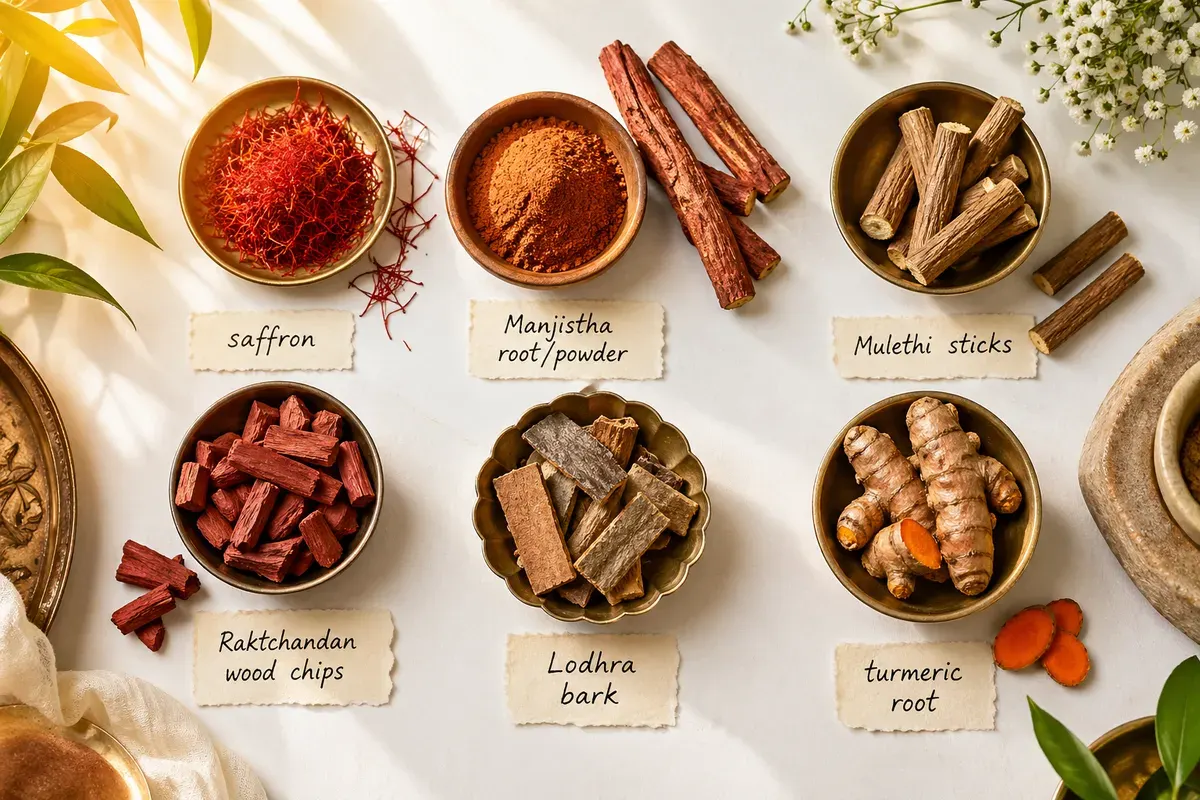
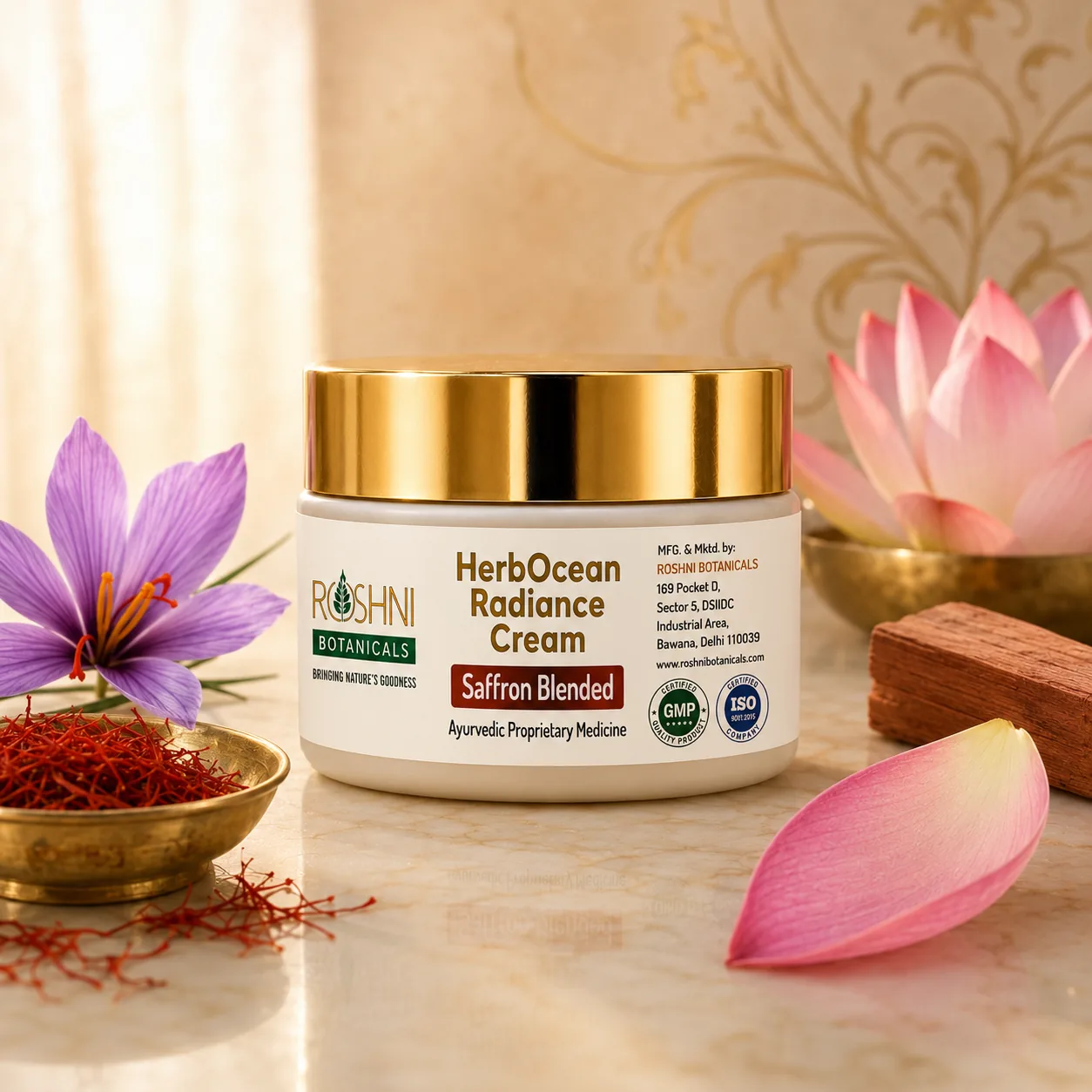
HerbOcean Radiance Cream is the daily care step that sits beside that plate. It is a saffron-led cream of twelve herbs at equal weight, sandalwood (Chandan), Manjistha, red sandalwood (Raktchandan), lotus (Kamal), Padmaakh bark, turmeric (Haldi), Kuth, Kakoli, Palash flower and the three Triphala fruits, Amla, Baheda and Harad, in a coconut oil and cream base, with saffron (Kesar) and three finishing oils, lavender, rose and mogra. It is an AYUSH-licensed Ayurvedic medicine for external use, classically indicated for facial pigmentation (Vyanga, the patches Hindi homes call jhaiyaan) and traditionally used in the care of dark spots and uneven tone. It is made in-house at our GMP-certified unit in Bawana, Delhi, under AYUSH Licence No. DL-474 A&U, and built on the 40-year Ayurvedic formulation legacy of Vaidya Shri Ram Prakash Ji.
Smooth over clean skin morning and night. Patch-test on the inner forearm 24 hours before first use and discontinue if irritation occurs; avoid the eye area. For external use only. Avoid if allergic to coconut or a listed botanical. If pregnant or breastfeeding, check with your doctor. HerbOcean does not manufacture a sunscreen, and nothing in the range replaces one, so by day always follow the cream with a broad-spectrum sunscreen.
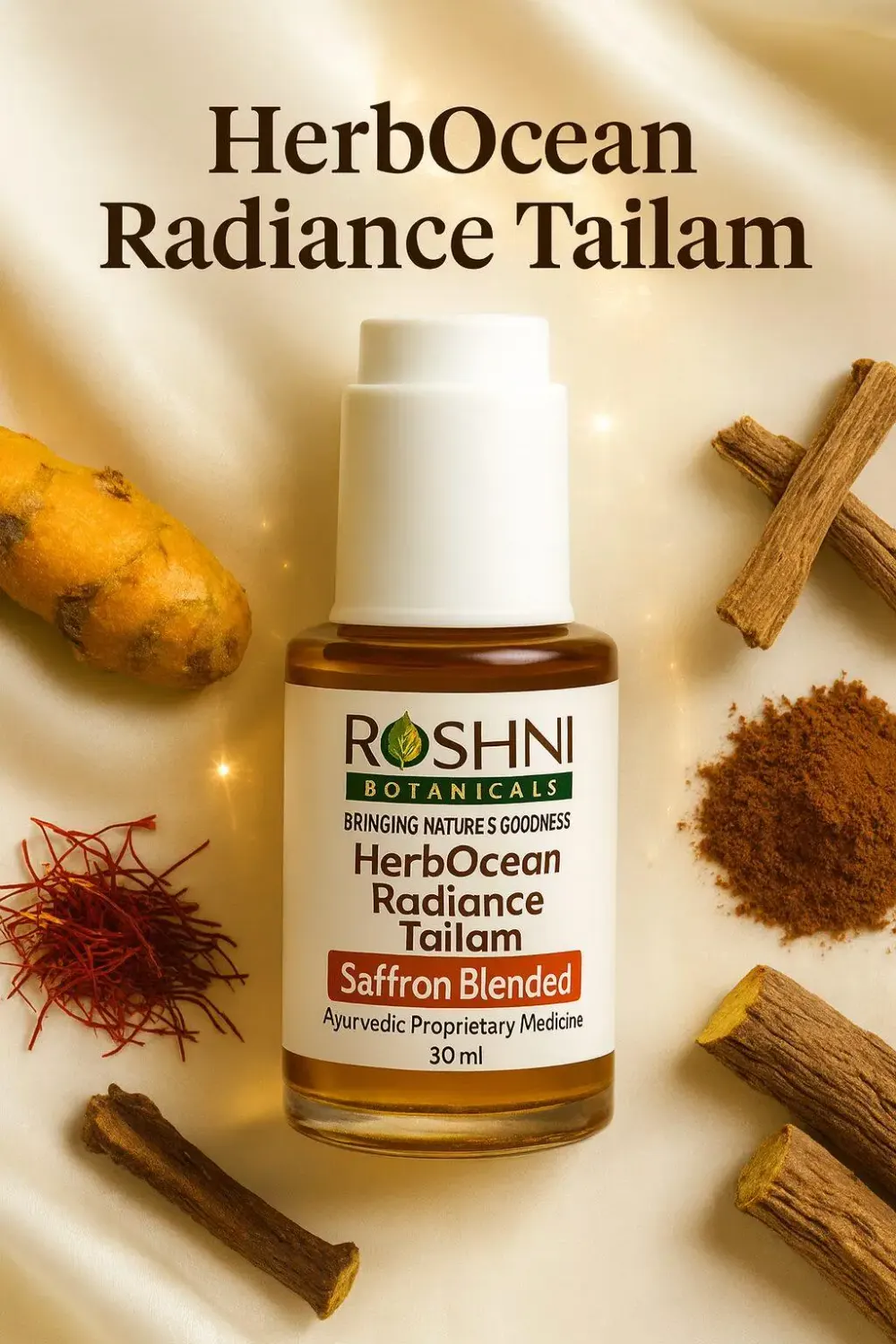
For melasma itself, Ayurvedic care for melasma on Indian skin sets out the classical approach, daily sun discipline and when to see a dermatologist, and HerbOcean Radiance Tailam is the night oil that pairs with the cream.
Eat the Week, Not the Meal
The pattern matters more than any single rule. Look at your week rather than the dinner in front of you, and let the plate back up the routine that does the visible work on your skin. Before a big occasion, the one habit worth avoiding is the crash diet. The HerbOcean skin formulas sit together in our Ayurvedic skincare range.
Patch-test any new preparation first, give a change on the plate eight to twelve weeks before you judge it, and give pigmentation months.
References: Charaka Samhita, Sutrasthana 11, on food as one of the three supporting pillars of life. Charaka Samhita, Vimana Sthana 1 (Rasa Vimana), on the rules of eating (ahara vidhi), beginning with eating food warm. Charaka Samhita, Sutrasthana 26, on the six tastes and their effect on the doshas. Charaka Samhita, Chikitsa Sthana 7 (Kushtha Chikitsa), on the dietary causes of skin disease, including eating before the last meal is digested and cold water taken straight after sun or exertion. Ashtanga Hridaya, Sutrasthana 2 and 3, on the daily and seasonal regimens (Dinacharya, Ritucharya). Meixiong J, Ricco C, Vasavda C, Ho BK. Diet and acne: a systematic review. JAAD International. 2022;7:95-112 (34 studies from 18 countries, one of them an Indian trial; glycaemic index and load associated with acne; dairy evidence mixed). Adebamowo CA, Spiegelman D, Danby FW, Frazier AL, Willett WC, Holmes MD. High school dietary dairy intake and teenage acne. Journal of the American Academy of Dermatology. 2005;52(2):207-214 (retrospective analysis within the Nurses Health Study II, 47,355 American women; among the milks, the association was strongest for skim milk, and whole milk showed no significant trend). Juhl CR, Bergholdt HKM, Miller IM, Jemec GBE, Kanters JK, Ellervik C. Dairy intake and acne vulgaris: a systematic review and meta-analysis of 78,529 children, adolescents, and young adults. Nutrients. 2018;10(8):1049 (14 observational studies; yoghurt associated with acne). Aghasi M, Golzarand M, Shab-Bidar S, Aminianfar A, Omidian M, Taheri F. Dairy intake and acne development: a meta-analysis of observational studies. Clinical Nutrition. 2019;38(3):1067-1075 (no significant association for yoghurt or cheese). Espósito ACC, Ribas CR, Barbosa GF, Bendini JD, Medeiros RGB, da Silva CN, Figueira TC, Miot HA. Dietary antioxidant intake in women with facial melasma: a cross-sectional study. Anais Brasileiros de Dermatologia. 2025;100(6):501218 (194 Brazilian women, 97 with facial melasma and 97 age-matched controls; no difference in dietary antioxidant intake). Shi Y, Guo S, Tan C. Diet and living environment as novel etiological factors for melasma: the results form a retrospective case-control study of 150 Chinese patients. Journal of Cosmetic Dermatology. 2025;24(2):e70038 (150 patients; alcohol as a risk association with a wide confidence interval). Davis EC, Callender VD. Postinflammatory hyperpigmentation: a review of the epidemiology, clinical features, and treatment options in skin of color. Journal of Clinical and Aesthetic Dermatology. 2010;3(7):20-31 (more frequent and more severe in darker skin; epidermal marks may take months to years to settle). Sen K, Sinhamahapatra P, Lalhmachhuana J, Ray S. A study of clinical profile of vitamin B12 deficiency with special reference to dermatologic manifestations in a tertiary care hospital in sub-Himalayan Bengal. Indian Journal of Dermatology. 2015;60(4):419 (25 hospital patients in West Bengal, India, 19 of them B12 deficient; the authors report that such patients often have skin hyperpigmentation). Palma L, Marques LT, Bujan J, Rodrigues LM. Dietary water affects human skin hydration and biomechanics. Clinical, Cosmetic and Investigational Dermatology. 2015;8:413-421 (49 Portuguese women; extra water raised skin hydration, most in those who usually drank little). International Institute for Population Sciences. National Family Health Survey (NFHS-5), 2019-21: India Fact Sheet. Ministry of Health and Family Welfare (anaemia among women aged 15 to 49 and adolescents). ICMR-National Institute of Nutrition. Dietary Guidelines for Indians. Revised edition. Hyderabad; 2024 (about eight glasses of water a day, other drinks included; vitamin C in the meal for plant iron; tea kept an hour away from meals; B12 a concern for vegetarians). Educational, not medical advice.
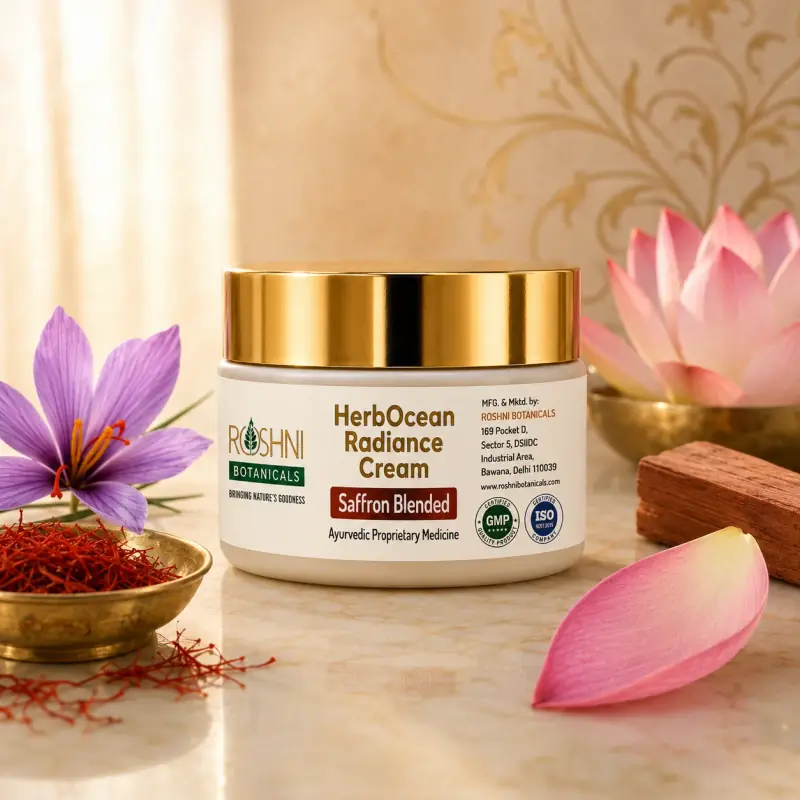
Radiance Cream
A daily saffron and sandalwood brightening cream with Manjistha, red sandalwood and lotus in a light coconut base. Supports a luminous, even-looking skin tone.
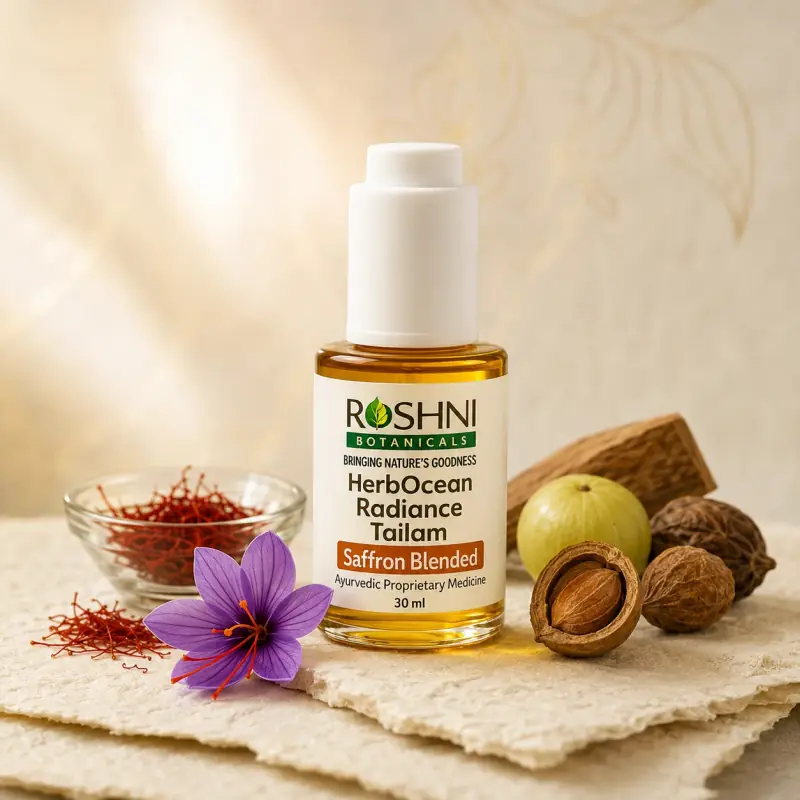
Radiance Tailam
A saffron brightening facial Taila with Manjistha and red sandalwood, traditionally used to support even tone where melasma, dark spots and PIH show.
Part of our guide: Ayurvedic treatment for melasma on Indian skin.