
How Fast Does Hair Grow, and What Your Routine Actually Controls
Growth rate is set at the follicle, and no oil changes it. What your routine actually controls is how much of that growth you keep.

Type baal lambe kaise kare jaldi into a search bar and a hundred promises come back, most of them attached to something you can buy. So here is where a brand that sells a hair oil stands. Hair does not grow faster than it grows: the rate is set at the follicle, under the scalp, by your genetics, your age and your general health, and nothing you wash with, oil with or massage in changes it. Your Sunday head massage (champi), your pre-wash oiling, your patient detangling decide something else altogether: how much of that growth stays on your head, and how much snaps off in the comb. A smaller promise, and one that can be kept.
Key takeaways
- Scalp hair grows at a rate set at the follicle by genetics, age and general health, and no oil, herb, massage or trim speeds it up, HerbOcean Hair Oil included.
- The figure usually quoted for scalp hair is roughly a centimetre a month, a little under half an inch, and plenty of heads sit above and below it.
- Trimming changes nothing at the root: growth happens at the follicle under the scalp, while a trim happens at the dead end of the strand.
- Hair that appears stuck at one length is usually breaking about as fast as it grows.
- How long each strand keeps growing before it rests is individual and largely inherited, which is why maximum length differs from person to person. Illness and crash dieting can cut that window short; nothing on a shelf lengthens it.
How Fast Hair Grows, and What Sets the Rate
Scalp hair grows at a largely steady rate, and genetics, age and general health decide it between them. The figure usually quoted is roughly a centimetre a month, a little under half an inch, and measured growth rates vary with ethnic origin (Loussouarn and colleagues, 2016, a study of 2,249 young adults from twenty-four ethnic groups across five continents), with plenty of heads above and below it. The rate can drift downward with age, and a long stretch of illness or poor nutrition can slow it, which is why the doctor paragraph later on this page is not decoration. What no shelf can do is push it up. An oil, a mask or a wash-day routine works on the shaft and on the scalp surface, while the growing happens at the follicle, on a schedule you inherited. Medicines that act at the follicle itself are a different category, prescribed and reviewed by a doctor rather than chosen off a shelf, and this page is about everything else.
So here it is in one sentence you can quote back at any advertisement: no oil, herb, massage or ritual makes hair grow faster, and that includes HerbOcean Hair Oil. We sell that oil, and an Ayurvedic oil sits in a different register from a growth promise. It is traditionally used in the care of hair fall, and the rest of this page is about the length you keep rather than the speed you were born with.
Every follicle runs its own cycle of growth, a brief transition, rest and shedding, which is why losing some hair each day is perfectly ordinary. The full cycle has a post of its own in the hair growth cycle and where a classical Taila fits in. A heavy, sudden shed is a different animal. That one usually traces back to an event a few months earlier: two to three after a fever, a crash diet or a new medication, nearer three or four after a delivery. Did yours begin after a fever or an illness? Read hair fall after fever or illness. If it began after a delivery, hair fall after delivery is the page written for you.
The Trim Myth, and Why Length Seems to Stall
Trimming does not make hair grow faster. It cannot: growth happens at the follicle, under the scalp, while a trim happens at the far end of a strand that stopped being living tissue long ago. Scissors have no line of communication with the root. What a trim does is take off the damaged section, and by the time a split shows at the end, the weakness usually runs further up the strand than it looks. That is a real service, just not the one the folklore advertises.
Why does trimmed hair look like it grows better? Because breakage was quietly subtracting length at the bottom while new length arrived at the top. Cut away the fraying ends and the same growth rate finally shows up as visible length, because less of it is going missing at the tips.
Terminal length is the second half of the answer. How long each hair stays in its growing phase before it rests is individual and largely inherited, and the published ranges for that window are wide, running to years. That is why one friend reaches her waist and another has never got past her shoulder blades on the same routine. The window can be cut short from the inside, by illness, crash dieting or an untreated deficiency, which is one more reason the doctor paragraph matters. What it cannot be is stretched from a shelf. If the women in your family have hair that sits at the mid-back and stays there, that is information about your family.
So when hair seems to have halted at shoulder length, ask the more useful question first. Is it not growing, or is it not staying?
Retention: The Part Your Routine Really Governs
Retention is the honest lever, and the arithmetic is plain: the length you keep is the length you grow minus the length you break. The first term is mostly settled for you. The second one you settle every single day, in how you wash, dry, detangle, tie and sleep on your hair. For the deep dive on exactly where length disappears, we have written one on why split ends and breakage quietly steal your length.
Through the humid weeks, and across most of India there are a good many of them, hair stays damp far longer than it should. Wet hair is delicate: water softens the keratin, so the fibre stretches further and gives way under less force. The towel is worth a second thought here. Twisting wet hair into a heavy turban and rubbing it dry adds tugging and friction at exactly the wrong moment; squeeze gently, blot with an old cotton kurta or a soft T-shirt, and let it hang. Plait it loosely before a two-wheeler ride, since open hair whipped about through forty minutes of traffic knots, and knots are combed out later at a cost. Your tap is the other quiet culprit: hard water leaves a microscopic mineral film on the shaft, and while the strength evidence is genuinely split, one study finding treated hair measurably weaker and another finding no difference, the film is real and the tangling is familiar. Hard water has a post of its own, on what hard water does to your hair and scalp. Let hair dry to damp before you detangle, with a wide-tooth comb, working from the ends upward in sections.
The rest of the retention toolkit is unglamorous, and it works. Wear looser styles and shift where the tie sits, so the same centimetre of hair is not gripped in the same spot day after day; if your hairline already looks wider at the temples, read what tight braids and sleek buns do to a hairline. Space out heat and chemical services: smoothing and straightening work by breaking bonds inside the shaft, and colour lifts the cuticle to get at what sits under it, so the damage adds up along the same length of hair. At night, a smoother pillow cover or a loose plait reduces the rubbing hair does against cotton through seven hours, comfort and convention rather than science. And take the ends off when they begin to fray, rather than saving up for one dramatic cut a year.
Diet belongs here too, with more caution than the internet usually brings to it. Shedding heavily and tiring easily? A thyroid panel and ferritin through your doctor come before any new bottle, ours included. What to eat sits in its own post, on nine everyday Indian foods for stronger hair. Crash dieting through a wedding season is a familiar trigger for a shed that surfaces months later, long after the diet itself has been forgotten. None of this speeds growth; it supports the ordinary functioning that growth quietly depends on.
Where a Weekly Champi Fits, and When to See a Doctor
Where does a medicated oil (Taila) fit into a retention routine? A pre-wash champi with HerbOcean Hair Oil, weekly, or two to three sessions a week the way the product page lays it out, supports scalp comfort and helps maintain a supple, well-lubricated strand. It is an Ayurvedic medicine for external use, traditionally used in the care of hair fall, and that classical indication is the whole of the claim.
The formula runs to sixteen botanicals. Twelve of them are herbs, each at the same measure and none of them leading: Bhringraj, Jatamansi, Brahmi, Shikakai, Amla, Nagarmotha, Chharila, Sugandhbala, Gudal (hibiscus), Tulsi, Gulab (rose) and Neem, infused into a sesame oil (Til tail) base. Lavender, curry leaf and rosemary go in at the end as finishing oils rather than herbs, which is why the count reads sixteen botanicals and not sixteen herbs.
The oil is built on the forty-year formulation legacy of Vaidya Shri Ram Prakash Ji, the master formulator whose work the HerbOcean line rests on, and it is made in-house at our GMP-certified unit in Bawana, Delhi. It is for external use. Patch-test on the inner forearm twenty-four hours before a first full application, and keep it off broken or inflamed skin. The complete ingredient list sits on the HerbOcean Hair Oil page.
For how oiling sits inside a whole routine, read the definitive guide to Ayurvedic hair oils for hair fall control. And know the point at which this stops being a question about routine. See a dermatologist if your parting is visibly widening, if coin-sized bald patches appear, if shedding arrives with scalp pain, burning or scaling, or if a shed that began after a fever, a crash diet or a new medication is still going strong at six months, longer after a delivery, where six to twelve months of shedding can still be ordinary. Carry photographs of the parting taken a few months apart if you have them, because a clinician reads change far better than memory does. Sudden, patchy or scarring loss needs a diagnosis, not a longer oiling schedule.
What a Routine Can Actually Promise
You cannot hurry a follicle. What you can do is stop losing what it has already made. Detangle gently, tie loosely, dry kindly, take the ends off before the fraying travels, and keep one unhurried pre-wash champi in your week. Retention is slow work that shows in seasons, not weeks. Growth is mostly inherited. Length, most of the time, is what you do not break.
References: Loussouarn G et al. European Journal of Dermatology. 2016;26(2):144-154 (2,249 young adults from twenty-four ethnic groups across five continents; growth rate slower in African hair and faster in Asian hair). StatPearls, Physiology of Hair (the growing phase runs for years, with wide published ranges). Luqman MW et al. International Journal of Trichology. 2018;10(3):113-117 (hard-water tensile comparison, 70 participants, Pakistan; treated hair weaker). Alahmmed LM et al. Indian Journal of Dermatology, Venereology and Leprology. 2017;83(6):740 (scanning electron microscopy, 20 volunteers; mineral deposition without visible surface damage). Srinivasan G et al. International Journal of Trichology. 2013;5(3):137-139 (15 volunteers, India; no tensile difference between hard-water and distilled-water treated hair).
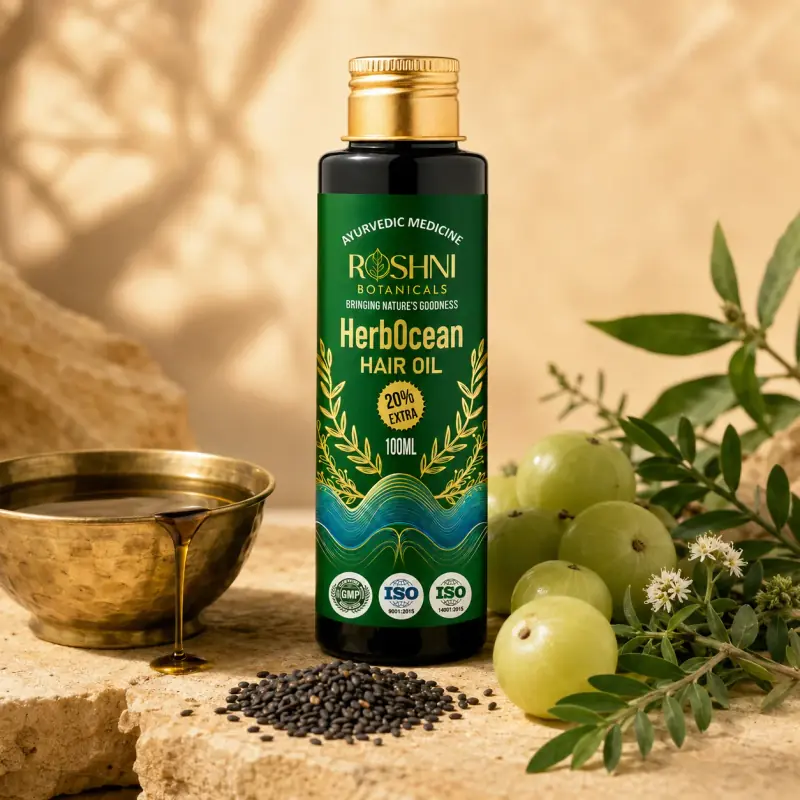
HerbOcean Hair Oil
A classical Taila for hair fall, dullness and a flaky scalp, with sixteen botanicals like Brahmi, Jatamansi, Amla and Neem in a slow sesame base.
Part of our guide: The definitive guide to Ayurvedic hair oils for hair fall.