
Tight Braids, Sleek Buns and Hair Fall: The Traction Problem Nobody Names
If your hairline looks wider at the temples, your hair may not be falling so much as being pulled. The early signs of traction hair fall, why a helmet doubles it, and the swap that costs nothing.

The choti was plaited tight for school assembly, and somehow the habit never loosened its grip: the sleek office bun, the gajra-heavy festive braid, the ponytail tucked under a two-wheeler helmet every morning. If your hairline looks a little wider at the temples lately, your hair may not be falling so much as being pulled. There is a name for this quiet culprit, traction, and the honest news is that caught early, it is one of the most recoverable kinds of hair fall.
Key takeaways
- Traction alopecia is hair fall caused by constant pulling at the roots, from tight braids, sleek buns, high ponytails and heavy extensions, and it concentrates along the hairline and at the temples.
- Caught early, it is genuinely recoverable: once the pulling stops, most hairlines recover over several months of gentle handling.
- Long-standing, smooth, shiny patches along the hairline are a different, later stage and typically stay put without medical help; that is the specific moment to see a dermatologist promptly, as is a hairline that keeps retreating despite looser styling.
- A tight ponytail under a two-wheeler helmet doubles the tension, the elastic pulls while the helmet presses, and hard Indian tap water leaves strands more brittle and quicker to snap at exactly that pull line.
- Champi with HerbOcean Hair Oil supports the scalp while looser styling does the real recovery work. It is a medicated hair oil (Taila), formulated by Vaidya Shri Ram Prakash Ji, carrying Bhringraj, Brahmi and Amla in a sesame base.
The Styles We Love, and What They Ask of the Hairline
None of this is a case against how you style your hair. The school plait pulled tight by a loving hand, the sleek bun for the office, the gajra-heavy braid for a wedding season that seems to run all year, extensions for a special occasion: these are not the problem. Constant tension is. When any hairstyle pulls steadily at the same strands for hours, day after day, the follicle underneath becomes chronically inflamed. Hairs weaken exactly along that line of pull, and because the front hairline and the temples carry more of the load in most tight styles, that is where the damage concentrates first.
The two-wheeler commute doubles the tension, and it rarely gets mentioned anywhere else. A tight ponytail pulls at the roots on its own. A helmet then presses and rubs against that same stretch of scalp for the length of every ride. Two sources of pull, stacked on top of each other, twice a day. A simple fix helps more than people expect: plait low and loose before the helmet goes on, and let your hair down the moment you arrive rather than leaving it cinched all day.
Season adds its own pressure. Through the monsoon months, sweat and humidity get trapped under a helmet or an all-day bun in a way they simply do not in drier weather, and a scalp that stays damp for hours is a scalp under more strain, not less. Loosen styles a little sooner in this season, and give your hair a real chance to dry out fully once you are home, rather than leaving it tied up damp until bedtime.
Early Signs Your Bun Is Too Tight, and the Good News
The early signs are easy to miss because they feel minor on their own. Watch for a hairline edge that seems to be inching backward, small tender bumps along the exact line where a style pulls hardest, and a scalp that aches or feels headache-tight by the end of the day. Snapped, short baby hairs at the temples are another quiet signal, and if you notice any of these, the moment to loosen your styles is now, not after the next wedding season.
Hard water plays its own part here. Mineral-heavy tap water, the norm in most Indian cities, leaves hair strands drier and more brittle, and brittle hair snaps sooner exactly where a tight style already has it under load. The same bun that a well-conditioned strand might tolerate for a season becomes a shorter runway to breakage where the water is hard; our guide to hard water and hair fall goes into what actually helps. A final rinse with filtered or boiled-and-cooled water, used consistently, keeps strands a little softer and less prone to snapping under tension.
Now the good news, and it is real. A 2017 review in the Indian Journal of Dermatology, Venereology and Leprology by Akingbola and Vyas describes traction alopecia as unusual among hair-loss conditions in being reversible at first and only later irreversible, once scarring sets in. The same review is blunt about what actually treats it: the mainstay is stopping the hairstyles that are doing the pulling. Not a product. Not a procedure. Stopping the pull. That is worth sitting with, because it means the most effective thing available to you is also free.
There is a real limit, though, and it deserves saying plainly. Long-standing patches that have gone smooth and shiny along the hairline are past that reversible window, and hair there typically does not return on its own. The two stages are surprisingly easy to confuse, mostly because neither looks dramatic. Early traction shows up as tenderness, small bumps and short, snapped baby hairs, all signs the follicle is irritated but intact. The later, scarred stage looks deceptively calm by comparison: the skin turns smooth and slightly shiny, almost healthy at a glance, because the follicle opening itself has closed over. That calm appearance is precisely why people wait too long to get it checked. If a patch has looked the same, smooth and quiet, for many months despite looser styling, that stillness is the signal to see a dermatologist rather than a reason for relief.
How This Is Different from Everyday Hair Fall
Indian households already carry plenty of theories about hair fall, so it helps to know where traction actually fits among them. Ordinary shedding from stress, diet or seasonal change tends to spread evenly across the scalp, a little more hair in the drain and on the pillow everywhere, not concentrated in one strip. Traction stays stubbornly along the exact line a style pulls, mostly the front hairline and the temples, and it rarely touches the crown or the back of the head unless a bun sits there instead. If your part is widening evenly all over, that is a different conversation, closer to the general patterns covered in our guide to what causes hair loss and how Ayurveda can help. If it is specifically your hairline retreating at the temples where your ponytail or plait sits tightest, traction is the far more likely explanation, and it calls for a completely different fix: less pulling, not more products.
One practical way to catch it early, before a mirror would show you anything: pay attention to what your scalp tells you at the end of the day. A style that is genuinely too tight announces itself within the first hour, not the eighth. If you find yourself reaching up to loosen a bun by mid-morning, or the relief when you finally take it down is noticeable rather than neutral, that is your answer, and it arrived months before any thinning would. Most people register that sensation and then talk themselves out of it because the style looks right. The sensation is the better guide.
Gentler Styling Swaps That Still Look Polished
Nobody is asking you to give up styling. A few swaps protect the hairline while still looking put together for work, for college, for a function. Braid loosely at night instead of tightly during the day, and rotate your parting every week or two so the same strip of scalp is not always the one doing the work. Silk or satin scrunchies grip hair with far less pull than a plain rubber band, and they are an easy, cheap swap for anyone who reaches for an elastic on autopilot.
Festive season and office culture both have their own version of this fix. A gajra-heavy braid for a wedding does not need banning, it needs rest afterward, a day or two of looser styling before the next occasion asks for the same tight weight again. Office buns can stay sleek and simply sit a little lower and a little slacker at the nape rather than pulled taut at the crown, and extensions do better alternated with lighter days than worn constantly. The one rule that costs nothing: never sleep in a style that is still tugging at your roots when you lie down.
Champi While the Follicles Rest: Where Oiling Fits
Looser styling does the real work here, and it is worth being clear that nothing in this section replaces it. What a gentle champi offers alongside it is supportive care, and HerbOcean Hair Oil is built for exactly that role. It is a medicated hair oil, an AYUSH-licensed Ayurvedic medicine (Licence No. DL-474 A&U) for external use, traditionally used in the care of hair fall and dullness, carrying Bhringraj, Brahmi and Amla among twelve classical herbs in a sesame (til tail) base, sixteen botanicals in all. It is formulated by Vaidya Shri Ram Prakash Ji, the master Ayurvedic formulator (a classical vaidya) whose 40-year Ayurvedic formulation legacy the HerbOcean line is built on, and made in-house at Roshni Botanicals' GMP-certified unit in Bawana, Delhi. Massage it in with light fingertip pressure, never a vigorous rub, since roots already under stress from styling do not need more force added on top. Patch-test on the inner forearm before the first full application.
Regular head oiling is old advice rather than new, and the texts are specific about it. The Charaka Samhita sets out the daily routine (Dinacharya) in Sutrasthana 5, and at verses 81 to 83 it lists what regular head oiling is expected to hold off, naming Khalitya, the classical term for hair fall and baldness, alongside premature greying and the falling of hair, with deep-rooted hair and sound sleep among the benefits. Read that as upkeep rather than rescue, which is precisely the role it plays here: the oiling supports, the loosening heals. For the fuller technique, from how much oil to how long to leave it in, our step-by-step Ayurvedic hair oiling routine walks through the whole ritual, and our definitive guide to Ayurvedic hair oils for hair fall control sets traction alongside the other patterns worth recognising.
Give it a fair window before you judge whether it is working, too. Hair grows slowly enough that a recovering hairline shows nothing useful for the first couple of months, and recovery here is measured in months rather than weeks. The mistake people make here is not impatience exactly; it is loosening the styles for a fortnight, seeing no change, and quietly going back to the tight bun because the effort seemed wasted. It was not wasted. It was simply early. Photograph your hairline in the same light once a month and compare month one with month six, not Tuesday with Wednesday. One thing should not wait for that six-month mark, though. If the hairline keeps retreating across those monthly photographs despite genuinely looser styling, or if the tenderness, bumps or redness persist instead of settling, see a dermatologist at that point rather than waiting the window out. A few other scalp conditions look almost exactly like traction at the temples, and some of them need attention early to limit further loss.
Let the Hairline Rest
A widening hairline from a favourite style is simply tension asking for a break, quietly, and in its early stage it answers that break remarkably well. Loosen the styles that are doing the pulling, give the two-wheeler ponytail a softer plait underneath the helmet, and let a few quiet minutes of champi support your scalp while the real recovery happens. Give it that rest, and most hairlines find their way back on their own.
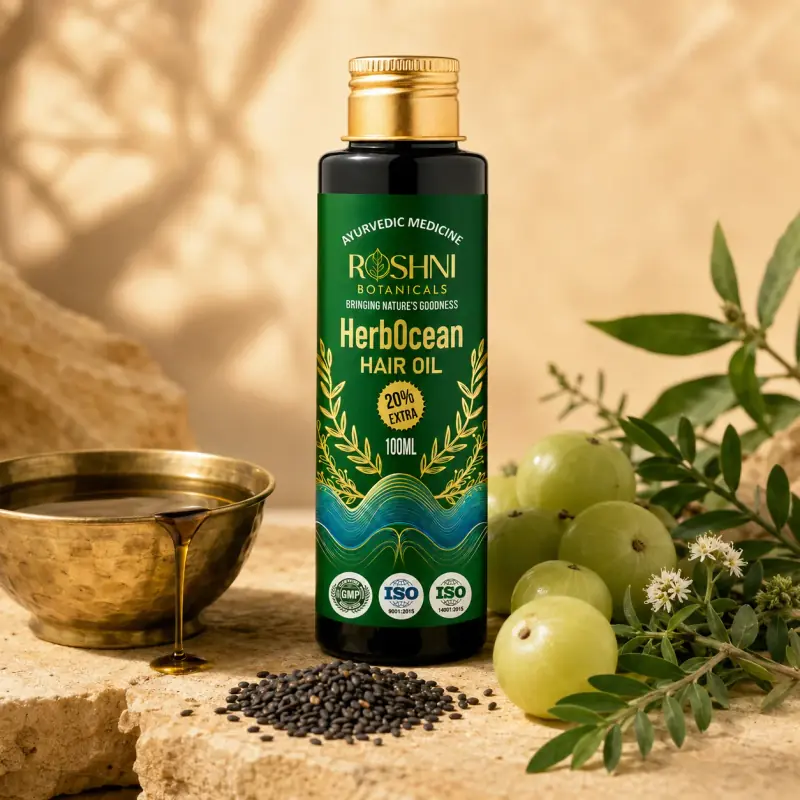
HerbOcean Hair Oil
A classical Taila for hair fall, dullness and a flaky scalp, with sixteen botanicals like Brahmi, Jatamansi, Amla and Neem in a slow sesame base.
Part of our guide: The definitive guide to Ayurvedic hair oils for hair fall.