
Split Ends and Hair Breakage: What Oiling Honestly Does, and What Only a Trim Can Do
Nothing fuses a split end back together. What Ayurvedic hair oiling honestly does for breakage, how to tell breakage from shedding, and why trim intervals are convention rather than evidence.

You notice it under the bathroom light: the last two inches of your plait looking dry and frayed, the ends forking into two. The usual reflex is to buy another serum. Between hard tap water, a hurried towel-rub and the straightener that comes out before every family function, the honest answer is less exciting than the bottle suggests, and a good deal more useful.
Key takeaways
- Nothing fuses a split end back together. The mending products that do exist bind the split temporarily and rinse out, and a trim is the only thing that takes the damaged section off.
- Most products promising to seal split ends are describing surface smoothing. Conditioning agents coat the frayed section so it lies flatter and combs more easily, until the next wash.
- Oiling works earlier in the chain. Applied along the mid-lengths and ends before a wash, it supports lubrication and softness on the length that has not split yet.
- Breakage and shedding are different problems. Frayed short pieces after combing point to the shaft; a widening parting, more scalp at the crown, or heavy fall a couple of months after a fever or childbirth point to the root.
- Trim intervals are salon convention, not a research finding. Every eight to twelve weeks suits most people, and no published study tests one interval against another.
What a Split End Actually Is, and Why Nothing Fuses It Back
A hair shaft is built like a roof. The outer cuticle sits in overlapping scales along the length, and beneath it lies the cortex, which carries the strand's strength. Friction, heat and repeated mechanical stress wear those scales away from the oldest part of the hair first, which is the ends, because they have been through the most washes, the most combing and the most sun. Strip enough of that outer layer and the cortex is left exposed, and the strand begins to divide.
The two forms you will actually recognise are the simple two-pronged fork and the tree-shaped split with several branches. Both are trichoptilosis, which is the clinical name for a split end. The thinned white dot partway up the shaft that eventually snaps clean through is worth separating out: that is trichorrhexis nodosa, a related shaft fault rather than a third kind of split. They turn up together often enough that most people treat them as one problem, and for practical purposes the handling advice is the same.
How the splitting actually happens has been studied more recently than you might expect. Laboratory work on the mechanics found that in split-prone hair, cracks began inside the strand and ran along it for more than five millimetres, while in control hair the cracks began at the surface and stayed short (Taylor and colleagues, Interface Focus, 2024). That was hair from two donors, tested in the laboratory rather than on anyone's head, so read it as a mechanism rather than a measurement of your own hair. It does explain something useful though: by the time a split is visible at the tip, the damage running behind it is longer than the visible fork.
Now the part the category tends to skip. Conditioning agents coat the frayed section so it lies flatter, looks tidier and drags less through a comb. That effect is genuine and worth having, and it is surface smoothing that washes away rather than structural mending. We should be precise here rather than absolute, because there is one real exception in the literature: a polyelectrolyte complex described in the Journal of Cosmetic Science in 2007 was shown to mend split ends semi-permanently, with the mend holding through combing, though the complex rinses off with shampoo (Rigoletto and colleagues). Even that is a temporary bond on a strand that stays divided underneath. Nothing on a shelf rebuilds keratin across the split. A product can make a split end less noticeable. Scissors are what remove it.
That is not an argument against conditioning, and it is not an argument for buying nothing. It is an argument for knowing which job you are paying for. A smoothing product buys you a tidier appearance until the next wash. A trim buys you the actual removal of the damaged section. Those are both worth money, and neither substitutes for the other.
Breakage Along the Length Versus Shedding From the Root
Before changing anything, work out which problem you have, because the two answer to completely different things. The honest version of this test is less tidy than the internet's. You may have read that a small pale bulb at one end proves a hair came from the root. That pale club is a real feature and a dermatologist reads it under magnification, but it is a clue rather than a verdict at home. A hair can leave the root without an obvious club, and short pieces are not proof of breakage on their own, particularly if your hair is wavy, curly or coily, where curl shortens the apparent length and ordinary shedding reads as short fragments.
What is more reliable is the pattern around the loss. Hair coming away during combing and towel-drying, with visibly frayed or forked ends, points to the shaft. A parting that is visibly widening, more scalp showing at the crown, or heavy fall starting a couple of months after a fever, surgery or childbirth points to the root instead. Those are different situations and the second one deserves a proper look rather than a new conditioner. If the pattern suggests shedding rather than breakage, our complete guide to Ayurvedic hair oils for hair fall covers that ground properly. Both can run together, which is exactly why it is worth looking before assuming.
What Actually Damages Hair in an Indian Routine
Hard water comes first, because it affects a lot of households and gets blamed the least. Groundwater sampled in South West Delhi is the measured case, where most samples sat well above the acceptable limit for hardness, and mineral-heavy water is commonly reported to leave hair feeling rough after washing and tangling more. How hard water affects hair in Indian cities goes into that properly, so this is the short version: a longer, more patient rinse helps, and softening at the inlet helps more if you already have it.
Most breakage in an everyday routine is generated by handling, and this is the part where the fixes cost nothing. Wet hair is delicate, and a wide-tooth comb is better than a brush for detangling it. If your hair is straight, let it dry a little first. If it is thick, tightly curled or textured, the American Academy of Dermatology's advice runs the other way: comb it in the shower while the conditioner is still in, because that is when it moves most freely. Either way, start at the ends and work upwards. Laboratory work on combing found that wetting the hair shifts where it breaks rather than simply causing more breakage (Robbins and Kamath, Journal of Cosmetic Science, 2007).
The rest is unglamorous and effective. Swap the vigorous towel-rub for squeezing and blotting, or use an old cotton kurta instead of a terry towel. Rubber bands pulled out in a hurry take hair with them, so a soft scrunchie earns its place. The straightener before a wedding is a reasonable trade if it stays occasional rather than weekly. And tight daily styles carry a separate cost of their own, which is covered in our post on why tight daily hairstyles pull at the hairline.
Humidity gets blamed a great deal, and here we would rather be honest than mechanistic. Humid air is widely reported to leave hair harder to manage, and we could not find a hair-science source that establishes a chain from humidity through to breakage that we would be willing to print as fact. Treat a humid stretch as a reason to reduce heat and tension rather than as a diagnosis.
Where Oiling Genuinely Helps, and a Sensible Trim Cadence
The champi most Indian households already run is maintenance, not rescue. Oil worked along the mid-lengths and ends before a wash supports lubrication and softness along the length, and may aid in easing comb drag. Dryness and friction are where new splits begin, which is why the mid-lengths and ends are worth attending to at all. What it does not do is mend the splits you already have. Our Ayurvedic hair oiling routine covers method and timing if you want the full version.
HerbOcean Hair Oil is an Ayurvedic medicine for external use, classically indicated for hair fall and dullness. It carries sixteen botanicals: twelve herbs at equal measured weights, being Bhringraj, Jatamansi, Brahmi, Shikakai, Amla, Nagarmotha, Chharila, Sugandhbala, hibiscus (Gudal), Tulsi, rose (Gulab) and Neem, in a sesame oil (Til tail) base, finished with lavender, curry leaf and rosemary oils. No single herb leads the formula; the twelve are declared at the same weight.
It is made in-house at Bawana, Delhi under AYUSH Licence No. DL-474 A&U. The manufacturing unit holds a Schedule-T GMP certificate issued by the Directorate of AYUSH, Government of NCT of Delhi, whose approved dosage forms include oils, and is certified to ISO 9001:2015. The formulation is built on the 40-year Ayurvedic formulation legacy of Vaidya Shri Ram Prakash Ji. That makes it a classical medicated hair oil (Taila) carried forward, rather than a fragrance-led blend assembled for a trend.
As for how often to trim, it is worth saying plainly that there is no published study testing one trim interval against another. Every eight to twelve weeks is salon convention, not a research finding, and a light dusting of just the ends is enough, so you are not obliged to lose length you have spent a year growing. Move closer to eight weeks if a straightener or dryer is a weekly habit, if your hair is tied tightly every day, or if you wash in hard water. Oiling well does not stretch the gap between trims.
Some things are not a haircare problem at all. See a dermatologist if your parting is visibly widening, if there is a smooth round patch of scalp, if the scalp is painful, oozing or thickly scaly, or if hair is snapping off right at the hairline where it is pulled back tightly. On shedding after an illness, the timing matters: it usually does not begin until two to three months afterwards, so heavy fall at the three-month mark is the expected peak rather than a warning sign. Get it looked at if it is still heavy past six months.
The Part of the Length a Routine Can Actually Look After
The ends you have now will need a trim, and no bottle changes that. What a routine can look after is the length that has not split yet: softer detangling, less heat, looser ties, and a steady pre-wash oiling habit that keeps the mid-lengths from drying out in the first place. If you want a classical medicated hair oil for that habit, ours is a sixteen-botanical sesame-oil formulation, traditionally used in the care of hair fall and dullness, made under AYUSH Licence No. DL-474 A&U.
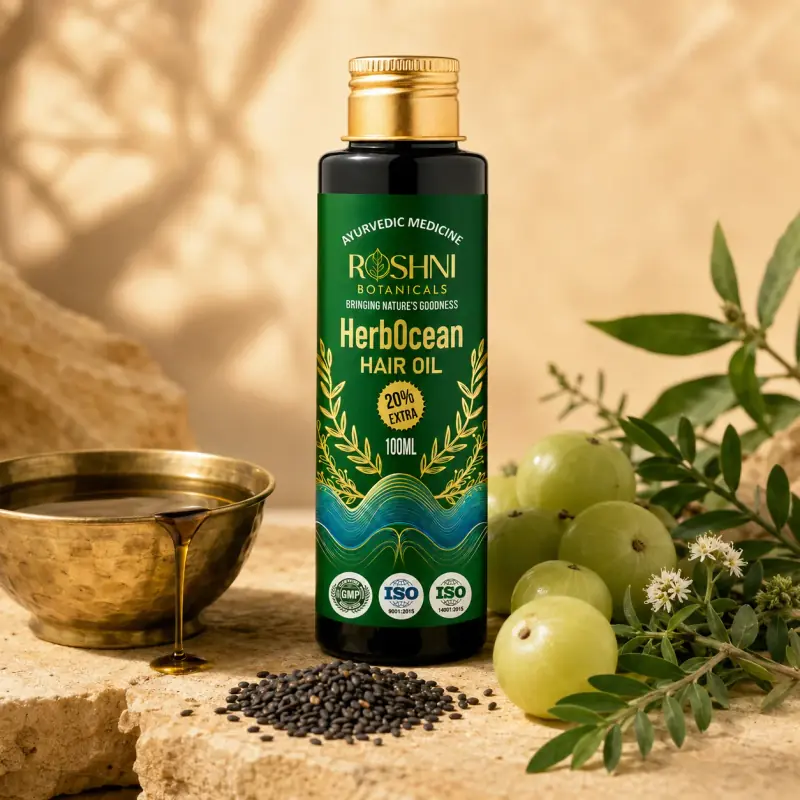
HerbOcean Hair Oil
A classical Taila for hair fall, dullness and a flaky scalp, with sixteen botanicals like Brahmi, Jatamansi, Amla and Neem in a slow sesame base.
Part of our guide: The definitive guide to Ayurvedic hair oils for hair fall.