
How to Wash Oiled Hair: The Wash-Day Method That Completes Your Champi
The other half of the champi, written down: how long the oil sits, why the shampoo goes into a mug of water first, and what hard water does to a rinse.

Most people in India were taught how to put oil in. Almost nobody was taught how to take it out. So the champi goes beautifully, and then wash day becomes three rounds of shampoo, a scalp that feels tight by evening, and a quiet decision that oiling does not suit you. It usually suits you fine.
How to wash oiled hair is the half of the routine nobody writes down, and it is fixable in one sitting. The classical texts describe the oiling in detail and say very little about the wash that follows, beyond keeping hot water off the head. What follows is the method in the order you would actually do it in your bathroom, with the Indian conditions built in.
Key takeaways
- Leave the oil on for at least an hour, or overnight if that suits your wash day. Overnight oiling is a tradition and a comfort, and it usually means more oil to wash out the next morning.
- Dilute the shampoo in a mug of water and pour it onto dry, oiled hair before any water goes on the head. Neat shampoo lands in one spot, refuses to spread, and pushes people into using far more than they need.
- Shampoo belongs on the scalp. The lengths get cleaned as the wash rinses down them, and they never needed a direct application.
- A gentle second pass after heavy oiling is normal, but needing two full washes every week is a quantity signal. Adjust the oil quantity first.
- Across much of Delhi and the north, hard water is often why a wash feels ineffective. A jug of stored or filtered water for the final pour means mineral-heavy tap water is not what dries on the strand.
The Pre-Wash Window: How Long the Oil Should Actually Sit
At least an hour, or overnight if that suits your wash day. Inside that first hour the oil settles along the partings, reaches the scalp and coats the strand. Read the clock as a convenience rather than a dose: what it is really deciding is how your wash day goes, so set it by the morning you have.
Overnight oiling is a real tradition, and nothing is wrong with it. Plenty of households swear by it, it feels lovely, and the smell of a warm medicated oil on a pillow is half the point. Still, it is a choice, and it usually means more oil to wash out the next morning. If wash day is the part you dread, the night soak is the first thing to shorten. And if you do oil at night, use less of it and put an old cotton cloth over your pillow. Whether a sesame or a coconut base suits your weather is a separate question, and we have set that out in sesame oil against coconut oil for hair.
Volume matters more than the clock. Use a little, and less than you think. Scalp first, along the partings, and the lengths get whatever is left on your palms. A lot of wash-day misery is a quantity problem wearing a shampoo costume: people pour oil the way they pour water, then blame the bottle for not coping.
Two situations call for a shorter window. An itchy or flaky scalp in humid weather suits the shorter window, an hour or two, better than a night under oil. Fine hair that goes limp for two days after a long soak is telling you something, and it is worth listening to. Application technique belongs to our companion piece, a step-by-step Ayurvedic hair oiling routine, which sets out the classical oil massage in full. Frequency is a separate question, and we have covered how often you should wash your hair.
The Wash Itself: Dilute, Scalp Only, and the Second-Pass Question
oil lagane ke baad baal kaise dhoyen is how this gets typed into a search box. Start in a mug, and start on dry hair. Put your usual amount of shampoo in, top it up with water, swirl it about, then pour that along the partings of dry, oiled hair before any water goes on the head. Wet the hair only once the diluted wash is worked in. One habit, no cost, and it accounts for most of the problem. Neat shampoo on an oiled scalp lands in a sticky spot, refuses to spread through oil, and leaves you squeezing out more because the first lot did nothing.
Diluted, it spreads on contact and lathers on an oiled head, which neat shampoo struggles to do. Roughly two parts water to one part shampoo is a sensible starting point. Adjust it once you have watched how your own bottle behaves in the mug.
Then keep it on the scalp. Work it in with the pads of your fingertips, slow circles, no nails. Nails scratch a scalp that has just been massaged, and scratching is how a mildly itchy scalp becomes a sore one. The lengths look after themselves. Shampoo is meant for the scalp rather than the lengths: rubbing it into the mid lengths increases friction and leaves hair tangled and rough, and the lengths get cleaned as the wash rinses down them.
Long hair? Clip the lengths up while you work the scalp. It keeps them out of the massage, and it stops you absent-mindedly scrubbing at them. Rinse properly before you decide anything about a second wash.
Yes, a gentle second pass is normal after heavy oiling, and it is far kinder than one aggressive wash with a harsh detergent. Read it upstream, though. Needing two full washes every week means the oil quantity should move, not the shampoo strength.
Water temperature next, where confident advice points in both directions. Lukewarm to wash. The classical instruction is unusually specific here: Ashtanga Hridaya, in the chapter on the daily routine, keeps warm water below the neck and off the head, where it is said to cost the hair and the eyes their strength. Hot water also leaves the scalp feeling tight, which is the opposite of the point. Cool for the final rinse if you like it, and be honest about that rinse: it feels pleasant and it costs nothing, but no controlled study has tested whether it does anything for the hair, so keep it as a preference and expect nothing more from it.
If you would rather skip commercial shampoo altogether, the traditional shikakai and reetha hair wash is the classical route, and we have written that up separately. Shikakai is one of twelve herbs among the sixteen botanicals in HerbOcean Hair Oil. Reetha sits outside that formula entirely.
Hard Water, the Monsoon Exit, and the Bathroom You Actually Have
Across much of Delhi and the north, the tap carries enough dissolved mineral to leave a film on the strand. Lather is suppressed, so the oil can feel harder to lift. Hair squeaks in the shower, then feels rough once dry, and the usual response is to buy a stronger shampoo, which is the wrong lever entirely.
Options, cheapest first: keep a jug of stored or filtered water aside for the final pour, so mineral-heavy tap water is not what dries on the strand; fit a simple inline shower filter; or at the very least stop escalating the detergent. Nothing removes what is already deposited. For the chemistry, the two-minute home test and what hard water does and does not do, we have set out what hard water does to your hair and scalp in full.
As the monsoon pulls back across North India, humidity is dropping, which helps. Hair still takes an age to dry in that transition, though, and a scalp left damp under a towel or knotted into a bun all afternoon tends to turn itchy by evening. If flaking or itch is already active, wash more often and more gently rather than less. So give the drying the same attention you gave the wash: squeeze the water out along the length, blot with an old cotton kurta rather than rubbing with a rough terry towel, let it air dry loose, and keep the tight bun and the plait off a wet scalp until it is mostly dry.
After the Rinse: Conditioner, Detangling and What Undoes It
Conditioner goes from mid length down, well clear of the scalp and roots. Your scalp has just had oil on it and needs no second coat of anything. Below the ears is a workable rule for most lengths. Leave it a few minutes while you do something else, then rinse until the hair feels smooth. If it still feels coated, rinse longer.
Ends still dry once everything else has dried? That is a case for a little more oil along the lengths at the next pre-wash oiling.
Then the habit that undoes a good wash, which is pulling a comb through wet hair. Water swells the hair shaft, and combing it wet is associated with long breaks along the strand where combing it dry produces short ones. Some of what gets counted as hair fall on wash day is breakage from the comb rather than shedding from the root. Fingers first, then a wide-tooth comb, starting at the ends and working upward. If your hair is straight, let it part-dry first; if it is thick, tightly curled or textured, detangle in the shower with the conditioner still in, which is when it moves most freely.
Nothing re-joins a split end once it has split, so the work is avoiding the next one, and our piece on what oiling honestly does for split ends and breakage goes further into it.
They cluster, so run through them as a set: neat shampoo straight onto oil, hot water, shampoo rubbed into the lengths, nails on the scalp, hair tied up wet, and a rough towel rub.
If you are choosing an oil for all of this, HerbOcean Hair Oil is an AYUSH-licensed Ayurvedic medicine for external use, a classical Taila (medicated oil) of sixteen botanicals: twelve herbs, the sesame base they sit in, and three finishing oils of lavender, curry leaf and rosemary. The twelve herbs are Bhringraj, Jatamansi, Brahmi, Shikakai, Amla, Nagarmotha, Chharila, Sugandhbala, hibiscus (Gudal), Tulsi, rose (Gulab) and Neem. It is made in-house at our GMP-certified unit in Bawana, Delhi, under AYUSH Licence No. DL-474 A&U, built on the 40-year Ayurvedic formulation legacy of Vaidya Shri Ram Prakash Ji. It is classically indicated for hair fall and dullness. For external use only. Patch-test on the inner forearm before a first full application. If you are pregnant or nursing, check with your doctor before use. Keep the oil off your breasts, and never use it on the baby.
A good wash makes oiling sustainable, which is the whole reason the method matters.
Change One Thing This Week
The champi is only half a routine. Whether you keep doing it gets decided by the wash, and plenty of people give up oiling because of a bad one. So change one thing this week, before you change anything else: dilute the shampoo in a mug and keep it on the scalp. Give the mug and the scalp-only rule a few wash days before you judge them. For the wider picture on shedding, our definitive guide to Ayurvedic hair oils for hair fall control sits behind all of this.
Be clear, though, about when this stops being a wash-day question. A widening parting, visible scalp at the crown, sudden patchy loss, a scalp that stays painful or scaly, or shedding that has clearly stepped up over several weeks belongs with a dermatologist rather than with a change to your wash day.
References: Ashtanga Hridaya, Sutrasthana 2 (Dinacharya Adhyaya), on daily head oiling (Murdha taila) within the classical daily routine, and on warm water poured below the neck rather than over the head. Charaka Samhita, Sutrasthana 5 (Matrashiteeya Adhyaya), where head oiling sits among the daily regimen practices. Gavazzoni Dias MFR. Hair cosmetics: an overview. International Journal of Trichology. 2015;7(1):2-15 (narrative review, Indian journal: shampoo is directed at the scalp rather than the lengths, and rubbing it into the lengths increases friction and tangling; conditioner is applied along the hair length avoiding the scalp; water absorption swells the hair shaft; wet combing is associated with long segment breaks and dry combing with short ones; the work of combing highly coiled hair is lower wet than dry).
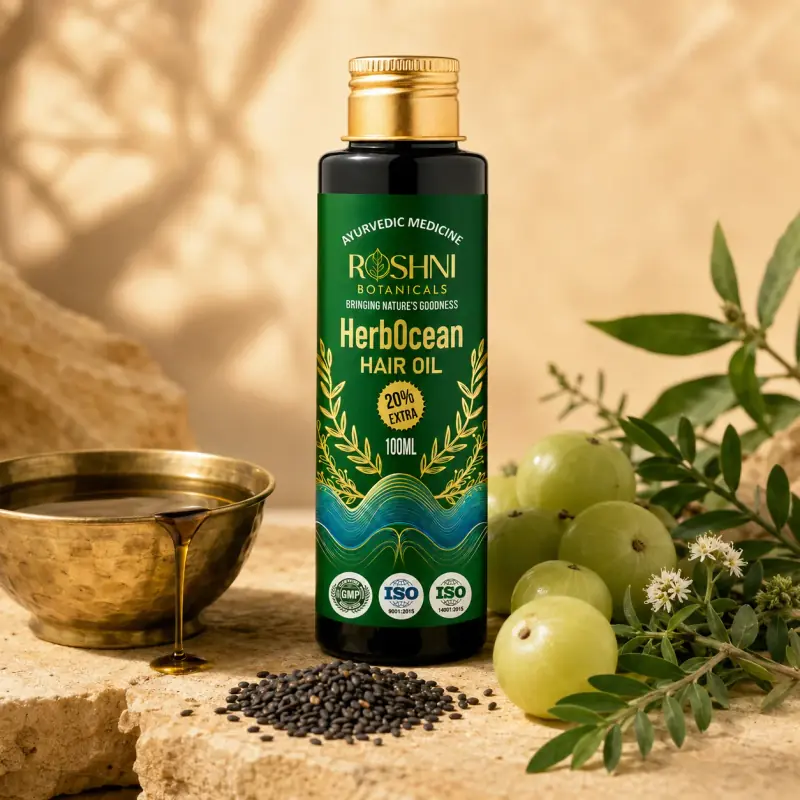
HerbOcean Hair Oil
A classical Taila for hair fall, dullness and a flaky scalp, with sixteen botanicals like Brahmi, Jatamansi, Amla and Neem in a slow sesame base.
Part of our guide: The definitive guide to Ayurvedic hair oils for hair fall.