
Sesame Oil or Coconut Oil for Hair: The Straight Indian Answer
Neither oil wins in the abstract. Why classical Taila making defaults to a sesame carrier, where coconut has the stronger case, and what the 2003 study did and did not test.
Ask this question at home and you will get an answer straight away, usually one that was inherited rather than argued. In Kerala it is coconut oil (nariyal tail), and there is nothing more to discuss. Go up to Delhi or Punjab and the coconut bottle sits cloudy and solid through a North Indian winter while somebody warms a spoonful between their palms, so sesame oil (til tail) gets used instead.
Both camps are right about their own weather. They are also repeating a real difference in how these two oils behave, one that classical oil-making noticed long before anybody measured anything in a laboratory. So let us take the question seriously instead of settling it with a slogan.
Key takeaways
- Neither oil wins in the abstract. The choice is regional, seasonal and personal, and plenty of Indian households sensibly keep both bottles going at once.
- In classical Taila (medicated oil) making, the base oil is doing extraction work rather than sitting in the bottle as an ingredient, and sesame is the default carrier across that tradition.
- Coconut oil is best documented before a wash rather than after one, and in the work behind that reputation the oil sat on the hair for at least fourteen hours, which is an overnight application.
- Coconut oil sets solid below roughly 24 degrees Celsius, which is why a North Indian winter makes it awkward and a coastal Kerala climate does not.
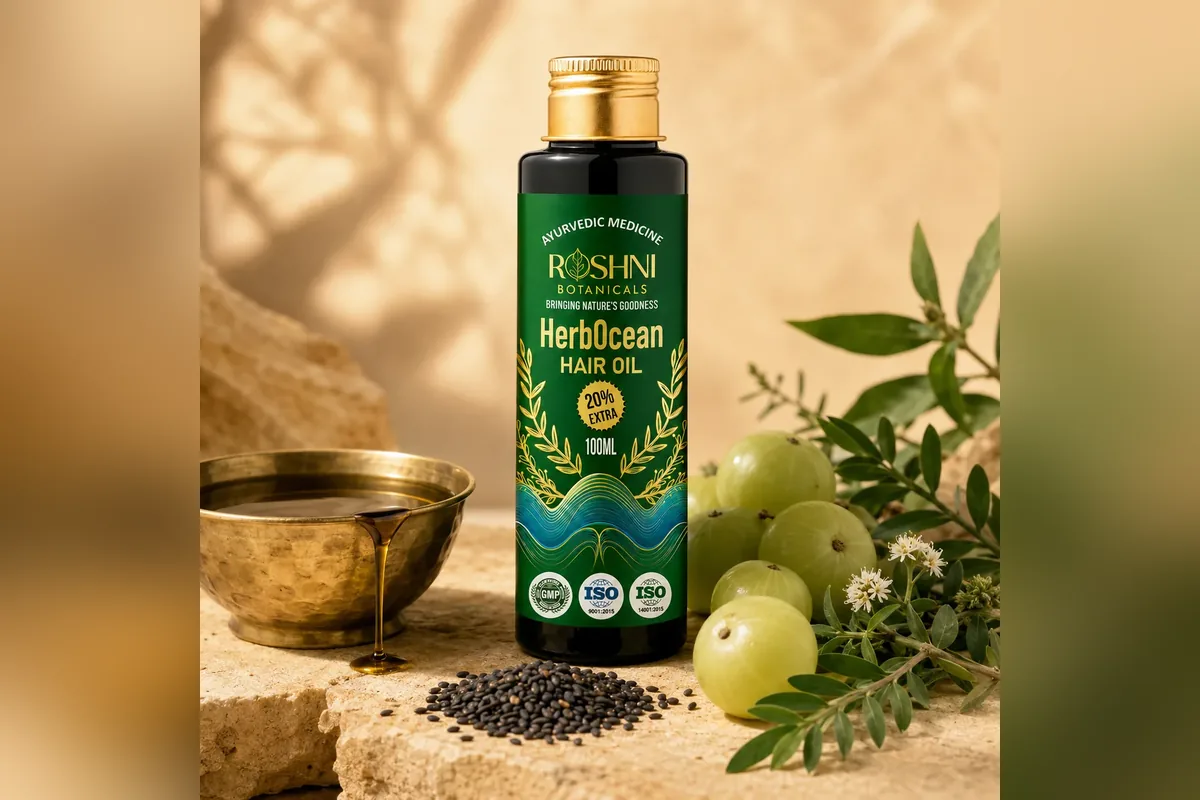
- HerbOcean Hair Oil is built on a sesame base and carries sixteen botanicals: twelve herbs, that sesame base itself, and three finishing oils of lavender, curry leaf and rosemary.
Why Classical Taila Making Leans on Sesame
A Taila is not oil with herbs floating in it. Think of a carrier oil cooked with herb material and a water phase, heated until the water goes off entirely and the herb extractives are left behind in the fat. That process belongs to the classical oil-making method known as Sneha Kalpana, and it explains why the base oil matters structurally rather than decoratively.
Two demands fall on the carrier. It has to hold up to hours of heat without turning, and it has to accept what comes out of the herbs. The first demand is harder than it sounds. A water phase of herb decoction has to be driven off slowly, over a low flame, and the oil sits at that heat for the whole of it; a base that scorches, foams or turns partway through spoils the batch and everything cooked into it. The second demand is quieter: whatever the herbs give up has to stay in the fat once the water is gone. Across the Charaka and Sushruta tradition, the oil named for that job again and again is sesame. Regular head oiling has its own classical name, Murdha taila, and the texts that describe it name sesame as the vehicle. Anutaila, a well-known classical oil used in the nasal route of administration (Nasya), is built on it too.
You will read almost everywhere that sesame gets deeper into the shaft or the scalp than other oils do. Take that as a reputation, not a settled fact. The claim travels through secondary sources with no primary reference attached, and published pages argue it in both directions: some crown sesame the more penetrating oil, others hand the same crown to coconut. When two sources assert opposite mechanisms with equal confidence, neither has earned your trust yet.
Popular labels deserve the same caution. Sesame and coconut get sorted into opposite camps by people who have oiled hair for four decades, and the sorting gets reversed just as confidently a district away. This post describes what people say rather than declaring which camp is right.
For the wider frame behind all of this, the definitive guide to Ayurvedic hair oils for hair fall control sets out how classical oils are meant to be used across a year, season by season.
For the record on where our own oil comes from: HerbOcean Hair Oil is built on the 40-year Ayurvedic formulation legacy of Vaidya Shri Ram Prakash Ji, and it is made in-house at our GMP-certified unit in Bawana, Delhi, under AYUSH Licence No. DL-474 A&U.
Where Coconut Oil Earns Its Place
Both of these oils are classical. Coconut oil carries its own long-standing place in Ayurvedic practice, and nothing in the carrier argument above takes that away. What follows is simply where it has the stronger case.
Its documented advantage is as a pre-wash oil rather than a post-wash one. In the work behind that reputation the oil stayed on for at least fourteen hours to simulate an overnight application, so this is not an argument against oiling overnight. It is an argument for washing afterwards. In practice that means a small quantity worked through the scalp and the lengths the evening before a wash day, a loose plait or a cotton cloth over the pillow, and a proper wash the next morning rather than a rinse.
A 2003 paper (Rele and Mohile, Journal of Cosmetic Science, 2003) compared mineral oil, sunflower oil and coconut oil and reported lower protein loss with coconut, and that single finding sits underneath almost every claim you have read on this subject. Read it with its limits attached, because the pages quoting it rarely do. The endpoint was protein lost from the hair fibre, not shedding and not scalp condition. It tested plain oils rather than any finished formulation. The authors worked in the research division of an Indian hair oil manufacturer. And sesame was not one of the three oils in the comparison. Sesame did not lose that contest. It was never entered in it.
Coastal South Indian practice deserves better than being filed away as folklore. Warm coconut oil worked into the scalp, left for the afternoon, washed out with a herbal wash powder: that routine has held for generations in a climate where it makes complete sense. The oil is local. It is pressed fresh, it stays liquid all year in Kerala, and it suits hair dealing with salt air and humidity rather than dry indoor heating. The wash that follows matters as much as the oil, and the shikakai and reetha powders that coastal homes reach for are made for exactly that job. A tradition that survives that long in one place is usually well matched to that place.
Then there is the plain physical fact that decides this in most homes. Coconut oil sets solid somewhere below roughly 24 degrees, so a jar in a Delhi bathroom through a North Indian winter has to be warmed before it will go anywhere, while the same jar in Kochi pours straight out all year. That is not chemistry. It is inconvenience, and inconvenience is what actually keeps people from oiling regularly.
Weighing a trending additive against a classical base, rather than two classical bases against each other? We have set out onion oil compared with a classical Ayurvedic hair oil separately.
Season, Climate and Water Decide More Than Chemistry Does
The humid weeks in North India are the awkward part of the year. The air has not dried out, scalps stay damp and a little sweaty by evening, and a heavy application left on overnight tends to sit rather than settle in. Through those weeks a shorter application often works better than a long one, whatever oil you are using. Once the air turns dry the swing goes the other way, indoor air loses its moisture, and a pourable sesame-based Taila becomes far easier to actually use.
Hard water is the other North Indian variable, and Delhi gets plenty of it. Oiling before a wash buys you comfort and manageability at the wash itself. It does nothing to the water in your tap. We have covered hard water and hair fall in Delhi in full elsewhere, and that page is the better place for it.
Three things are worth saying plainly here, because a great deal of oil writing quietly implies otherwise. Nothing applied from the outside changes the speed at which hair grows, and how fast hair actually grows is set at the follicle rather than at the bottle. No oil re-joins a strand that has already split, which is the subject of what oiling honestly does for split ends and breakage.
HerbOcean does not manufacture a sunscreen, and nothing in the range replaces one. If you are out in strong sun for hours at a stretch, an oil is not the thing standing between your scalp and it.
What oiling supports is more modest and more useful than the claims made around it. Combing gets easier. Oiling helps maintain a scalp that feels less tight and less itchy, and it buys you twenty minutes of massage that most of us otherwise skip. None of that needs a claim attached to it. If your routine has drifted, a step-by-step scalp oiling routine at home is worth revisiting before you change oils at all.
How HerbOcean Hair Oil Is Built, and How to Choose for Your Own Head
HerbOcean Hair Oil carries sixteen botanicals: twelve herbs, the sesame base they sit in, and three finishing oils. The twelve herbs are Bhringraj, Jatamansi, Brahmi, Shikakai, Amla, Nagarmotha, Chharila, Sugandhbala, hibiscus (Gudal), Tulsi, rose (Gulab) and Neem. The finishing oils are lavender, curry leaf and rosemary, and they are counted as finishing oils rather than herbs. There is no henna in it and no onion. What each group of herbs is doing is set out in full on its own page.
The base is sesame for the carrier reason set out at the top, not as a verdict on coconut. Herb material has to be cooked into something, that something has to survive hours of heat, and the tradition settled on til tail long before any of us were formulating anything.
Sesame also stays pourable through a North Indian winter, which matters when a bottle has to be usable in the cold months as well as the warm ones. Somebody in Thrissur with a jar of fresh coconut oil is not doing this wrong. They are matched to their own weather, which is exactly the argument this post is making.
So, til ka tel ya nariyal ka tel. In plain words: if your air is dry, your winters are cold and you oil overnight, a sesame-based Taila is the easier fit. If your air is humid, your winters are mild and you oil for a stretch before a wash, coconut has a real case.
Three questions settle it faster than any comparison table. What is your weather doing right now? Are you oiling overnight, or washing it out the same day? And how does the scalp feel the next morning, calm or coated? If the answers point in different directions, let the weather win. A bottle that is a nuisance to open in the cold does not get used, and an oil that sits heavy on a damp scalp gets washed out too soon to matter. The right oil is the one you will actually reach for twice a week.
Choosing Between Sesame Oil and Coconut Oil
Read the full composition on the HerbOcean Hair Oil page if you want to see the sesame base in its proper context. And if the season you are in is what you are deciding about, read how the oil suits each part of the Indian year.
For external use only. Patch-test on the inner forearm before a first full application. If you are pregnant or nursing, check with your doctor before use. Keep the oil off your breasts, and never use it on the baby. One caution worth being specific about: sudden patchy loss, a scalp that is sore, weeping or persistently itchy, or shedding that has clearly stepped up over several weeks belongs with a dermatologist rather than with any oil, sesame or coconut.
References: Rele AS, Mohile RB. Effect of Mineral Oil, Sunflower Oil, and Coconut Oil on Prevention of Hair Damage. Journal of Cosmetic Science. 2003;54(2):175-192 (hair-tress protein-loss and combing measurements plus salon half-head tests on twenty clients each with normal and bleached hair; the oil left on the tresses for at least fourteen hours to simulate an overnight application; comparators mineral, sunflower and coconut oils, sesame oil not tested; authors in the research division of an Indian hair oil manufacturer). Sharngadhara Samhita, Madhyama Khanda 9 (Sneha Kalpana), the classical oil-making chapter, on how a Taila is prepared and why the carrier oil does the extraction work. Ashtanga Hridaya, Sutrasthana 2 (Dinacharya Adhyaya), on daily head oiling (Murdha taila) within the classical daily routine, and Sutrasthana 20 (Nasya Vidhi Adhyaya), where Anutaila is prepared on a sesame base.
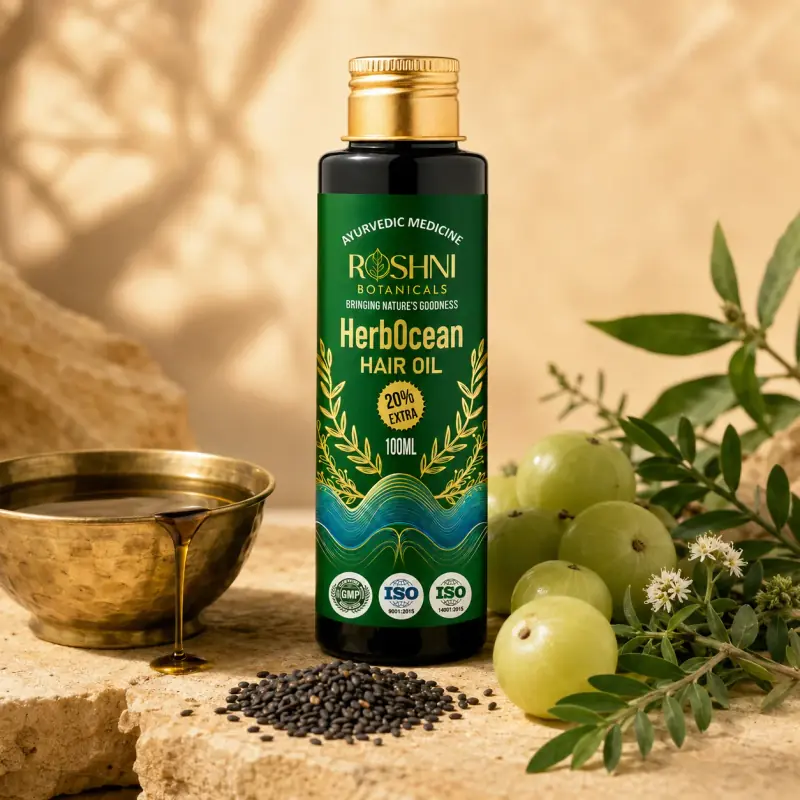
HerbOcean Hair Oil
A classical Taila for hair fall, dullness and a flaky scalp, with sixteen botanicals like Brahmi, Jatamansi, Amla and Neem in a slow sesame base.
Part of our guide: The definitive guide to Ayurvedic hair oils for hair fall.