Winter Hair Care in India: Dry Air, Static and Oiling Through the Year
In winter, hair crackles as a sweater comes off and knots by evening, and a hot bath leaves the scalp tight. How to care for it in the cold and all year round.
Good winter hair care means oiling your scalp and lengths a little more often while the air stays dry, washing your head in water that is lukewarm rather than hot, keeping a cotton or silk layer between your hair and wool, and letting your hair dry with no rubbing and no heater. Cold air outdoors and dry heat indoors both draw water out of the hair, so the lengths feel rough, crackle and tangle.
You will know the signs. You tug a sweater off and your hair rises with a crackle. A plait that felt smooth in the morning comes undone coarse and knotted at night. After a long bath with the geyser turned right up, your scalp feels tight well into the day. Across the dry cold of North India, it all begins once the heaters come out.
Key takeaways
- Hair gives up water to dry winter air, indoors and out, so the lengths turn rough, dull and quick to knot.
- Static builds on dry hair with friction; conditioner, a little oil on the ends and a wide-tooth comb help, and one review suggests a lower pH shampoo may mean less frizz.
- A cap goes on dry hair only, and hair dries well away from a room heater, never in front of one.
- Ayurveda meets dryness with oil, the thinking behind a classical Taila (medicated oil) for the hair, though an oily scalp or dandruff takes oil only on a wash day.
- Sudden shedding, smooth round patches, or a scalp that stays red, cracks or bleeds needs a dermatologist.
Why Does Hair Turn Dry and Rough in Winter?
Cold air cannot hold much water, and indoor heat dries what little is left. Hair gives up some of its own water to that air, so by evening the lengths feel rough, look dull and knot more easily than they did in warm, damp weather.
The scalp feels the cold air too, and a long hot bath leaves it tighter still. Tightness is not flaking, though. A tight scalp with no flakes points to plain dryness. Once flakes appear, the care depends on their kind, so learn how to tell a dry scalp from dandruff before you change your oiling.
In Ayurveda, Ritucharya (the classical routine for the seasons) adjusts food, sleep, bathing and oiling as each season sets in. In the Charaka Samhita, dryness and roughness are listed with the qualities of Vata (the bodily energy that Ayurveda links with air and movement). The classical answer is to bring in the opposite quality, and for a dry quality the opposite is oil.
Static, Frizz and Tangles: What Dry Air Does to the Lengths
Dry hair picks up an electric charge easily, and friction piles more on: a plastic comb, a sweater dragged over your head, a cap tugged on and off, a rough towel. Strands carrying the same charge push away from one another, so they lift and fly about, and the hair turns frizzy. Frizzy hair knots, and knotted hair snaps under a comb.
Your shampoo can add to this. In 2014, Gavazzoni Dias and colleagues in Brazil reviewed the research on shampoo pH and measured the pH of 123 shampoos. They concluded that an alkaline shampoo may raise the negative charge on the hair and the friction between strands, and that a lower pH may leave less static and less frizz. The paper pairs a review of earlier work with test-strip readings of pH, and no one washed their hair for it.
Oil softens, too. Mysore and Arghya, in a 2022 review from Bengaluru, describe the primary job of a hair oil as that of an emollient, or softener, with some oils doing more besides. For winter lengths, the everyday care is conditioner after each wash, a little oil smoothed over the ends, a wide-tooth comb, and knots worked loose from the ends up.
Dry lengths break more easily, so you may find short pieces in the comb, tips that split or turn pale, and lengths that feel coarse between your fingers. For the causes of that breakage, read about colour, heat and wash damage to the length.
Woollen Caps, Mufflers, Helmets and Room Heaters
A woollen cap pulled over damp hair holds the damp against your scalp long after you leave the house, so let your hair dry fully first. Wool also rubs the lengths each time you turn your head, which roughens them and builds static, so slip a thin cotton or silk scarf under the cap. A muffler wound over loose hair rubs the same way: tuck your hair into your collar, or plait it loosely first.
A tight band also rubs and grips the same line at your hairline, day after day, so pick a cap that stays on without gripping.
On a two-wheeler, your helmet sits over a warm, sweaty scalp every day. A thin cotton cloth folded inside it takes up the sweat and the rub. Let your scalp air once the helmet is off, and if small bumps start turning up along your hairline, the guide to scalp acne and bumps on the hairline explains what they can be.
Room heaters and blowers dry the lengths fast. Sit well back from one, and never dry your hair in front of it. At night, tie your hair loosely, in a soft band or a loose plait, so that it does not knot against the pillow.
Should You Oil Your Hair More in the Cold Months?
Should you oil your hair through the cold, or sardiyon mein tel lagana chahiye kya, as the question goes at home? The classical texts say yes. In the Charaka Samhita, murdha taila (oil to the head) belongs to every day of the year, and the Ashtanga Hridaya adds oil massage and oiling the head to its practices for the cold season.
So as the air turns dry, reach for the oil more often than you would in warm, damp weather, and stay within the directions that come with your oil. If your family rubs oil over the whole body before a bath when it turns cold, that practice has a classical name: abhyanga (oil massage).
To see where oiling fits in your hair care through the cold, read what regular oiling supports.
An oily scalp or dandruff changes the plan. With roots that turn greasy by evening, or with dandruff, oil only on a day you wash, so that the same wash takes it out. A red or sore scalp is different again: keep the oil off it and let a dermatologist take a look.
A Classical Hair Taila for the Dry Months
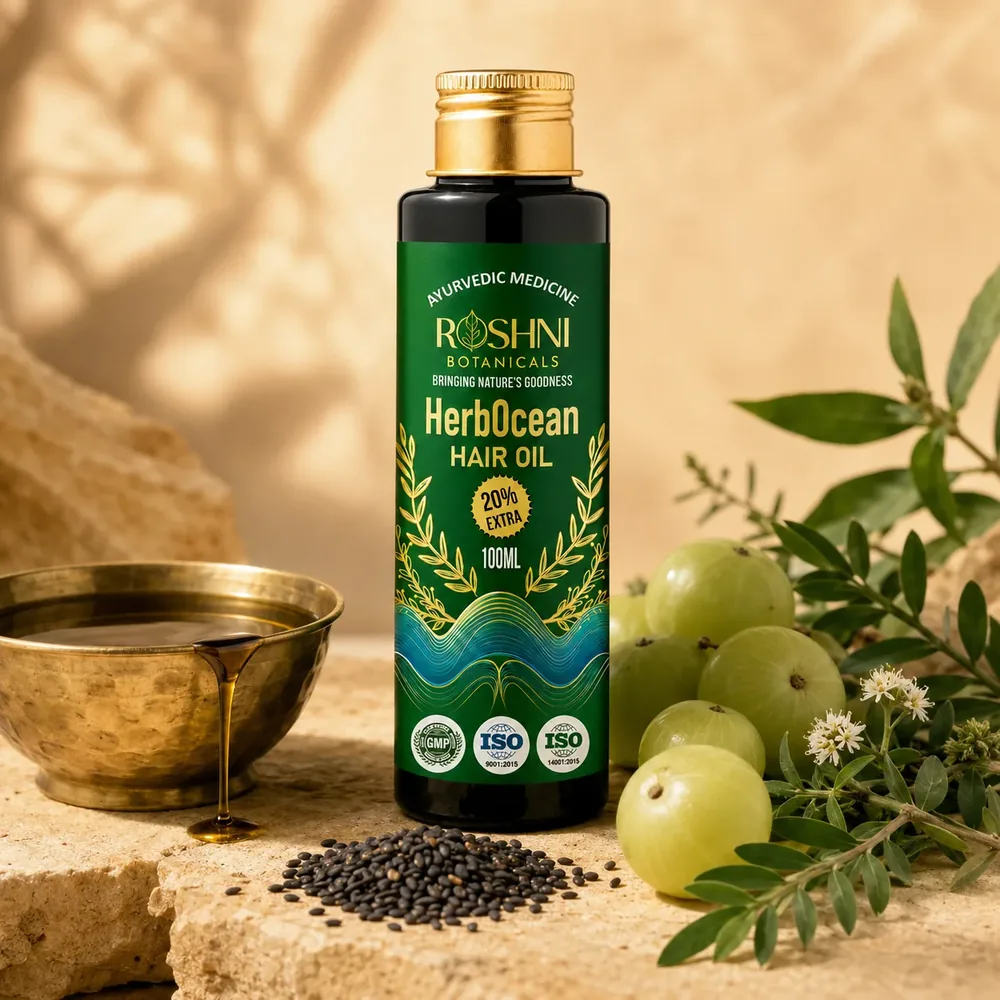
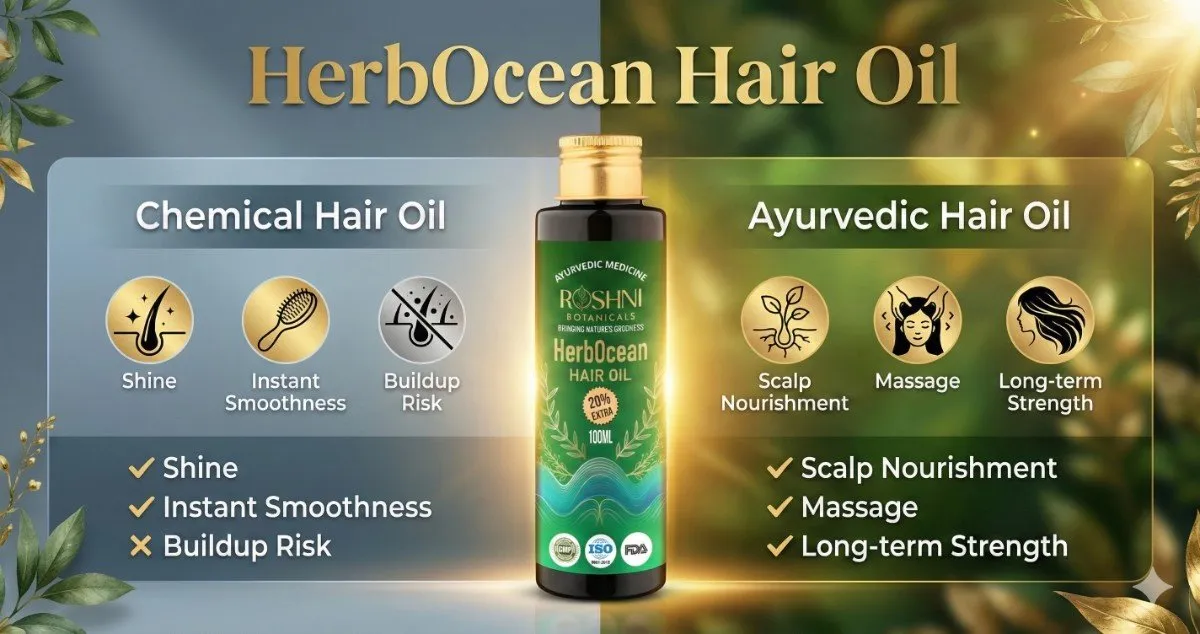
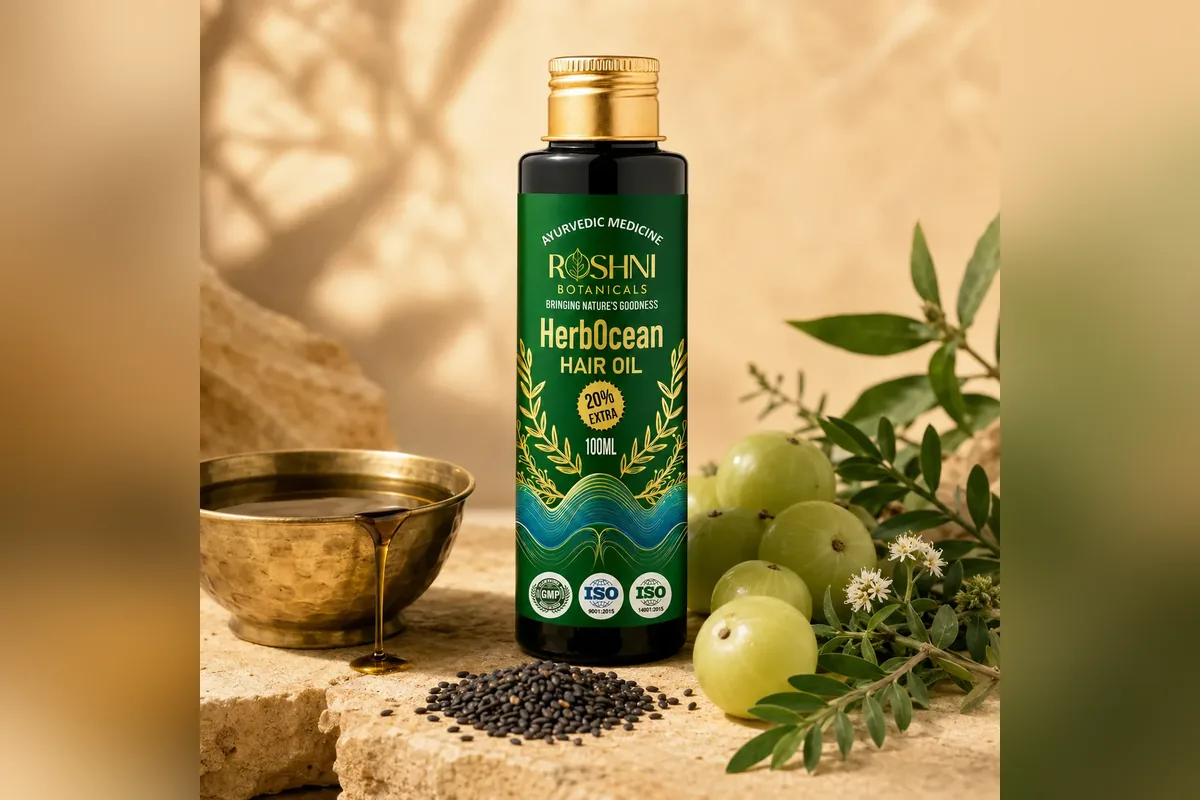
If you pick a medicated oil for these months, start by reading its label. HerbOcean Hair Oil is an AYUSH-licensed Ayurvedic medicine for external use, classically indicated for hair fall and dullness. It nourishes the scalp, helps keep it clean and flake-free, and is traditionally used to support the scalp against dryness and seasonal hair fall. It is a classical Taila of sixteen botanicals in a sesame (Til tail) base: twelve herbs, namely Bhringraj, Jatamansi, Brahmi (Bacopa monnieri), Shikakai, Amla, Nagarmotha, Chharila, Sugandhbala, dried hibiscus (Gudal), Tulsi, rose (Gulab) and Neem, finished with lavender, curry leaf and rosemary oils. It is made in-house at our GMP-certified unit in Bawana, Delhi, under AYUSH Licence No. DL-474 A&U, and built on the 40-year Ayurvedic formulation legacy of Vaidya Shri Ram Prakash Ji.
Its directions for use are these. Warm a little oil between your palms, part the hair and massage it into the scalp with your fingertips for a few minutes, leave it on for at least an hour or overnight, then cleanse.
This is a medicine, so read the cautions before you start. For external use only. Patch-test on the inner forearm 24 hours before first use and discontinue if irritation occurs; avoid the eye area. Anyone with a known allergy to sesame or to a listed botanical, or with an active scalp infection or broken skin, should not use it without medical advice. If you are pregnant or nursing, check with your doctor before use. Keep the oil off your breasts, and never use it on the baby.
Washing and Drying Hair When the Air Is Cold
The Ashtanga Hridaya draws its line at the neck: the same hot water that brings strength to the body weakens the hair when it is poured over the head. A modern study of skin, not hair, also favours cooler water. Herrero-Fernandez and colleagues in Spain, in a study published in 2022, had each of 50 healthy volunteers soak one hand in hot water while the other sat in cold, and afterwards the skin of the hot-water hand was losing more water than the skin of the cold one. So keep the water lukewarm on your head, and from the neck down let it be warm rather than hot.
Washing itself depends on your scalp. A dry, tight scalp can go a little longer between washes, while an oily scalp or dandruff still needs regular, gentle washing whatever the weather. On a day you have oiled, change the order of the wash. Apply shampoo to dry, oiled hair before wetting. Then rinse, and shampoo again if the roots feel slick.
Dry your hair gently, too. Squeeze the lengths through a soft cotton towel instead of rubbing them, since rubbing wet hair roughens it and adds tangles. A spot in the winter sun is one of the nicest places to let it dry; wait until it is partly dry before you comb it. If you use a dryer, set it to cool or low and keep it moving.
Hair Care Through the Indian Year
In the hot, dry months, use less oil and wash it through well, and cover your head in harsh sun. In the humid stretch, when the air is heavy and sticky, keep oil to the days you wash, and make sure the scalp is dry before you tie your hair up or cover it.
As the air dries out again after the humid stretch, you may find more hair in your comb for a while. If your face and hands feel tight, turn to a cold-season routine for dry skin.
When Winter Hair Changes Need a Dermatologist
Some changes are for a doctor to judge, not for a new habit to fix. Shedding that comes on suddenly or fast, smooth patches the size of a coin with no hair in them, and any disease of the scalp all belong with a dermatologist. Go as well if your parting keeps widening, if your scalp stays red, cracks, bleeds when scratched or itches enough to wake you, or if you see raised patches of thick, silvery scale, or scaly patches where the hairs have broken off short. Hair loss after an illness, a new medicine or childbirth should be seen by a doctor at least once; after a new medicine, that means the doctor who prescribed it.
Shedding that begins two to three months after the trigger, such as a high fever or an illness, follows that event rather than the cold, and if it has not eased by six months, a dermatologist should review it; the page on hair fall after a fever or illness explains why. To match what you see in the comb to a cause, read how each kind of hair fall looks, and for oiling in general, the definitive guide to Ayurvedic hair oils for hair fall control goes further.
So through the cold, wash your head in barely warm water, put a soft layer between your hair and the wool, oil a touch more as the air dries, and let your hair dry slowly. None of it costs much, and all of it can begin with your next wash.
References: 1. Charaka Samhita, Sutra Sthana 1 (Deerghanjiviteeya), on the qualities of Vata, dryness and roughness among them, and their balance by qualities of the opposite kind. 2. Charaka Samhita, Sutra Sthana 5 (Matrashiteeya), on head oiling in the daily regimen; cited at chapter level. 3. Vagbhata. Ashtanga Hridaya, Sutra Sthana 2 (Dinacharya), on the daily routine, hot water over the head and over the body among its points; cited at chapter level. 4. Vagbhata. Ashtanga Hridaya, Sutra Sthana 3 (Ritucharya), on the seasonal regimen, oil massage and oil on the head in the cold season among its practices; cited at chapter level. 5. Gavazzoni Dias MF, de Almeida AM, Cecato PM, Adriano AR, Pichler J. The shampoo pH can affect the hair: myth or reality? International Journal of Trichology, 2014; 6(3): 95 to 99. Literature review with a pH measurement of 123 shampoos, no human sample, Brazil. 6. Herrero-Fernandez M, Montero-Vilchez T, Diaz-Calvillo P and colleagues. Impact of water exposure and temperature changes on skin barrier function. Journal of Clinical Medicine, 2022; 11(2): 298. Prospective observational study, 50 healthy volunteers, one hand in hot water and the other in cold, Spain. 7. Mysore V, Arghya A. Hair oils: indigenous knowledge revisited. International Journal of Trichology, 2022; 14(3): 84 to 90. Narrative review, Bengaluru, India. Educational, not medical advice.
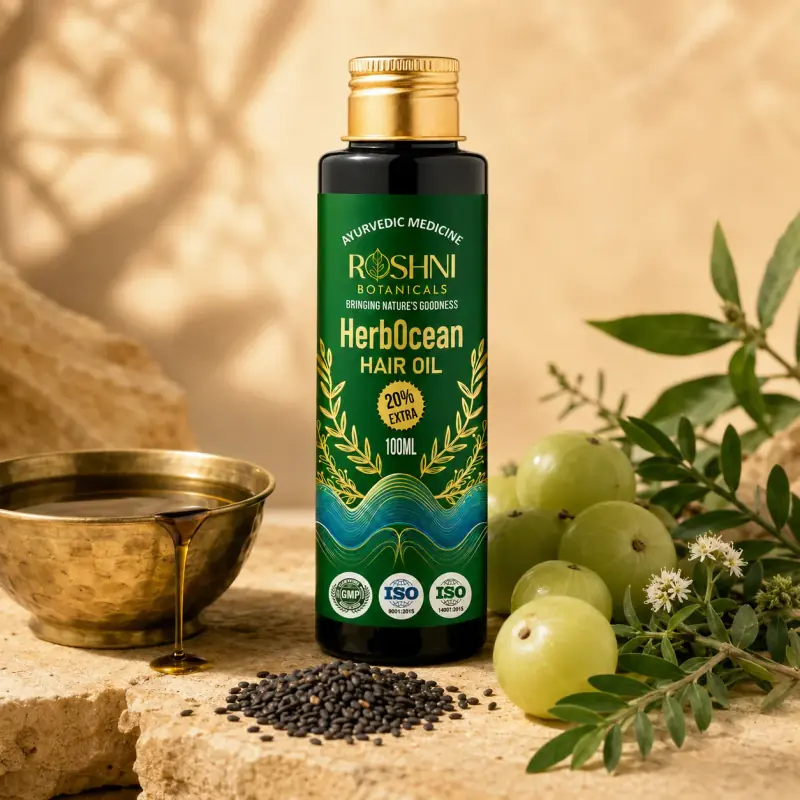
HerbOcean Hair Oil
An Ayurvedic medicated hair oil (Taila) with Bhringraj, Brahmi, Amla and Neem, traditionally used in the care of hair fall, dullness and a flaky scalp.
Part of our guide: The definitive guide to Ayurvedic hair oils for hair fall.
Frequently asked
This article is general educational content about Ayurvedic skin and hair care. HerbOcean products are classical Ayurvedic preparations for external use, made under AYUSH Licence DL-474 A&U and traditionally used to support healthy skin and hair. This is educational and not a substitute for professional medical advice; for persistent or worsening concerns, please consult a qualified dermatologist.