Does Hair Oil Work? What Regular Oiling Can and Cannot Do for Your Hair
What regular oiling does for the hair you already have, where every oil reaches its limit, and a simple way to judge any hair product for yourself.
Yes, within limits. Regular oiling looks after the hair you already have and keeps the scalp comfortable. It lubricates the strand, so fewer strands snap during combing and washing, and in laboratory work on hair samples, coconut oil applied before washing lowered how much protein the hair lost in washing and combing. Thinning that shows as a widening parting or a receding hairline is a medical question for a dermatologist.
Search for hair oil and you meet bold claims on one side and flat dismissal on the other. The truth sits in between: oiling does real work on the length of your hair and the comfort of your scalp, and it has limits worth knowing.
Key takeaways
- Regular oiling lubricates the strand, so fewer strands snap during combing and washing, and it keeps a dry scalp comfortable.
- In laboratory work on hair samples, coconut oil applied before washing lowered how much protein the hair lost; the finding is about coconut oil and the length, not the root.
- Breakage and thinning are different problems: breakage snaps the hair you have along its length, while thinning is a change in density with medical causes.
- Heavy, even shedding that starts a while after a fever, an illness or a hard stretch of stress is a temporary shedding phase, and it is expected to settle by itself.
- A widening parting, a receding hairline, smooth round patches or heavy fall that is not easing belong with a dermatologist.
What Oiling Is Traditionally Used For
If someone oiled your hair as a child, the picture will be familiar. The oil is warmed, the hair parted, and the fingers work slowly while you sit on the floor and the afternoon goes quiet around you. It is a living household habit, and it is worth taking seriously.
The classical texts gave that habit a formal place. The Charaka Samhita puts Murdha Taila (regular oiling of the head) inside Dinacharya (daily routine), next to bathing and trimming the hair, and ties it to the care of the scalp and Kesha (hair). A classical oil was meant for ordinary life, not only for the day the comb starts filling up. Notice what that tradition asks of the oil: steady care of the scalp and the length, kept as a routine.
What the Evidence Supports for the Length of Your Hair
Start with lubrication. A dry strand drags against the comb, the towel and the strands around it. An oiled strand slides. Less friction means fewer strands snap, and every strand that does not snap is length that stays on your head. So if your hair never seems to get longer, look at breakage along the length before you blame the root, and if the lengths are already roughed up, read about colour, heat and wash damage to the length.
Then there is protein, and the idea that oiling before a wash helps hair hold on to it. That idea comes from work published in the Journal of Cosmetic Science: coconut oil used before a wash reduced the protein lost when the washed hair was combed, while sunflower and mineral oil did not. The researchers measured it on laboratory samples of Indian hair and in salon tests where one half of each head was oiled, and the finding belongs to coconut oil, since sesame was not among the oils tested. Useful, but narrow: it is about coconut oil, measured as protein lost from the hair, and about the length of the strand, not the root. You cannot carry that result across to sesame oil, or to any finished hair oil, simply because they are oils too.
Why would oiling before a wash matter at all? A wet strand swells as it takes up water and shrinks again as it dries, and that cycle, wash after wash, slowly wears the strand down. The International Journal of Trichology carried a 2015 overview that calls this hygral fatigue and notes that some oils can enter the hair and limit how much water it takes up. Those water findings come from laboratory work on single oils, not from any finished hair oil. A 2022 review of hair oils in the same journal sums up the wider picture: the main role of a hair oil is as an emollient, and much about its exact effect on hair and scalp is still unclear.
Research on a single ingredient answers a question of its own, too. A trial of one oil on its own, rosemary for instance, tells you about that oil under the conditions of the trial, not about what a finished blend of botanicals does on your scalp.
Hard groundwater, the kind found across parts of Delhi, can leave hair feeling rougher and harder to comb after a wash. That is a texture and handling matter. Oiling before a wash is the traditional habit, though oiling has not been shown to lift the minerals off the hair. Curly and coily lengths are drier and quicker to break than straight hair, so they stand to gain more from oil on the length.
Breakage and Thinning Are Different Problems
Breakage and thinning can look alike in the mirror, but they are different problems. A parting that keeps getting wider, or a hairline moving back, is a change in density, and density has medical causes: inherited pattern thinning, thyroid trouble, low iron, a hormonal shift. Those belong with a dermatologist, who can examine your scalp and order the right tests. Breakage shortens the hair you have; thinning reduces the number of hairs, so the two need different answers.
Some limits apply to every oil on the shelf. No oil changes the rate at which hair grows from the root, and no oil can mend a split end; a trim is the lasting answer for that.
Why Hair Oil Stories Online Mislead
Hair oil videos and reviews are full of remarkable stories. However sincere, they are unsubstantiated, because a story is not a test. Three ordinary things can push a story the wrong way.
The first is timing. Hair fall that shows up two to three months after dengue, typhoid or a serious fever, evenly from the whole scalp, is what dermatologists call telogen effluvium (a shedding of resting hairs). The same shedding follows a crash diet or a hard stretch of stress, starts long after the trigger, and is expected to settle by itself. Whatever you happened to be using at the time takes the credit. Our page on hair fall after a fever or illness has the detail.
The second is that people change several things at once. A new oil arrives at the same time as better sleep, a different shampoo and a quieter stretch at work, but the oil is the change you can see, so the oil gets thanked. The third is the camera. Light, angle, distance, and wet or freshly styled hair can make the same scalp look sparse one day and full the next.
Nobody has to be making it up for the story to mislead. The remedy is a better record of your own hair, and that is easy to keep.
How to Judge Any Hair Product for Yourself
Maybe you have searched kya tel lagane se baal ghane hote hain at some point. The plain answer is that oiling looks after the length and the scalp, and whether the hair is getting denser is a separate question with a test of its own. To find out what any product is doing for you, keep a count and a photograph.
Start with a shed count. On the same wash day, with the same routine, count the hairs on your comb or in the drain and note the number. A single wash day says little, because shedding rises and falls by itself. A run of counts kept over a long stretch shows the direction, and the direction is what you want.
Add a photograph of your parting, taken in the same light, from the same spot and distance, on dry hair. Alter a single thing at a time, so that if something improves you know which change did it. Softer lengths and a more comfortable scalp are easy to notice; shedding is harder to read, and that is what the count is for.
Match what you notice to what is going on, because each pattern asks for something different. Dry, rough, frizzy lengths point to a weathered, under-lubricated strand: regular oil on the length softens it, and a gentle wash keeps it that way. Short snapped pieces, and hair that never seems to get longer, point to breakage along the length: oil the lengths, keep styles loose, go easy on heat and trim as needed. A flaky, itchy scalp can be a dry scalp or dandruff (Darunaka), which are not the same thing and are not oiled the same way; read how to tell a dry scalp from dandruff before you decide, and see a dermatologist if the scalp is red and inflamed or the flaking persists.
Heavy, all-over shedding that begins a while after a fever, an illness or a stressful spell points to that temporary shedding phase: gentle care while it settles, and a doctor if it drags on. A parting that keeps widening or a hairline moving back is a change in density: oil looks after the hair you have, and a dermatologist looks for the cause. Smooth round patches, and a scalp that is painful, red or scarring, need a dermatologist promptly.
Where a Classical Oil Belongs in Your Routine
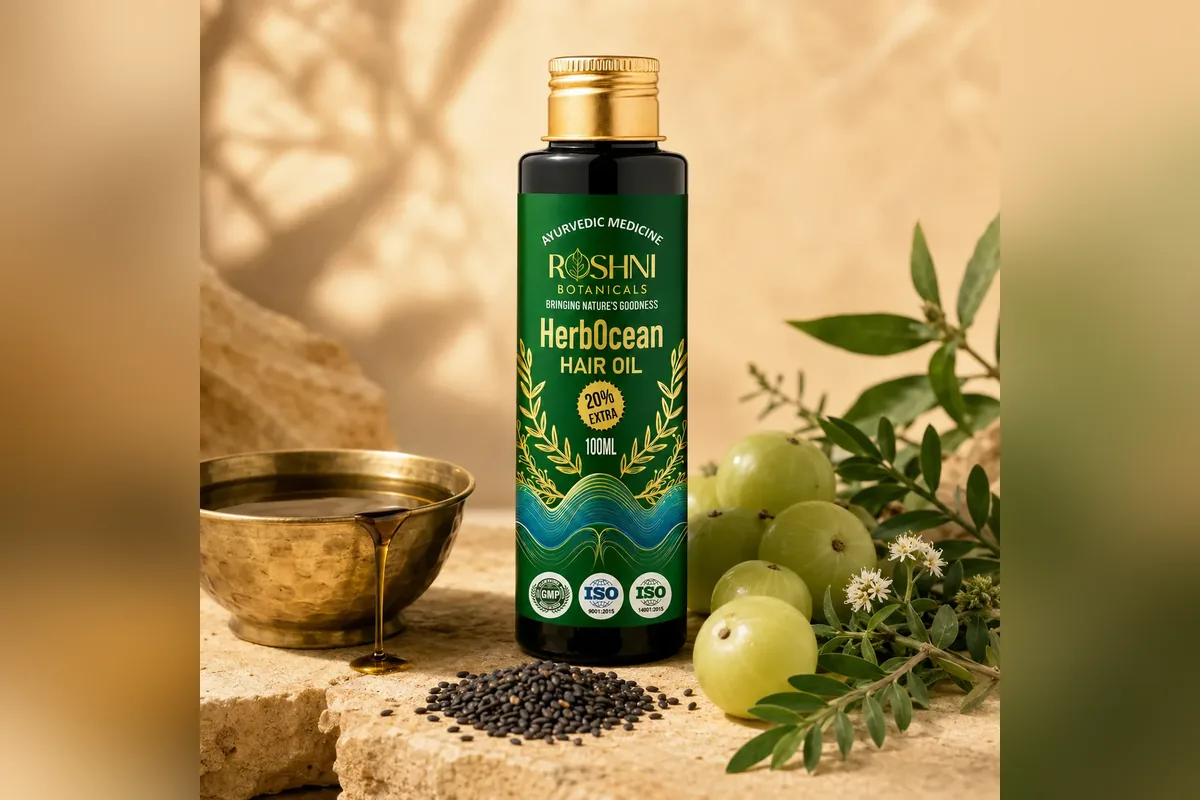
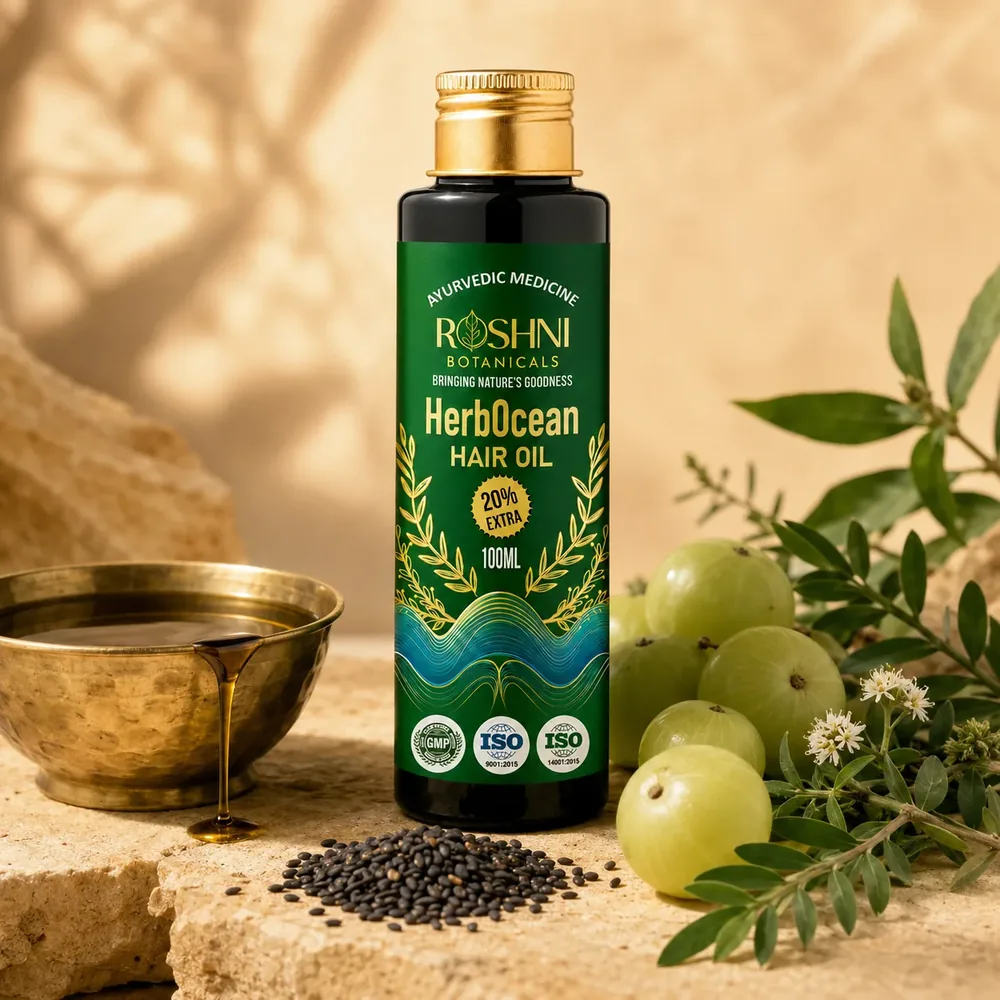
A classical Taila (medicated oil) has a clear job, and the household habit becomes a routine. HerbOcean Hair Oil is an AYUSH-licensed Ayurvedic medicine for external use, classically indicated for hair fall and dullness. It nourishes the scalp, helps keep it clean and flake-free, and is traditionally used to support the scalp against dryness and seasonal hair fall. It is a classical Taila of sixteen botanicals in a sesame (Til tail) base: twelve herbs, namely Bhringraj, Jatamansi, Brahmi (Bacopa monnieri), Shikakai, Amla, Nagarmotha, Chharila, Sugandhbala, dried hibiscus (Gudal), Tulsi, rose (Gulab) and Neem, finished with lavender, curry leaf and rosemary oils. The finished oil is a deep reddish amber. It is made in-house at our GMP-certified unit in Bawana, Delhi, under AYUSH Licence No. DL-474 A&U, and built on the 40-year Ayurvedic formulation legacy of Vaidya Shri Ram Prakash Ji.
The routine itself is easy to follow. Warm a little oil between your palms, part the hair and massage it into the scalp with your fingertips for a few minutes, leave it on for at least an hour or overnight, then cleanse. Apply shampoo to dry, oiled hair before wetting.
This is a medicine, so read the cautions before you start. For external use only. Patch-test on the inner forearm 24 hours before first use and discontinue if irritation occurs; avoid the eye area. Anyone with a known allergy to sesame or to a listed botanical, or with an active scalp infection or broken skin, should not use it without medical advice. If you are pregnant or nursing, check with your doctor before use. Keep the oil off your breasts, and never use it on the baby.
An oil sits best alongside the basics: iron and protein on the plate, which takes a little planning when you eat vegetarian, proper sleep, gentle heat and loose styles. Within that routine the oil supports the scalp and helps maintain soft, comfortable lengths.
When to See a Dermatologist, and What to Keep Doing
See a dermatologist promptly for smooth, round, coin-shaped patches, and for a scalp that hurts, is red, scaly or scarring. Book an appointment as well for a sudden heavy shed, a parting that keeps widening or a hairline moving back. Show the shedding to a doctor once, and see a dermatologist if heavy shedding has not eased by six months.
If the shedding comes with tiredness, weight change, feeling cold or heavy periods, ask for blood tests for iron and thyroid. If it followed a new prescription, tell the doctor who wrote it. A blood test and a dermatologist can find the cause, and you can keep oiling alongside their advice.
Hair oil does its best work when you ask it for the right things: look after the length, keep the scalp comfortable and give you a habit you can keep. Keep your own count and your own photographs, and the verdict on any product will rest on your own records. For the wider picture, read our definitive guide to Ayurvedic hair oils for hair fall control.
References: 1. Charaka Samhita, Sutrasthana 5 (Matrashiteeya Adhyaya). The daily regimen; regular oiling of the head among the habits of the day, beside bathing and trimming the hair. 2. Rele AS, Mohile RB. Effect of mineral oil, sunflower oil, and coconut oil on prevention of hair damage. Journal of Cosmetic Science, 2003; 54(2): 175 to 192. Laboratory tests on tresses of Indian hair, 25 per treatment, and salon half-head tests on 20 clients per group; coconut oil alone reduced protein loss; authors from an Indian hair oil maker. 3. Gavazzoni Dias MFR. Hair cosmetics: an overview. International Journal of Trichology, 2015; 7(1): 2 to 15. Narrative review, Brazil; hygral fatigue, oils limiting water uptake by the hair, and the fragility of curly hair. 4. Mysore V, Arghya A. Hair Oils: Indigenous Knowledge Revisited. International Journal of Trichology, 2022; 14(3): 84 to 90. Narrative review, India. Educational, not medical advice.
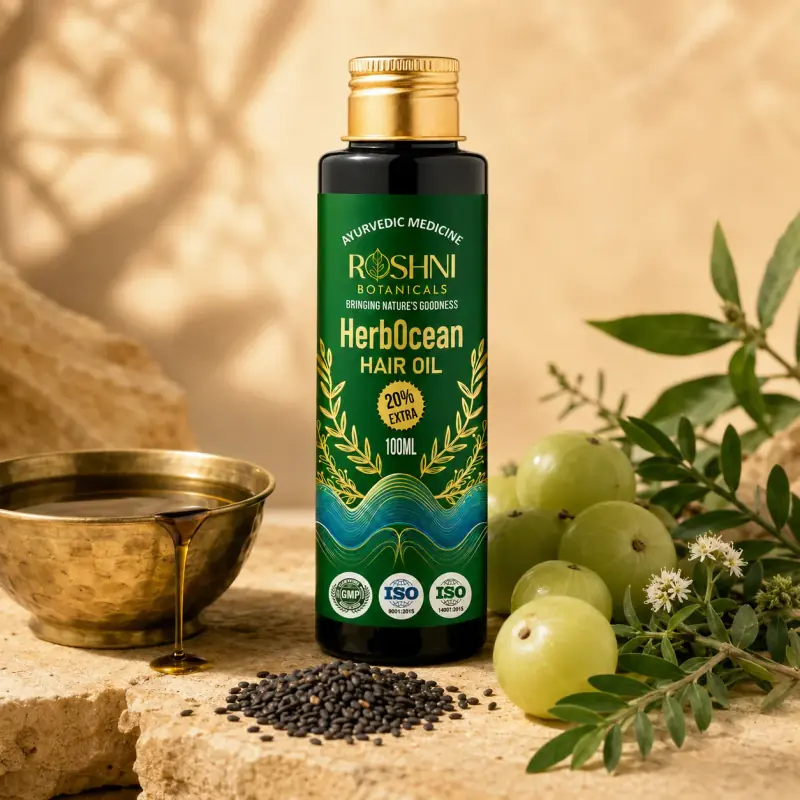
HerbOcean Hair Oil
A classical Taila for hair fall, dullness and a flaky scalp, with sixteen botanicals like Brahmi, Jatamansi, Amla and Neem in a slow sesame base.
Part of our guide: The definitive guide to Ayurvedic hair oils for hair fall.