Dry Scalp or Dandruff? How to Tell Them Apart, and What Each One Needs
White flakes on your shoulders can mean a dry scalp or dandruff. Check your roots to tell which, then see when to oil and when a dermatologist should look.
A dry scalp sheds small, fine, white flakes from skin that feels tight. Dandruff (Darunaka, the name the classical texts give a rough, itching scalp) sheds flakes that can be larger and oilier, from roots that can turn greasy, and a yeast called Malassezia, which feeds on scalp oil, plays a main part in it. The quickest test is your roots by evening: tight and dry points to a dry scalp, slick points to dandruff. A dry scalp needs gentle washing and regular oiling. Dandruff needs more frequent gentle washes, oil washed out the same day, and a medicated anti-dandruff shampoo when it keeps coming back.
You brush a dusting of white off your shoulders and, if oiling is what you grew up with, you reach for the bottle. For a dry scalp, that is exactly right. With dandruff, oil left sitting on the scalp can keep the flakes coming. On a dark kurta the two can look alike, but one comes from a scalp short of oil and the other from a scalp reacting to a yeast that lives on oil.
Key takeaways
- Check your roots by evening: slick points to dandruff, dry and tight points to a dry scalp, whatever colour the flakes happen to be.
- Dandruff involves Malassezia, a yeast that feeds on scalp oil, and it sits at the mild end of one continuum with seborrhoeic dermatitis.
- A dry scalp is the classical case for oiling. With dandruff, oil is only a short pre-wash step, washed out the same day.
- Keep the water on your scalp lukewarm rather than hot. Hard water can leave hair feeling rough and lather thin.
- Thick silvery plaques, scaly patches with broken hairs, or red greasy patches spreading to the eyebrows need a dermatologist.
The Difference Between a Dry Scalp and Dandruff
Start with what you can see. On a dry scalp the flakes are small, fine and white, and they dust off easily. The scalp feels tight after a wash and the roots stay dry. Your hair may look dull as well, and the skin on your shins, hands and lips may feel dry too. The scalp is just one more place the dryness shows.
Dandruff is messier. Its flakes can be fine and off-white, or larger, oilier and yellowish, and they sit in the hair as well as on the scalp. It may itch a little or not at all, and the roots can turn greasy by evening. The greasier and redder it gets, the closer it moves to seborrhoeic dermatitis. One dermatology review describes the two as a single continuum, with dandruff at the milder end.
So do not judge by flake colour alone. Wash as usual, leave your hair be, and check your roots in the evening. Slick points to dandruff, even if the flakes look white. That is the short answer to rusi aur dry scalp mein fark, the difference between dandruff and a dry scalp. And yes, one head can have both, with dry patches in one place and greasy roots in another. Redness is the other clue: a dry scalp shows none, and dandruff shows little or none.
Two other conditions can look like either one. Seborrhoeic dermatitis has greasy, yellowish scale on red patches, it can itch, and it can spread beyond the scalp. Keep oil off the scalp and on the lengths, and let a dermatologist guide the medicated care it needs. Scalp psoriasis has thick, silvery-white scale on raised, well-defined plaques, and it can itch a great deal. Ask your dermatologist before you oil it, and leave its care to them.
Why a Dry Scalp and Dandruff Need Opposite Care
A dry scalp is short of oil and water in its outer layer, so that layer sheds in fine flakes. Hot water, strong or very frequent cleansing and dry air all make it worse. The skin is simply running low.
Dandruff runs the other way. Malassezia is a normal resident of healthy skin, the scalp included, and it feeds on sebum, the oil your scalp makes. On a susceptible scalp, the by-products of that feeding irritate the skin and upset its normal shedding, so it flakes. The yeast lives on that oil, which is why greasy roots are the sign to watch.
Classical Ayurveda named an itching scalp long before anyone could see a yeast. Sushruta Samhita, Nidana Sthana 13, names Darunaka among the minor conditions (Kshudra Roga) and traces it to aggravated Vata and Kapha, which Ayurveda counts among its three doshas, or biological energies. Dryness and roughness are Vata qualities, and oiliness belongs to Kapha. For a fuller look at both readings, see reading the scalp by dosha. In practice, one scalp is asking for oil, and on the other, oil is food for the yeast.
Should You Oil a Flaky Scalp? The Answer Depends on Which Kind
A dry, tight scalp is where oiling belongs. Charaka Samhita, Sutrasthana 5, places head oiling (murdha taila) in the daily regimen, as everyday care, which is what a scalp short of oil needs.
With dandruff, the question is how long the oil stays on. The yeast feeds on scalp oil, so a heavy oil that sits on a flaking scalp for days can give it more to feed on. Make the oil a short step before a wash, and shampoo it all out the same day.
If the scalp is red or inflamed, or a doctor has diagnosed seborrhoeic dermatitis, keep the oil on the lengths and off the scalp. Mayo and colleagues, in a 2023 letter on hair oils in Black patients, give that advice for seborrhoeic dermatitis, on laboratory evidence that the yeast grows on oils, and they point out that no clinical study had yet tested hair oils in the condition. They also note that seborrhoeic dermatitis can pass for a dry scalp because of its scale, and then gets oiled. For plain dandruff that keeps coming back despite regular washing, try a medicated anti-dandruff shampoo.
Oiling a Dry Scalp With a Classical Taila
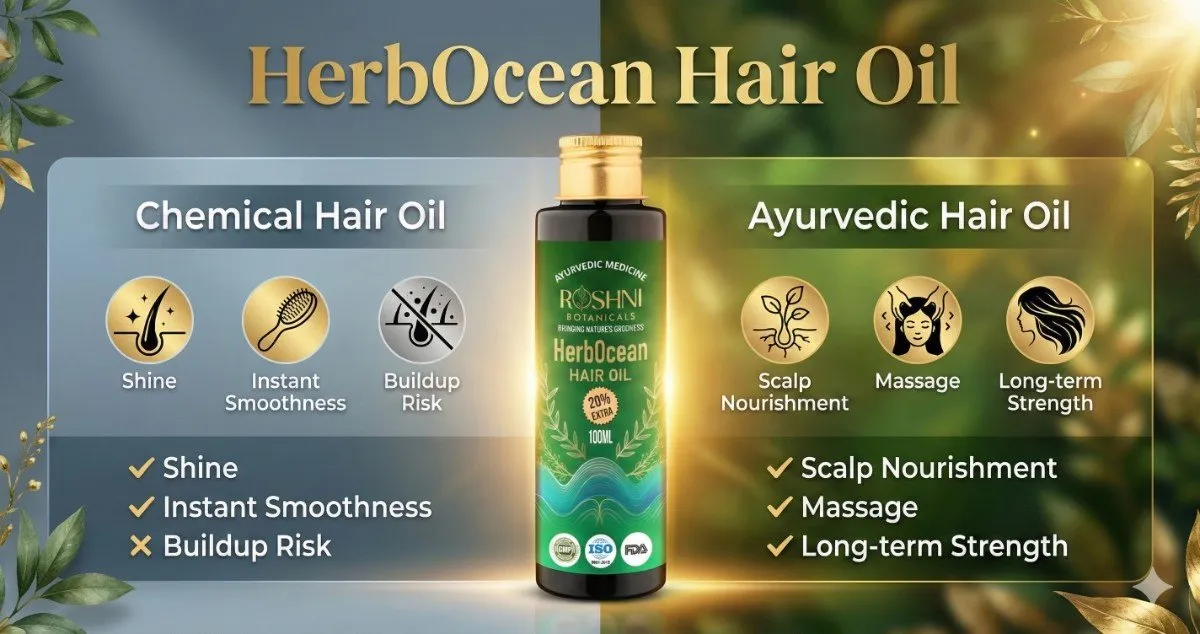
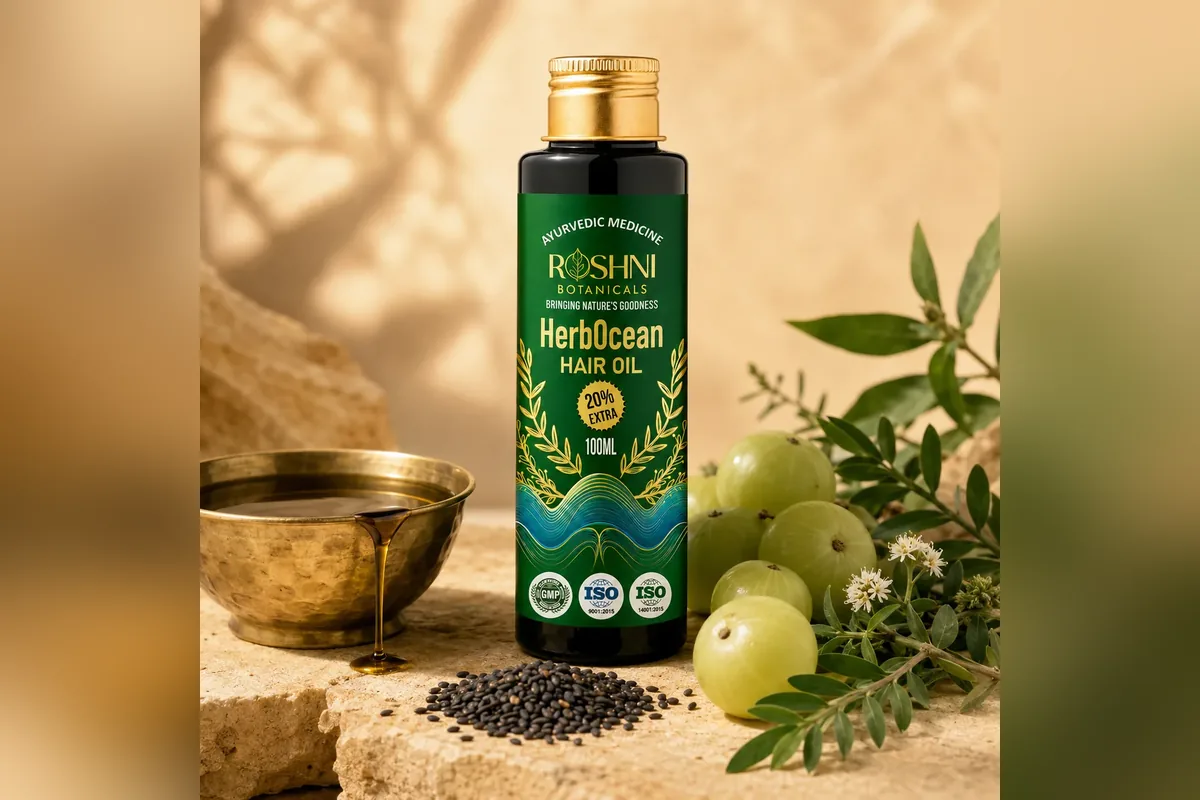
If you oil a dry scalp with a Taila (medicated oil), it is worth knowing what is in the bottle. HerbOcean Hair Oil is an AYUSH-licensed Ayurvedic medicine for external use, classically indicated for hair fall and dullness. It is also traditionally used to support the scalp against dryness. It is a classical Taila of sixteen botanicals in a sesame (Til tail) base: twelve herbs, namely Bhringraj, Jatamansi, Brahmi (Bacopa monnieri), Shikakai, Amla, Nagarmotha, Chharila, Sugandhbala, dried hibiscus (Gudal), Tulsi, rose (Gulab) and Neem, finished with lavender, curry leaf and rosemary oils.
It is made in-house at our GMP-certified unit in Bawana, Delhi, under AYUSH Licence No. DL-474 A&U, and built on the 40-year Ayurvedic formulation legacy of Vaidya Shri Ram Prakash Ji. On the product page, the method reads like this. Warm a little oil between your palms, part the hair and massage it into the scalp with your fingertips for a few minutes, leave it on for at least an hour or overnight, then cleanse. One wash-day trick helps. Apply shampoo to dry, oiled hair before wetting.
This is a medicine, so read the cautions before you start. For external use only. Patch-test on the inner forearm 24 hours before first use and discontinue if irritation occurs; avoid the eye area. Anyone with a known allergy to sesame or to a listed botanical, or with an active scalp infection or broken skin, should not use it without medical advice. If you are pregnant or nursing, check with your doctor before use. Keep the oil off your breasts, and never use it on the baby.
If the oil is the first medicine in your routine, one concern, one product explains why it goes in on its own.
Hot Water, Hard Water and the Way You Wash
Temperature matters for both scalps. Ashtanga Hridaya, Sutrasthana 2, says hot water poured over the body from the neck down gives strength, but over the head it weakens the hair and the eyes. In one study of the hands, hot water was harder on the skin barrier than cold water. Keep the water on your scalp lukewarm.
The case against hard water is thinner, at least for dandruff. On hard groundwater, as in parts of Delhi, hair can feel rough and lather builds less, and what harsh washing and hard water do to hair looks at that roughness more closely. We found no study showing that hard water causes dandruff. You can try a filtered final rinse, though nobody has tested whether it helps the scalp.
How often you wash depends on which scalp you have. Flaking with oily roots calls for more washing, done more gently. A dry, tight scalp needs a different kind of wash: mild shampoo, lukewarm water, oil before you wash, and a little more space between washes if it still feels tight.
Medicated shampoos meant for yeast-driven dandruff carry an antifungal such as ketoconazole, zinc pyrithione or selenium sulfide. If you use one, follow its label, contact time included. And keep your nails off an itchy scalp, because scratching damages the skin further and keeps the itch going.
Why Flaking Shows Up When the Air Turns Cold and Dry
Cold, dry air pulls water out of the skin. A scalp with little oil of its own shows it as fine flakes and a tight, prickling feel. A long hot bath on a cold morning can leave a dry scalp drier.
An Indian study adds one data point. It looked at 879 children under five at the skin outpatient department of Calcutta National Medical College, seen across a hot month, a wet month and a cold month, and found seborrhoeic dermatitis more common in the cold month, falling steadily with age from infancy. These were small children at one clinic, and infant seborrhoeic dermatitis is not the dry scalp of an adult, so the finding belongs to infants. Either kind of flaking can turn up at any time of year, so your roots are still the first thing to check.
When It Is Neither: Signs That Need a Dermatologist
Some flaking is neither, and it needs a doctor to name it. Seborrhoeic dermatitis brings red, greasy patches with yellowish scale that can spread to the eyebrows, the folds beside the nose or the skin behind the ears. Scalp psoriasis looks heavier and sharper: well-defined plaques with silvery-white scale that can cross the hairline, with or without patches on the elbows or knees, or changes in the nails. On brown skin, psoriasis plaques can look purple or dark brown rather than red.
Tinea capitis, a fungal infection of the scalp, shows up as scaly patches with broken hairs or hair loss. It is more common in children, and in a child even scaling that looks like plain dandruff can be tinea, so it needs a doctor. Hair that comes out evenly from the whole scalp, with no scale, is a separate question: start with how to tell even shedding from patchy loss. Contact dermatitis is itch or redness after you use a hair colour, shampoo or oil, even one you have used before: stop using it, and see a doctor if the reaction does not settle, or at once if your face or eyelids swell.
See a dermatologist, too, if the flaking does not settle with regular gentle washing, if the skin cracks, if the itch wakes you at night, or if scratching draws blood. Once a doctor has named the problem, follow the care they set out. Tender spots under the hair are a different matter again: see bumps and pimples on the scalp.
Reading Your Own Scalp
Before you reach for the oil, check your roots by evening. Oil a dry scalp regularly, as the classical daily regimen advises, keep oil to a short pre-wash step for dandruff, and keep it off a red, sore scalp.
If your roots go slick and the flakes keep coming back, try a medicated anti-dandruff shampoo, and see a dermatologist if they still return. Our complete guide to Ayurvedic hair oils for hair fall covers the wider practice.
References: 1. Sushruta Samhita, Nidana Sthana 13 (Kshudra Roga). 2. Charaka Samhita, Sutrasthana 1 (the qualities of Vata and Kapha) and Sutrasthana 5 (head oiling in the daily regimen). 3. Ashtanga Hridaya, Sutrasthana 2 (Dinacharya, the daily routine). 4. Borda LJ, Wikramanayake TC. Seborrheic dermatitis and dandruff: a comprehensive review. Journal of Clinical and Investigative Dermatology, 2015;3(2). Narrative review, United States. 5. Banerjee S, Gangopadhyay DN, Jana S, Chanda M. Indian Journal of Dermatology, 2010;55(1):44 to 46. Clinic study of 879 children under five, Calcutta National Medical College, Kolkata. 6. Mayo T, Dinkins J, Elewski B. Hair oils may worsen seborrheic dermatitis in Black patients. Skin Appendage Disorders, 2023;9(2):151 to 152. Letter drawing on laboratory studies, no clinical study, United States. 7. Herrero-Fernandez M and colleagues. Impact of water exposure and temperature changes on skin barrier function. Journal of Clinical Medicine, 2022;11(2):298. Observational study, 50 healthy volunteers, hands, Spain. 8. Acharya S, Sharma SK, Khandegar V. Data in Brief, 2018;18:2019 to 2028. Groundwater quality, 50 samples, South West Delhi. Educational, not medical advice.
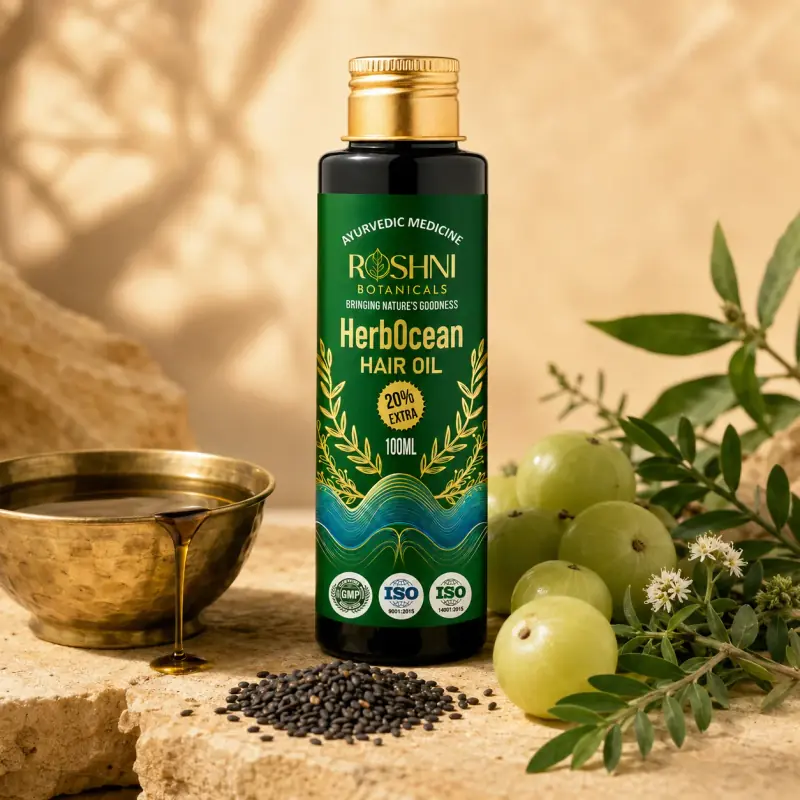
HerbOcean Hair Oil
A classical Taila for hair fall, dullness and a flaky scalp, with sixteen botanicals like Brahmi, Jatamansi, Amla and Neem in a slow sesame base.
Part of our guide: The definitive guide to Ayurvedic hair oils for hair fall.