Natural Hair Repair for Colour, Heat and Wash Damage: An Ayurvedic Guide
Colour, bleach, heat and harsh washing wear down the outer layer of Indian hair. What steady care does for damaged lengths, and where oiling fits.
Damaged hair is hair whose outer layer, the cuticle, has been lifted or worn down by colour, bleach, heat styling or harsh washing, so the length looks dull, tangles and snaps. Caring for it comes down to a few steady habits: a milder wash, less heat, regular oiling so the length stays softer and easier to handle, and a trim for the ends that have already split.
You run a comb through after a wash and it catches halfway down. The ends feel like straw, the colour you paid for has gone flat, and short broken pieces are collecting in the basin. Between the salon chair, the straightener and the water from your own tap, your hair has been through plenty. Each of those wears the hair in its own way, and each has a habit that eases the strain.
Key takeaways
- Damage lives in the length of the hair. Wear builds from root to tip, so the ends, which grew out first, show it before anything else.
- Lasting hair colour needs an alkaline pH to open the cuticle. A published review ties alkaline colouring and other alkaline treatments to the loss of 18-MEA, the fatty layer that keeps hair water repellent.
- Heat damage starts at the surface. In a laboratory study, surface damage rose with dryer temperature, yet the authors judged a dryer kept moving at a distance less harmful overall than natural drying.
- Oiling and conditioning coat the surface, so the length can take up less water and run through a comb with less drag, and the hair you keep stays softer.
- See a dermatologist for hair snapping at a pulled hairline, a widening parting, a scalp that burns, blisters or swells after colour or henna, or a smooth round patch with no hair.
What Damaged Hair Is, and Why the Damage Stays in the Length
Picture each strand of Kesha (hair) as a thin rod covered in overlapping scales, a bit like roof tiles. That covering is the cuticle. Underneath sits the cortex, which makes up the bulk of the strand. When colour, heat or rough washing lift and chip those scales, the strand takes up water more readily, snags on its neighbours and snaps wherever it is weakest.
A scraped knee mends because skin is alive. The length of a hair is not living tissue, and wear on it adds up instead of mending. Caring for damaged hair is about the length you already have, and about sparing it fresh wear. Hair fall from the root is a different problem altogether, and our complete guide to Ayurvedic hair oils for hair fall covers it.
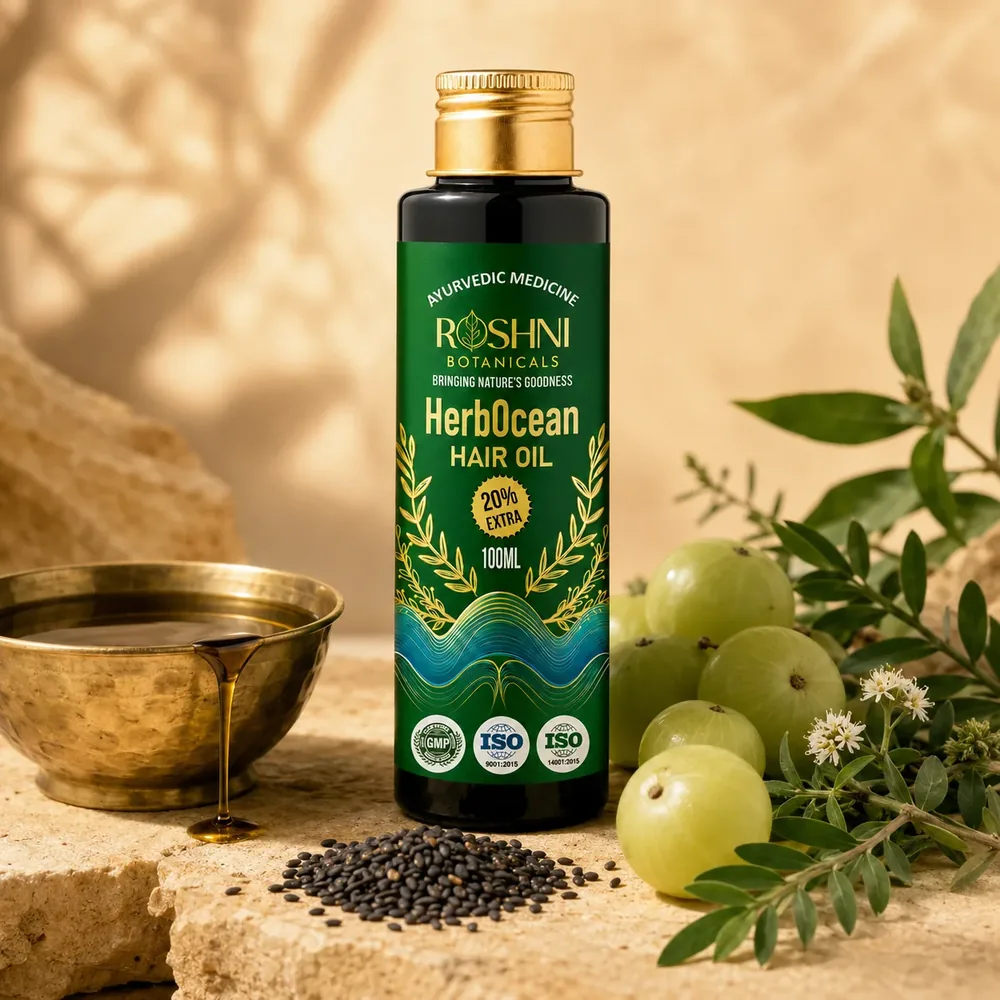
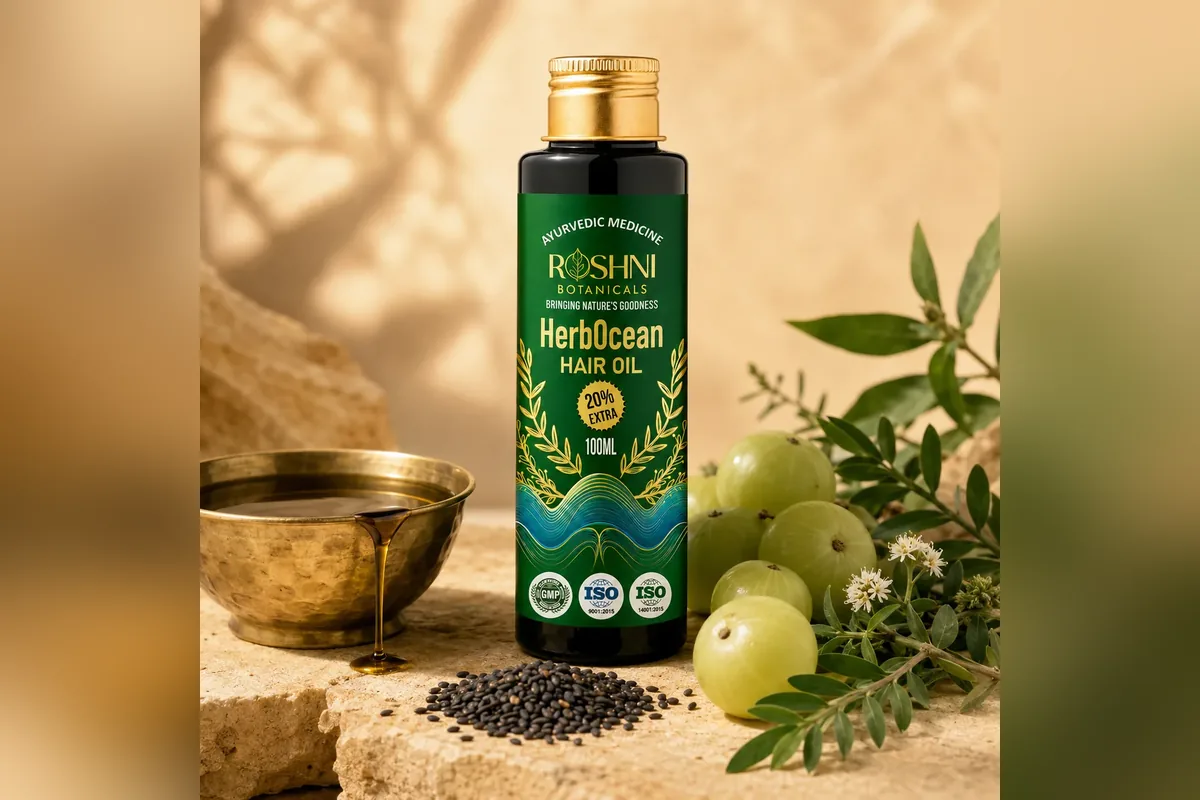
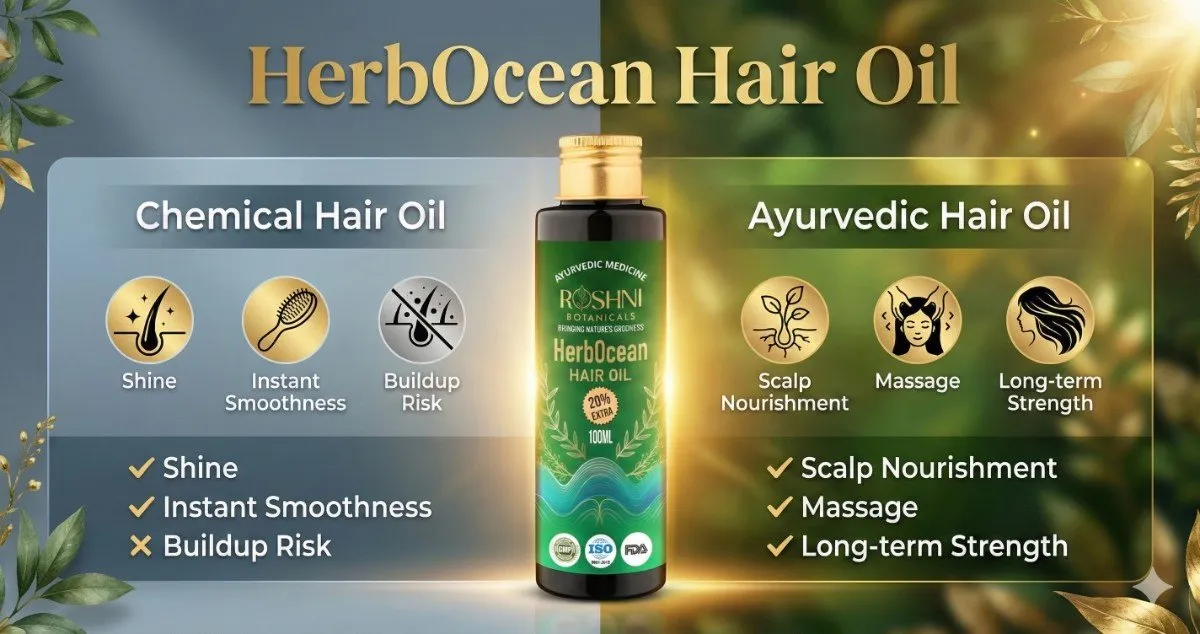
The oil we make for the scalp is a Taila (medicated oil). HerbOcean Hair Oil is an AYUSH-licensed Ayurvedic medicine for external use, classically indicated for hair fall and dullness. It nourishes the scalp, helps keep it clean and flake-free, and is traditionally used to support the scalp against dryness and seasonal hair fall. It is a classical Taila of sixteen botanicals in a sesame (Til tail) base. Bhringraj is one of its herbs, and one classical Sanskrit name for it is Kesharaja, king of hair.
Colour, Bleach and Henna: What Chemistry Does to the Strand
Lasting hair colour, the kind that grows out rather than washing out, has to get past the cuticle to reach the cortex, and it does that at an alkaline pH that opens the scales. A review in the International Journal of Trichology describes alkaline colouring and other alkaline chemical treatments stripping away 18-MEA, a fatty surface layer that keeps hair water repellent, and heavily treated hair showing lifted, cracked scales. Without that layer the strand turns porous. It takes up more water, frizzes and tangles.
Bleach has a chemistry of its own. It is an alkaline oxidiser, and a 2024 laboratory study of hair from one donor found torn, brittle cuticle scales after repeated bleaching, with the cuticle layer stripped away in places. The damage adds up, too. Highlights redone again and again, or bleach taken across the same stretch twice, build on whatever the last round left behind, so ask your colourist to keep fresh colour to the new growth at the roots. Smoothening and keratin services pair chemistry with high heat, so it is worth asking the salon what goes into the product before you book.
Henna deserves a proper word, because it is a habit with deep roots in Indian homes. If your hair feels dry or rough after a henna day, look after the length the way you would after colour: a mild wash, conditioner on the lengths and oil before the next wash. Black henna is another matter. The paste used for black henna tattoos can carry high levels of PPD (paraphenylenediamine), a contact allergen that can cause intense blistering, so it pays to know how to spot a black henna cone before one touches your skin.
Heat Styling: The Straightener, the Dryer and the Surface of the Hair
Heat works from the outside in. A laboratory study in the Annals of Dermatology shampooed and dried untreated hair again and again, either in room air or with a dryer held at different distances. Surface damage climbed with the dryer temperature, and any dryer left the surface rougher than air drying did. Only the hair left to dry on its own, though, showed damage in an inner layer, and the authors concluded that a dryer held at a distance and kept moving did less harm overall than natural drying.
A straightener or curling tong presses hot metal straight onto the strand. Keep it for occasions, on the lowest setting that works, and limit how long it touches any one section. If you use a dryer, hold it well back and keep it moving.
Harsh Washing and Hard Water: What Happens at Home
Wash day is hard on porous hair. A strong shampoo rubbed into the lengths adds to the wear, while a mild shampoo massaged into the scalp and left to rinse through the lengths is kinder. For the water itself, the Ashtanga Hridaya, in its chapter on Dinacharya (daily routine), keeps hot water off the head: on the body it gives strength, while poured over the head it takes strength from the hair and eyes. Lukewarm water keeps to that line.
Hard water is the other suspect at home. If your hair feels rough and fights the comb after a wash at home, the water is worth a look, and groundwater sampled in South West Delhi has tested hard. Laboratory studies on cut or shed hair point in different directions. One from Coimbatore found more calcium and magnesium on hair washed in hard water, and a ruffled surface; an earlier test by the same group found no loss of strength; and a study of hair from 70 men in Pakistan found the strands weaker. At home, keep up the household habit of oiling before the wash.
What a Routine Does for Damaged Lengths
Care does three things for a damaged length. Oils and conditioners coat the surface, so the length can take up less water and run through a comb with less drag, and the review in the International Journal of Trichology adds that applying oil on a regular basis can lubricate the shaft and help it break less. Less heat and a milder wash slow fresh damage. And a trim takes off the ends that have already split.
You may have heard that oiling before a wash cuts the protein hair loses in washing. That idea comes from work published in the Journal of Cosmetic Science: coconut oil used before a wash reduced the protein lost when the washed hair was combed, while sunflower and mineral oil did not. The researchers measured it on laboratory samples of Indian hair and in salon tests where one half of each head was oiled, and the finding belongs to coconut oil, since sesame was not among the oils tested. To weigh up the two household oils, read sesame oil or coconut oil for hair.
Where Regular Oiling Sits, and What the Hair Oil Is
The Hair Oil is a medicine first: an Ayurvedic Taila whose classical indication is hair fall and dullness, and in a routine for damaged hair it is the oil that goes on the scalp before a wash. Ayurveda counts dryness and roughness among the qualities of Vata (one of three doshas, or biological energies, in Ayurveda), and the Ashtanga Hridaya puts abhyanga (classical full-body oil massage) into every day, says it settles Vata, and names the head, along with the ears and feet, for special attention, while holding it back during indigestion and in some other states.
The twelve herbs are Bhringraj, Jatamansi, Brahmi, Shikakai, Amla, Nagarmotha, Chharila, Sugandhbala, hibiscus (Gudal), Tulsi, rose (Gulab) and Neem. They go into the sesame base in equal measure, and rosemary, lavender and curry leaf oils round off the blend, which makes sixteen botanicals with the sesame itself. In the bottle, the finished oil is a deep reddish amber. It is made in-house at our GMP-certified unit in Bawana, Delhi, under AYUSH Licence No. DL-474 A&U, and built on the 40-year Ayurvedic formulation legacy of Vaidya Shri Ram Prakash Ji.
Using it is simple, and the steps are the ones on the product page. Warm a little oil between your palms, part the hair and massage it into the scalp with your fingertips for a few minutes, leave it on for at least an hour or overnight, then cleanse.
This is a medicine, so read the cautions before you start. For external use only. Patch-test on the inner forearm 24 hours before first use and discontinue if irritation occurs; avoid the eye area. Anyone with a known allergy to sesame or to a listed botanical, or with an active scalp infection or broken skin, should not use it without medical advice. If you are pregnant or nursing, check with your doctor before use. Keep the oil off your breasts, and never use it on the baby.
How to Care for Coloured and Heat-Styled Hair
The answer to colour ke baad baalon ki care kaise kare is a steady rhythm centred on wash day. When you oil, do it before a wash, and carry what is left on your fingers down to the dry lengths and ends. Space out colour, bleach and smoothening appointments, so the same length is not put through one service on top of another.
On wash day, the order matters. Apply shampoo to dry, oiled hair before wetting. Then rinse slowly with lukewarm water and put conditioner on the lengths. Press the water out with a soft towel or an old cotton dupatta, and comb out gently from the ends upwards. Loose ties matter too, and it helps to know what tight ties do to the hairline.
Save heat tools for the days that need them. Before colour day, ask your colourist whether they want your hair clean or oiled, rather than guessing. If your hair is thick and curly, do the detangling under the shower with a wide-tooth comb, while conditioner still coats the hair. And if dullness bothers you more than breakage, read what makes hair catch the light.
When Breakage Needs a Dermatologist
Some of what looks like breakage belongs with a dermatologist rather than a new routine. See one if hair keeps breaking along the hairline where a tight style pulls, if your parting is widening or more scalp shows at the crown, or if a smooth, round patch with no hair appears. If your scalp burns, itches, blisters or swells after colour or henna, get seen promptly: it can be a reaction to a hair colour ingredient such as paraphenylenediamine (PPD). On brown skin, that rash may look darker brown, purple or grey rather than red. Sudden swelling of the lips, mouth, throat or tongue, or struggling to breathe, after colour is an emergency.
Look closely at what lands in the basin, too. Short broken pieces point to the length. Whole strands with a tiny bulb where they left the scalp point to shedding from the root rather than breakage. If what you are seeing is heavy shedding after an illness, it follows its own timing, and a doctor can help you place it.
Looking After the Hair You Are Keeping
The length you are keeping carries every wash, every heat tool and every salon visit it has been through. Space out the salon chemistry, keep any dryer moving and held back, and use every wash as a chance to handle that length a little more kindly.
If you want a classical medicated oil for the scalp alongside these habits, that is what the Hair Oil is, and its product page sets out the method in full. You can also browse the Ayurvedic hair care range.
References: Gavazzoni Dias MFR. Hair cosmetics: an overview. International Journal of Trichology, 2015;7(1):2 to 15 (narrative review, Brazil). Kim DH and colleagues. Effects of excessive bleaching on hair: comparative analysis of external morphology and internal microstructure. Applied Microscopy, 2024;54:11 (laboratory study, Korea, hair from one donor). Lee Y and colleagues. Hair shaft damage from heat and drying time of hair dryer. Annals of Dermatology, 2011;23(4):455 to 462 (laboratory study, Korea, untreated commercial hair; one affiliation a consumer goods company). Rele AS, Mohile RB. Effect of mineral oil, sunflower oil, and coconut oil on prevention of hair damage. Journal of Cosmetic Science, 2003;54(2):175 to 192 (tresses of Indian hair and salon half-head tests on 20 clients each with normal and bleached hair; authors from an Indian hair oil maker). Vagbhata. Ashtanga Hridaya, Sutra Sthana 2 (Dinacharya); translation by R. Vidyanath, Chaukhamba Surbharati Prakashan, 2013. Srinivasan G and colleagues. Effects of hard water on hair. International Journal of Trichology, 2013;5(3):137 to 139 (hair from 15 volunteers, Coimbatore; no change in strength). Srinivasan G, Chakravarthy Rangachari S. Scanning electron microscopy of hair treated in hard water. International Journal of Dermatology, 2016;55(6):e344 to e346 (shed hair from 15 women, Coimbatore; more calcium and magnesium, ruffled surface). Luqman MW and colleagues. International Journal of Trichology, 2018;10(3):113 to 117 (hair from 70 men, Pakistan; weaker after hard water). Acharya S, Sharma SK, Khandegar V. Data in Brief, 2018;18:2019 to 2028 (groundwater quality, South West Delhi, 50 samples). DermNet and NHS on paraphenylenediamine (PPD) allergy, black henna tattoos and reactions on brown skin. Educational, not medical advice.
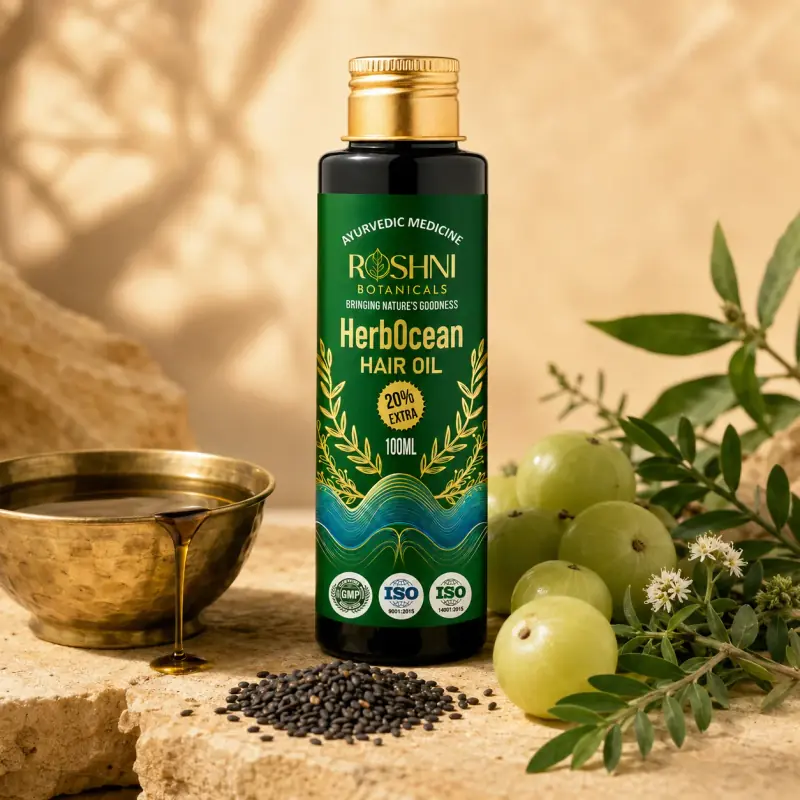
HerbOcean Hair Oil
A classical Taila for hair fall, dullness and a flaky scalp, with sixteen botanicals like Brahmi, Jatamansi, Amla and Neem in a slow sesame base.
Part of our guide: The definitive guide to Ayurvedic hair oils for hair fall.