How to Get Shiny Hair: What Makes Indian Hair Catch the Light
Shine is what a smooth strand does with light. Why Indian hair goes dull, hard water first, and where a classical hair oil fits in a routine you can keep.

A serum can make hair throw light back like glass, and a silicone film often does that work well, for as long as the film lasts. What carries from one wash to the next is a smooth strand, and on Indian hair the things that roughen a strand are specific and ordinary. Borewell water in a Delhi bathroom. Ten minutes with a straightener before a family function. A towel rubbed hard down wet lengths.
The short answer: hair looks shiny when the scales on its surface lie flat, and the whole of good care is keeping them that way. Here is what shine is, the five everyday causes of dullness in India, hard water first, what a pre-wash oil does for a rough strand, and a four-week routine you can keep.
Key takeaways
- Shine is cuticle physics. Flat, overlapping scales send light back in one direction and the eye reads gloss; lifted or chipped scales scatter it and the same hair reads dull.
- Hard water is the first thing to rule out at home across much of Delhi and the north: calcium and magnesium from the water deposit on the strand, and shampoo struggles to rinse them away.
- Hair above the scalp is not living tissue, so care works by keeping the scales you have lying flat, and a split end needs a trim.
- A pre-wash medicated oil (Taila) can settle into the gaps between lifted scales and eases friction on wash day. The smoothing washes out and is rebuilt week by week.
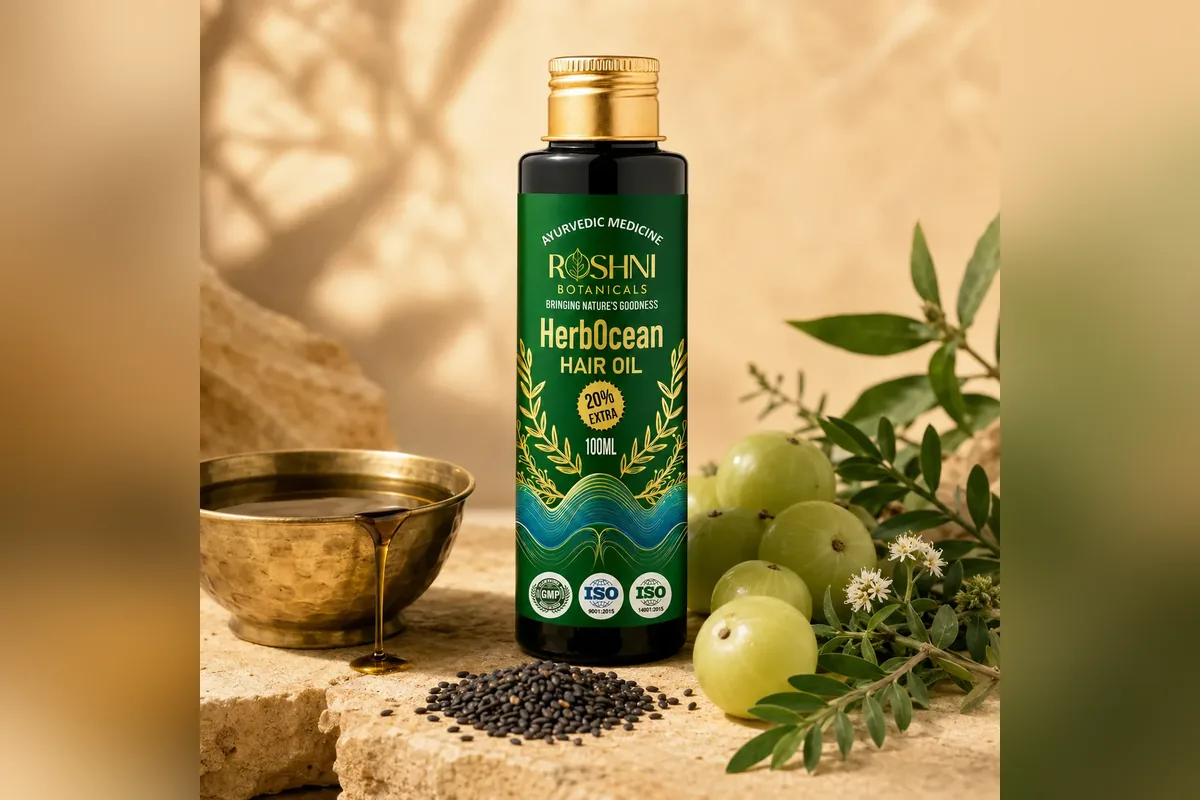
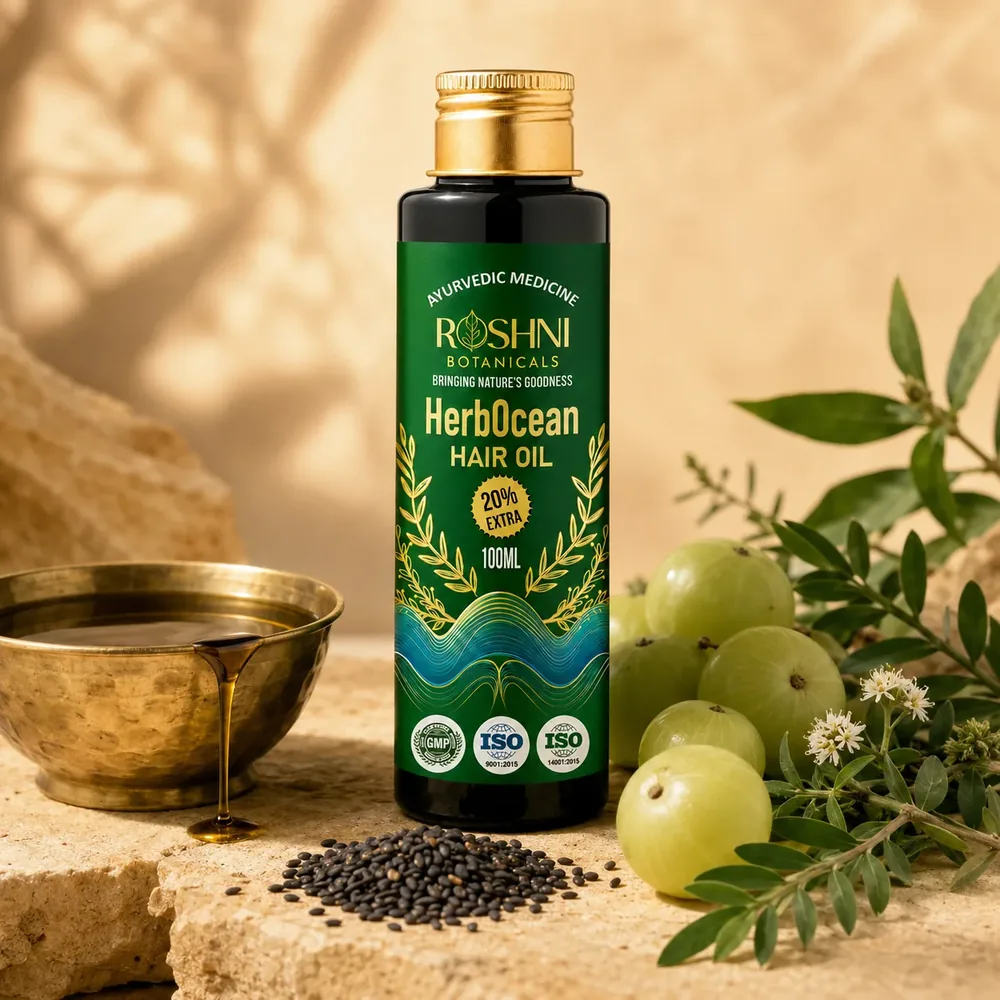
- HerbOcean Hair Oil nourishes the scalp and helps keep it clean and flake-free: an AYUSH-licensed Ayurvedic medicine for external use, sixteen botanicals in a sesame base, classically indicated for hair fall and dullness.
What Shine Is, in Plain Terms
Each strand is wrapped in a cuticle, a layer of overlapping keratin scales that sit like tiles on a roof. Lying flat, they make the strand behave like one continuous surface, and light comes back in a single direction. Your eye reads that as gloss. Chip or lift those scales and light scatters instead, so the same hair reads dull. Straight hair tends to read glossier for the same reason: a straight strand presents one long, even surface to the light, and a curl presents many short ones, which is why curly hair can be in perfectly good condition and still look less glossy.
Hair above the scalp is not living tissue. It has no blood supply and no way to rebuild itself, so nothing you apply afterwards puts a chipped scale back. What good care does is keep the scales you still have lying flat, and stop new damage arriving. That is real and repeatable, and it is the work care does on the strand you already have.
Why Indian Hair Goes Dull: Five Everyday Causes, Hard Water First
One: hard water. Across much of Delhi and the north, tap water carries enough dissolved calcium and magnesium to leave a film on the strand. The same minerals keep shampoo from lathering well, and they bond to the strand during washing and can dry into a fine mineral coat, so the rinse never quite finishes. If your hair changed when you changed cities, check the water first. We have written separately on what hard water does to your scalp and hair, including the two-minute bottle test for hard water.
Two: sun. Long exposure to sunlight breaks down the protein of the strand and thins the water-repellent lipid layer on its surface, so on long afternoons outdoors a dupatta, scarf or cap over the hair is the simple cover. Three: heat tools. High heat from a dryer or straightener can boil the water inside a damp strand and blister its surface, which is why a heat protectant goes on first and a lower setting is kinder.
Four: a stripping shampoo. Strong cleansers can leave the strand more charged, frizzier and harder to comb, which is a question of what you wash with more than how often; our piece on how often to wash your hair sets out the evidence on frequency. Five: mechanical wear. A terry towel rubbed down wet hair, a comb dragged from the crown through knots, tight bands, a rough pillowcase. Each is small; together they are where everyday wear comes from.
Before changing anything, run a self-check. Chalky scale on the taps, soap that refuses to lather, hair that squeaks in the shower and feels rough once dry: hard water. Papery ends that snap while the roots feel fine: heat and mechanical wear. A scalp that itches or flakes belongs with a dermatologist if it carries on despite gentler washing.
The Ayurvedic Reading: Vata Dryness, Pitta Heat and a Rough Strand
The classical lens reads the same dullness differently. Hair (Kesha in the classical texts) is described as a by-product of bone tissue (Asthi dhatu), so the tradition never reads it as a surface alone, and pairs what goes on the head with diet, sleep and daily habit. Dull hair with flyaways, splitting and a papery feel sits with Vata (one of the three doshas, the biological energies in Ayurveda), whose qualities include light, dry, rough and mobile. Dullness on a scalp that feels warm or tender reads closer to Pitta, the dosha of heat, and there the scalp is the tell rather than the lengths.
Oil, applied and worked in, is the classical answer to dryness. Oiling the head sits among the acts of the daily routine (Dinacharya) in both the Charaka Samhita and the Ashtanga Hridaya, and the classical order, oil first and bath after, is the order a modern reading of the cuticle would also suggest. The dry months after the rains are when hair tends to feel drier, because the water a strand holds rises and falls with the humidity of the air around it.
What a Pre-Wash Oil Does to a Dull Strand
A pre-wash oil can settle into the gaps between lifted cuticle scales and leave a thin film on the surface, so the strand reads smoother, to light and to your fingers. It can ease friction while you wash and comb, when a wet strand takes the heaviest handling. Taking the oil from the scalp down the lengths also spreads sebum, the oil your scalp makes on its own, along the strand, much as combing does.
A split end stays split. The only answer to the split itself is a trim, at whatever interval your salon suggests, commonly eight to twelve weeks, and oiling is used to ease the friction behind new ones. Our piece on what oiling can do for split ends and breakage, and what only a trim can sets out that line in full. The oil itself washes out with the shampoo; what carries over is the handling it eased, which is why the routine comes round again the following week.
Inside HerbOcean Hair Oil: Sixteen Botanicals in a Sesame Base
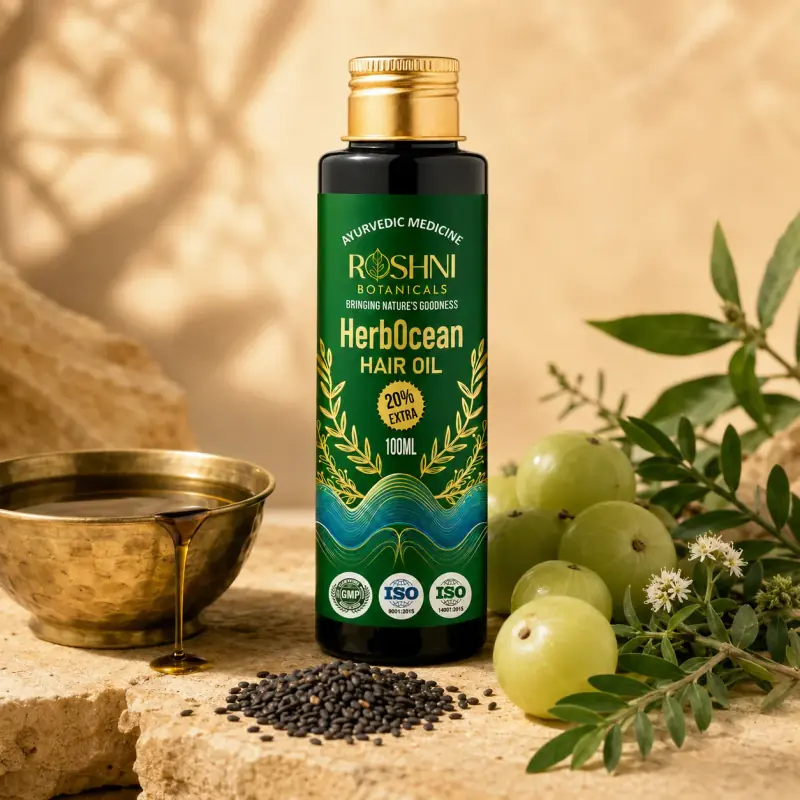
HerbOcean Hair Oil is an AYUSH-licensed Ayurvedic medicine for external use, classically indicated for hair fall and dullness. It nourishes the scalp, helps keep it clean and flake-free, and is traditionally used to support the scalp against dryness and seasonal hair fall. It is a classical Taila of sixteen botanicals in a sesame (Til tail) base: twelve herbs, namely Bhringraj, Jatamansi, Brahmi (Bacopa monnieri), Shikakai, Amla, Nagarmotha, Chharila, Sugandhbala, dried hibiscus (Gudal), Tulsi, rose (Gulab) and Neem, finished with lavender, curry leaf and rosemary oils. No single herb leads the formula; the twelve are declared at the same weight. It is made in-house at our GMP-certified unit in Bawana, Delhi, under AYUSH Licence No. DL-474 A&U, and built on the 40-year Ayurvedic formulation legacy of Vaidya Shri Ram Prakash Ji.
Sixteen is the count of the whole blend, because the base and the finishing oils do work too: the sesame carries the herbs to the scalp, and the three finishing oils are partly there for scent, so that a medicated oil is pleasant to reach for every week, and are traditional in hair care in their own right. Our guide to the sixteen botanicals in a classical hair oil, herb by herb carries the detail, and there is a separate piece on what Amla does in a classical hair oil.
Two things worth knowing before you open the bottle. Henna and onion are not part of this formula; we have set out onion oil compared with a classical Ayurvedic hair oil separately. The finished oil is a deep reddish amber, and that colour comes from the herbs cooked into the sesame base.
How to use it for shine. Warm a little, part the hair and work it into the scalp with your fingertips for a few minutes, then take what is left down the lengths. Leave it for at least an hour, or overnight, and wash it out with a mild shampoo. Two or three sessions a week is the rhythm.
The Shine Routine: Wash Day, Drying, Night and Heat
On wash day, oil first, warmed gently and never hot: a small steel katori standing in a bowl of hot water is enough. Then wash it out properly, because a single hurried shampoo on an oiled head leaves residue, and residue is dulling; we have a separate piece on how to wash oiled hair properly. Where a softener is not realistic, keep a jug of filtered, RO or boiled-and-cooled water for the final rinse, so mineral-heavy tap water is not the last thing to dry on the strand. A cool final rinse feels good and costs nothing, but we found no published controlled study showing that cold water locks a cuticle scale shut, so keep it as a free habit rather than a fix.
Squeeze instead of rubbing: an old, much-washed cotton kurta or a soft cotton dupatta soaks up water without the abrasive loops of a terry towel. Comb from the ends upward, a small section at a time, until the comb runs through clean, and let straight hair part-dry first; a comb dragged from the crown can pull a knot tighter.
At night, a loose plait started below the nape, or for curls a loose gather high on the crown, cuts the hours of rubbing against cloth. A satin or silk pillowcase is a habit rather than a proven step, and it costs little to try. Our nighttime hair care routine has the detail. Ration the heat: if you use a dryer, keep it on a lower setting and keep it moving; keep the straightener for the days that need it, and put a heat protectant on first. For the full method of the oiling itself, see our step-by-step scalp oil massage (Abhyanga) at home.
A Four-Week Routine You Can Keep
Week one, change two things only: two pre-wash oilings, and a proper wash after each. Week two, fix the drying and the combing: old cotton kurta, wide-tooth comb, ends upward. If the self-check pointed at your tap, start the jug of filtered, RO or boiled-and-cooled water for the final rinse this week.
Week three, add the night plait and pull heat styling back to once a week. Week four, assess in daylight, in the same window at the same time of day, and judge the surface rather than the length. If shedding rather than dullness is the worry, the definitive guide to Ayurvedic hair oils for hair fall control is the read you want instead.
Because this is a medicine, the cautions come with it. For external use only. Patch-test on the inner forearm 24 hours before first use and discontinue if irritation occurs; avoid the eye area. Anyone with a known allergy to sesame or to a listed botanical, or with an active scalp infection or broken skin, should not use it without medical advice. If you are pregnant or nursing, check with your doctor before use. Keep the oil off your breasts, and never use it on the baby. See a dermatologist for sudden heavy shedding, a widening parting, a smooth patch of scalp with no hair, or a scalp that stays sore, itchy or flaking despite gentler washing.
Shine Is a Habit You Keep Up
A flat cuticle is the whole of it, and it comes from small habits repeated week after week. Oil before the wash, wash it out properly, dry gently, comb from the ends, keep the heat for the days that need it, and let the last rinse come from the jug rather than the tap. Start with the one cause your self-check pointed at, not all five.
If you want a classical Taila that nourishes the scalp and helps keep it clean and flake-free, ours is HerbOcean Hair Oil, an AYUSH-licensed Ayurvedic medicine for external use. You will find it, and the two-bottle pack, on our Ayurvedic hair care page.
References: Charaka Samhita, Sutrasthana 1 (Deerghanjiviteeya Adhyaya), verses 59 to 60, which list the qualities of Vata and of Pitta and the principle that opposite qualities settle them. Charaka Samhita, Sutrasthana 5 (Matrashiteeya Adhyaya), where daily oiling of the head and of the body sit among the acts of the daily regimen. Ashtanga Hridaya, Sutrasthana 2 (Dinacharya Adhyaya), where daily oil massage is to be given especially to the head, ears and feet. Charaka Samhita, Chikitsasthana 15 (Grahanidosha Chikitsa), verses 18 to 19, which name the by-product of each tissue, with the hair of the head and body (Kesha and loma) as the by-product of bone tissue (Asthi). Gavazzoni Dias MF. Hair cosmetics: an overview. International Journal of Trichology. 2015;7(1):2-15 (narrative review from Brazil, in an Indian journal, of hair fibre structure, the cuticle, and how shampoos, conditioners, oils, silicones, sunlight and heat act on it; no study population). Keis K, Ramaprasad KR, Kamath YK. Studies of light scattering from ethnic hair fibers. Journal of Cosmetic Science. 2004;55(1):49-63 (laboratory light-scattering study of single unaltered hair fibres of European, African and Asian origin; fibre shape, curvature and surface roughness spread the reflected light and lower lustre; non-Indian). Santos Nogueira AC, Joekes I. Hair color changes and protein damage caused by ultraviolet radiation. Journal of Photochemistry and Photobiology B: Biology. 2004;74(2-3):109-117 (laboratory study on human hair samples exposed to lamp radiation and to sunlight, Brazil; protein loss rose with exposure in every hair type tested, with no significant change in mechanical properties or surface topography; non-Indian). Srinivasan G, Chakravarthy Rangachari S. Scanning electron microscopy of hair treated in hard water. International Journal of Dermatology. 2016;55(6):e344-e346 (laboratory study on shed hair from 15 healthy women, Coimbatore, India, washed in hard or distilled water for 30 days; hard-water samples carried more calcium and magnesium and showed a ruffled surface). Alahmmed LM, Alibrahim EA, Alkhars AF, Almulhim MN, Ali SI, Kaliyadan F. Scanning electron microscopy study of hair shaft changes related to hardness of water. Indian Journal of Dermatology, Venereology and Leprology. 2017;83(6):740 (hair samples from 20 healthy volunteers, Saudi Arabia, washed in hard or soft water for three weeks; more magnesium with hard water, no significant difference in calcium or in surface structure; non-Indian). Lee Y, Kim YD, Hyun HJ, Pi LQ, Jin X, Lee WS. Hair shaft damage from heat and drying time of hair dryer. Annals of Dermatology. 2011;23(4):455-462 (laboratory study on hair tresses, Korea; surface damage increased with dryer temperature, and although any dryer roughened the surface more than natural drying did, one held 15 cm away and kept moving did less damage to the strand as a whole than natural drying; non-Indian). Educational, not medical advice.
HerbOcean Hair Oil
A classical Taila for hair fall, dullness and a flaky scalp, with sixteen botanicals like Brahmi, Jatamansi, Amla and Neem in a slow sesame base.
Part of our guide: The definitive guide to Ayurvedic hair oils for hair fall.