Amla for Hair: What the Kitchen Fruit Does in a Classical Hair Oil
Amla is the fruit every Indian kitchen already knows. Here is what it does for hair, which form does that work, and where it sits in a classical hair oil.
Murabba in a jar. Salted candy after lunch. That glass of winter juice you probably winced your way through. You have known amla your whole life, and you have known it as food. What amla is asked to do for hair, which form of the fruit does that work, and where it sits inside a classical medicated hair oil (Taila): that is what follows. Your household already has an opinion about this fruit, long before any brand offers one.
Key takeaways
- Amla (Emblica officinalis) is the Indian gooseberry, one of the three fruits of Triphala, and a herb Ayurvedic hair care has leaned on for a very long time.
- A medicated hair oil carries the classically processed fruit, not a vitamin C serum. Fresh amla on your plate and oil-processed amla on your scalp run in two separate lanes.
- Powder packs, the weekly champi, the amla and shikakai wash: all traditional uses, each with its own effort, mess and sourcing question.
- A strand that has already grown out grey does not change colour because you oiled it, and this oil is not sold as a colour treatment.
- In HerbOcean Hair Oil, amla is one of the twelve herbs in a sixteen-botanical formula, present at the same share as each of the other eleven.
The Fruit Every Indian Kitchen Already Knows
Nobody in India needs amla introduced. Every winter it arrives by the kilo. Some of it gets boiled down into murabba, some salted and dried into the candy that sits near the till at every kirana shop, and the rest turns up in the chyawanprash spoon that mothers still administer without negotiation. Hold on to that familiarity, because it changes how you read a hair-care claim.
Botanically it is Emblica officinalis, the Indian gooseberry. Classical Ayurveda counts it among the three fruits of Triphala, the other two being Baheda and Harad, and places it in the long-term tonic category (rasayana), herbs associated with sustained, slow-acting tissue support. One thing to be clear about: Triphala tells you where amla sits in the tradition, and it says nothing about what goes into a bottle. Neither Baheda nor Harad is part of HerbOcean Hair Oil, and nor is Triphala as a combination in this oil.
What your tongue already knows needs no reference at all. Amla is sharply sour, astringent enough to make you pull a face, and that character survives drying. But sourness in the mouth tells you nothing about how the fruit behaves in an oil. That is a separate question about what the process carries across.
Fresh, Dried or Oil-Processed: What Reaches Your Hair
Three forms of the same fruit reach an Indian household, and swapping one for another does not work. Fresh fruit, eaten or juiced, belongs to your diet. Dried fruit, ground into a coarse grey-green powder, is what goes into hair packs. And dried fruit processed into oil is what goes onto your scalp as a medicated hair oil.
Fresh amla is celebrated for its vitamin C. That is a property of the fresh fruit. Vitamin C is water-soluble and it does not take heat, and a Taila is made by holding herb and oil together at cooking heat for hours until the water has gone. An oil infusion is not a vitamin C serum. If it is vitamin C you are after, eat the fruit.
So what does the process carry across? Not one tidy fraction of the herb, and we are not going to invent a neat answer. Classical oil-making works the herb into the oil with heat and time until the water is driven off and the medicated oil is what remains. It is slow. It runs in batches. What you put on your scalp is the oil-processed fruit in a base that stays where you put it. How much of any single constituent survives that, and how much of it reaches a follicle, we have not measured and will not guess at.
Eat amla if you like it. Murabba in the morning, candy after lunch, juice if you can take it neat: that is Indian food culture, and it needs no marketing case built around it. Just keep it in its own lane. A winter fruit on your plate and a medicated oil on your scalp are doing different jobs, and HerbOcean Hair Oil is for external use only. If it is the plate you want to get right, our guide to what to eat for stronger hair takes that lane on its own.
Amla at Home: Champi, Hair Packs and the Shikakai Wash
An amla powder pack, loosened with water or curd in the ubtan style, is a weekend afternoon’s work: sourcing powder you trust, getting the consistency right, keeping it off the bathroom tiles, then giving it forty minutes before a wash that takes twice as long as usual.
Grinding your own is harder still. The fruit has to be dried properly first or it turns within days: halved, the stone taken out, and sun-dried until the pieces are hard and dark, which in humid air takes many days longer than it would in a dry one. Then it has to be ground fine enough to make a paste and coarse enough not to turn to glue, and a domestic mixer does neither well. Loose market powder saves you all of that and hands you a different problem: it varies from shop to shop in colour, smell and how much grit comes with it. Fresh powder is a dull grey-green and smells sharply sour when you open the packet. Brown, flat and dusty means that powder has been sitting in the sack too long, and no amount of curd will bring it back. Buy small quantities, buy from a shop that turns its stock over, and check the packing date where one is printed.
Storage decides a good deal of how it goes. A tightly shut jar in a dry cupboard keeps powder usable for months. The same powder left open in a warm, damp bathroom cabinet will clump and turn long before that. Mix only what you will use, and throw away what is left rather than keeping a wet paste for next week.
Count the time honestly too. A pack is forty minutes on the head, then a wash that needs two rinses instead of one to get the last of the grit out, then a towel that has to be washed separately. That does not make the practice any less worth having. What you are choosing between is a routine you control ingredient by ingredient, and a formulated oil where the proportions are fixed, measured and identical in every bottle.
The weekly champi needs no defence from anyone. Warmed oil, an unhurried scalp massage, a wash afterwards: a habit that has outlived every generation’s opinion of it. If you want the method set out step by step, our guide to a step-by-step scalp abhyanga at home has it. And if your tap runs hard, oiling before a wash is a long-standing way of getting some oil onto the hair first. More on hard water and hair in Indian cities sits in a separate post.
The amla and shikakai wash is a different way of cleaning hair from shampoo, not a better one. Some households have never used anything else, and that is a perfectly reasonable place to be. We have written about the classical shikakai wash separately, so it is not repeated here.
Amla and Grey Hair: What Oiling Does Not Change
Amla’s association with hair colour is old, it lives inside Indian hair-care ritual, and the tradition register is where it stays.
A strand that has already grown out grey does not change colour because you oiled it. We are not going to dress that up into something more hopeful, and we are not going to pretend there is a debate where there is simply no result we can show you. This oil is not sold as a colour treatment. Amla’s old association with hair colour stays where it has always been, in tradition. If your greying is sudden, patchy or unusually early, take it to a dermatologist rather than to the oil shelf.
Where Amla Sits in HerbOcean Hair Oil
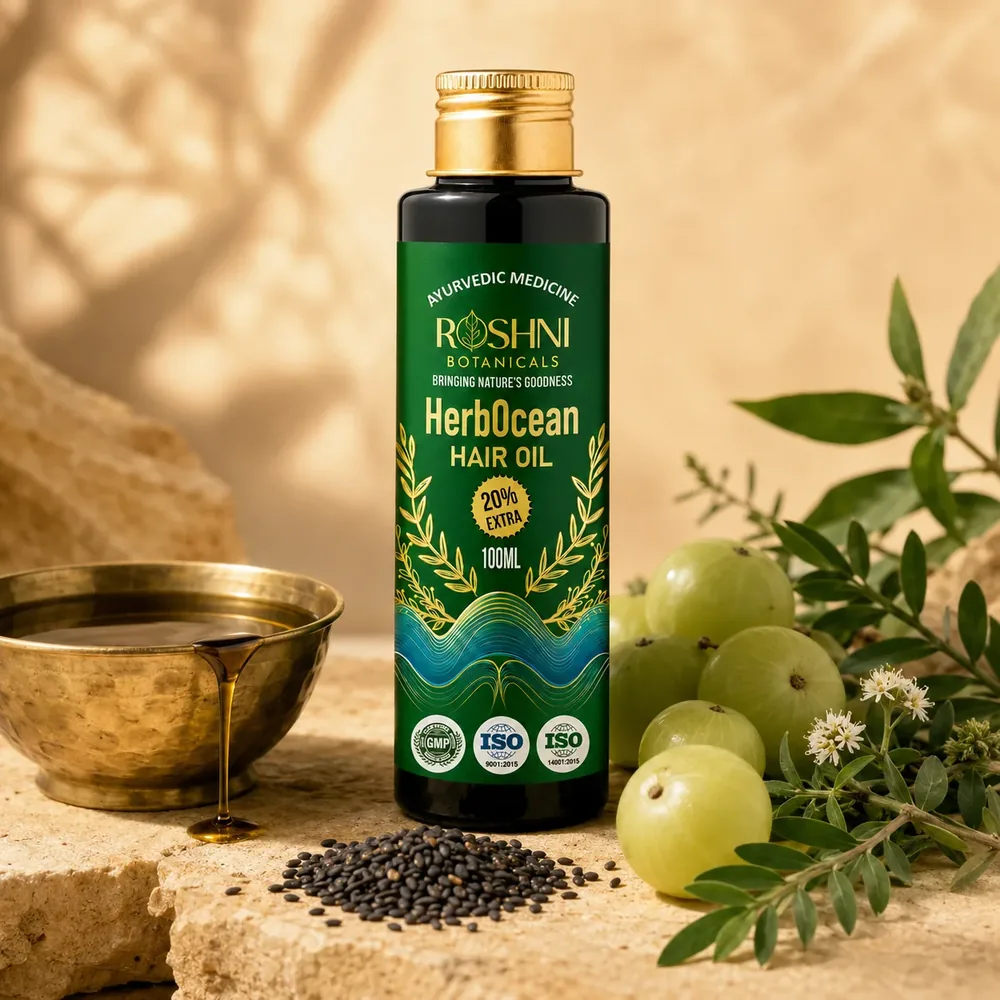
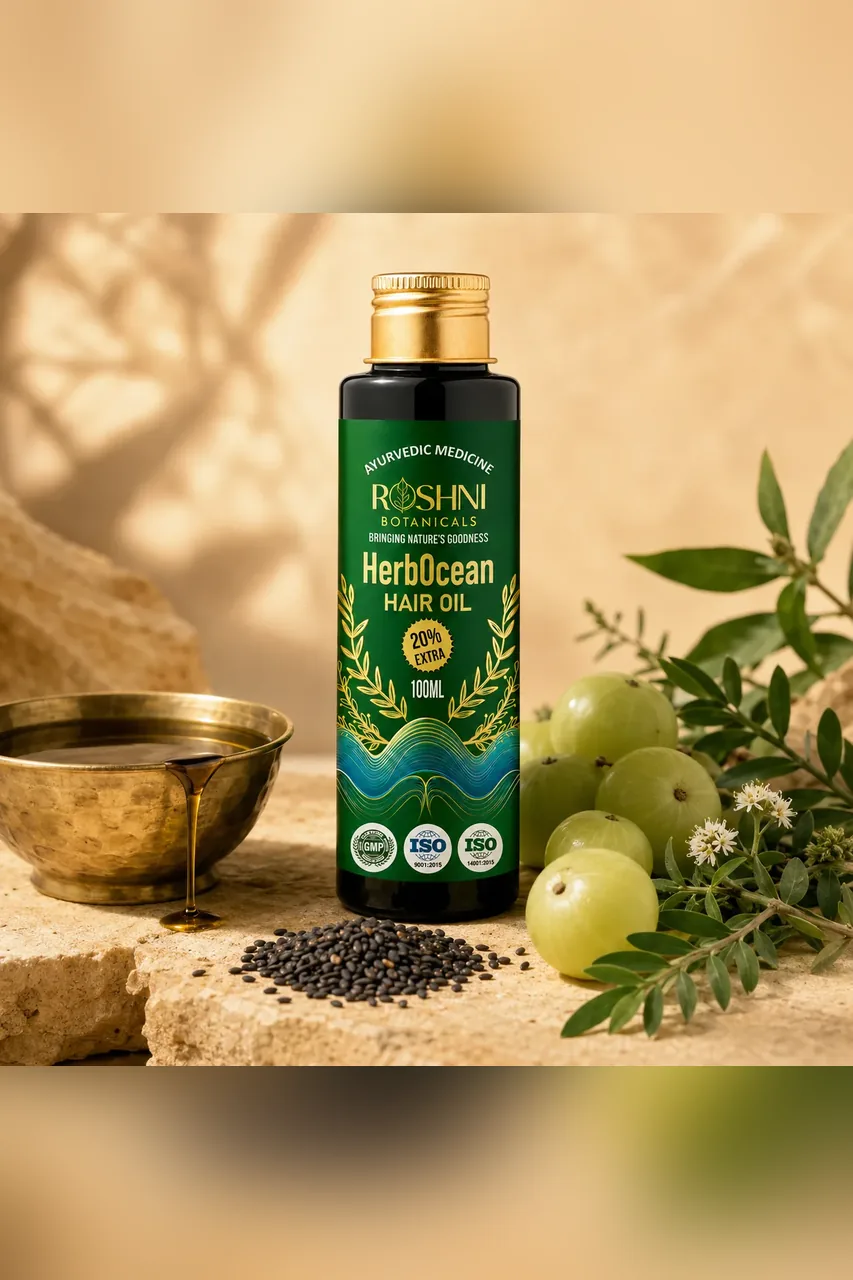
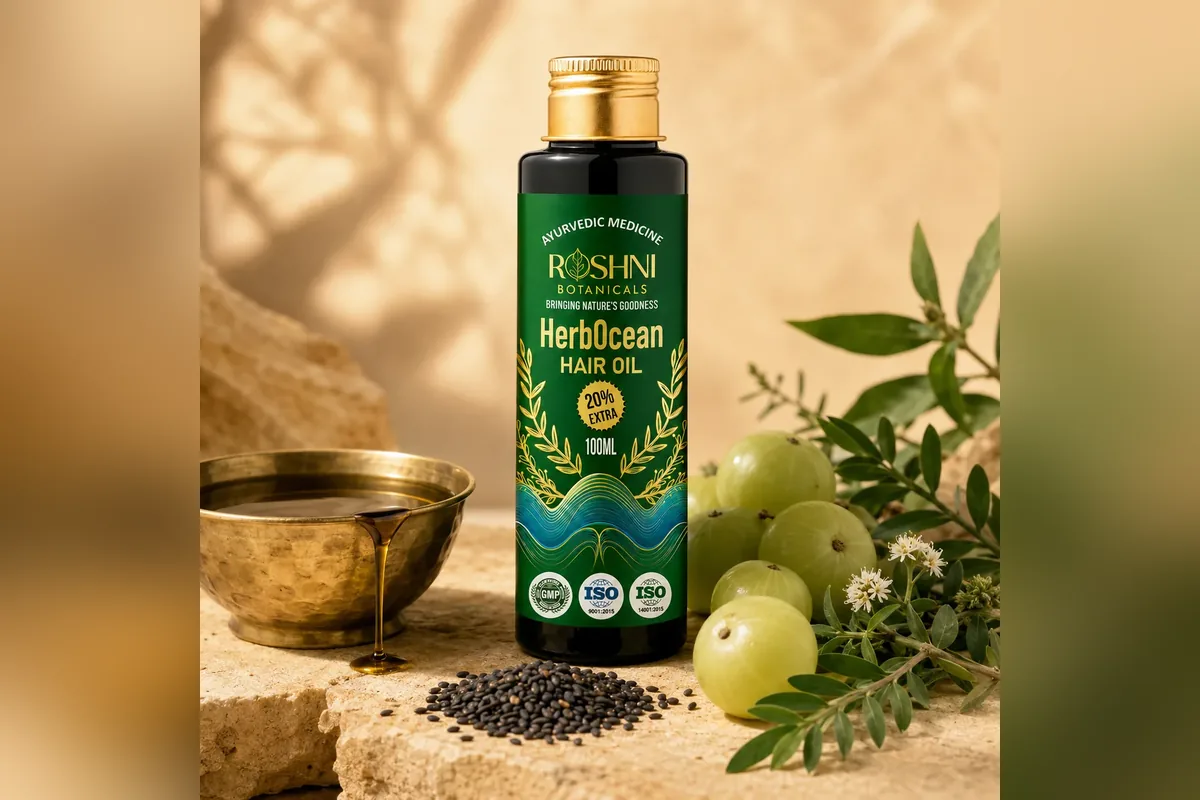
In HerbOcean Hair Oil, amla is one of twelve herbs: Bhringraj, Jatamansi, Brahmi, Shikakai, Amla, Nagarmotha, Chharila, Sugandhbala, Gudal, Tulsi, Gulab and Neem. Sixteen botanicals in all: twelve herbs, a sesame oil (Til tail) base, and three finishing oils, lavender, curry leaf and rosemary. The three finishing oils are exactly that, finishing oils rather than herbs. Amla is present at a measured weight per litre, the same share as each of the other eleven herbs, and the same in every batch.
HerbOcean Hair Oil is finished with lavender, curry leaf and rosemary oils, so it is aromatic: a Taila carried forward, not a fragrance-led blend. The oil is an AYUSH-licensed Ayurvedic medicine (Licence No. DL-474 A&U), traditionally used in the care of hair fall (Khalitya). It is made in-house at our GMP-certified unit in Bawana, Delhi, and the formulation is built on the forty-year Ayurvedic legacy of Vaidya Shri Ram Prakash Ji.
Twice a week before a wash is the usual rhythm. In humid weather a scalp stays damp for hours anyway, so put the oil on an hour or two ahead rather than leaving it in overnight. Warm the oil, spend ten unhurried minutes on the scalp, and wash the same day.
For external use. Patch-test on the inner forearm before the first full application, keep the oil away from the eyes, and stop using it if the scalp reacts. This oil carries lavender, rosemary and curry leaf oils, and reactions to fragrance components can take a day or two to show, so give the patch test time. If you already know you react to fragrance, this is not the oil for you. The wider case for medicated oils, and how to judge one before you buy, is laid out in the definitive guide to Ayurvedic hair oils for hair fall control.
Back to the Jar on the Kitchen Shelf
Amla needs placing more than it needs introducing. Sour fruit in winter. Powder in a weekend pack. Oil-processed herb in a bottle that lives by the bathroom door. If you want to see it used alongside fifteen other botanicals, that is HerbOcean Hair Oil.
Sudden smooth circular bald patches, hair fall with scalp scaling, pain or pus, a patch where the skin looks smooth and shiny and the follicle openings seem to have gone, a hairline receding where it is pulled tight, or heavy shedding after a fever, a crash diet, heavy periods or a thyroid diagnosis belong with a dermatologist or trichologist first. Postpartum shedding follows its own course, set out in a separate post on hair fall after delivery.
HerbOcean Hair Oil
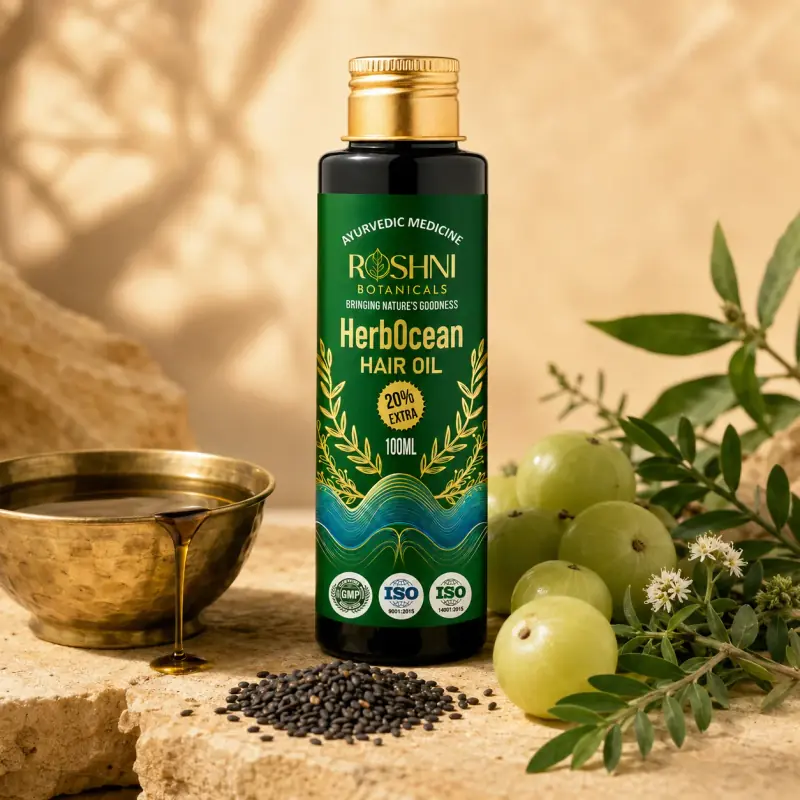
A classical Taila for hair fall, dullness and a flaky scalp, with sixteen botanicals like Brahmi, Jatamansi, Amla and Neem in a slow sesame base.
Part of our guide: The definitive guide to Ayurvedic hair oils for hair fall.