Bhringraj Oil for Hair: The Plant Ayurveda Calls the King of Hair
What bhringraj is, where classical Ayurveda places it, what the studies have looked at, and how to use the leaf, powder and oil on your scalp at home.
Bhringraj is Eclipta prostrata, also called Eclipta alba or false daisy, a small white-flowered plant of damp ground across India and a classical Ayurvedic hair herb. The later classical lexicons give it hair names, one of them Keshya (hair-supporting, a classical class of herbs), and classical hair oils cook it with other herbs into a medicated oil. Modern hair research on bhringraj by itself is still laboratory and animal work.
You may know bhringraj as a word on a hair oil bottle, or as the green paste worked into the scalp before a head bath at home. Both lead back to the same plant, which carries a long classical reputation and a modern research record that is still early. So start with the plant itself, then follow it into the texts, into the laboratory and into your kitchen.
Key takeaways
- Bhringraj is a low, white-flowered plant of the daisy family that grows in damp ground across India, and older books and labels still carry its earlier botanical name.
- The later Ayurvedic lexicons, the Bhavaprakasha Nighantu among them, know the plant as a hair herb, and it is classically named Kesharaja (literally, king of hair).
- Modern hair research on bhringraj by itself is laboratory and animal work with plant extracts, and a PubMed search turned up no published human trial of the herb alone.
- If grey hair starts early or comes on quickly, see a doctor, who may check thyroid function, iron and B12.
- At home, bhringraj goes on the scalp as a fresh leaf pack, a dried powder pack or a home-cooked oil, and each one is washed out.
What Is Bhringraj? The Plant Behind the Name
Bhringraj is the kind of plant you would walk past without a second look. It grows low, with narrow leaves and small white flower heads, along field edges, in damp ground and beside drains across India and tropical Asia. Botanists place it in the daisy family, which is where the English name false daisy comes from. Older books and some labels still use the earlier botanical name, and a 2021 review of the plant in the journal Biomolecules lists the two names side by side.
The Ayurvedic texts give it several names. Bhringaraja is the name the Bhavaprakasha Nighantu uses, and Markava the name the Raja Nighantu lists it under. The word itself joins the Sanskrit words for bee and king. Another, Kesharaja, means king of hair, and you will also see bhringraj called the king of herbs for the hair. The classical name says king of hair, and it tells you what the plant was valued for. The Bhavaprakasha verse that gives the name Kesharaja also sorts bhringraj into kinds by colour, white, red and yellow, and the white kind is the false daisy of the botanists. The Raja Nighantu sorts its kinds a little differently, into white, yellow and blue, and there too the white kind is the false daisy.
Where Classical Ayurveda Places Bhringraj
Ayurveda names herbs for what they do, and Keshya is the word for the ones that support the hair. Bhringraj is described as a hair herb in the later lexicon literature, the Nighantu (classical herb lexicons), which list plants one by one with their names and uses. The Bhavaprakasha Nighantu places it in its Guduchyadi Varga (the chapter of herbs that opens with guduchi, the giloy vine) and gives it its string of names, Kesharaja among them. The Raja Nighantu enters it as Markava, and Keshya is one of the names it gives the white kind.
Classical hair oils cook bhringraj together with other herbs, so the finished Taila (medicated oil) carries the whole group rather than a single name. The herbs go in with their juice or with water, and the pot stays on low heat until the water has cooked away and only the oil remains. It is slow work. If your family kept a bottle of homemade bhringraj oil in the kitchen cupboard, you have seen the method at home.
What Modern Studies Have Looked At So Far
The modern record is short, and its shape matters. The paper to read first is a 2021 review in Biomolecules by Timalsina and Devkota, which records the plant in traditional use in India, Nepal and Bangladesh for complaints of the skin, the liver and the stomach. It sets out the chemistry of the plant, coumestans such as wedelolactone, phenolic acids, flavonoids, saponins and thiophenes, and it points out that relatively few studies have shown which of these compounds is behind which effect. Its closing call is for mechanism studies in animals and for clinical studies.
In one hair study, Begum and colleagues, writing in the International Journal of Molecular Medicine in 2015, worked with thirty male nude mice, a laboratory strain bred without a coat, in six groups of five. One group had a petroleum ether extract of the plant applied to the back skin, three had other fractions of the plant and two were comparison groups, and the team read the follicles in that skin under a microscope. Each follicle moves through a growing phase, a short transition and a resting phase before the hair sheds, and that cycle is the frame the researchers used when they looked at the treated skin.
So read it for what it is: a mouse study with a solvent extract, not an oil on a human scalp. A PubMed search turned up no published human trial of bhringraj on its own for hair, and none of this work tested a finished hair oil. Bhringraj has a long traditional place in hair care, and the modern record for the herb by itself is early laboratory and animal work.
Using Bhringraj at Home: Fresh Leaf, Powder and Oil
The Hinglish form of the question, bhringraj baalon ke liye kaise use kare, has an answer in three forms. The simplest is the fresh leaf. It is ground to a paste or pressed for juice, put on the scalp as a pack and washed out. Fresh paste spoils quickly, so make a small batch for the day, and get the plant from someone who knows it by sight. Look for the small white flower heads, because a yellow kind also goes by the name.
Dried powder, the churna (powder) form, keeps longer. Stir it with water into a smooth pack, work it onto the scalp and rinse it out completely. Quality varies a great deal by source. Bhringraj powder and juice are also taken by mouth in Ayurveda, but that is for an Ayurvedic physician to advise, not part of a hair routine.
The third form is the home-cooked oil. Leaves or juice are cooked slowly in sesame or coconut oil until no water remains, and then the oil is strained. Do not hurry that last stage. Water left behind in the oil makes it go off.
Three practical points go with all three forms. Whichever home form you use, try it on a small patch of skin first. Curly or coily hair needs one extra step: a leaf or powder pack can dry into the coils and tangle them, so rinse it out fully and detangle with conditioner while the hair is still wet. And when you wash out any oil, remember the wash-day rule. Apply shampoo to dry, oiled hair before wetting.
Bhringraj and Grey Hair
The question comes up because bhringraj has long been tied to dark hair in Indian homes. No herb changes the colour you were born with. A hair that has already come through grey keeps that colour, whatever is oiled into the scalp around it.
In a routine, bhringraj belongs with scalp care. If grey hair starts early or comes on quickly, show it to a doctor, who may check thyroid function, iron and B12.
Bhringraj Inside a Classical Hair Oil
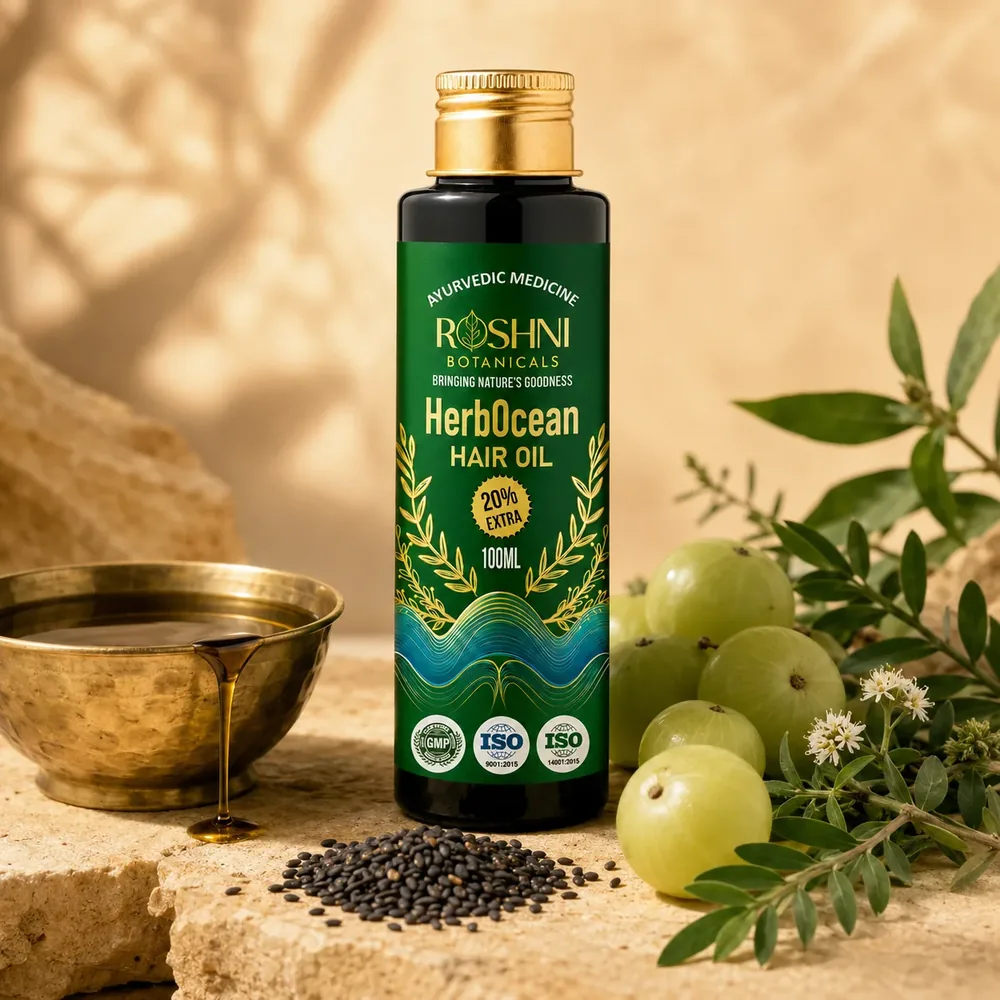
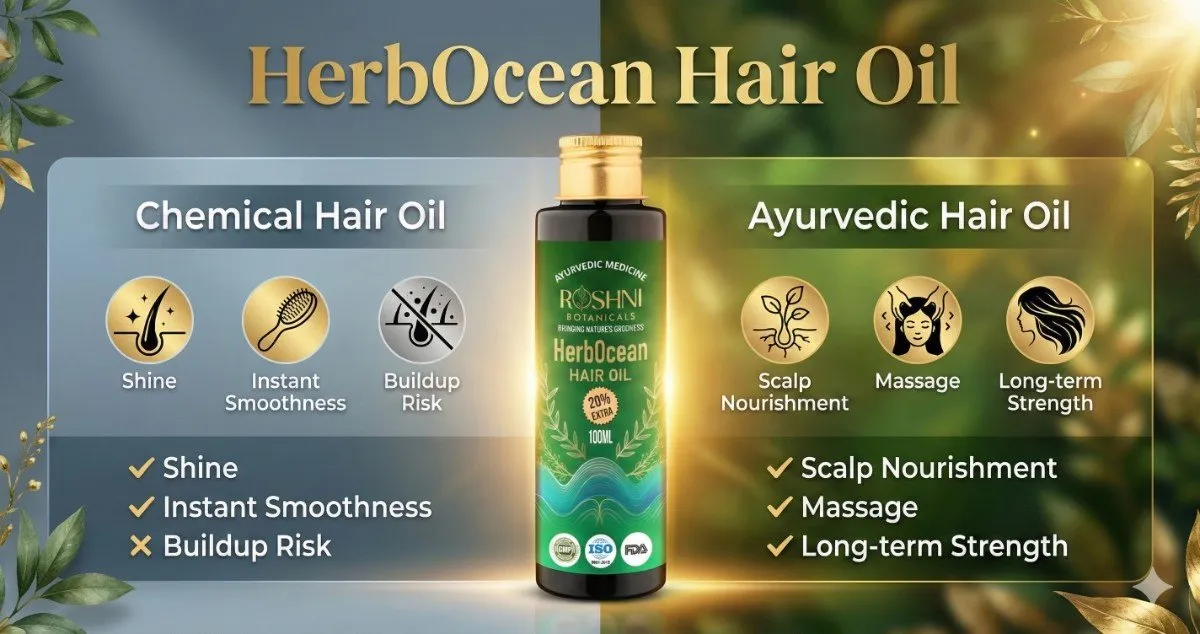
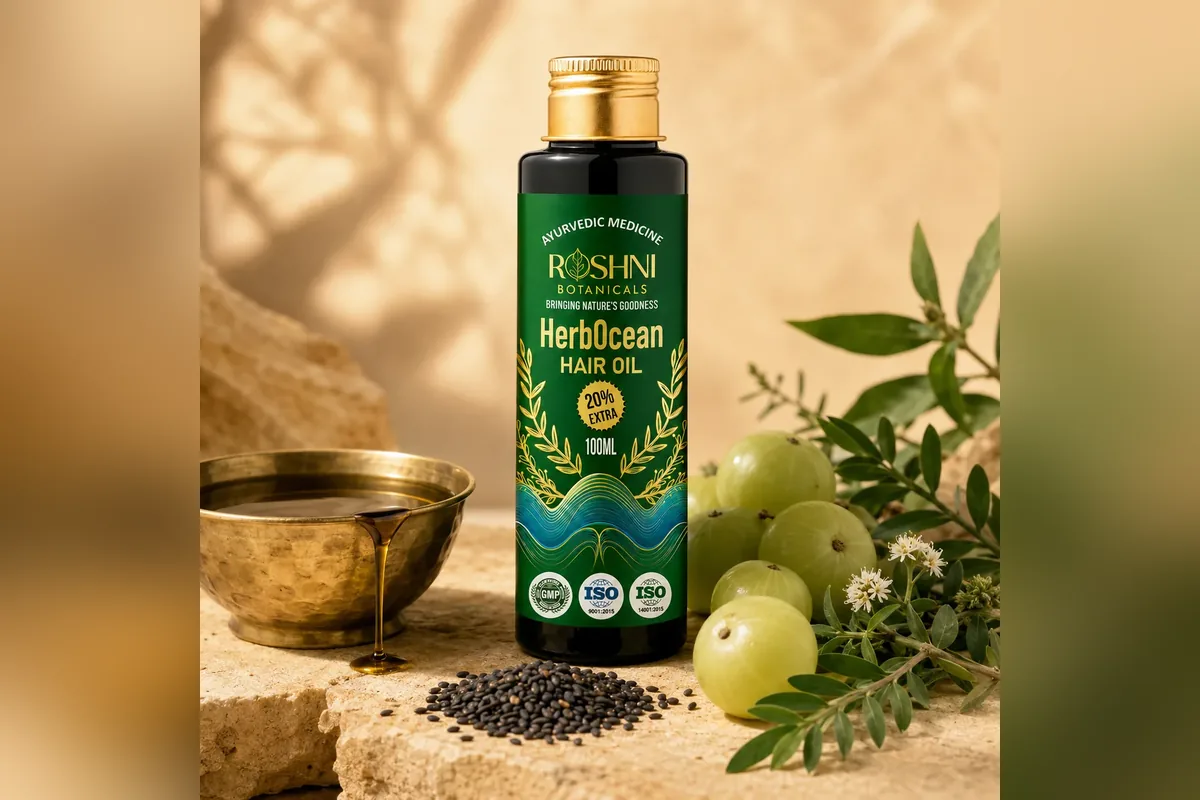
HerbOcean Hair Oil is an AYUSH-licensed Ayurvedic medicine for external use, classically indicated for hair fall and dullness. It nourishes the scalp, helps keep it clean and flake-free, and is traditionally used to support the scalp against dryness and seasonal hair fall. It is a classical Taila of sixteen botanicals in a sesame (Til tail) base: twelve herbs, namely Bhringraj, Jatamansi, Brahmi (Bacopa monnieri), Shikakai, Amla, Nagarmotha, Chharila, Sugandhbala, dried hibiscus (Gudal), Tulsi, rose (Gulab) and Neem, finished with lavender, curry leaf and rosemary oils. The finished oil is a deep reddish amber. It is made in-house at our GMP-certified unit in Bawana, Delhi, under AYUSH Licence No. DL-474 A&U, and built on the 40-year Ayurvedic formulation legacy of Vaidya Shri Ram Prakash Ji.
Bhringraj is one of the twelve, and none is placed ahead of another. When a flaky, itchy scalp turns out to be dandruff, the Ayurvedic word for it is Darunaka (the classical term for dandruff).
Warm a little oil between your palms, part the hair and massage it into the scalp with your fingertips for a few minutes, leave it on for at least an hour or overnight, then cleanse.
This is a medicine, so read the cautions before you start. For external use only. Patch-test on the inner forearm 24 hours before first use and discontinue if irritation occurs; avoid the eye area. Anyone with a known allergy to sesame or to a listed botanical, or with an active scalp infection or broken skin, should not use it without medical advice. If you are pregnant or nursing, check with your doctor before use. Keep the oil off your breasts, and never use it on the baby.
You will find it in our Ayurvedic hair care range, and you can read what regular oiling supports before you begin.
The Indian Scalp, and Signs for a Dermatologist
Your scalp lives with Indian conditions, and they shape what any oil can do. Start with water. Parts of Delhi draw hard groundwater, and its minerals can settle on the strand and leave it rough after a wash.
Then the air. As it turns dry and cold, a scalp that felt fine can go tight and flaky, and the first thing to settle is whether you are dealing with a dry scalp or dandruff, because the two are cared for differently; how to tell a dry scalp from dandruff lays out the signs. Heat styling brings its own wear, and the lengths show it first; the page on colour, heat and wash damage to the length covers that side. Oiling itself is a practice handed down in Indian families.
A few patterns are a question for a clinic. See a dermatologist for sudden or rapid shedding, for smooth, coin-shaped patches with no hair on them, for a scalp that hurts, weeps or crusts over, and for a widening parting. A shiny patch where the skin has lost its follicle mouths needs prompt attention, because that can mean scarring. If the hair loss began after a new medicine, show it to the doctor who prescribed that medicine rather than stopping it yourself. Shedding after childbirth, a fever or an illness runs a known course, and hair fall after a fever or illness explains it. If you want the whole practice in one place, go on to the definitive guide to Ayurvedic hair oils for hair fall control.
One Herb in Good Company
Bhringraj sits in Indian hair care as one herb in good company, cooked slowly into a medicated oil. Know the plant, know what the texts and the studies each say, and use the leaf, the powder or the oil with the care any medicine deserves. The oil is one part of that care, and the habit is the rest.
References: 1. Bhavaprakasha Nighantu, Guduchyadi Varga. The synonym verse (Bhringaraja, Kesharaja) and the kinds by colour. 2. Raja Nighantu, chapter 4 (Markava). Keshya among the names of the white kind, and the kinds by colour. 3. Timalsina D, Devkota HP. Eclipta prostrata (L.) L. (Asteraceae): Ethnomedicinal Uses, Chemical Constituents, and Biological Activities. Biomolecules, 2021; 11(11): 1738. Narrative review by authors in Nepal and Japan; the traditional uses, the chemistry, and the call for animal mechanism studies and clinical studies. 4. Begum S, Lee MR, Gu LJ, Hossain J, Sung CK. Exogenous stimulation with Eclipta alba promotes hair matrix keratinocyte proliferation and downregulates TGF-beta1 expression in nude mice. International Journal of Molecular Medicine, 2015; 35(2): 496 to 502. Animal study, Republic of Korea: 30 male nude mice in six groups of five; one group had a petroleum ether extract applied to the back skin daily for 20 days. Educational, not medical advice.
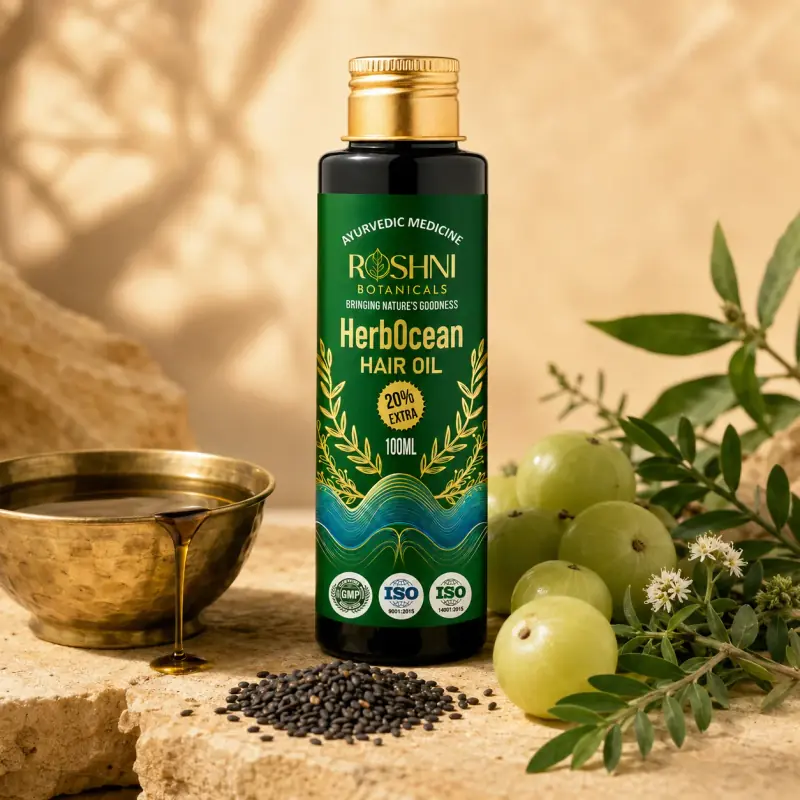
HerbOcean Hair Oil
A classical Taila for hair fall, dullness and a flaky scalp, with sixteen botanicals like Brahmi, Jatamansi, Amla and Neem in a slow sesame base.
Part of our guide: The definitive guide to Ayurvedic hair oils for hair fall.