Rosemary Oil for Hair: What the Trend Gets Right, and How Ayurveda Has Always Used It
Rosemary is everywhere on your feed, and the trend is not wrong, only incomplete. What one small trial actually found, why dilution is the whole game, and how a classical Taila solved it centuries ago.
Your feed has decided rosemary oil is the answer to every hair problem, and the reels are hard to look away from. The trend is not wrong, exactly; it is just incomplete. Rosemary has genuine merit for the scalp, but how you use it matters far more than whether you use it, and on a hot, humid Indian scalp the how is where most people go wrong. This is the calm version of the story, including the one thing the viral posts almost never mention: the tradition that solved rosemary's biggest problem centuries ago.
Key takeaways
- Rosemary oil may support scalp circulation and general hair health, and early research is encouraging, but no oil, herbal or otherwise, produces results on a promise or overnight.
- It is an essential oil, so it must always be diluted in a carrier oil; neat rosemary on a sweaty Indian scalp can irritate rather than help.
- Classical Ayurvedic oil-making (the Taila tradition, meaning a medicated oil) built dilution in from the start, processing potent botanicals into a gentle base oil, which is exactly the discipline the DIY trend keeps skipping.
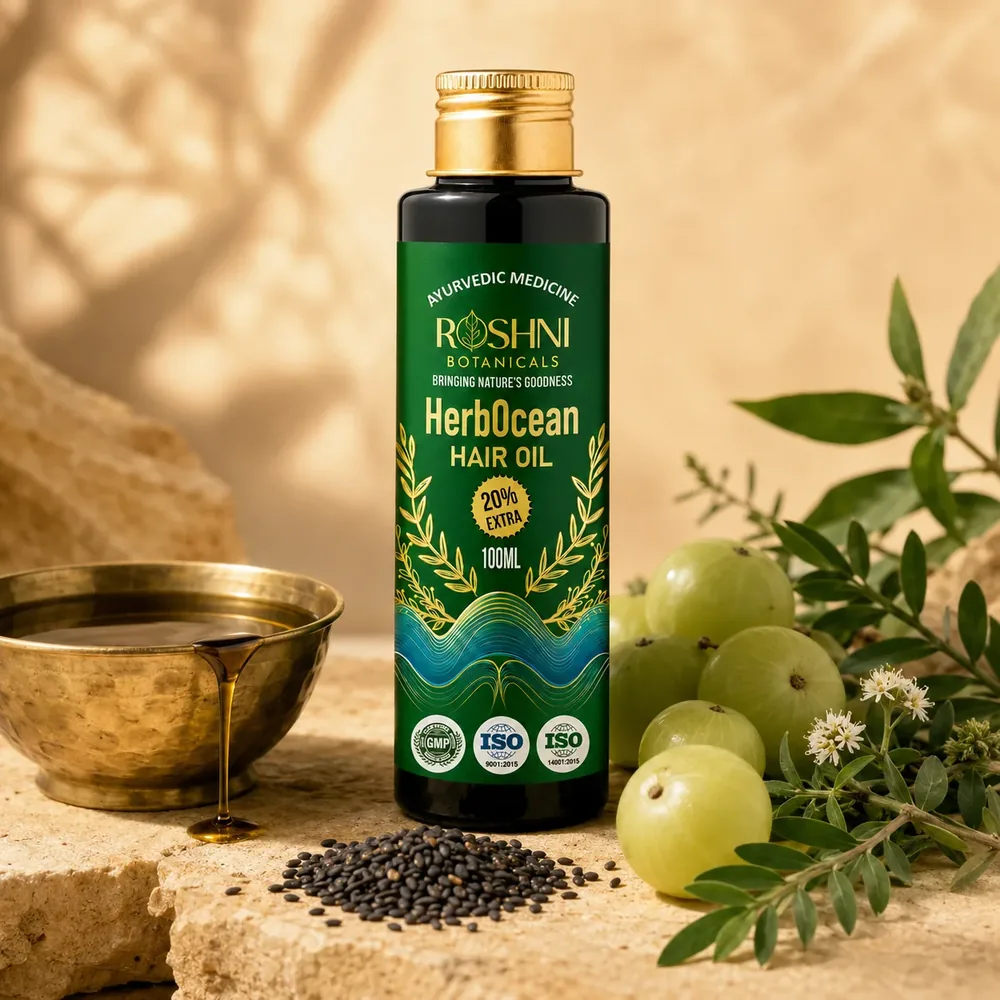
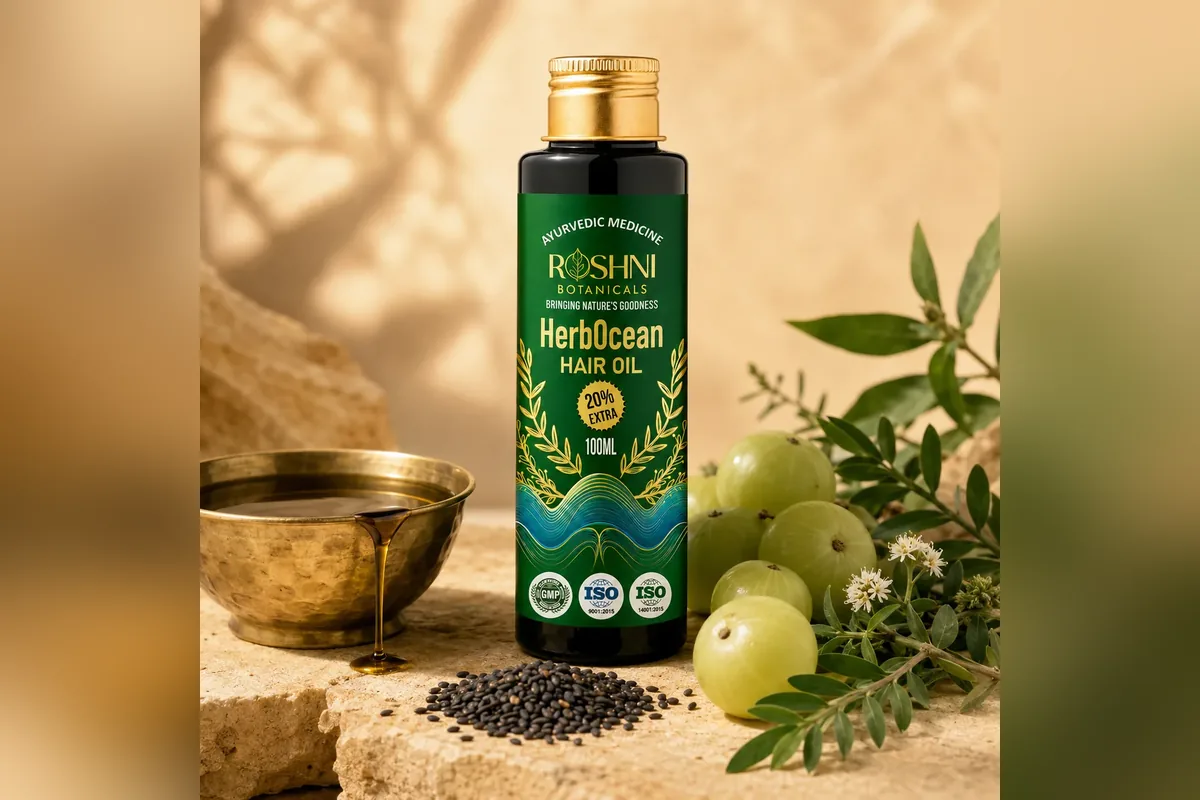
- HerbOcean Hair Oil already includes rosemary the correct way: a small, measured dose finished into a sesame base, so you never have to guess at drops.
- Much of what the trend credits to rosemary comes from the champi itself; scalp massage supports circulation whatever oil your fingers are carrying.
Why Rosemary Went Viral, and What the Research Actually Shows
First, what it actually is, since the reels rarely pause to say. Rosemary oil is the essential oil steam-distilled from the leaves of the rosemary shrub, the same fragrant herb on your kitchen masala shelf, concentrated many times over into a few potent drops. That concentration is the source of both its interest and its risk, and holding both in mind is the whole trick to using it sensibly.
Now an honest reading of the evidence, because the trend rarely offers one. The study everyone is loosely referring to is a single-blind randomised trial by Panahi and colleagues, published in SKINmed in 2015, which followed 100 adults with pattern hair loss for six months, fifty using rosemary oil and fifty using a 2 per cent pharmaceutical lotion. At three months neither group had a measurable change in hair count. At six months both groups showed an increase against their own starting point, and the researchers recorded no significant difference between the two. Scalp itching was reported in both groups.
Read that carefully, because the internet mostly does not. It is one small trial, single-blind, in a single population, and the paper did not report the population as Indian. One study of a hundred people is a promising signal, not settled science, and it is emphatically not a reason to stop or replace a treatment a doctor has prescribed for you. Nothing in this post, and no bottle of hair oil, is a substitute for prescribed medicine. What the trial reasonably supports is a modest claim: rosemary is a scalp botanical worth taking seriously, judged over months of consistent, gentle use.
Which is where the honest version parts ways with the viral one. You will see confident numbers online, exact percentages of growth and thickness, and claims that rosemary acts on the hormone behind pattern hair loss; read those with the same caution you would give any too-neat statistic on a product page, because the science is younger and softer than the marketing suggests. The trustworthy takeaway is modest and still worth having, and if hair loss is significant or sudden, that is a reason to see a doctor rather than to reach for a stronger bottle.
The Dilution Lesson the Trend Keeps Missing
Here is the single most useful sentence in this post: rosemary oil is an essential oil, and essential oils are potent and must be diluted in a carrier oil before they touch your scalp. Applied neat, especially on a scalp already warm and sweaty through an Indian summer or monsoon, concentrated rosemary can irritate, redden and itch, which is the opposite of what you wanted. If you do mix your own, the safe rule is a few drops of essential oil per tablespoon of a carrier such as sesame or coconut, patch-tested on the inner arm first, and never slept in neat.
Which carrier you reach for can follow the season, the way classical practice always let it. Sesame is the traditional base and the one to want through dry winter air and after a hard-water wash, because it sits on the strand and shields it. Through the stickiest monsoon weeks a lighter hand suits better: less oil, left on for less time, so the scalp is not kept damp and warm for hours, which is the condition flakes and itch enjoy most. The oil is not the variable to fuss over as much as the quantity and the dwell time, and both of those should move with the weather rather than stay fixed all year.
A safety note the reels almost never pin, and it matters in a country where hair oiling is a family affair: concentrated rosemary essential oil is generally advised against in pregnancy and while nursing, and anyone with sensitive skin, or a tendency to allergy, should be especially careful with the neat oil. If you are expecting, feeding, or simply prone to reactions, the sensible move is to skip the DIY concentrate entirely and rely on a gentle, already-diluted preparation, or to check with your doctor first. Potency is exactly what makes an essential oil worth respecting rather than splashing on.
Classical Ayurveda solved this problem so long ago that it never had to state it as a warning. The making of a medicated hair oil never applied concentrated aromatics on their own; potent herbs and oils were always processed into a gentle base oil, usually sesame, so that what reached the scalp was already diluted, balanced and safe to use regularly. The viral trend is, in effect, rediscovering that discipline the hard way, one irritated scalp at a time. A classical oil is dilution built in, by design, centuries before anyone made a reel about carrier oils.
How HerbOcean Hair Oil Delivers Rosemary the Classical Way
This is the quiet advantage of a formulated oil over a DIY blend, and it is why HerbOcean Hair Oil earns its place in a post about a trend. Rosemary is already in it, finished correctly: a small, measured dose of rosemary oil blended alongside lavender and curry leaf oils over a sesame (til tail) base that carries twelve classical herbs, led by Bhringraj, the classical hair-supporting (Keshya) herb whose fuller story lives in its own post on why Ayurveda calls it the king of herbs for hair, with Amla, Jatamansi, Brahmi and eight others. Counted properly that is sixteen botanicals in all. You get rosemary at a scalp-safe dilution without ever measuring a drop, and you get it in the company of a whole classical formula rather than alone. It is an AYUSH-licensed Ayurvedic medicine (Licence No. DL-474 A&U) for external use, traditionally used in the care of hair fall and dullness, formulated by Vaidya Shri Ram Prakash Ji, the master vaidya (a traditionally trained Ayurvedic physician) whose 40-year formulation legacy the HerbOcean line is built on, and made in-house at Roshni Botanicals' GMP-certified unit in Bawana, Delhi. For external use; patch-test on the inner arm before first use.
There is an India-specific reason a sesame-based oil suits the job, too. The hard, mineral-heavy water in most Indian metros leaves a film on the hair shaft that dulls it and roughens the cuticle; a sesame base helps shield the strand against exactly that wash-day stripping, a lived problem no viral rosemary reel filmed in a soft-water bathroom will mention. Rosemary is the fragrant, scalp-friendly finishing touch on that base, not a wonder worked in isolation, which is precisely how the classical tradition would have positioned it. If you want the full account of what goes into the bottle and why, our guide to the sixteen botanicals inside HerbOcean Hair Oil walks through the whole blend, neem and tulsi and rosemary included.
Champi: The Delivery Ritual the Trend Rediscovered
Watch the viral scalp-massage videos closely and you will notice something the captions rarely admit: half of what is happening is simply massage. This is the champi you grew up with, warm oil worked into the scalp with slow fingertip pressure for five to ten minutes, and the massage itself supports blood flow to the scalp, which is the very mechanism the trend attributes to rosemary. The oil carries the botanicals; the champi does much of the work. Give it that credit, and you also see why the ritual, not just the ingredient, is what deserves the following.
Used well, the rhythm is unhurried and undramatic: a gentle champi with a properly diluted oil two or three times a week, warmed comfortably, left an hour or two before a wash, or overnight in cooler weather; go lighter and shorter in peak monsoon humidity so the scalp is not left perpetually damp. This is the practical, repeatable version of scalp care that actually compounds over months, rather than the intense, occasional experiment the trend encourages.
Judge it honestly, too, because this is where most people mislead themselves. Hair grows slowly enough that nothing meaningful shows in a fortnight, and the trial above found nothing measurable at three months either; six is a fairer window. Shedding fifty to a hundred strands a day is ordinary, so a heavier monsoon shed is not proof your oil has failed any more than a quiet autumn is proof it worked. If you want to know, take one photograph in the same light at the same parting every month and compare month one with month six, not Tuesday with Wednesday. That is a slower verdict than a reel offers, and it is the only kind worth having.
When to See a Dermatologist
Rosemary, however you use it, is scalp care, not medical care, and a few situations need a doctor rather than a bottle. See a dermatologist or trichologist for sudden or patchy hair loss; for a scalp that is painful, scaly or persistently itchy despite gentle care; for shedding that continues heavily beyond a season; and for hair fall that arrives alongside fatigue, feeling cold or other body changes, which deserve thyroid and iron blood tests. A promising botanical is a fine thing to add to a routine; it is not a substitute for a diagnosis when the pattern is unusual, and it is not a reason to delay one.
Keep the Ritual, Skip the Hype
Rosemary earned its moment, and it deserves a calm place in a hair routine rather than the pedestal the reels keep building for it. Dilute it, respect it, and let the champi take the credit it is owed, and you have most of what the trend was reaching for. If you would rather not measure drops or risk the neat-oil mistake, HerbOcean Hair Oil delivers rosemary the way a classical medicated oil always has, a small measured dose in a sesame base, alongside Amla, curry leaf oil and a full company of classical herbs. Our definitive guide to Ayurvedic hair oils for hair fall control maps the wider practice; the trend will move on, but the tradition underneath it has been quietly right all along.
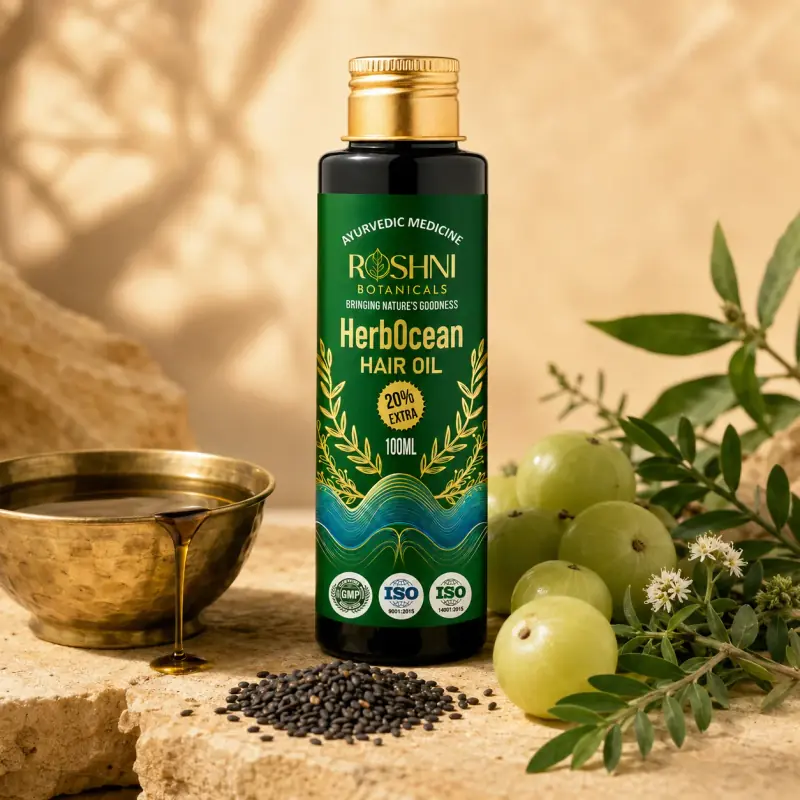
HerbOcean Hair Oil
A classical Taila for hair fall, dullness and a flaky scalp, with sixteen botanicals like Brahmi, Jatamansi, Amla and Neem in a slow sesame base.
Part of our guide: The definitive guide to Ayurvedic hair oils for hair fall.