Ayurvedic Ingredients for Hair: The Sixteen Botanicals in a Classical Hair Oil and What Each One Does
Sixteen botanicals, grouped by the job each one does: the root herbs, the scalp herbs, the cleanser, the calmers, the base, and honest expectations.
You turn the bottle over at a chemist's counter, or you scroll an ingredient panel on a listing page late at night, and it runs to sixteen lines. Bhringraj you know. Amla, of course. But Chharila? Sugandhbala? The fair question follows: is this a considered formula, or a long list assembled to look impressive?
Four things worth settling before the herb-by-herb detail.
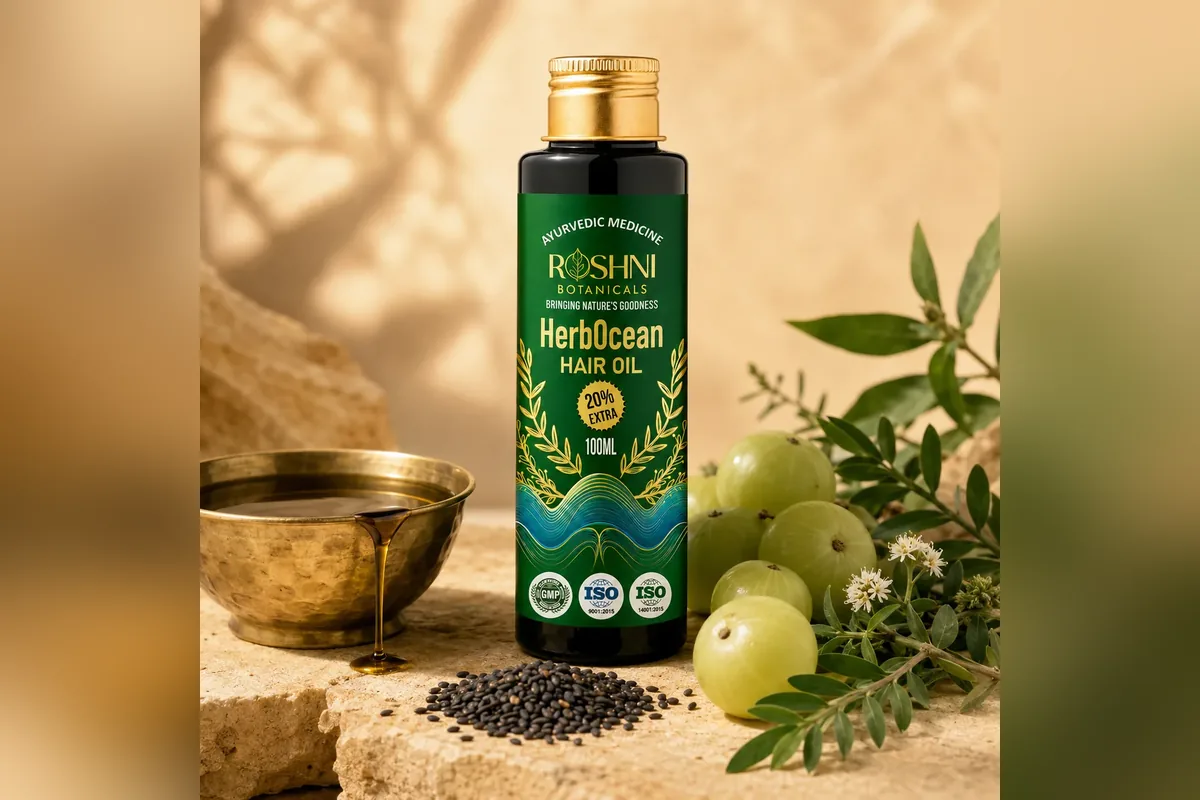
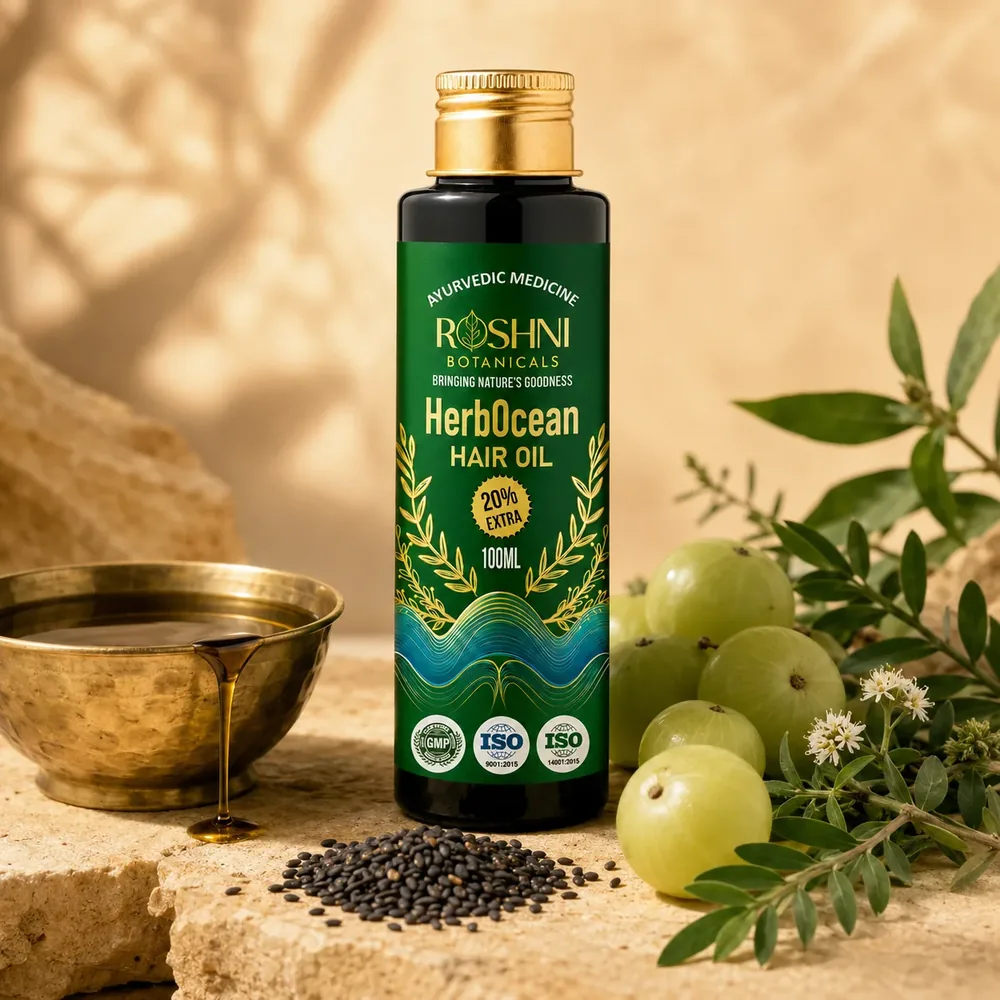
- A classical Taila (medicated oil) is not one showpiece herb in a carrier. HerbOcean Hair Oil carries sixteen botanicals: twelve herbs, a sesame base, and three finishing oils.
- The twelve herbs sit in equal measure, the same measured weight for every one. No herb outranks another, so the panel divides by job and not by rank.
- Hair grows at roughly one centimetre a month, and measured rates vary from head to head. No oil, herb, massage or ritual changes yours.
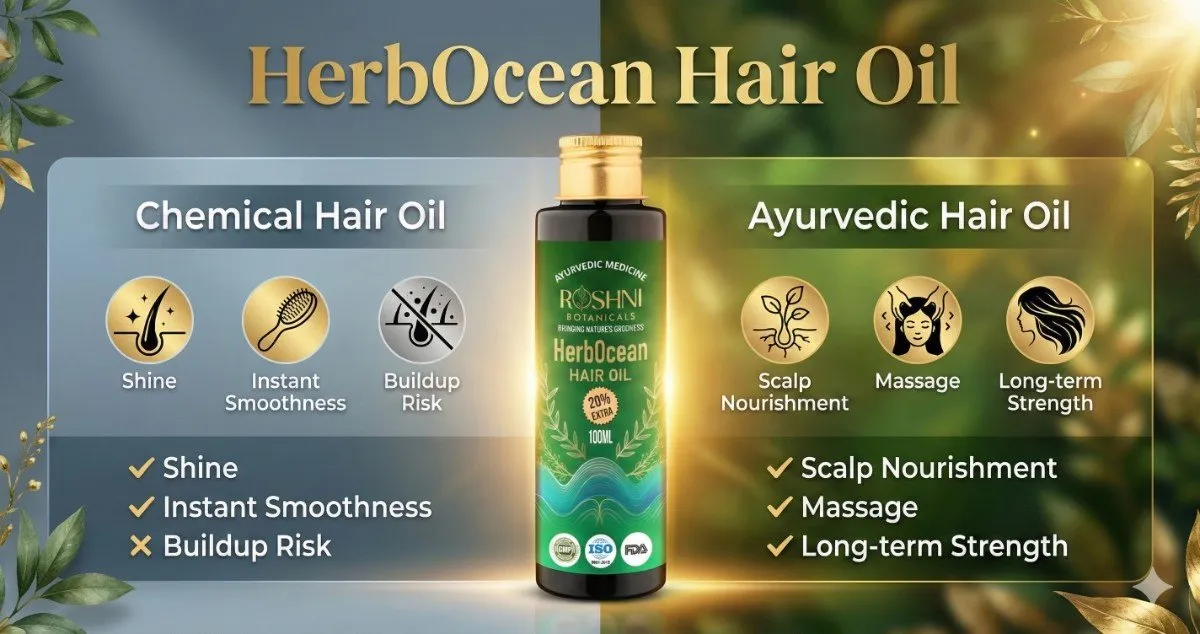
- It is an AYUSH-licensed Ayurvedic medicine for external use, traditionally used in the care of hair fall and dull hair.
What a classical Taila is actually doing
The herbs are cooked into the oil over long, low heat, so that their character carries into the finished preparation and what you pour out is a medicine instead of a scented base. That method is slow and expensive, which is exactly why the classical instinct is to layer several herbs into one long infusion rather than pick a single one.
Ayurveda keeps a working category for the herbs it holds to be hair-supporting, Keshya (hair-supporting, a classical class of herbs). It is a category and not a ranking, and it is selective: plenty of well-known herbs sit outside it. Several of the herbs in a classical hair oil are Keshya, and they are not twelve attempts at the same job. They are complementary by design.
In HerbOcean Hair Oil no herb sits above the others. Read that way, a long panel turns from a crowd of hopefuls into a small set of groups, and the groups are easy to hold in your head. If you want the dosha reading of hair fall specifically, we have set that out in how dosha balance shapes a hair fall oil.
What Indian hair and scalps are actually up against
Water first, the variable most people never think to check. Parts of Delhi draw on borewell groundwater, which tends to be harder than treated piped supply. Hard water leaves mineral residue, and households on it commonly describe hair that feels dull, coated and stiff after a wash.
Whether hard water measurably damages the hair fibre is not settled. What has been tested is the strength of cut hair in a laboratory, and the studies disagree. An Indian study in the International Journal of Trichology in 2013 soaked hair from fifteen volunteers and found no difference in tensile strength or elasticity. Two Pakistani studies, one in 2016 with seventy-six male donors and one in 2018 with seventy, found that hard water did reduce fibre strength. All three are small, all worked on cut hair, and none measured hair falling out. We have set out what that does and does not mean in what hard water actually does to hair.
Indian air does not hold one setting either. Stretches of heavy humidity give way to stretches of dry heat, and a scalp that felt greasy and itchy in the first can feel tight and flaky in the second, so one rigid routine suits neither.
Oiling in India is inherited, not adopted. Somebody taught you, usually a grandmother or an aunt, and the champi (the traditional head massage) arrived with a rhythm attached to it, before a wash and not after. That inheritance is worth engaging seriously instead of rediscovering it as a wellness trend.
Why the list divides by job, not by rank
If you arrived looking for the single best Ayurvedic herb for hair, the honest answer is that the question does not survive contact with a classical formula. Four jobs are being done at once, and no herb does all four.
The first is the root and the strand itself. The second is the surface of the scalp, the ground everything else grows out of. The third is cleansing, because an oil that seals in last week's build-up is working against you. The fourth is the quality of the thing on your head at the end of the day: its softness, its scent, how settled it feels.
This panel was written by a formulator and not by a marketing team. HerbOcean Hair Oil is built on the forty-year Ayurvedic formulation legacy of Vaidya Shri Ram Prakash Ji, and a formula assembled that way reads as four short answers and a base. That is why we would rather show you the groups than hand you a ranked list.
The twelve herbs in HerbOcean Hair Oil, grouped by job
The root and strand herbs
Bhringraj is the classical "king of herbs" for hair, and it carries the reputation in this category. A reputation that old is worth taking seriously, though it was never meant to be the only thing in the bottle. There is more in why Ayurveda calls bhringraj the king of herbs for hair.
Amla, the Indian gooseberry, is the other name everyone recognises, tied traditionally to the strength and condition of Kesha (hair). One caution belongs here, the most repeated error in the category. Amla is famously rich in vitamin C, but vitamin C is water-soluble and does not hold up well to heat, and a medicated oil is not a vitamin C serum. We have not measured what crosses into the finished oil, and we are not going to guess at it. The classical case for amla in a hair Taila never rested on that vitamin anyway. There is more in our guide to amla for hair.
The scalp herbs
Neem, Tulsi and Nagarmotha are the scalp herbs here, reached for classically where the scalp is uncomfortable, flaking or out of order. Chharila, stone flower, is the one almost nobody recognises, and the one that tells you the formula was written from classical sources.
These four do ground work: a follicle sits in skin, and skin that is flaking, crusted or sore is a poor address for anything. Two siblings go deeper: the science behind neem, hibiscus and nagarmotha, and how neem, tulsi and rosemary look after the scalp.
The cleanser
Shikakai is the household hair wash of Indian kitchens, a dried pod that lathers gently. Inside an oil it is not there to wash your hair. It is there because a classical hair formula has always treated cleansing and nourishing as one idea instead of two products, and because build-up on the scalp is a genuine obstacle to everything else.
The calming and conditioning herbs
Brahmi is Bacopa monnieri, the small thick creeping leaf, and not the pennywort sometimes sold under the same English name. It is the calming herb that appears in almost every classical hair Taila. Jatamansi and Sugandhbala are the quiet roots beside it, traditionally reached for where a person is unsettled and the scalp is unsettled along with them.
Gudal, dried hibiscus flowers, is the classical favourite for the feel and body of hair. Gulab, rose, closes the group. Conditioning is not the lesser job. For most people the first thing they notice about any oil is how the hair feels the day after a wash, and that is these five herbs working with the base.
The three finishing oils
Lavender, curry leaf and rosemary go in at the end as finishing oils rather than as herbs, which is why the count reads sixteen botanicals and not sixteen herbs. They are partly there for scent, and there is no need to be coy about that: an oil you dislike smelling is an oil you stop using. They are also traditional in hair care in their own right, curry leaf especially in South Indian households.
The sesame base, and why it is not an afterthought
Twelve herbs and three finishing oils need something to live in, and a base is not filler. HerbOcean Hair Oil uses sesame oil, Til tail, the classical carrier for a hair Taila. It suits a dry scalp, it holds up well over time, and it is what takes the herbs to the scalp instead of leaving them sitting on the lengths.
The finished oil is a deep reddish amber. That colour comes from the herbs and the long infusion, and it is worth knowing before you open the bottle: a pale, water-clear oil and a dark one are different preparations. Sesame against coconut is a real question with a real answer, and we have set the two side by side in sesame oil against coconut oil for hair.
What an oil can do, and what it cannot
No oil, herb, massage or ritual makes hair grow faster, and that includes HerbOcean Hair Oil. The detail sits in how fast hair actually grows.
What a classical Taila offers is steadier ground underneath. HerbOcean Hair Oil is an AYUSH-licensed Ayurvedic medicine for external use, traditionally used in the care of hair fall (Khalitya) and dull hair. Those are narrower terms than the category usually reaches for, and they are the ones we can stand behind.
Expect the feel of the hair and the comfort of the scalp to shift before anything else does. Shedding is much harder to read honestly. The count rises and falls with washing and combing, and one bad week at the basin tells you very little. Judge it across months, and not across a hairbrush.
Two things an oil does not do, stated plainly. A strand that has already turned grey will not be re-pigmented by anything you massage into the scalp around it. And hair fall driven by thyroid disease, iron deficiency or a hormonal condition needs the doctor who can test for it.
How to oil: the champi, done properly
The method matters as much as the bottle, and most of what goes wrong is technique.
Warm the oil gently, and warm is not hot: a small steel katori standing in a bowl of hot water is enough, and oil taken straight off a flame is how people scald a scalp. Part the hair in sections and work the oil onto the scalp itself with the pads of your fingers, never your nails, in slow circles. Whatever is left on your palms can go down the lengths. Two to three sessions a week suit most people. Leave it in for at least an hour, or overnight if that fits your week better, then wash it out properly, because oil left sitting under several days of city dust becomes its own problem.
Before the first full application, patch test on the inner forearm. Leave it alone, look at the skin again the next day, and do not go ahead if there is redness, itching or swelling. This is a medicine for external use, and it is not for broken or inflamed skin, or a scalp with an active infection. Anyone with a known allergy to sesame or to any of the botanicals listed above should not use it without medical advice. If you are pregnant or nursing, check with your doctor before use. Keep the oil off your breasts, and never use it on the baby. Our fuller Ayurvedic hair oiling routine covers the rhythm around washes.
When to see a dermatologist
Scalp care is for ordinary shedding, dryness and a scalp that is merely out of sorts. Several patterns are not that. See a dermatologist if any of these apply.
- Loss that is patchy, with smooth bald areas instead of general thinning.
- A parting that is visibly widening.
- Pain, burning or tenderness in the scalp.
- Scaling, crusting or pustules that will not settle.
- Shedding that is sudden and diffuse and is still going beyond six months.
That last one carries a timing note. Sudden, heavy shedding is worth a doctor's visit early instead of late, because its usual drivers are testable: iron deficiency, thyroid disease, a recent fever, the months after a delivery, or a medicine started recently. The same goes if the hair change arrives with fatigue, breathlessness, irregular periods or unexplained weight change.
One pattern earns prompt attention rather than a wait: a bald patch where the skin looks smooth and the follicle openings have disappeared. That can be scarring, and hair does not return from a follicle that has been scarred over.
Reading a hair oil panel, in short
The long panel on the back of a classical oil is not padding. It is four jobs and a base, written by people who assumed that root, scalp, cleansing and comfort were one problem instead of four products. HerbOcean Hair Oil is built on that assumption: twelve herbs in equal measure, a sesame base, three finishing oils, and nothing set above the rest. For the wider picture of where an oil sits in a hair-fall routine, and where it does not, our guide to Ayurvedic hair oils for hair fall control is the place to begin.
HerbOcean Hair Oil
A classical Taila for hair fall, dullness and a flaky scalp, with sixteen botanicals like Brahmi, Jatamansi, Amla and Neem in a slow sesame base.
Part of our guide: The definitive guide to Ayurvedic hair oils for hair fall.