Shikakai for Hair: The Gentle Classical Cleanser That Also Feeds the Roots
If your nani boiled shikakai with reetha and amla, you know clean hair without shampoo. The hair fruit has two roles: a gentle wash, and a quiet conditioner inside a classical oil.
If your nani boiled shikakai pods with reetha and amla on a Sunday morning, you already know how clean hair can feel without a drop of shampoo. Shikakai cleanses gently because its natural saponins lift oil and dust without stripping the scalp bare. That same gentleness is why it earns a place inside a classical hair oil, not just in the wash bucket, and why HerbOcean Hair Oil carries it alongside eleven other classical herbs. This is the story of the hair fruit, told properly.
Key takeaways
- Shikakai (Acacia concinna, literally the 'hair fruit') is traditionally used to cleanse the scalp gently without stripping its natural oils; its mildly acidic, saponin-rich pods have washed Indian hair for generations.
- Shikakai plays two different roles: as a wash, its saponins lather mildly and cleanse; infused into a sesame-based medicated oil (Taila), it contributes conditioning and scalp-comfort support with no lather at all.
- Unlike strongly alkaline, high-foam cleansing, shikakai is mildly acidic, close to the scalp's own slightly acidic surface, which is one reason it rinses cleaner in India's hard-water cities.
- In the classical herb classification, shikakai sits within the hair-supporting (Keshya) cleansing tradition: the texts approached washing as care for the scalp's environment, not as degreasing.
- Expect a short adjustment when switching from sulphate shampoos: less lather, two to three washes to recalibrate, and keep shikakai water strictly out of the eyes, because it stings.
What Shikakai Is, and Why It Earned the Name 'Hair Fruit'
Shikakai is the dried pod of a thorny climbing shrub that grows across central and southern India. The pods, ground or boiled, release saponins: plant compounds that behave like a gentle soap, binding to oil and grime so water can carry them away. The mechanism matters, because saponins clean by lifting rather than dissolving. A sulphate surfactant strips the scalp's oil layer wholesale and asks the skin to rebuild it; shikakai's saponins take the excess and the dust and leave the base layer largely where it belongs. That difference is the entire personality of the herb.
The second quiet advantage is acidity. Shikakai is mildly acidic, in the same neighbourhood as the scalp's own slightly acidic surface film, where strong foaming cleansers tend alkaline. Washing with something close to the skin's own chemistry means the cuticle lies flatter after the rinse and the scalp barrier is left less disturbed, which readers notice as hair that feels soft rather than squeaky.
It is worth pausing on how current this old herb suddenly sounds. The global sulphate-free and co-washing wave is, at its heart, a rediscovery of what Indian households never lost: that a scalp cleaned gently, at its own chemistry, behaves better than a scalp scrubbed to squeaking. The name itself records the use; shikakai translates, near enough, as the fruit for hair, and a plant does not earn a name like that from one generation's enthusiasm. It earns it from centuries of Sunday mornings.
Classically, shikakai belongs to the cleansing wing of the hair-supporting (Keshya) tradition. The materia medica of Ayurveda records it among the herbs used for washing the head and body; classical texts such as the Bhavaprakasha Nighantu carry the entry, and the tradition's framing is worth keeping: washing was treated as care for the scalp's environment, the soil the hair grows from, not as an act of degreasing. Every practical tip in this post follows from that one idea.
The Grandmother's Method: Shikakai, Reetha and Amla in the Wash Bucket
The home method survives because it works. Pods of shikakai, a few reetha (soapnut) shells and dried amla, soaked overnight or boiled until the water turns the colour of strong tea, strained, and worked through wet hair as a low-lather wash. Roughly equal parts of the three is the common household starting point; shikakai-heavy mixes cleanse more gently, reetha-heavy mixes cleanse more strongly. The liquid does the cleansing, reetha adds the lather, and amla brings its own long association with hair strength; its dedicated story is a post of its own, so one line here will do.
If you are switching from years of sulphate shampoo, arrive with honest expectations. There is far less foam, and foam is not what cleans; give your scalp two to three washes to recalibrate before judging the result. Keep your eyes firmly shut through the rinse, because shikakai water stings sharply, a caution every grandmother issued and most blog posts forget. And strain the liquid well, or pod grit will spend the week in your parting.
A few modern adaptations keep the method liveable on a working week. Ready-ground shikakai powder soaked for an hour stands in acceptably for whole pods boiled for longer, though whole pods strain cleaner. Make only what the week needs: the strained liquid keeps two to three days in the fridge in a clean bottle, and a batch that smells sour has crossed its date. And know whose hair it suits best: oiled and regularly champi-ed hair takes to shikakai beautifully, while very dry, bleached or chemically straightened hair may find it slightly astringent, and can either shorten the soak or return to it after the hair recovers. The method is forgiving; it just rewards a little judgement.
Hard water is where this tradition quietly outperforms modern habit. The borewell and tanker supply in most Indian metros is mineral-heavy, and high-foam shampoos leave surfactant and mineral residue that builds into the dull film hard-water households know well. A low-lather, mildly acidic wash rinses out more completely in the same water, which is much of why shikakai-washed hair keeps its swing in cities where shampooed hair turns flat by Thursday. An occasional final rinse with filtered or boiled-and-cooled water helps whichever route you take. The wash itself is set out step by step, with the trade-offs it asks of you, in our full guide to the shikakai and reetha hair wash.
Shikakai in an Oil, Not Just a Wash: What Infusion Changes
Here is the distinction the internet skips, and the reason this post exists. When shikakai is infused into an oil, it stops being a cleanser. There is no water phase, so the saponins never foam; what the sesame base draws out of the pod instead is its conditioning, scalp-comforting side. One herb, two roles, decided entirely by the medium carrying it. The wash-bucket shikakai cleanses your scalp on Sunday; the oil-infused shikakai supports it quietly all week.
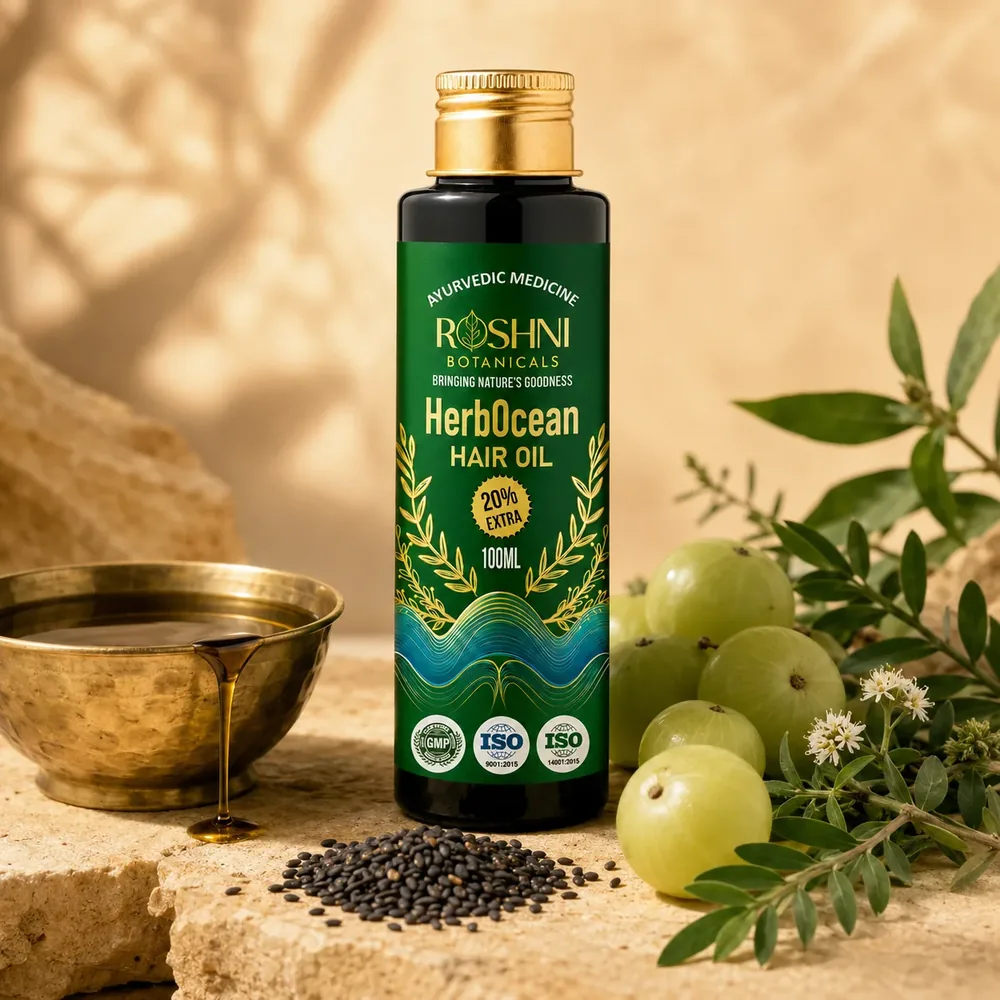
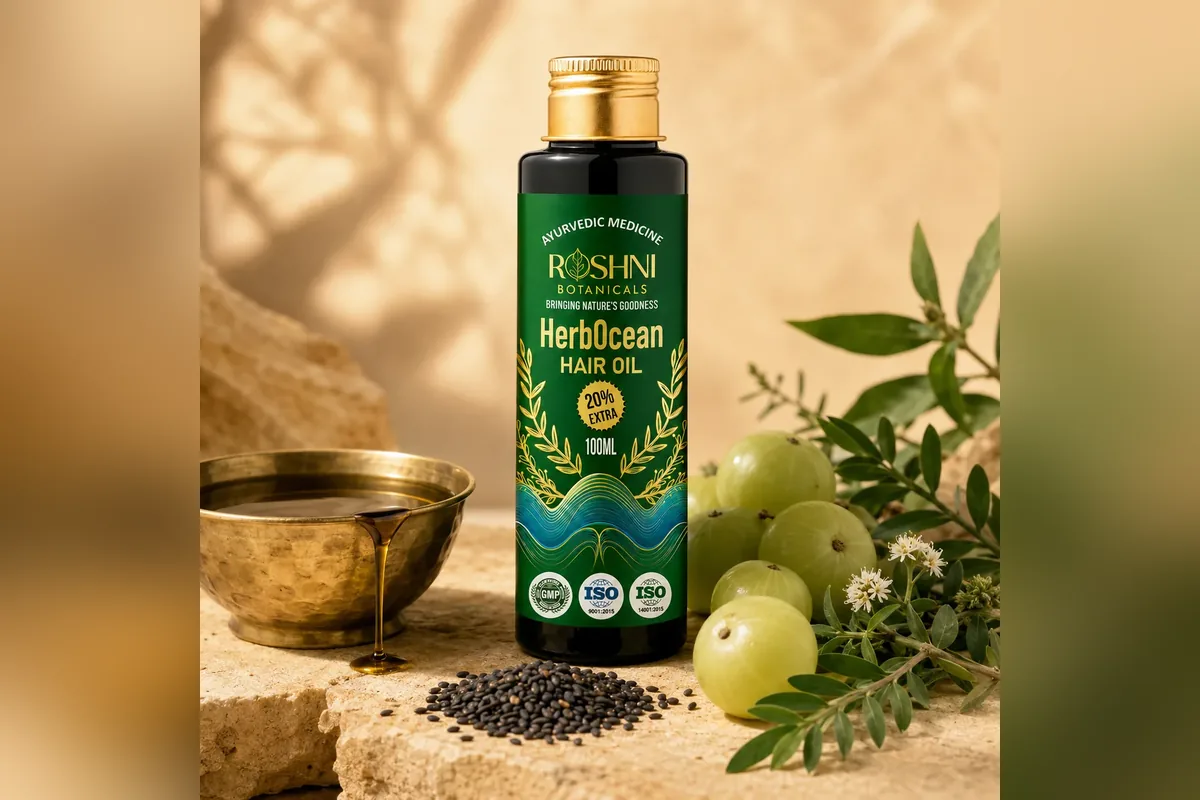
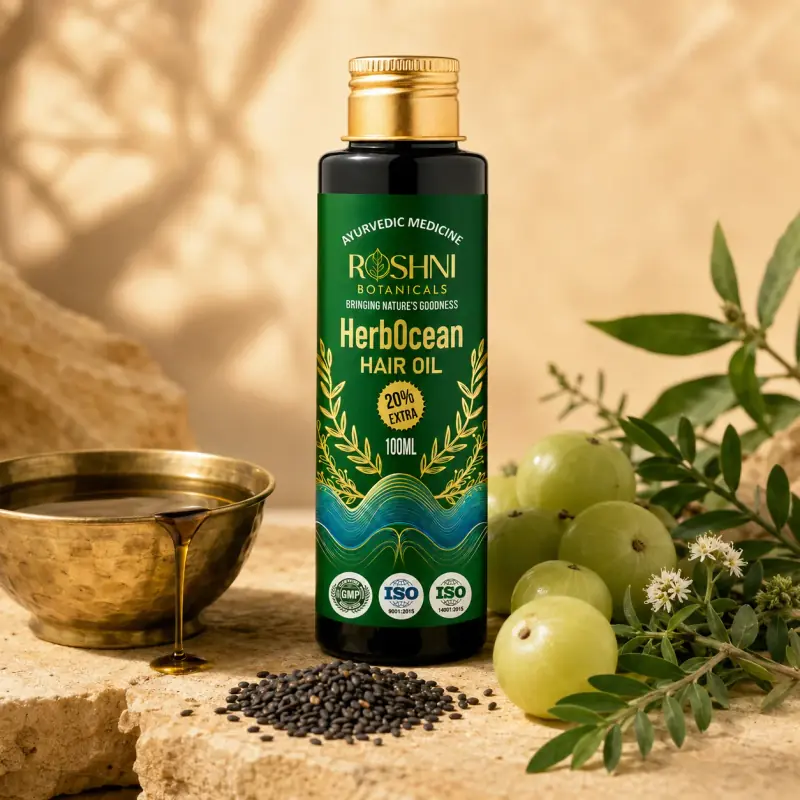
That is the role it plays in HerbOcean Hair Oil, a classical medicated hair oil (Taila) in a sesame-oil base, where Vaidya Shri Ram Prakash Ji, the master vaidya whose 40-year formulation legacy the HerbOcean line is built on, places shikakai alongside Bhringraj, the classical Keshya rasayana (rejuvenative tonic) whose full story lives in a post of its own, Amla, Jatamansi, Brahmi, Nagarmotha, Chharila, Sugandhbala, Gudal (hibiscus), Tulsi, Gulab (rose) and Neem, finished with lavender, curry leaf and rosemary oils. It is an AYUSH-licensed Ayurvedic medicine (Licence No. DL-474 A&U) for external use, made in-house at Roshni Botanicals' GMP-certified unit in Bawana, Delhi, and it is traditionally used in the care of hair fall and dullness. Our guide to the herbs inside a classical hair oil walks through all sixteen.
Why would a vaidya put a cleansing herb into an oil at all? Because a classical formulation is designed as a week of scalp care in one bottle, not a single effect. The formulation logic reads like a rota: nourishing herbs for the roots, calming herbs for the mind and scalp, hygiene-keeping herbs for the humid days, and shikakai's conditioning side to keep the whole blend sitting comfortably on skin. Each herb is chosen for what the sesame base can draw from it, which is a different question from what water draws from it in a wash bucket. That is the quiet craft in a sixteen-botanical Taila, and the reason it cannot be improvised by stirring powders into a bottle at home.
The monsoon is when this pairing earns its keep. Humid weeks leave the scalp sweaty, buildup-prone and limp at the roots, and the honest seasonal routine is a one-to-two-hour pre-wash oiling followed by a thorough gentle wash, rather than heavy oil left on a damp scalp for days. A shikakai-inclusive oil before a shikakai-style wash is the tradition agreeing with itself: conditioning support first, gentle cleansing after, and a scalp that comes out of the season comfortable instead of coated.
How to Use Shikakai Well (and When to See a Dermatologist)
A simple weekly rhythm covers most heads. Oil the scalp the night before or one to two hours ahead of wash day, with a gentle fingertip champi; wash with your chosen cleanser, shikakai liquid or otherwise, two to three times a week; rinse thoroughly, and let hair part-dry before combing. The oil is for external use; patch-test on the inner forearm before first use, as with any new preparation. If you colour your hair, note that shikakai's mild deposit can very slightly deepen tones over months, which most Indian hair reads as richness rather than damage.
The gentleness also makes shikakai a family herb. Generations of Indian children had their first head washes with shikakai water precisely because it asks so little of young skin, and the same logic holds today: for a child's wash, keep the liquid weaker, the session shorter, and the eyes-shut rule absolute. As with any preparation, a first-time patch test on the inner arm is sensible at every age, and anything that provokes redness or itching, however traditional, is not for that particular scalp. Tradition supplies the method; your own skin supplies the verdict.
And keep the honest boundary in view: shikakai is a cleanser first. It supports a clean, comfortable scalp, which is the ground healthy hair grows from, but it does not act on hair fall directly. Sudden or patchy hair loss, persistent itching or flaking despite gentle care, a painful or scaly scalp, or shedding that arrives with fatigue or weight changes are signals for a dermatologist or trichologist, not for another home preparation. A correctly named problem is half solved.
The Hair Fruit, Kept in the Family
Shikakai never needed rediscovering in India; it only needed explaining properly. As a wash, it cleans the way the scalp prefers to be cleaned, gently and at its own chemistry. Inside a classical oil, it turns conditioner, supporting the scalp between washes. If you would rather let a vaidya do the measuring, HerbOcean Hair Oil carries shikakai alongside Bhringraj, Amla and nine other classical herbs in a sesame-oil Taila, and our definitive guide to Ayurvedic hair oils for hair fall control sets out how the whole tradition fits together. Your nani's wash bucket and a modern formulation desk agree on this one.
References
- Bhavaprakasha Nighantu, the classical Ayurvedic materia medica, which records shikakai (Acacia concinna) among the herbs used for washing the head and body.
- Phytochemical studies of Acacia concinna have documented its saponin content and mild surfactant action; these describe the plant's cleansing chemistry and are not a treatment claim.
HerbOcean Hair Oil
A classical Taila for hair fall, dullness and a flaky scalp, with sixteen botanicals like Brahmi, Jatamansi, Amla and Neem in a slow sesame base.
Part of our guide: The definitive guide to Ayurvedic hair oils for hair fall.