Grey Hair and Ayurveda: What Oiling Can and Cannot Do
Grey strands in your twenties, and an internet full of promises. Here is what is actually known, and what a hair oil can and cannot do.
You are in your twenties, perhaps the early thirties, and there it is at the parting: one strand catching the light differently from the rest. By next month there are two more. Then the searching begins, and the internet answers with oils, powders and promises.
This page makes no promise about the colour of your hair, because nothing HerbOcean sells carries a claim about hair colour at all. What it offers instead is what is actually known: what a grey strand is, what Indian studies have found, how the classical texts read early greying, and where a hair oil fits.
Key takeaways
- A strand that has already grown out grey is keratin without pigment, and nothing applied to it alters its colour. Mehendi and dyes coat or stain it, which is the honest answer if you want the grey covered.
- The follicle question is more open than either side of the argument admits. A 2021 human study documented individual hairs regaining pigment along their length, while the finding that stress greys you for good is from mice.
- Indian research points first at family history, then at low vitamin B12 and thyroid dysfunction, with one of the two studies also finding lower ferritin. These are associations, not established causes.
- Before you buy anything, ask your doctor for serum vitamin B12, serum ferritin and a thyroid panel. A largely vegetarian plate makes B12 worth checking on its own account.
- HerbOcean Hair Oil is an AYUSH-licensed Ayurvedic medicine for external use, classically used for hair fall, dullness and scalp care. It carries no indication for hair colour, and none is offered.
What a grey strand actually is
Colour is put into hair before you ever see it. Melanocytes at the base of the follicle deposit melanin into the shaft as it is built, so a strand emerges already coloured. A strand that emerged without pigment is keratin without pigment, and nothing applied to it will change that. Mehendi and chemical dyes coat or stain the outside of the strand, a different mechanism entirely, and if you want the grey covered, that is the honest route.
The follicle underneath is a more open question than most confident advice allows. In 2021 a study published in eLife mapped pigment hair by hair in fourteen people aged nine to sixty-five in the United States, and documented individual hairs that lost pigment and regained it further along their length, in several cases during periods the donor reported as less stressful. Those hairs belonged to participants ranging from a child to adults in their thirties, not to the very old.
Set against it is the study everyone quotes when they say stress greys you for good. That one appeared in Nature in 2020 and was done in mice, where stress-released noradrenaline emptied the follicle of its melanocyte stem cells. Careful work, and a mouse model. So a strand already grown out grey is fixed, while whether a given follicle is finished is not settled either way. None of that is a claim for any oil, including ours.
Premature by whose clock?
There is no agreed Indian reference range for when greying counts as early. The convention quoted in the literature draws the line before twenty in White populations, before twenty-five in Asian populations and before thirty in African populations. Indian studies have generally worked with a cut-off of twenty-five years and five or more grey hairs on the scalp. Read that as a convention: a line drawn so researchers can compare groups, not a verdict on you.
What Indian studies have found
Two Indian studies are worth knowing. The first, a retrospective analysis of seventy-one cases at an urban skin clinic in North India, published in the Indian Journal of Dermatology in 2017, found vitamin B12 deficiency and hypothyroidism significantly associated with early greying, while anaemia, serum ferritin and fasting blood glucose were not. A positive family history in a parent or sibling turned up in the large majority of those cases. The second, a case-control study at a trichology clinic in Bengaluru, published in the International Journal of Trichology in 2016, set thirty-seven people under twenty-five against thirty-seven matched controls and found lower serum ferritin, lower vitamin B12 and lower HDL cholesterol in the greying group.
Read both as associations rather than causes. The numbers are small, they are clinic populations, and the two do not even agree about ferritin. What survives both is worth acting on: family history is the strongest single factor and is not a deficiency of anything, and vitamin B12 sits in both pictures.
The practical consequence is specific. Before you buy anything for your hair, ask your doctor for serum vitamin B12, serum ferritin and a thyroid panel including TSH. If your plate is largely vegetarian, as most Indian plates are, B12 deserves checking on its own merits. If any of the three comes back low, the correction belongs on your plate and with your doctor rather than in a bottle; our note on everyday Indian foods for stronger hair is a place to begin.
The classical reading
Grey hair is Palitya in the classical texts, and greying before its time is Akala Palitya. Sushruta Samhita places Palitya among the Kshudra Roga (minor diseases) in Nidana Sthana 13, where minor describes the prognosis, not the importance. The cause given there is unusually specific: heat in the body, raised by anger, grief and overwork, takes recourse to the region of the head and ripens the hair before its natural time. Ashtanga Hridaya says almost the same in Uttara Sthana 23, on disorders of the head.
This is why the tradition reads early greying as aggravated Pitta (the heat principle among the three doshas, the biological energies of Ayurveda), and answers it with habits rather than anything applied to the strand: cooling food, unhurried meals, sleep at a sensible hour, less heat in the day and in the temper, and regular oiling of the head. Take that as the reading of a tradition, not as physiology. Two systems of thought, twenty centuries apart, put a finger on the same lever, which is calm. Worth noticing; it is not evidence that the texts anticipated a paper from 2021.
What oiling can honestly do
Oiling does real and unglamorous work: it conditions a dry scalp and eases the tightness and flaking that follow. Applied before a wash, it lays a film over the strand so that less of what comes out of the tap reaches the hair, which matters in Delhi and much of North India, where hard water leaves hair rough and liable to snap mid-length; our post on what hard water does to your scalp goes into that. It also softens dullness and cuts breakage.
Then there is the champi itself. Ten minutes of steady pressure on the scalp at the end of a long day settles you, and that settling is the one lever both the tradition and the 2021 human observation point towards. It is an observation about what the body does under less strain, not a property of any oil, and no claim that a calmer month changes the colour of your hair.
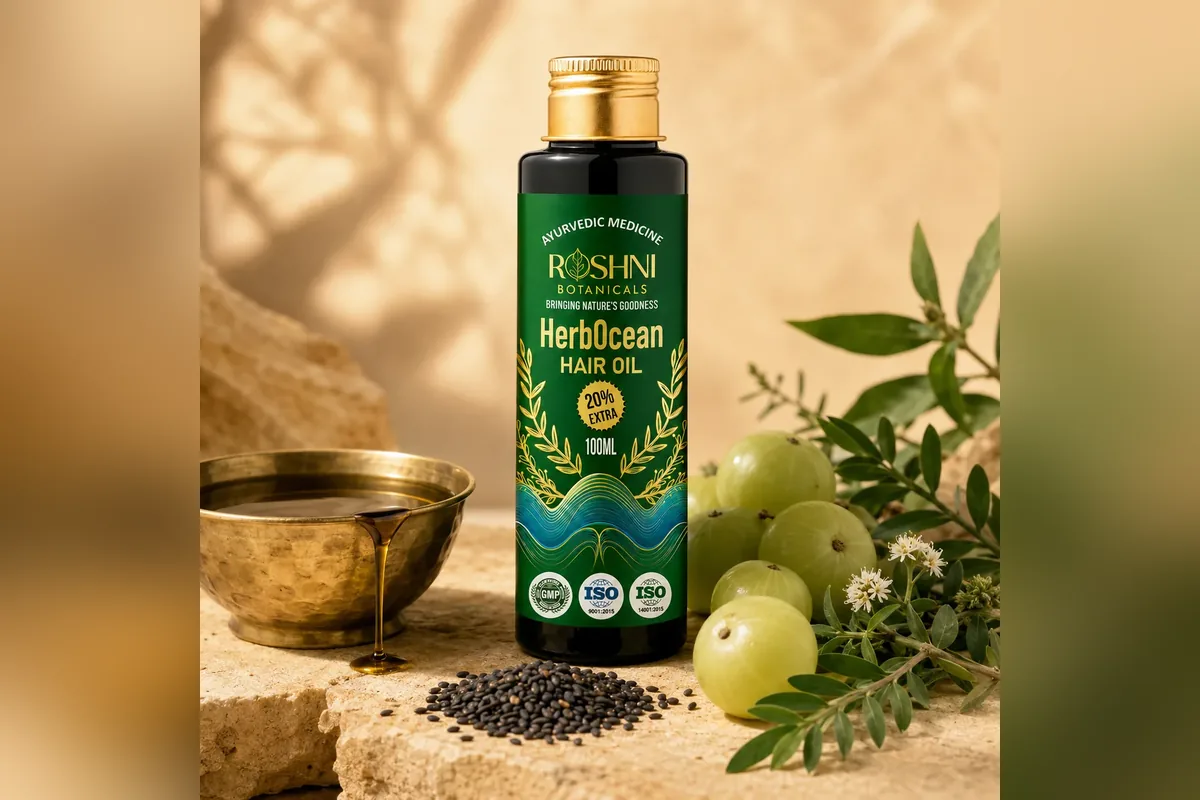
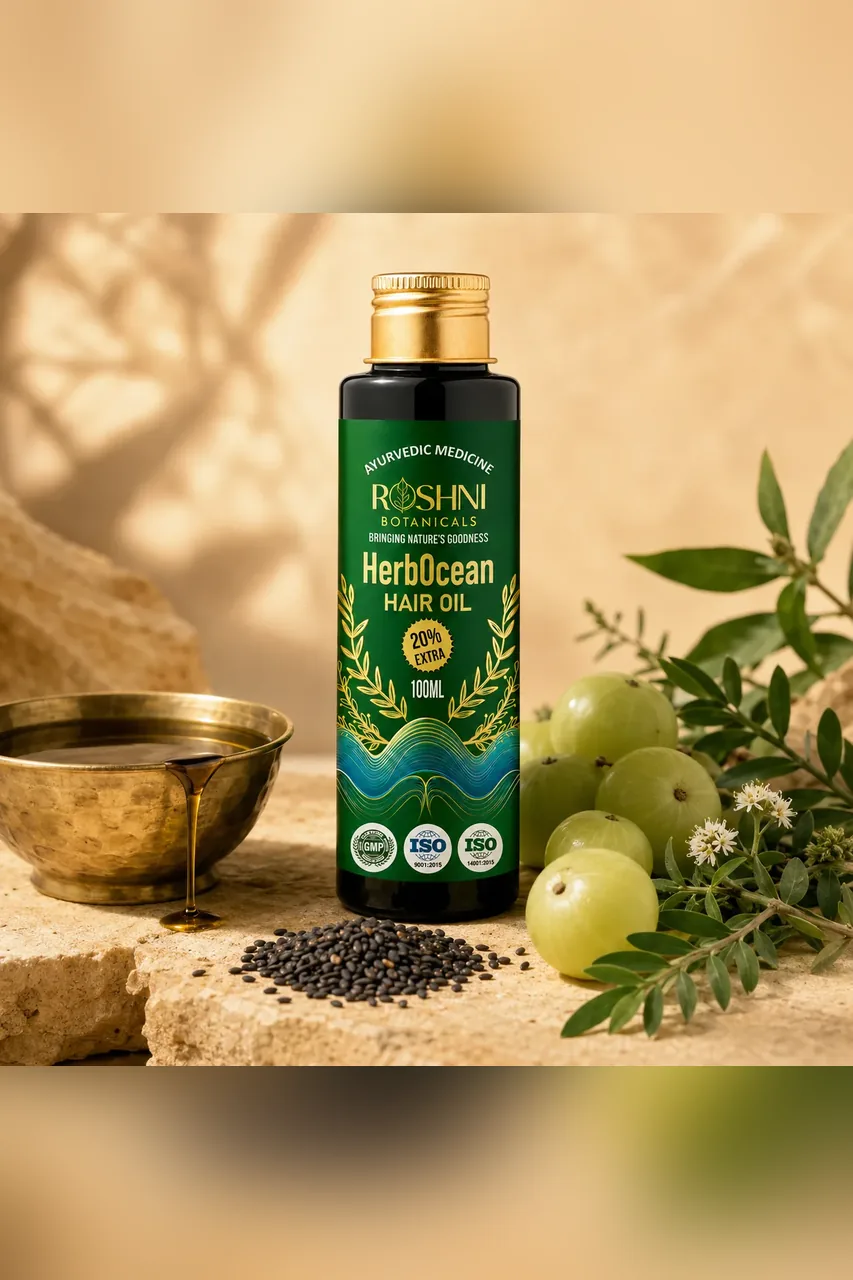
That is where HerbOcean Hair Oil sits. It is a classical sesame-based Taila (medicated oil) of sixteen botanicals made in-house in Delhi, among them Bhringraj, Jatamansi, Brahmi, Shikakai, Amla, Nagarmotha, Chharila, Sugandhbala, Gudal or hibiscus, Tulsi, Gulab and Neem, with lavender, curry-leaf and rosemary oils. It is an AYUSH-licensed Ayurvedic medicine for external use, classically used for hair fall (Khalitya), dull and dry hair, and ordinary scalp care. It carries no indication for hair colour and is not sold for hair colour. Amla is in the formula, and the long association between amla and hair colour belongs to the tradition rather than to any tested claim; the detail sits in our post on amla oil for hair growth.
The rhythm fits in a sentence: two or three times a week, oil warmed a little above body temperature, worked in with the pads of the fingers, left a few hours or overnight, then washed out gently. The full method is in our step-by-step Ayurvedic hair oiling routine, and if hair fall rather than colour is your real worry, begin with the definitive guide to Ayurvedic hair oils for hair fall control.
What oiling cannot do
It does not put pigment into a strand that has already grown out grey. Nothing does. It does not alter what you inherited, and inheritance is the strongest single factor in the Indian data. It does not correct a vitamin B12, iron or thyroid problem either; those need a blood test and a doctor, not a bottle.
And there is no number of weeks to offer for colour, because oiling does not act on colour at all. Over some weeks you may find the scalp less tight and the hair easier to comb. For anything to do with pigment, that is not what the oil is for. Any brand that hands you a timeline for the colour of your hair is telling you something it cannot know.
When greying is a reason to see a doctor
Greying on its own is not an emergency, and in most families it is simply what the family history predicted. A few combinations, though, deserve an appointment rather than another bottle.
If the greying arrives with persistent tiredness, breathlessness climbing a flight of stairs, or tingling in the hands and feet, ask for vitamin B12 and iron studies. If it comes with weight change you cannot account for, a new intolerance of heat or cold, or a clearly shifted resting heart rate, ask for a thyroid panel. A patch of white hair over a patch of white skin belongs with a dermatologist, as does greying that arrives suddenly, over weeks rather than years.
Greying that begins in childhood or adolescence is worth one conversation with a paediatrician or dermatologist, particularly where the family history runs young. One conversation, not alarm: in most such families the finding is what that history would predict.
There is a quieter way to sit with all of this. You can look after the hair you have, without asking any of it to rewind. Eat in a way that gives the follicle something to build with, get the three blood tests if you are greying young, and oil your scalp because it feels good. The strands that have already turned will do what they were always going to do, and you are entitled to cover them with mehendi or simply wear them.
References: Sushruta Samhita, Nidana Sthana 13, Kshudra Roga Nidana, on Palitya. Ashtanga Hridaya, Uttara Sthana 23, Shiroroga Vijnaniya, listing Palitya among the disorders of the scalp. Sonthalia S, Priya A, Tobin DJ. Demographic Characteristics and Association of Serum Vitamin B12, Ferritin and Thyroid Function with Premature Canities in Indian Patients from an Urban Skin Clinic of North India: A Retrospective Analysis of 71 Cases. Indian Journal of Dermatology, 2017;62(3):304-308 (retrospective, n=71, urban North India). Chakrabarty S, Krishnappa PG, Gowda DG, Hiremath J. A case-control study of premature greying in a young Indian population. International Journal of Trichology, 2016;8(1):11-14 (case-control, n=37 cases and 37 matched controls, Bengaluru, India). Rosenberg AM, Rausser S, Ren J, and colleagues. Hair-by-hair pigment mapping in relation to life stress. eLife, 2021;10:e67437 (n=14, aged 9 to 65, United States). Zhang B, Ma S, Rachmin I, and colleagues. Hyperactivation of sympathetic nerves drives depletion of melanocyte stem cells. Nature, 2020;577(7792):676-681 (mouse model).
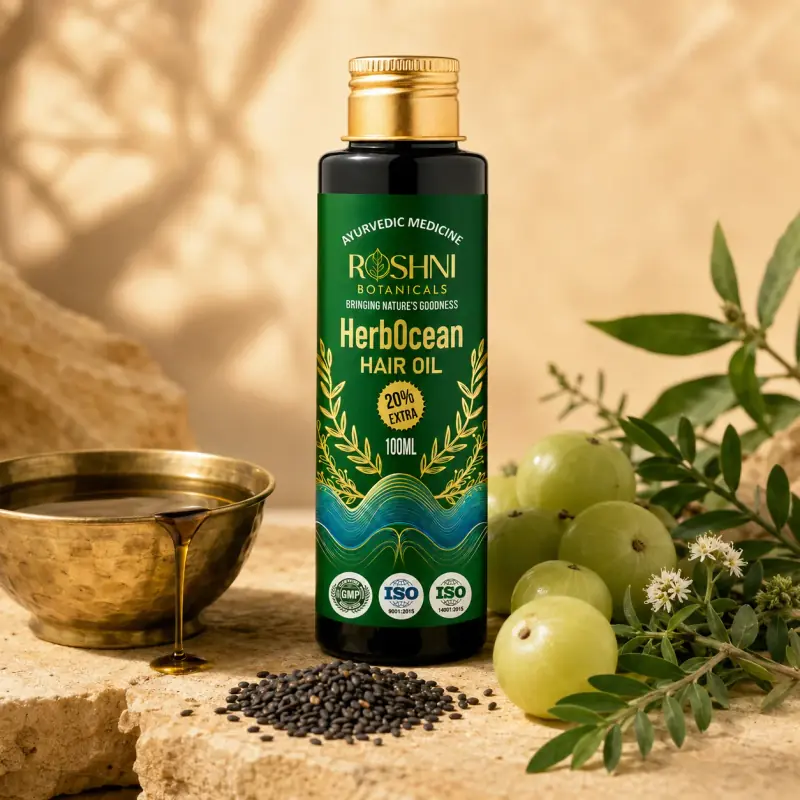
HerbOcean Hair Oil
A classical Taila for hair fall, dullness and a flaky scalp, with sixteen botanicals like Brahmi, Jatamansi, Amla and Neem in a slow sesame base.
Part of our guide: The definitive guide to Ayurvedic hair oils for hair fall.