Ayurvedic Nighttime Hair Care: How Long to Leave the Oil In
A night routine moves two things: the hours the oil sits, and the hours your hair spends against cloth. How to use both, and the nights to skip the oil.

Most of us learnt hair oiling as a night thing. Oil before bed, wash in the morning, and nobody at home questioned the order. Then the internet split into two confident camps. One says an overnight soak is the only way the herbs get a proper chance. The other says eight hours of oil on a scalp is mostly oil sitting in dust and sweat. Neither camp lives in your house, and neither has measured it. So here is the night side of the champi loop, set out plainly.
Key takeaways
- Leave the oil in for at least an hour, or overnight if that suits your wash morning. An after-dinner application is the version most households already run.
- Overnight is a choice, not an upgrade. It suits dry, coarse or chemically processed lengths, and is best skipped when the scalp is itchy, flaky or sore.
- A loose plait or a soft low bun keeps the lengths from dragging on the pillow. Tight elastics and high tight buns pull at the hairline night after night.
- A satin or silk pillowcase is comfort and convention rather than a proven intervention, and it costs little to try.
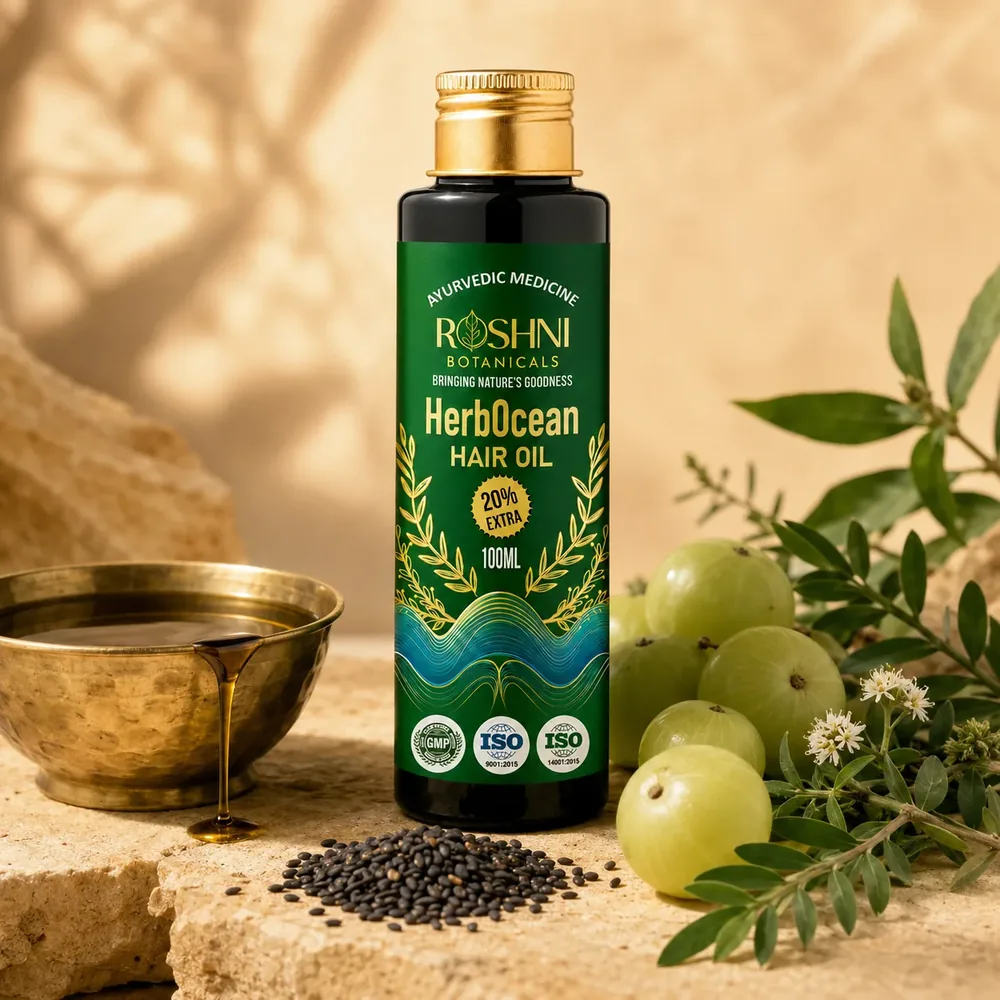
- HerbOcean Hair Oil is a classical Taila (medicated oil) of sixteen botanicals in a sesame base, an AYUSH-licensed Ayurvedic medicine for external use.
Why the Night Is the Easy Half of the Routine
Ayurveda organises care by the time of day. The daily routine, dinacharya, is what you do at fixed points, and oil massage, abhyanga, sits inside it. The seasonal routine, ritucharya, is how that shifts as the weather turns. A night routine belongs to both, and that is the whole of its claim on your attention.
What can an evening routine actually influence? Two things: how long an oil stays in contact with your scalp, and how much your hair rubs against cloth while you sleep. Everything below follows from those two. The hair you can see is not living tissue doing overnight repair work, and growth rate is set at the follicle rather than on the pillow. If that is the question you arrived with, how fast hair actually grows has the arithmetic. If the worry is shedding rather than speed, the definitive guide to Ayurvedic hair oils for hair fall is the fuller read.
What the night really hands you is unhurried time. Five minutes of fingertip work is hard to find at eight in the morning and easy at nine at night. A routine you will keep is the only kind that helps.
The Evening Oiling Window: After Dinner, Not at Lights-Out
The instruction on the bottle is simple: Warm a little, part the hair and massage into the scalp with fingertips for a few minutes. Leave at least an hour, or overnight, then cleanse with a mild shampoo. Two to three sessions a week suit most people. In most Indian homes that lands after dinner, kitchen shut, nothing left to rush for, with the wash waiting next morning.
No published work compares one contact time against another, so set the clock by the morning you can actually wash rather than by a rule. The amount you use and the massage you give it are the parts of the routine you control.
Quantity first. Two or three teaspoons suit most lengths, and if it all looks flat and wet the next morning, you used too much. Then five to ten unhurried minutes of fingertip work on the scalp. The sectioning, the stroke pattern and the pressure are set out in the full scalp abhyanga method, step by step.
HerbOcean Hair Oil is the one we make for this hour. It is an Ayurvedic medicine for external use, classically indicated for hair fall and dullness. It is a classical Taila of sixteen botanicals in a sesame (Til tail) base: twelve herbs, namely Bhringraj, Jatamansi, Brahmi, Shikakai, Amla, Nagarmotha, Chharila, Sugandhbala, dried hibiscus (Gudal), Tulsi, rose (Gulab) and Neem, finished with lavender, curry leaf and rosemary oils. It is made in-house at our GMP-certified unit in Bawana, Delhi, under AYUSH Licence No. DL-474 A&U, and built on the 40-year Ayurvedic formulation legacy of Vaidya Shri Ram Prakash Ji. The sixteen botanicals, herb by herb, are set out in our ingredients guide.
Overnight Oiling: Who It Suits and Who It Does Not
Overnight oiling is an old habit in most Indian households, and there is nothing to unlearn about it. What a full night changes is how much oil there is to wash out in the morning, and whether your scalp is in a state to sit under it. A full night simply means longer contact, along the lengths as well as the scalp. Which of the two suits you is a question about your scalp and your wash morning, not about a better result.
It suits dry, coarse, curly or chemically processed hair, and lengths that feel rough from the mid-shaft down. Dry air is its season: once the rains have gone the case for a full night is at its strongest, where in peak monsoon our own method page caps the oil at an hour or two. And if a spare evening hour never appears in your week, a light overnight application you will actually do beats a soak you keep postponing.
Where it works less well is an itchy, flaky or breaking-out scalp, very fine hair that goes limp the moment it is touched, or any week when you cannot wash the next morning. An old strand of Ayurvedic caution belongs here too. Classical practice is careful about excess unctuousness rather than enthusiastic about it, and heaviness and moisture are the qualities Ayurveda reads as Kapha, one of the three doshas. Take that as classical guidance rather than as a measured finding.
The compromise most readers want is simple. Oil the lengths and leave them overnight, and wash the scalp side out the same evening. A light hand matters as much as the clock.
Tying Hair and Pillow Friction Through the Night
Three ties cover almost everybody. Medium to long straight or wavy hair does best in a loose plait started below the nape, finished with a cloth scrunchie. Curls do better gathered high and loose on top, the pineapple, so the pattern is not crushed flat. Shorter layered hair wants a soft low bun, or a wide cloth band for the front pieces.
What to avoid is more specific than people expect. Tight elastics, metal clips, rubber bands and high tight buns, worn night after night, keep sustained tension on the hairline. Sustained pulling is a recognised pattern of hair fall, and it concentrates along the hairline and at the temples rather than spreading evenly across the scalp. A 2017 review in the Indian Journal of Dermatology, Venereology and Leprology describes it as reversible at first and irreversible only once scarring sets in. If your scalp feels sore when you let the hair down, that tie was too tight. For the deeper read, see tight hairstyles and the traction problem.
Damp hair is the delicate state, so plait it before you lie down rather than leaving it loose. Nothing fuses a split end back together either, so the aim at night is simply fewer new snags, and what oiling honestly does for breakage sets out the rest.
A night is a long time for hair to be rubbed against cloth, and that rubbing is the reason a loose plait is worth the moment it takes. How much a given weave actually costs a strand has not been measured. What is clear is where the complaint lands: tangles and breakage show up along the mid-length, and a mid-shaft problem has a mid-shaft cause, so this is one the scalp routine is not built to answer.
A satin or silk pillowcase is comfort and convention rather than a proven intervention, and it costs little to try. What it changes is the surface your hair moves against along the lengths, and it is not a substitute for a scalp routine.
The low-cost version works nearly as well and answers a second problem. On oiling nights, lay an old, much-washed cotton cover or a plain cotton stole over your pillow. A much-washed cotton cover feels softer than a new starched one, and it is a cloth you will not mind marking.
Scalp Hygiene on Oiled Nights, and the Morning Rinse
The places that need attention are the ones people skip: hairline, parting, nape. That is where oil, pillow contact and overnight sweat collect. Wipe the forehead hairline with a soft dry cloth before you lie down, and keep the oil off the face, particularly if you break out along the temples.
The oil then has to come off properly, and the pre-wash window and the full wash sequence are set out in how to wash oiled hair properly. What matters at night is only this: decide before you oil which morning you are washing. An oiling night needs a wash morning behind it.
What usually goes wrong is oil left on for days and topped up without a proper wash in between. That road ends in a heavy, itchy scalp, and then in blaming the oil. Oil goes on, oil comes off, and the scalp gets to breathe in between.
When the scalp is breaking out, the timing changes rather than the routine. While spots are sore and new ones keep arriving, oil an hour or two before a wash instead of the night before, and rinse until no film is left at the crown or the nape. Pausing entirely for a wash cycle or two during a bad flare is also a reasonable call. Our guide to pimples under the hair and what honest care looks like covers the interim properly, and painful, recurring or spreading bumps under the hair are a matter for a dermatologist rather than a reason to oil harder.
What Changes as the Monsoon Pulls Back
As the rains withdraw across North India the air dries quickly, and hair that wanted less oil through the damp weeks often wants a little more. The ends go first.
Three adjustments carry most of the turn. Oil the lengths more often than the scalp. Resist raising your wash frequency just because the hair feels flat, because flat hair in a drying spell is usually dry hair. And read the first flaky week carefully rather than reaching straight for a medicated shampoo. Our note on how the oil suits each part of the Indian year gives the short season-by-season view, and the Ayurvedic hair care range shows what sits alongside it.
The drier months are also when the function season begins and hair gets handled, pinned and heated more than usual. Reason enough to be gentler at night.
The Short Version
Oil in the evening. Tie the hair loosely. Sleep on something smooth. Wash it out properly. Skip the oil on the nights your scalp is unhappy. The routine needs no more parts than that, and the classical texts describe dinacharya and abhyanga in much the same unhurried spirit.
For external use only. Patch-test on the inner forearm 24 hours before first use and discontinue if irritation occurs; avoid the eye area. Anyone with a known allergy to sesame or to a listed botanical, or with an active scalp infection or broken skin, should not use it without medical advice. See a dermatologist for sudden heavy shedding, a widening parting, bald patches, or a scalp that is painful, weeping or breaking out in spreading spots.
References: Charaka Samhita, Sutrasthana 5 (Matrashiteeya Adhyaya), where daily head oiling and abhyanga sit among the acts of the daily regimen. Akingbola CO and Vyas J, Traction alopecia: a neglected entity in 2017, Indian Journal of Dermatology, Venereology and Leprology, 2017; a narrative review, so no sample size and no single study population, reporting that traction most commonly affects the frontotemporal hairline, that it is reversible before scarring sets in, and that stopping the styles which pull is the mainstay of care. No published work compares one hair-oil contact time against another, and no indexed study measures hair against pillow fabric or silk against cotton, which is why neither is cited above. Educational, not medical advice.
HerbOcean Hair Oil
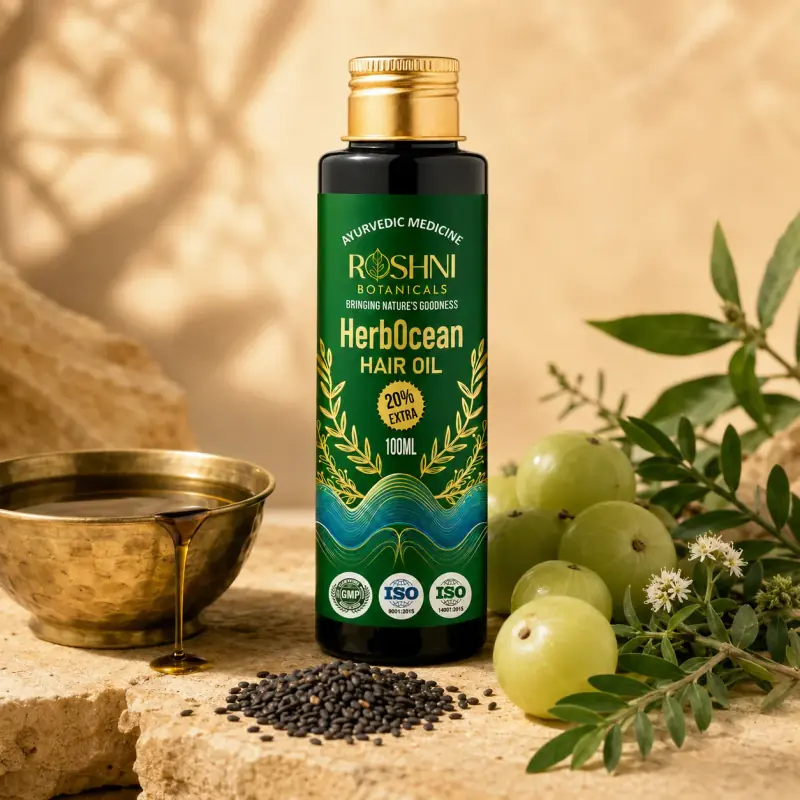
A classical Taila for hair fall, dullness and a flaky scalp, with sixteen botanicals like Brahmi, Jatamansi, Amla and Neem in a slow sesame base.
Part of our guide: The definitive guide to Ayurvedic hair oils for hair fall.