
How Often Should You Wash Your Hair? An Honest Answer for Indian Hair
There is no proven number for Indian hair. What the evidence actually shows, what the classical texts really say, and how to read your own scalp instead.

Ask five people how often you should wash your hair and you will get five confident answers. Here is the honest one: nobody has actually measured it for Indian hair. There is no study of wash frequency conducted in India, and the research that does exist comes from elsewhere and points in a direction most Indian readers would find surprising. What follows is what the evidence really shows, what the classical texts really say, and how to read your own scalp instead of borrowing someone else's rule.
Key takeaways
- There is no proven number. No wash-frequency study has been done in India or on Indian hair, so any confident weekly figure you read online, including ours, is practice and judgement rather than a research finding.
- Two to three washes a week is what most Indian households settle on, and it is a sensible place to start. Treat it as a starting point you adjust, not a rule you obey.
- The fear of washing too often is not well supported. The one substantial frequency study found flaking and itch got better as washing got more frequent, not worse, though it was done in China with industry funding and its authors caution it may not carry across to more textured hair.
- Flaking reverses the advice. If your scalp is flaking or itching, wash more often and more gently, never less. That single signal overrides everything else on this page.
- Oiling the head before wash day has genuine classical warrant, and it is the part of this routine Ayurveda actually speaks to. A champi with a classical Taila (medicated oil) such as HerbOcean Hair Oil is the step the texts describe, not the shampoo schedule.
The Honest Answer: There Is No Proven Number
Two to three gentle washes a week suits most Indian routines, and if you want one sentence to act on, that is it. But you deserve to know how thin the ground under that sentence is. We looked for a study of wash frequency conducted in India or on Indian hair, and there is not one. Not a trial, not a comparison, nothing. The widely repeated Indian figures come from practice and habit, which are worth something, but they are not measurements.
What does exist runs the other way, and honesty requires saying so. The most substantial look at frequency itself surveyed 1,500 adults in Xi'an, China, alongside a five-week study of 60 habitual infrequent washers moved onto daily washing (Punyani and colleagues, Skin Appendage Disorders, 2021). Flaking and itch improved as washing became more frequent, overall satisfaction was highest at five to six washes a week, and the authors concluded that worries about overcleaning were not borne out. Read that with three caveats firmly attached: the work was funded entirely by a shampoo manufacturer, the participants were Chinese, and the authors themselves note the findings may not extend to hair with much more texture or curl than they studied. It is not an instruction for Indian hair. It is, however, enough to retire the idea that washing your hair often is inherently damaging.
There is one signal pointing the other way, and it is fair to put it beside the first. A small study of 60 hijab-wearing women in Jakarta found that washing every one to two days left the scalp losing measurably more water through the skin barrier than washing every three to five days (International Journal of Trichology, 2024). Sixty women in one very specific situation is not much to build on, but it is the honest counterweight, and it is why the sensible answer sits in the middle rather than at either extreme.
So the reasonable position is not a number handed down, but a habit: wash when your scalp asks to be washed. If it feels oily, sweaty or itchy, wash it, whatever the calendar says. This guide sticks to frequency. If you are wondering how often to oil rather than wash, our step-by-step Ayurvedic hair oiling routine covers that separately.
What Your Water Actually Does
Hard water is a real problem in a lot of Indian homes, and it does leave something behind. In a laboratory study at PSG Institute of Medical Sciences and Research in Coimbatore, shed strands from fifteen healthy women were washed in hard water at 212.5 ppm for ten minutes on alternate days across a month, against distilled water for comparison (International Journal of Dermatology, 2016). The hard-water strands carried around three times the surface calcium and over four times the magnesium, and showed a ruffled cuticle under the microscope. Fifteen volunteers is a small study, and the published abstract reports no significance testing on those figures, so hold the numbers loosely.
Two things follow that are worth being careful about. The first is that this is evidence about the surface and feel of the hair, not about hair falling out. Searching the indexed literature for hard water and hair loss turns up essentially nothing, and the one paper that comes close says explicitly that it concerns weakening rather than loss. If your hair is genuinely shedding, hard water is unlikely to be the reason, and our post on how hard water affects hair goes further into what the evidence does and does not support there.
The second is a piece of advice you will see everywhere, including in earlier versions of this guide: that a final rinse with stored or filtered water lifts the mineral film away. It is a reasonable-sounding idea and nobody has tested it. There is no study showing that any rinse, shampoo or treatment removes deposited calcium and magnesium from hair. So by all means try a filtered final rinse, it costs nothing and may help how your hair feels, but we are not going to tell you it works when the honest answer is that nobody has checked. What you can act on is simpler: hardness varies sharply between cities and even between colonies, so find out what your own supply is like before assuming it is the villain.
Season: What the Texts Say, and What They Do Not
Ayurveda has a seasonal routine, Ritucharya, set out in Charaka Samhita, Sutrasthana 6 and Ashtanga Hridaya, Sutrasthana 3. It is worth saying plainly what it does and does not contain, because it is frequently quoted for things it never says. It gives no wash count. There is no cadence, no times-per-week, no instruction anywhere in those chapters about how often to wash the head. What it gives is the principle that the routine should move with the season, which is genuinely useful and quite different from a schedule.
The texts do say something specific about washing, and it is about temperature rather than frequency. Ashtanga Hridaya, Sutrasthana 2.17 draws the distinction that warm water poured over the body below the neck is said to bestow strength, while the same water over the head is said to weaken the hair (kesha) and the eyes. Whatever your frequency, that is the classical instruction worth keeping: save the hot water for below the neck, and let the scalp have it lukewarm.
One popular belief needs correcting, and it is one we have repeated ourselves. Dandruff is usually described as a monsoon problem. The Indian data runs the other way. An observational study of 879 young children attending a dermatology outpatient department in Kolkata, sampled across three seasons, found seborrhoeic dermatitis in 28.3 per cent of winter attendances against 8.9 per cent in the rainy season and 6.4 per cent in summer (Indian Journal of Dermatology, 2010). Those were small children at a clinic rather than adults in the general population, so read it for direction and not for your own odds. But no Indian study supports dandruff flaring in the monsoon, and what evidence exists points at winter.
| Scalp type | Monsoon | Summer | Winter |
|---|---|---|---|
| Oily | 3 a week | 3 a week | 2 to 3 a week |
| Dry | 2 a week | 2 to 3 a week | 2 a week |
| Combination | 2 to 3 a week | 2 to 3 a week | 2 a week |
| If you are flaking | Ignore the row above. Wash more often, not less, and more gently. While flaking is active, do not leave more than three or four days between washes. | ||
That table is a starting point, not a prescription, and you should know exactly what it rests on. There is no research setting wash frequency by scalp type and season, so the cells are judgement. They lean on two things we can stand behind: skin oil production rises with temperature and is lowest in winter, and washing very infrequently is associated with more flaking rather than less. Your hair texture matters more than any row here. Tightly curled and coily hair usually tolerates, and often prefers, longer gaps than this table suggests, while fine straight hair through a Delhi summer may want more. Let your scalp correct the table rather than the other way round.
Wash Day Follows Oil Day
This is the part of the routine Ayurveda genuinely speaks to, and it is worth separating from the shampoo question entirely. Head oiling is treated as upkeep in its own right, not as damage control. Charaka Samhita, Sutrasthana 5.81 to 83 sets out murdha taila (head oiling) as part of the daily regimen, describing hair that is better rooted and less prone to falling; Sushruta Samhita, Chikitsasthana 24.25 to 26 records shiro abhyanga (oil massage of the head) as making hair dense and dark. Note what is not being claimed there: the texts describe oiling as a regular practice, and do not sequence it against the bath. The habit most Indian households already keep, oil the night before and wash the morning after, is a sensible domestic rhythm rather than a rule the texts impose.
The HerbOcean Hair Oil sits in that pre-wash step. It is a classical medicated hair oil (Taila) built from sixteen botanicals in all: twelve herbs including Bhringraj, Amla, Brahmi, Jatamansi and Neem, a til tail (sesame oil) base, and three essential oils. It is formulated by Vaidya Shri Ram Prakash Ji, the classical vaidya whose forty-year formulation legacy the HerbOcean line is built on, and it is traditionally used in the care of hair fall and dullness. For a fuller picture of how classical hair oils are put together and what they are for, our definitive guide to Ayurvedic hair oils for hair fall control covers the ground properly.
Wet hair asks for its own care, separate from the wash. Skip the rough towel rub; a gentle squeeze and pat does the same job without roughing up the cuticle. Reach for a wide-tooth comb only once hair is partially dry rather than dripping, since wet strands stretch further before they break. And resist the tight bun on wet hair, however tempting on a rushed morning, because damp hair under tension is the combination that invites breakage.
When It Stops Being a Frequency Question
On a rushed morning the whole guide reduces to two questions: does your scalp feel like it needs washing, and is it flaking? The first sets your frequency. The second overrides it, upward.
Know when this stops being about scheduling altogether. Sudden diffuse shedding across the whole scalp, patchy loss in defined spots, a scalp that stays painful or scaly despite gentle handling, or flaking that keeps going despite regular washing all deserve a dermatologist rather than another adjustment to your calendar. Scalp psoriasis and fungal infection can both look like ordinary dandruff, and neither is a wash-frequency problem. Whatever oil or routine you settle into, patch-test anything new on the inner forearm first, and remember everything here is for external use.
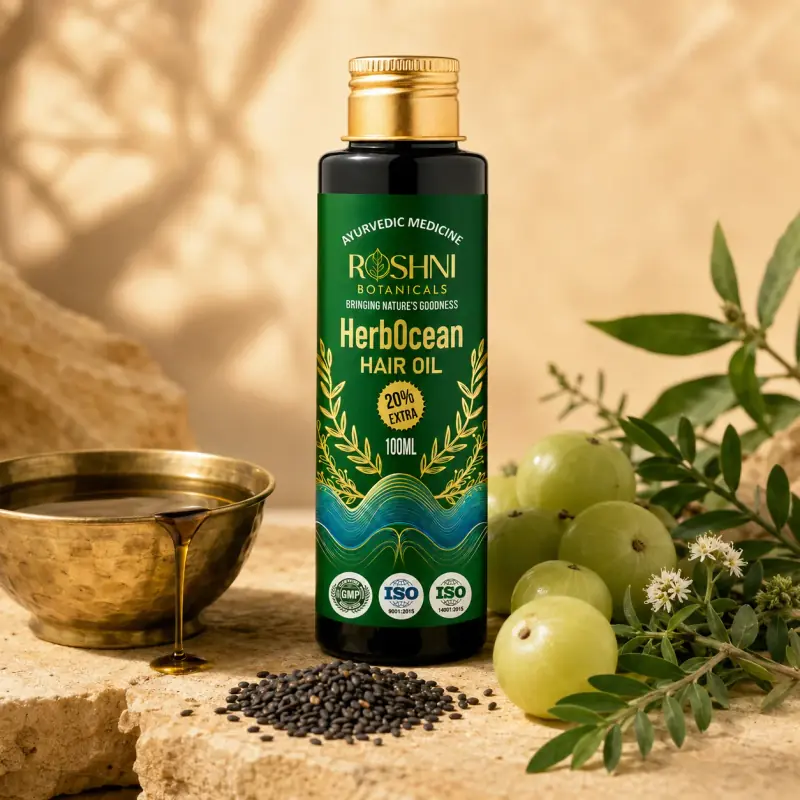
HerbOcean Hair Oil
A classical Taila for hair fall, dullness and a flaky scalp, with sixteen botanicals like Brahmi, Jatamansi, Amla and Neem in a slow sesame base.
Part of our guide: The definitive guide to Ayurvedic hair oils for hair fall.