Onion Oil vs Ayurvedic Hair Oil: An Honest Comparison for Indian Hair
Onion oil's famous evidence is one small 2002 study of raw onion juice on alopecia areata, not everyday hair fall. What each design is actually for, and the strand test that tells you which one your hair needs.
Walk into any chemist or open any shopping app in India, and onion hair oil looks back at you from the bestseller shelf. It is the biggest wave Indian hair care has seen in a decade, and if you have been wondering whether to switch, your question deserves a straight answer rather than a sales pitch. So here is an honest comparison between the onion-oil category and the classical Ayurvedic medicated-oil (Taila) tradition, written to help you work out what your hair actually needs.
The short version
- The evidence most often quoted for onion oil is a single 2002 study that applied crude onion juice to patchy alopecia areata, an autoimmune condition, in 38 people. It was not a study of everyday hair fall, and it was not a study of bottled oil.
- Onion (Palandu) is documented in the Ayurvedic materia medica, but among the vegetables and food articles. It is not among the herbs described as Keshya (literally "hair-supporting"), from which the classical hair oils are built.
- The Charaka Samhita lists regular head oiling (murdha taila) as protective of hair, naming Khalitya, the classical term for hair fall and baldness, in the same breath.
- Most of what Indians call hair fall in hard-water cities is breakage, not root shedding. The two look identical in the drain and need opposite responses.
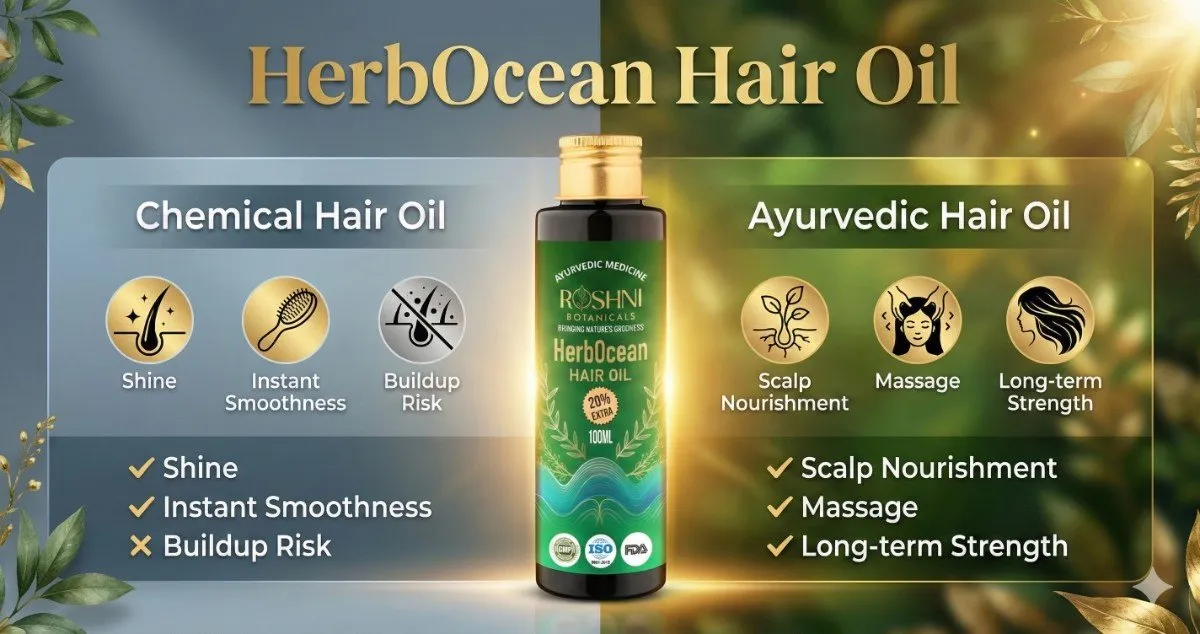
- HerbOcean Hair Oil takes the other design route: twelve classical herbs processed into a sesame-oil base, sixteen botanicals in all.
What Onion Oil Honestly Offers
Start by giving the category its due. Tens of lakhs of Indian households have brought an onion oil into the bathroom in the last few years, and they did not do it out of foolishness. The pitch is easy to follow, the price is accessible, and the smell has become a kind of proof that something active is happening.
The theory is genuinely reasonable. Onion is rich in organosulphur compounds, and keratin, the structural protein of the hair shaft, is itself sulphur-rich: its strength comes largely from disulphide bridges between cysteine residues. Put a sulphur-bearing extract on the scalp and the logic writes itself.
The evidence is where the story gets thinner than the marketing suggests. Almost every onion-oil claim online traces back to one paper: Sharquie and Al-Obaidi, published in the Journal of Dermatology in 2002. Thirty-eight patients with patchy alopecia areata took part at a Baghdad teaching hospital. Twenty-three applied crude onion juice twice daily and fifteen applied tap water. Regrowth was reported in 20 of the 23 in the onion group by six weeks, against 2 of the 15 controls by eight weeks.
Three things in that study matter more than the headline. Alopecia areata, the condition being treated, is autoimmune: it produces coin-sized bald patches and has a notably high rate of spontaneous regrowth, so in a small two-month trial that alone can flatter whatever was applied. The study also used raw juice, rubbed in twice a day; a bottled oil in which onion extract sits some way down the ingredient list is a materially different product being asked to inherit the same result. And nobody in that study was there for the ordinary, diffuse, gradual hair fall that most readers of this page are dealing with. It was a single centre in Iraq rather than an Indian population.
One more thing deserves an honest mention, and it cuts across the whole category rather than against onion in particular. In classical terms onion is Ushna, heating in potency. Applied raw or near-raw, twice a day, at full strength, a heating single ingredient is a lot to ask of a scalp that is already reactive or itchy, and some people do report stinging and redness. That is not a defect in onion. It is an argument about concentration and preparation, which is exactly what the next section is about.
Why Onion Never Entered the Classical Hair-Oil Canon
A classical Taila is not a mixing exercise, and this is the part most comparison articles skip entirely. Under the taila paka method, a herb paste (kalka) and a water or milk decoction (drava) are cooked together with the oil for hours over controlled heat, until specific physical signs confirm the oil has taken up the herbs. The process was codified centuries ago, and it is a manufacturing discipline as much as a recipe. That is the real difference between a herb infused into an oil over hours and a herb extract added to a bottle: not which plant, but how much of it survives into the finished oil and in what state.
The tradition is specific about the practice, too. The Charaka Samhita sets out head oiling in its chapter on daily regimen (Sutrasthana 5, verses 81 to 83), and the verse is unusually direct about what regular murdha taila is expected to hold off: headache, Khalitya (hair fall and baldness), Palitya (premature greying) and the falling of hair, alongside deep-rooted hair and sound sleep. Daily oiling is not framed there as a remedy for a crisis. It is framed as upkeep.
The herbs the canon reaches for are consistent across the texts: Bhringraj, Amla, Jatamansi, Brahmi. Bhringraj carries the synonym Kesharaja, king of hair, and the classical texts describe it as Keshya. Amla is classically associated with hair lustre and with greying. Jatamansi and Brahmi are the calming herbs, which is why classical head oils so often double as sleep aids.
Onion sits elsewhere in that same literature, and the placement is the whole point. Palandu is documented, with its own recognised qualities: heavy, unctuous, heating in potency and pacifying to Vata (one of the three doshas, the biological energies in Ayurveda). But it is grouped with the vegetables and food articles and used chiefly internally, and it is not among the herbs described as Keshya that the hair oils are assembled from. That absence is not an oversight by physicians who plainly knew the plant and wrote its properties down carefully. Onion had a settled place in their pharmacy; it simply was not this one. The hair-oil use that fills your feed today is a modern application, not a classical one, and it is worth knowing which of the two you are buying into.
Neither design is wrong. They are answers to different briefs, written centuries apart. If you want this argument applied to modern mineral-oil products rather than to onion, our companion piece on Ayurvedic hair oils or chemical hair oils covers that ground.
Breakage or Root Shedding: The Question the Ads Skip
Here is the diagnostic no onion-oil advertisement will do for you, and it changes which bottle is right. Collect a day's fallen hair on a sheet of white paper and look at the ends. A strand shed from the root is full length and carries a tiny pale bulb at one end. Breakage gives you short pieces of uneven lengths with no bulb at either end, often alongside rough, dry mid-lengths and split ends. Losing fifty to a hundred rooted strands a day is normal. Finding a scatter of bulbless fragments on your pillow and around your comb is not shedding at all; it is your hair snapping, and no scalp treatment of any kind will fix a problem that is happening halfway down the shaft.
Much of northern and western India runs hard water. Calcium and magnesium salts deposit along the cuticle, leaving hair rough, tangle-prone and grabby against a comb, and rough hair under tension breaks. In Delhi and Gurugram this is routinely the whole explanation for what a reader has diagnosed as hair fall; our guide to hard water and hair fall goes into what actually helps. The monsoon adds its own pattern, keeping the scalp damp for hours, which encourages flaking and itch, and scratching contributes its own mechanical damage. North Indian winters run the opposite way: dry indoor air and hot-water washes strip lubrication from the shaft.
Pre-wash oiling earns its keep against exactly this. An oiled shaft goes into a wash less able to swell and abrade, and comes out with less friction damage. That benefit holds whichever oil you choose, which is why technique deserves as much of your attention as the label does. Warm the oil until it is comfortably warm to the wrist and never hot; part the hair in sections and work it onto the scalp with fingertips rather than nails for eight to ten minutes; leave it forty-five to sixty minutes before washing, or overnight if your scalp tolerates it; two or three times a week is plenty, and consistency beats quantity. Detangle with a wide-tooth wooden comb, and never force a comb through wet hair. Our step-by-step Ayurvedic hair oiling routine sets the whole champi out in order.
Inside a Twelve-Herb Classical Formula
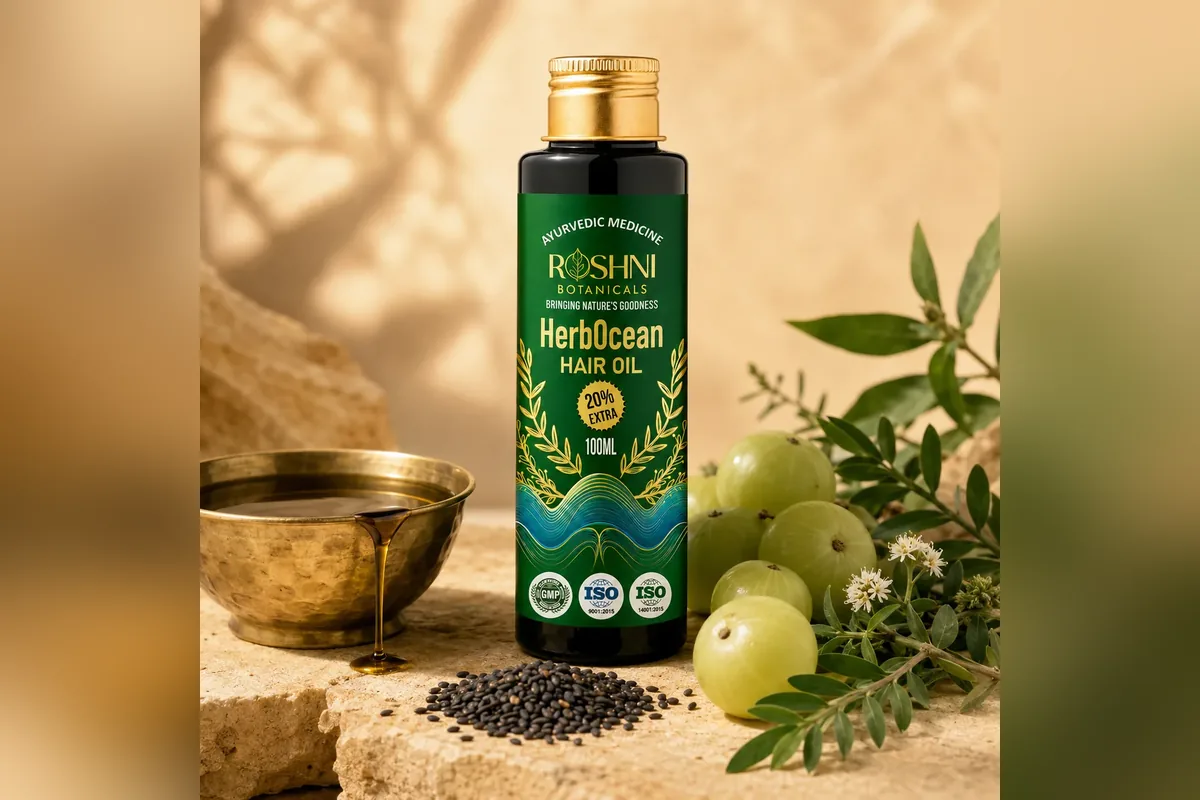
HerbOcean Hair Oil is built on the other design philosophy: layered rather than singular. Twelve classical herbs, Bhringraj, Jatamansi, Brahmi, Shikakai, Amla, Nagarmotha, Chharila, Sugandhbala, Gudal (hibiscus), Tulsi, Gulab (rose) and Neem, are processed into a sesame oil (til tail) base and finished with lavender, curry leaf and rosemary oils. Sixteen botanicals in all.
Each is there for a stated classical action rather than for how it reads on a label. Bhringraj is the Keshya herb the canon leads with, and modern work is beginning to look at it seriously: a methanol extract of Eclipta alba showed dose-dependent activity when tested for hair growth in pigmented mice (Datta and colleagues, Journal of Ethnopharmacology, 2009), which is animal data worth knowing and not a human claim. Amla is classically tied to hair lustre and greying. Jatamansi and Brahmi bring the calming character. Neem and Tulsi address scalp cleanliness through the humid months, and Shikakai is the subcontinent's original hair cleanser. Curry leaf oil carries a long South Indian record of use for the follicle.
The formulations are the work of Vaidya Shri Ram Prakash Ji, the classical vaidya (a master Ayurvedic formulator) whose 40-year Ayurvedic formulation legacy the HerbOcean line is built on. The oil is manufactured in-house in Bawana, Delhi, under AYUSH Licence No. DL-474 A&U and a Schedule-T GMP certificate for Ayurvedic drugs, in an ISO 9001:2015 certified facility. It is an Ayurvedic medicine traditionally used in the care of hair fall and dullness, for external use only. Patch-test on the inner forearm before the first full application.
Who Suits Which
| If this sounds like you | The design that fits |
|---|---|
| Short bulbless fragments, rough mid-lengths, hard-water city | A multi-herb Taila, pre-wash, two or three times a week |
| Reactive or easily irritated scalp | A processed multi-herb Taila, where any single herb is a fraction of the whole, rather than a raw single-ingredient routine |
| You want one ingredient and a simple routine, expectations set | An onion oil, chosen with clear eyes about the evidence |
| Coin-sized patches, scalp pain or sudden diffuse loss | A dermatologist first; no oil is the answer here |
| Postpartum shedding under six months | Gentle oiling and patience, with a review at the six-month mark |
For the full picture on patterns, herbs and what a realistic timeline looks like, our definitive guide to Ayurvedic hair oils for hair fall control goes considerably deeper than a comparison post can.
When to See a Dermatologist Rather Than Switch Bottles
Some patterns need a diagnosis, not a new purchase. Book an appointment for sudden diffuse shedding, coin-sized bald patches, scalp pain, scaling or pus, postpartum shedding that continues past six months, or hair changes arriving alongside fatigue, weight change or irregular periods. Iron deficiency, thyroid disorders, PCOS and alopecia areata are all common in India and all treatable once identified. No oil substitutes for that appointment, and nothing in this comparison is a reason to delay one.
Where That Leaves You
Onion oil is not a fraud and a classical Taila is not magic. They are two different bets: one ingredient chosen for a plausible mechanism, or many herbs layered by a tradition that spent centuries deciding which ones belonged together and how they should be cooked. If your hair is mostly snapping rather than shedding, and you live with hard water and a long monsoon, the multi-herb route was built for that shape of problem. If a considered, multi-herb routine feels right for your hair, HerbOcean Hair Oil is a twelve-herb classical Taila traditionally used in the care of hair fall and dullness, formulated by Vaidya Shri Ram Prakash Ji and made in-house in Delhi. Either way, read the strand before you read the label.
HerbOcean Hair Oil
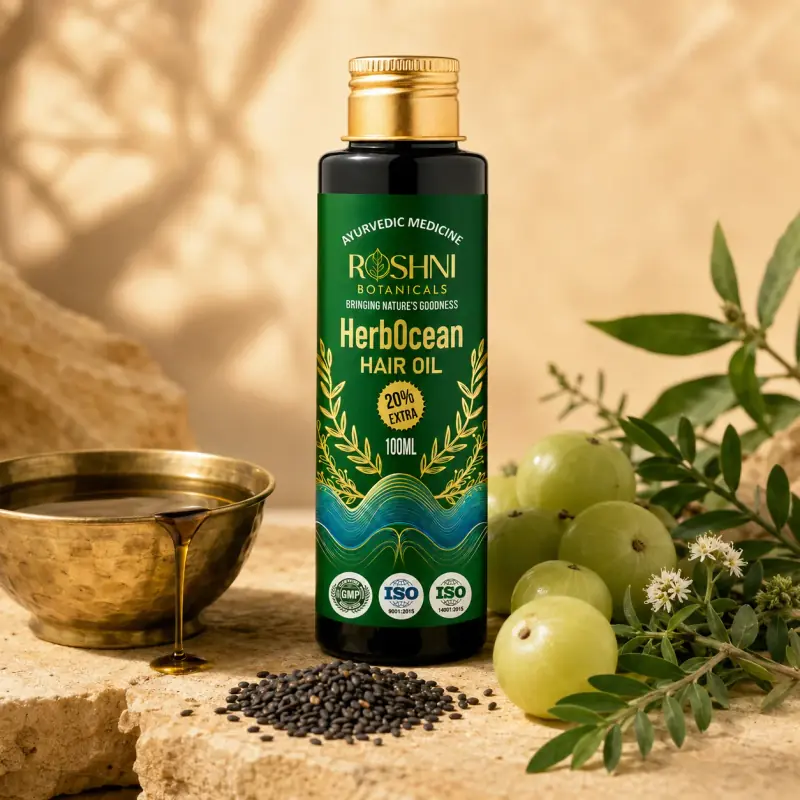
A classical Taila for hair fall, dullness and a flaky scalp, with sixteen botanicals like Brahmi, Jatamansi, Amla and Neem in a slow sesame base.
Part of our guide: The definitive guide to Ayurvedic hair oils for hair fall.