Mehendi and Skin Safety: How to Spot a Black Henna Cone
Not every cone in the market queue is plain henna. How to read a cone in ten seconds, how to test one, and what to do if skin reacts.
Whenever there is something to celebrate, mehendi artists set up outside every market from Lajpat Nagar to Dadar, and the queue moves fast. Many cones are plain natural henna. Some are not. It is worth learning the difference before a cone touches your hand, or your child’s.
Key takeaways
- Natural henna, from the dried leaves of Lawsonia inermis, stains skin orange first and deepens to reddish brown over several hours. A cone promising jet black in ten minutes usually carries paraphenylenediamine, written as PPD, a hair dye chemical that dermatology literature links to severe allergic contact dermatitis on skin.
- Three signals, readable while the artist sets up: black in minutes, a sharp chemical smell, and no answer to the question of what is in the cone. Any one is reason enough to decline.
- Patch test every cone you believe is plain on the inner forearm and wait forty-eight hours, our own margin rather than a published standard. A quiet forearm means the cone did not irritate you quickly, not that it is safe.
- No mehendi on a baby or infant at all, natural or otherwise. The colouring compound in henna itself can harm a child with G6PD deficiency, and no patch test can catch it.
- A contact reaction on melanin-rich Indian skin can settle into post-inflammatory hyperpigmentation, a flat mark that lingers long after the rash itself has gone.
Natural Henna and Black Mehendi Are Not the Same Thing
Natural henna comes from the dried, powdered leaves of Lawsonia inermis. Mix it with water and something acidic and it stains skin orange at first, deepening to reddish brown over the following day. Hours, not minutes. That slowness is the point, because the dye molecule binds to the outer layer of skin at its own pace.
Across India the practice has a long and generally gentle record. An Indian dermatology review of cultural practices puts it plainly, that pure henna rarely causes allergic reactions, and attributes most reported reactions to added PPD (Gupta and Thappa, Indian Journal of Dermatology, 2015). Reactions to plain henna do happen. They are uncommon, though, and the red flags below are not about plain henna at all.
So-called black mehendi is a different substance wearing the same name. To force a near-black stain within ten or fifteen minutes, cones are adulterated with paraphenylenediamine, usually written as PPD, a dye developed for colouring hair.
The cone in front of you was mixed at a stall, not packaged for retail, so it carries no ingredient list, and you will rarely be given one. A full review of henna and black henna side effects (de Groot, Contact Dermatitis, 2013) records that black henna is red henna combined with PPD, and that contact allergy to PPD arises from these applications.
A reaction to a PPD cone does not always end when the rash settles. One severe reaction to a black henna cone can leave a lasting sensitivity, and sources differ on how long it persists. It does not stay with mehendi either: the same review reports cross-reactions to other hair dyes, to dyes used in textiles, to some local anaesthetics and to rubber chemicals. Tell your own doctor and your dentist, and read hair colour labels from then on. That is a conversation for your clinician, not an avoid-list to police on your own.
The Ten Second Check Before the Cone Touches Skin
Three signals are enough, and you can read all of them while the artist is still setting up. First, a promised jet-black stain within minutes. Second, a sharp chemical smell rising off the cone, quite unlike the grassy, slightly earthy smell of henna paste. Third, no ingredient information anywhere on the cone and no clear answer when you ask. Any one of the three is reason enough to decline.
Asking is the awkward bit, so keep the sentence ready: what is in this cone, and is it plain henna? A good artist answers without hesitation, and plenty will tell you straight out that the black cones sit aside for customers who insist.
Take a small dot of paste from the cone you plan to use, place it on the inner forearm, let it dry the way it normally would, wash it off, and then wait. We ask for forty-eight hours. That is our own margin rather than a published standard: nobody publishes a home test for a mehendi cone, because the published advice on a suspect cone is to refuse it rather than test it. So test the cones you believe are plain. If any of the three signals above is present, decline the cone and do not test it, because the test is itself an exposure.
Be clear about what a clean result means. If a cone sensitises you for the first time, the rash usually appears four to seven days later, not at forty-eight hours (Panfili and colleagues, 2017, two children, Italy), and reactions two weeks after application are on record (Lasa and colleagues, 2007, two children, Spain). A quiet forearm at forty-eight hours means the cone did not irritate you quickly. It does not mean the cone is safe.
Itching, redness, swelling or small bumps at that spot mean more than “not this cone”. Stop, and from that point treat yourself as PPD-sensitive until a dermatologist says otherwise.
Do this again for every new cone, because mixes change between batches, between artists and between one stall and the next. A clean result last year tells you nothing, and it can mislead you. The case reports run the other way: children who had a black design the previous year with only a mild reaction, or none, and who reacted severely the next time they met the same chemical, sometimes from a bottle of hair dye rather than a cone (Glatstein and colleagues, 2016, three children outside India). The first exposure sensitises you quietly. The second is the one that hurts.
Warm, humid weather adds its own pressure. Damp air keeps skin moist under full sleeves and stacks of bangles, sweat sits beneath the stain for hours, and irritation shows up faster on skin that has not been dry all day. Decide about the cone before you join the queue, not at the front of it.
Mehendi on Babies and Young Children
Babies are a separate case, and the caution has nothing to do with allergy. Henna’s own colouring compound, lawsone, passes through the skin, and in a child with G6PD deficiency, an inherited enzyme fault that leaves red blood cells unable to withstand oxidative stress, it can destroy red blood cells. Published paediatric reports describe severe cases in newborns and infants after ordinary, plain henna was applied to the skin, including one infant who died despite transfusion (Raupp and colleagues, Archives of Disease in Childhood, 2001, four children in the United Arab Emirates), and a hospital in Kuwait recorded fifteen such newborns over ten years (Kandil and colleagues, Annals of Tropical Paediatrics, 1996). Those reports describe henna applied over large areas of a newborn’s body, not a small design on an older child. But most families in India have never had a child screened, so the status is simply unknown.
No patch test protects against this. A patch test looks for an allergic rash on the skin. This is a reaction in the blood, and it gives no skin warning first.
So the rule for the youngest children is not natural-henna-tested-first. It is no mehendi on a baby or infant at all, natural or otherwise, not on the palms, not on the soles, not one dot. For an older child, plain natural henna only, a small design, and never a black cone.
And at any age, if a child who has had henna becomes unusually sleepy or feeds poorly, looks pale, turns yellow in the eyes or skin, passes dark or cola-coloured urine, or becomes breathless, that is a hospital the same day, not a wait and watch.
If Skin Reacts: Wash Off, Cool Down, See a Doctor
The rule for actively reacting skin is narrow: put nothing on it of your own choosing, ours included. If a doctor prescribes something, use it exactly as directed, and that is their call, not a decision to make from a blog post. Rinse the paste off gently under plain running water, apply a cool compress, and leave the area alone. Do not scrub, do not use a loofah or a harsh soap, and do not try to lift the stain, because friction on inflamed skin makes the mark that follows worse. Do not burst blisters.
See a doctor the same day for: blistering, oozing, redness or swelling spreading beyond the stained area, fever, any reaction near the eyes or mouth, or any reaction at all on a child.
Emergency care now, not the same day: difficulty in breathing, swelling of the face, lips or tongue, or a rash spreading across the body.
In most Indian households the instinct is to reach for the kitchen first. This is the moment to resist it. Haldi paste, besan, malai, a balm from the cupboard, or any thick application on blistered or broken skin can trap heat, add fresh irritants to a barrier that has already been damaged, and make the doctor’s job harder by the time you get there. Lemon juice in particular has no place on raw or reacting skin. Cool water and a clean cloth, then medical attention.
Two things help the doctor. Photograph the area before you leave, since a reaction changes by the hour and a rash tracing the outline of the design is itself the clue. And keep the cone, or a photograph of it and of the stall, because there will be no ingredient label. Reactions often begin days after the design, so mention the mehendi even if it was a week ago.
What a Reaction Can Leave Behind on Indian Skin
On melanin-rich skin the rash is often not the last chapter. Inflammation in more pigmented skin readily leaves post-inflammatory hyperpigmentation, a flat brown or greyish mark that can outlast the reaction by months and sometimes traces the exact outline of the design. A review in darker racial and ethnic groups describes it as more frequent and more severe in darker skin, with marks in the upper layer taking months to years to fade on their own (Davis and Callender, 2010, United States). Our guide to how brown marks differ from red ones explains why the colour of a mark matters.
And pigment can go the other way. An Indian review of dermatoses from cultural practices lists the after-effects of these reactions as darkening or loss of pigment, persistent leukoderma (patches where the pigment has gone and stayed gone), extra hair growth, lichenoid reactions and keloids (Gupta and Thappa, Indian Journal of Dermatology, 2015). Keloids deserve their own line here, because keloid-prone skin is common in India. That is the honest reason to have a reaction looked at early rather than waiting it out: the mark left behind is shaped by how long and how hard the skin stayed inflamed.
If you are already living with settled marks, the longer discussion sits in our guide to ayurvedic care for melasma and pigmentation on Indian skin, which follows how pigmentation behaves over months rather than days.
Darkening the Stain, and Caring for Skin Afterwards
The traditional tricks for deepening a henna stain are real practice, passed down and worth taking seriously. Holding dried mehendi over clove smoke. Sealing it with a dab of balm. Brushing the sugar and lemon mix over the drying paste. All three are said to keep the paste warm and damp for longer so the stain sets deeper, and there is nothing wrong with wanting a deeper stain. But heat, friction and acidic mixes on freshly stained skin are exactly the conditions some skins do not enjoy, and a stain from a questionable cone will not be improved by an hour over cloves either.
On the lemon we take a firm line, and it has a name. Citrus juice on skin followed by sunlight causes phytophotodermatitis: compounds in lemon and lime react to ultraviolet light and produce redness, then blisters that can look like a burn, and then a flat brown mark tracing wherever the juice ran (Maniam and colleagues, 2021, a clinical review, United States). Lemon and sugar dabbed over drying mehendi, on hands, outdoors, in daylight, is that exact setup. So no lemon juice on skin, stained or not. Clove smoke and a light seal are the gentler end of the tradition, though gentler is not the same as studied: we found no published harm from clove smoke over dried mehendi beyond heat close to skin, and eugenol, the compound clove smells of, is a recognised fragrance allergen. Light hands, no heat close enough to feel hot, and never on skin that is already itching.
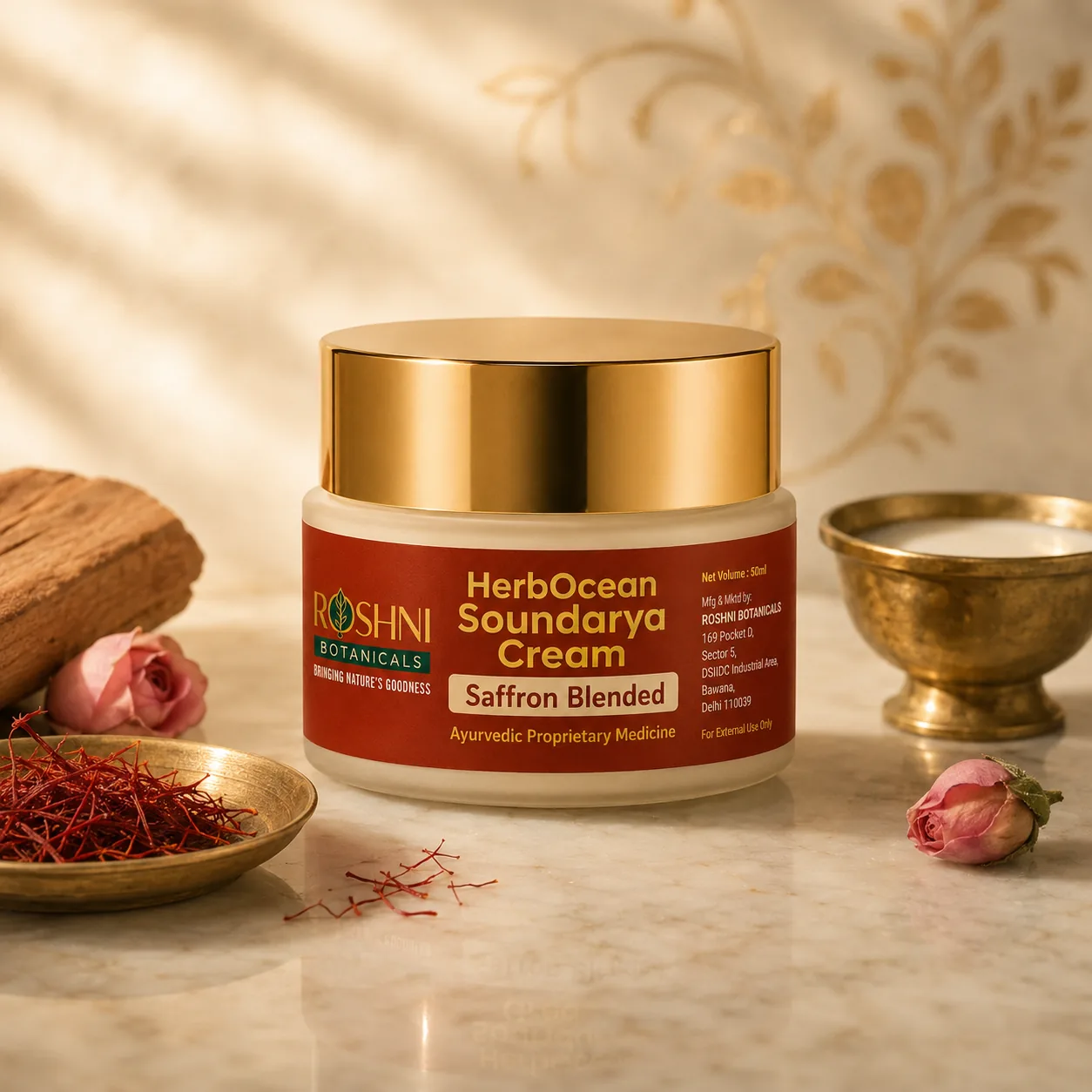
Long after the skin has settled, with the surface unbroken and no itch left in it, HerbOcean Soundarya Cream sits in ordinary daily care. It is a rich saffron repair cream with bargad (Vatt) bark on a goat-milk and coconut base, with shea and kokum butters: an AYUSH-licensed Ayurvedic medicine for external use, traditionally used to support soft, nourished skin. It is made in-house at our GMP-certified unit in Bawana, Delhi, under AYUSH Licence No. DL-474 A&U, and built on the 40-year Ayurvedic formulation legacy of Vaidya Shri Ram Prakash Ji.
One boundary belongs beside that. A mark left behind by a contact reaction is not what this cream is being offered for. That mark belongs to the doctor who saw the reaction, and it is their call, not a decision to be made from a blog post.
The cone test earlier in this post is a different and shorter one. Soundarya Cream carries its own instruction on the product page: patch-test on the inner forearm twenty-four hours before first use, and stop if irritation appears. Take that as the minimum rather than the finish. Reactions to plant oils and natural fragrance are often slow, so we ask readers to keep the same forearm patch going twice a day for at least ten days and preferably fourteen before a new preparation of ours goes near the face, and to stop at once if it itches, reddens or stings. If your skin reacts easily to most things, not only to cones, our guide to a calm routine for skin that reacts easily is the better place to start.
Carry the Patch Test With You
Mehendi belongs in the celebration. PPD does not belong on skin, and the gap between those two sentences is a cone, a smell and forty-eight hours. Ask what is in it. Test it on the inner forearm. Wait. If something reacts, wash it off and see a doctor. And for the youngest in the house, no cone at all. Once the skin is calm and unbroken, the HerbOcean Soundarya Cream page carries the full formulation detail, and our pre-wedding skincare routine takes the same slow, tested approach over a longer runway.
References: de Groot AC. Side-effects of henna and semi-permanent “black henna” tattoos: a full review. Contact Dermatitis. 2013;69(1):1-25 (single-author narrative review; no study population). Gupta D, Thappa DM. Dermatoses due to Indian cultural practices. Indian Journal of Dermatology. 2015;60(1):3-12 (narrative review of Indian practices, JIPMER Puducherry). Davis EC, Callender VD. Journal of Clinical and Aesthetic Dermatology. 2010;3(7):20-31 (review of post-inflammatory hyperpigmentation; darker racial and ethnic groups, United States; not Indian evidence). Panfili E, Esposito S, Di Cara G. Temporary black henna tattoos and sensitization to para-phenylenediamine (PPD): two paediatric case reports and a review of the literature. International Journal of Environmental Research and Public Health. 2017;14(4):421 (two children, Italy). Lasa EM et al. Anales del Sistema Sanitario de Navarra. 2007;30(1):131-4 (two children, Spain). Glatstein MM et al. American Journal of Therapeutics. 2016;23(1):e292-4 (three children, non-Indian). Raupp P et al. Henna causes life threatening haemolysis in glucose-6-phosphate dehydrogenase deficiency. Archives of Disease in Childhood. 2001;85(5):411-2 (four children, United Arab Emirates, topical application over large areas). Kandil HH et al. Henna (Lawsonia inermis Linn.) inducing haemolysis among G6PD-deficient newborns. Annals of Tropical Paediatrics. 1996;16(4):287-91 (fifteen newborns over ten years, Kuwait). Maniam G, Light KM, Wilson J. Phytophotodermatitis. Journal of the American Board of Family Medicine. 2021;34(2):398-401 (clinical review, United States).
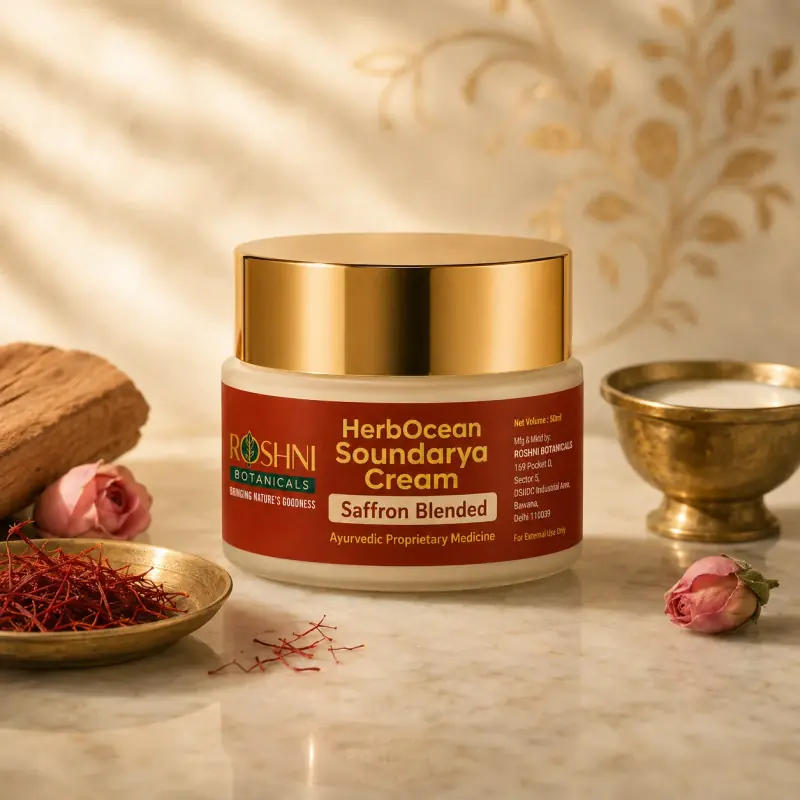
Soundarya Cream
A rich saffron brightening and repair cream with bargad (Vatt) bark on a goat-milk and coconut base, with shea and kokum butters, traditionally used in the care of skin where post-acne marks (PIH) linger.