Henna for Hair: An Honest Guide for Indian Hair
Henna deposits colour, and only colour. What that means for grey hair, for roots, for the dryness complaint, and for the oiling around it.
In most Indian homes, henna day is already a ritual. An iron kadhai soaking overnight. Dark green paste in a steel katori. A whole Sunday morning set aside for it, no arguments.
Go online, though, and that settled feeling disappears fast. One page says henna will sort out everything your scalp has ever done to you, the next says stay away from it, and neither explains the small piece of chemistry that decides what you get. So let us do that instead.
Key takeaways
- Henna colours hair with lawsone, a small reddish stain molecule that binds to the keratin of the strand. It carries no ammonia and no peroxide, so it can only add colour.
- Grey shows the colour most vividly, often frankly coppery, because there is no dark pigment underneath to mask the stain; dark hair gains a warm sheen instead.
- Henna colours the hair that has already grown. It does nothing to the pigment your follicle puts into new growth, so roots show as hair grows, and reapplication is the only answer to that.
- Boxed dyes sold as black henna often rely on PPD, a known contact allergen, and reactions are delayed. Read the panel before you buy.
- Keep henna day itself oil-free, then oil on the days in between. The rhythm, not any single product, is what keeps hair comfortable.
What Henna Actually Does to Your Hair
Henna is the dried, powdered leaf of Lawsonia inermis, and mehendi and henna are the same plant. Its colour comes from lawsone, a small reddish stain molecule that the leaf releases from its own precursors and that then binds to the keratin of the hair itself (Dallmann and colleagues, International Journal of Cosmetic Science, 2026, an experimental dyeing study on yak hair). That binding is why the colour is wash-fast rather than rinsing away.
What henna does not do is what a permanent boxed dye does. A boxed dye uses ammonia to swell the fibre open and peroxide to act on the melanin already inside it (Gavazzoni Dias, International Journal of Trichology, 2015, a review). Henna carries neither. It has nothing that lifts melanin, so it can only add: a reddish copper over whatever is already there.
Grey is the other half of the story. Grey shows the colour most vividly, often frankly coppery on the very first application, because there is no dark pigment underneath to mask the stain, while dark hair gets a warm sheen you mostly catch in sunlight.
The structural point matters just as much. Henna colours the hair that has already grown, and it does nothing to the pigment your follicle puts into new growth, so whatever grows out next arrives in the colour your follicle is making today. Roots show as hair grows, and reapplication is the answer. Nothing here puts pigment back into a strand that has already grown out grey, and oiling does not act on colour at all; we have set out separately what oiling can and cannot do about grey.
The household method deserves to be taken seriously, not filed away as folklore. The overnight soak in an iron kadhai, tea stirred into the paste, a squeeze of lemon in some kitchens, the paste resting out on a balcony: real variables, and a few genuinely move the result. How long the paste rests before it goes on is household practice, and no one has put a number on it. Iron has a chemistry of its own: lawsone forms coloured complexes with metal ions, which is why iron pushes plant dyes darker and browner in classical textile work, and why old kitchens reached for the kadhai. Read the household version as tradition with a chemistry behind it, not as a measured result on hair. And a mildly acidic range, pH 4.5 to 6.0, is where lawsone binds to hair keratin (Cui and colleagues, Molecules, 2022, a review), so we would not count on a harsher squeeze of lemon for a darker stain.
One line from the internet we will not repeat: that henna cools the scalp. Its classical potency needs a printed classical reference before we say it out loud, ours included, so we leave it unsaid.
The Dryness Question, Answered Plainly
Now for the complaint that fills every henna thread: hair that feels rough, stiff or straw-like for a few days afterwards. The experience is genuinely common, and the leaf does not need defending on this point.
A clay-like paste sits drying on the strand for hours. The wash-out runs long, often several rinses before the water goes clear. Conditioner usually gets skipped that day so the colour can settle. Whether henna alters the strand surface in any lasting way is not something we will assert, because the record does not settle it. What most people report is that the roughness eases over the following few washes, and when it does not, the mix is the first place to look: undiluted lemon juice is the frequent culprit.
Then there is your tap. If your water comes from a borewell or a tanker rather than a treated supply, the calcium and magnesium in it leave a film on the shaft, and many people find that adds to the rough, coated feel after a long henna rinse. The research here is not settled, so rule it out rather than blame it first; we have covered how hard water affects your hair separately. One habit from that guide is worth carrying into henna day: keep a jug of filtered or boiled-and-cooled water aside for the final rinse, so mineral-heavy water is not what dries on a freshly stained strand.
The traditional balance is a rhythm rather than a product. Keep henna day itself oil-free: with a dye that has to migrate out of a paste and into the fibre, an oil film on the strand is one variable fewer to argue with, and that is practice, not a tested result. Then oil on the days in between, on the rhythm our guide to Ayurvedic hair oils for hair fall control sets out.
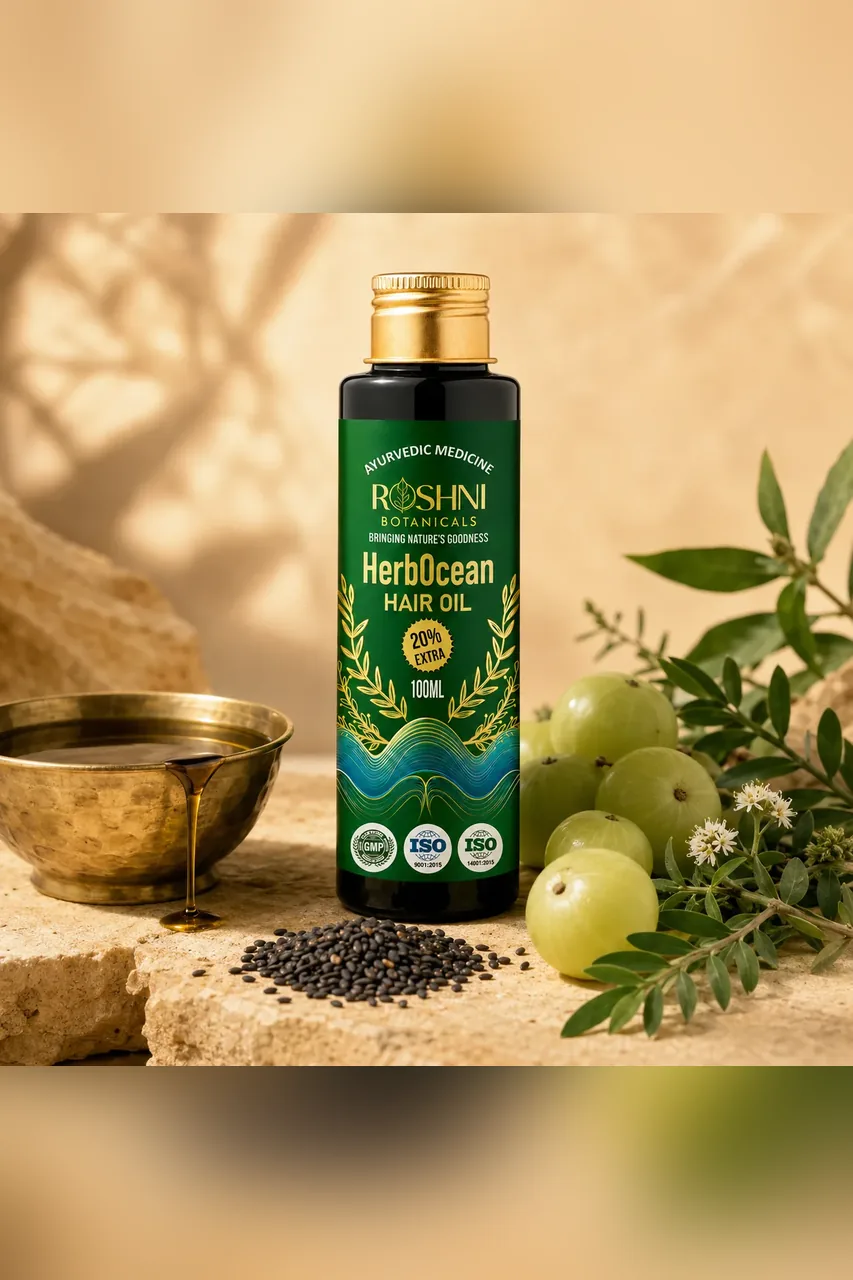
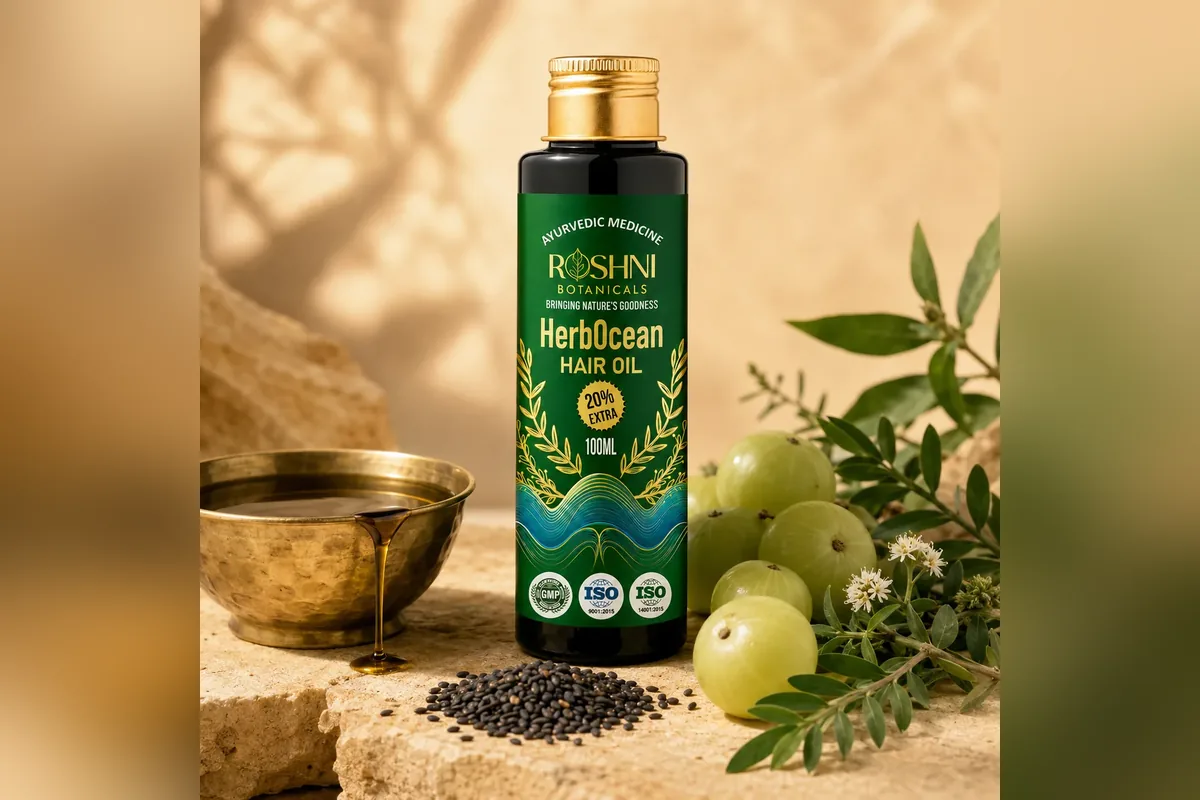
HerbOcean Hair Oil was built for exactly that in-between slot. It carries sixteen botanicals: twelve herbs, each at the same measure, Bhringraj, Jatamansi, Brahmi and Amla among them, in a sesame oil (Til tail) base, finished with lavender, curry leaf and rosemary oils, finishing oils rather than herbs. It is an AYUSH-licensed Ayurvedic medicine (Licence No. DL-474 A&U), traditionally used in the care of hair fall, made in-house at our GMP-certified unit in Bawana, Delhi, and built on the 40-year formulation legacy of Vaidya Shri Ram Prakash Ji.
Two boundaries, in plain words. The Hair Oil contains no henna and makes no colour claim of any kind: it will not deepen your henna, hold the stain longer, or alter a grey strand. And nothing on this page, henna or oil, is a promise that hair fall will stop.
Black Henna, PPD and the Two-Step with Indigo
Boxed dyes marketed as black henna are where caution stops being optional. In the dermatology literature, black henna simply means henna with PPD (paraphenylenediamine) added, and PPD is a contact allergen (de Groot, Contact Dermatitis, 2013, a full review). Many boxed dyes sold under the name rely on it rather than on the leaf alone. An Indian review of cultural practices puts the balance plainly: pure henna rarely causes allergic reactions, and most reported reactions are attributed to added PPD (Gupta and Thappa, Indian Journal of Dermatology, 2015).
On the scalp a reaction can show as itching, burning, weeping or blistering, and the timing is the part people get wrong: it is delayed. In someone already sensitised it usually begins a day or two after the rinse rather than during it, and if a dye is sensitising you for the first time the rash often appears only four to seven days later (Panfili and colleagues, 2017, two paediatric cases and a review, Italy). Nothing showing by bedtime is not the all-clear.
One reaction can leave a lasting sensitivity, and it does not stay with the box: cross-reactions are reported to other hair dyes, to dyes used in textiles, to some local anaesthetics and to rubber chemicals (de Groot, 2013). If that has ever happened to you, tell your own doctor and your dentist, read hair colour labels from then on, and do not test your way back in: treat yourself as PPD-sensitive until a dermatologist says otherwise.
So read the panel, not the front of the pack. Plant colour legitimately blends several herbs, henna with indigo, amla or shikakai, so a long list is not by itself a warning. A synthetic amine is. PPD does not always appear as PPD on a panel: look also for p-phenylenediamine, 1,4-diaminobenzene, and related para-dyes such as toluene-2,5-diamine. And no plant turns hair black in twenty minutes; a paste promising that is not pure henna, whatever the front says. If the panel names a para-dye, put the box back rather than testing it, because the test is itself an exposure.
If you are testing a box you believe is plain, a box is not a cone: it prints its own patch-test instruction. Follow it exactly, at the spot the pack names, for the waiting time it states, and repeat it for every new box, not just the first. Then be clear about what a quiet result means: the dye did not irritate you quickly, not that it is safe. A home test misses slow reactions, and a first sensitisation often shows days later. This applies to pure henna too: reactions to plain henna are uncommon, but they happen, and plant origin is not the same as universal tolerance. Your scalp is skin, and our companion guide to mehendi and henna skin safety covers the cone side of this in detail.
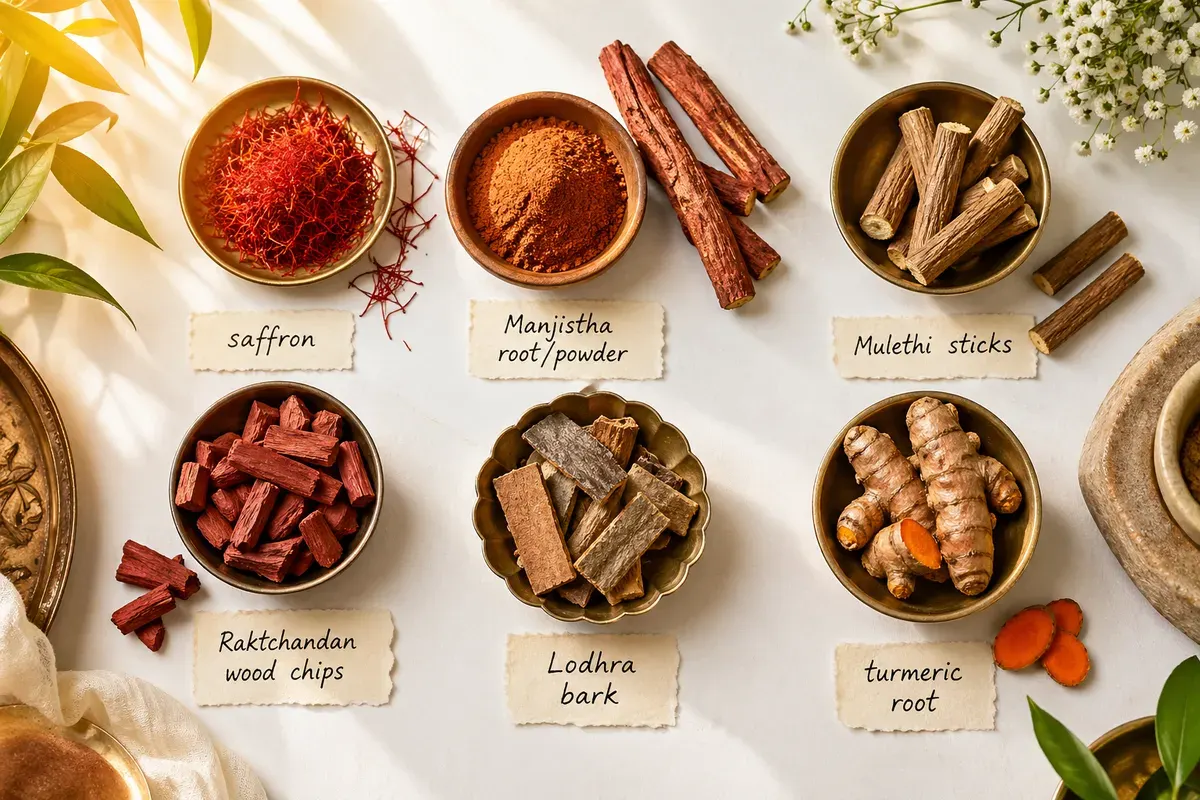
For deeper tones there is a route that has been used for generations and needs no PPD at all: the two-step with indigo. Pure henna goes on first and gets rinsed out; then indigo (Indigofera tinctoria) goes over the stained hair, taking the result from copper towards brown or near-black, depending on how long it stays on and how much henna sits underneath. It is slower than a single box and asks for two sittings. What it is not is a different kind of process: henna and indigo both deposit colour, and neither does more than that.
Whichever route you take, the shelf needs reading: single-ingredient loose powder from a trusted pansari (the neighbourhood herb seller), or a labelled pack that lists only henna, or henna with named herbs. A box that offers several shades from one powder is not a single leaf. Buy small the first time; crop and grind vary between batches.
A Humid-Weather Henna Routine, and When to See a Doctor
Humid weather works against you at both ends: the paste takes longer to do its work, and hair takes longer to dry after the rinse, which is how people end up sleeping on a damp scalp and waking up itchy. Start early enough in the day that hair is properly dry before you sleep, and if it is still damp at bedtime, dry it; go by the hair, not the clock. If you are planning henna around an occasion, apply a few days ahead and keep the days after for oiling, which puts the first scalp oil massage (champi) and the comfort it brings before the event, not after it.
A simple fortnight, ours rather than a classical rule, so move it to suit your hair. Day one, henna on clean, oil-free hair, rinsed out with plain water; most households skip shampoo that day so the colour can settle. For the next day or two, many people leave the hair alone, and that is habit, not a rule: in sticky weather, or if you have sweated, or if you use a medicated shampoo on a set schedule, wash. A scalp left damp and unwashed is the bigger problem, and scalp comfort wins over shade every time. Then the first champi with the oil, done the way our step-by-step hair oiling routine lays it out; leave the oil at least an hour before the wash, and in sticky weather take that shorter window rather than overnight. Two or three sessions a week suit most people, fewer if your scalp runs oily, and finish with a proper wash before your next henna, so the paste goes onto clean, oil-free hair.
Two cautions belong on any oil, ours included. It is for external use, so keep it off broken or inflamed skin, and patch-test on the inner forearm before the first full application, as the product page says. Reactions to plant oils and natural fragrance are often slow, so watch the same spot for several days, and stop at once if it itches, reddens or stings. And do not colour a scalp that is broken, sore, scratched or already itching, whether the pack says henna or something else; let it settle first.
One household line, since the bowl is usually out for everyone at once. No mehendi on a baby or infant at all, natural or otherwise, and keep wet paste, drips and rinse water off an infant’s skin. The reason is not allergy but G6PD deficiency, an inherited enzyme fault, and our companion guide to mehendi and henna skin safety sets it out in full.
Some symptoms are not part of the process.
See a doctor the same day for: itching, burning, blistering or oozing on the scalp after any henna or boxed dye, redness or swelling spreading past the hairline onto the face, neck or shoulders, sudden patchy hair loss, fever, or any reaction at all on a child. And a child who has had henna and turns unusually pale or drowsy, or passes dark urine, is a hospital the same day.
Emergency care now, not the same day: difficulty in breathing, swelling of the face, lips or tongue, or a rash spreading across the body.
If your scalp is reacting, stop, rinse thoroughly under plain running water, use a cool compress, and put nothing else on it of your own choosing, ours included. No oil, no haldi, no besan, no malai, no lemon. Thick applications on inflamed or broken skin trap heat and add fresh irritants to a barrier that is already damaged. Photograph the scalp before you leave, and take the box with you, because the panel is the only ingredient list anyone will have.
Keep the Ritual, Add a Rhythm
Henna needs neither rescuing nor debunking. It is a plant stain that colours the hair already grown, shows most on grey, adds colour only, and asks for reapplication as hair grows. Around that, the routine your grandmother already knew still holds. Henna day oil-free, the oil on the days in between, indigo as the second step if you want a deeper tone, and a patch test before anything new goes near your scalp.
References: Gavazzoni Dias MFR. Hair cosmetics: an overview. International Journal of Trichology. 2015;7(1):2-15 (review; Indian journal; mechanism of oxidative dyes and plant dyes). Dallmann N, Vill V, Straske F. International Journal of Cosmetic Science. 2026;48(2):310-326 (experimental dyeing study on yak hair, not human scalp hair in use; lawsone released from hennoside precursors during extraction and formulation). Cui H et al. Recent advancements in natural plant colorants used for hair dye applications: a review. Molecules. 2022;27(22):8062 (review; lawsone binds keratin in a mildly acidic range; metal-ion colour complexes). de Groot AC. Side-effects of henna and semi-permanent “black henna” tattoos: a full review. Contact Dermatitis. 2013;69(1):1-25 (single-author narrative review; black henna defined as henna with PPD; cross-reactions). Gupta D, Thappa DM. Dermatoses due to Indian cultural practices. Indian Journal of Dermatology. 2015;60(1):3-12 (narrative review of Indian practices; pure henna rarely allergenic, most reactions attributed to added PPD). Panfili E, Esposito S, Di Cara G. International Journal of Environmental Research and Public Health. 2017;14(4):421 (two paediatric cases and review, Italy; de novo sensitisation declares at four to seven days).
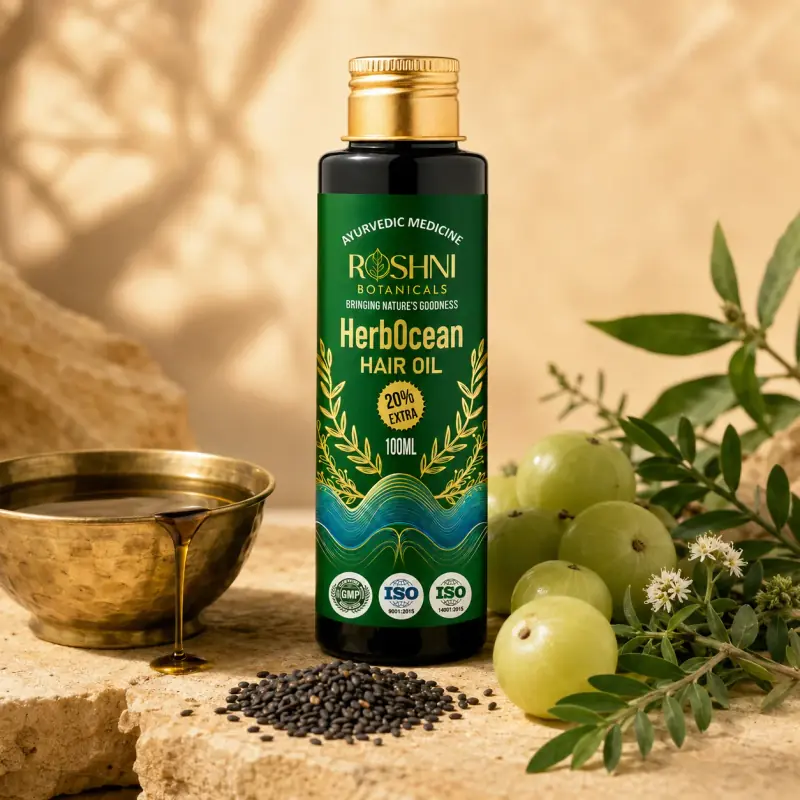
HerbOcean Hair Oil
A classical Taila for hair fall, dullness and a flaky scalp, with sixteen botanicals like Brahmi, Jatamansi, Amla and Neem in a slow sesame base.
Part of our guide: The definitive guide to Ayurvedic hair oils for hair fall.