Ayurveda for Sensitive Skin: A Calm, Patch-Test-First Routine
Skin that reacts is not a fixed skin type. Start with the forearm test, then the water you wash in, then what to take out of the routine.
Most sensitive-skin advice written for Indian readers is really advice for slightly dry skin. Yours reacts, which is a different problem altogether. A wash that leaves everyone else comfortable leaves you tight. The cream your cousin swears by stings for ten minutes, then settles into a flush that lasts the evening. So the useful question is not which herb is calming. It is how you find out, safely, what your own skin will tolerate.
One unglamorous habit costs nothing and saves a great deal of trouble, plus a short list of things worth taking out of your routine before you put anything new into it. As the monsoon pulls back in North India the air starts drying out, and that is when skin that reacts tends to announce itself.
Key takeaways
- Sensitive skin describes skin that reacts rather than a fixed skin type, and reactivity moves with the season, with how you wash, and with how much the skin has been disturbed lately.
- The inner-forearm patch test is the method: one preparation at a time, left undisturbed, and kept going for longer than a single look, because a reaction to something put on skin is usually a delayed one.
- The Soundarya and Radiance preparations carry botanical fragrance oils, lavender, rose and mogra, and saffron sits in several of them, so they get the same forearm test as anything else.
- Hard water across Delhi and much of North India makes your cleanser harder to rinse away, so more of it stays on the skin after washing, and readers routinely blame the cream they applied afterwards.
- Subtraction comes before addition: pause acids, scrubs, very hot water and extra washes before you introduce anything new, and judge the result by comfort rather than by speed.
What sensitive skin actually means, and what it is not
Three different situations get collapsed into one word. One is sensitive skin itself: skin that stings after washing, feels tight in dry air and flushes at small provocations, with no single ingredient to blame. Another is a true allergy to one substance, showing up reliably every time that substance touches you. Third comes the one-off irritant flare from something genuinely harsh, a strong acid or a gritty scrub, which usually settles once the insult stops, though repeated irritation can be slow to clear. Of the three, the allergy is the one that tends to stay with you, and only a doctor can tell you whether you have one. Reactivity is a state skin can be in, and states change.
Classical Ayurveda usually reads the heat-prone, easily flushed pattern as leaning towards Pitta (one of the three doshas, the biological energies in Ayurveda). The idea that a person carries a constitutional tendency, prakriti, is set out in the Charaka Samhita, Vimana Sthana 8, where it is one of the ten things a physician is told to examine before treating. Read the label as a starting point for observation. It tells you what to watch for. It cannot tell you what your skin did last Tuesday, and on its own it settles nothing.
Two local facts matter more than most pages allow. On melanin-rich Indian skin, a flare can leave a brown shadow behind that outlasts the redness by months, so calming a reaction early counts for more here than elsewhere. The monsoon exit in North India is also a transition: the humidity that was propping your skin up drops away, and skin that coped through the wet weeks starts to feel tight within a week. Before you change a single product, write down what your skin did over the past two weeks, and after which product. That record beats any dosha quiz.
Patch test first: the inner-forearm method
Here is the whole procedure. Wash the inner forearm with your usual gentle cleanser and pat it dry. Apply a small amount, about a coin-sized patch, and mark the edge lightly with a pen if you want to find it again. Leave it alone. Do not wash that spot, do not cover it with a bandage, and do not keep touching it to see what is happening. The instruction printed on every HerbOcean product page applies here: patch-test on the inner forearm 24 hours before first use and discontinue if irritation occurs. Take that as the minimum rather than the finish: reactions to plant oils and natural fragrance are often slow, so keep the same forearm patch going, twice a day, for ten days to two weeks before anything new goes near your face, and stop at once if it itches, reddens or stings.
An allergic reaction to something put on skin is usually a delayed one, showing itself one to three days after contact, which is why an early look on its own settles nothing. This is an open test done at home. A dermatologist runs a patch test that is kept covered and read over several days, and it picks up what a home test can miss, which is worth knowing if your skin has reacted badly before.
What counts as a reaction: redness, itching, burning, swelling, small bumps, scaling, or a patch that simply feels hot to the back of your hand. Any of those means stop. Nobody should talk themselves out of a result they can feel.
Two rules make the test mean something. One preparation at a time, and a fresh test whenever a formula changes, so that a response has an obvious culprit. The inner forearm is the site we use here, sensitive enough to show a response yet more forgiving than your face; behind the ear works if you would rather not carry a marked patch on your arm.
Two cautions belong here as well. Keep any preparation away from the eye area. And a preparation that stung once does not deserve a second attempt, whatever the label says and whoever recommended it. If your worry is congestion rather than reactivity, the companion piece on do face oils clog pores answers that properly, and there is no need to repeat it here.
Fragrance, hard water, and what to set aside before you add anything
Start with the thing most brands leave to the ingredient list. The Soundarya and Radiance preparations carry botanical fragrance oils, lavender, rose and mogra, and saffron (Kesar) sits in several of them. That is a scent, it comes from plants rather than a synthetic blend, and botanical still does not mean risk-free for skin that reacts. If scented products have troubled you before, a fragrance-light option is a reasonable choice. For the story behind those notes, the aromatherapy of Soundarya Cream covers it.
Then the water. Delhi and much of North India run hard water through the taps, and hard water matters mainly through what it does to your cleanser: more of it stays on the skin after every wash. That squeaky, tight feeling reads as clean to most people; to skin that reacts it reads as stripped. Whatever cream goes on afterwards gets the blame. The fix is modest: a gentler wash, less of it, and rinse properly rather than quickly. If you keep a jug of boiled-and-cooled or RO water aside for a final splash, take it as a preference rather than something anyone has tested on facial skin.
Now the subtraction list. Stop stacking acids on top of scrubs: each on its own asks the skin to shed faster, and together they leave it raw before anything calming has a chance. Drop very hot water, which feels wonderful for four seconds and leaves the barrier worse off; lukewarm lifts a cleanser perfectly well. Adding two new products in one week is how you end up never knowing which one spoke, so bring in one thing at a time and give it its own forearm test. Pause sheet masks while skin is flaring, since a wet sheet pressed onto skin that is already complaining is a lot of contact at the wrong time. And stop washing more often in the hope it will settle things, since over-washing is a comfort and barrier problem before it is anything else; why over-washing backfires in Indian humidity goes into that at length.
One thing stated plainly. HerbOcean does not manufacture a sunscreen, and nothing in the range replaces one, so if you are outdoors through a Delhi afternoon that job belongs to shade, a hat and your sunscreen. Comfort is the measure here, and comfort is what a calm routine can reasonably be judged on.
Where HerbOcean Soundarya Cream sits
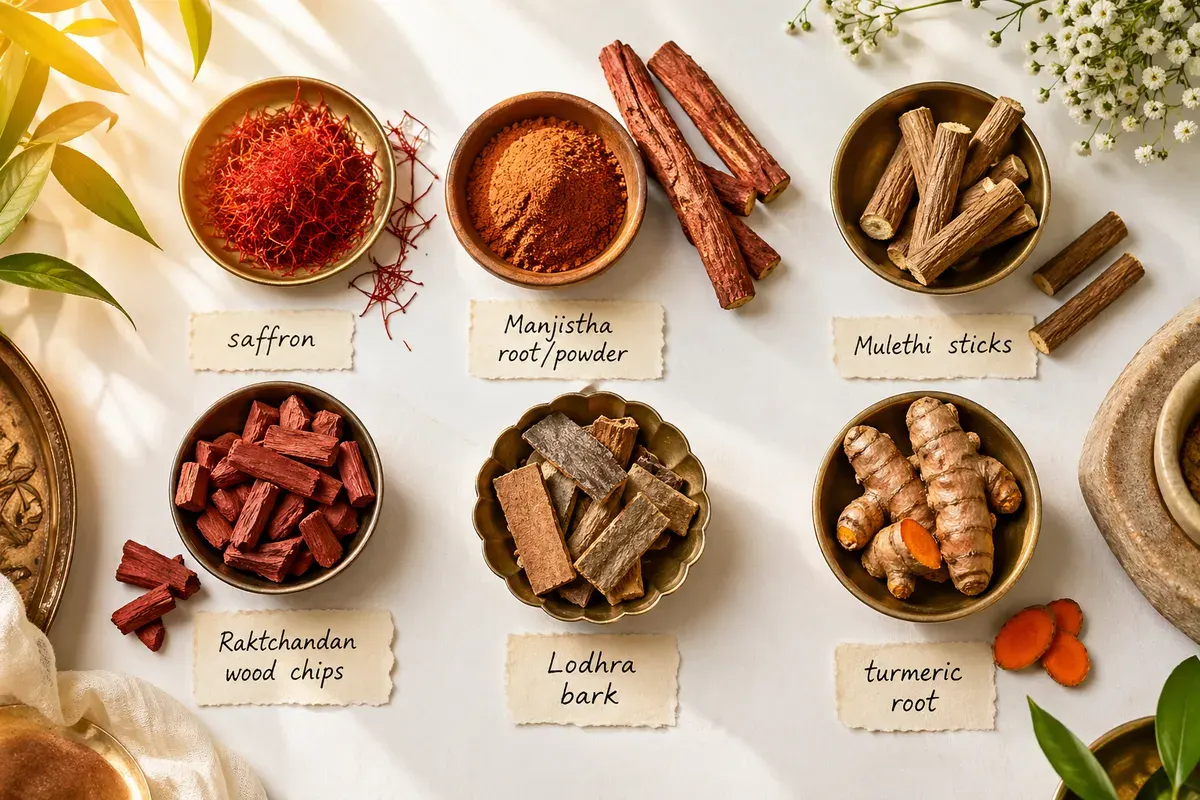
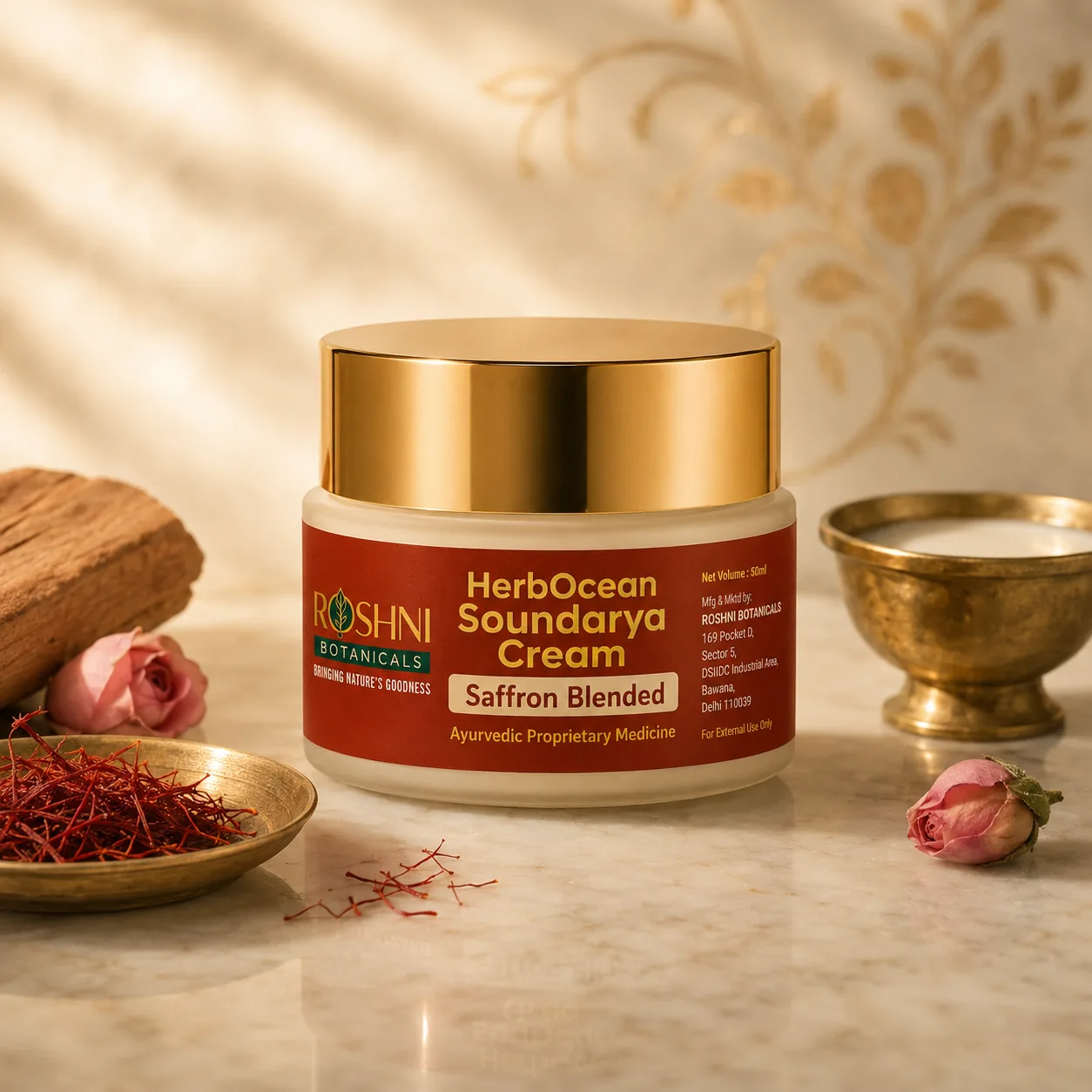
HerbOcean Soundarya Cream is an AYUSH-licensed Ayurvedic medicine for external use, traditionally used to support soft, nourished skin, and it helps maintain comfort in dry, depleted skin. It is a rich saffron repair cream with bargad (Vatt) bark on a goat-milk and coconut base, with shea and kokum butters. Named in the full declaration are bargad (Vatt) bark, saffron (Kesar), goat milk (Ajadugdh), Indian madder (Manjistha), liquorice (Mulethi), red sandalwood (Raktchandan), Palash, Priyangu, Laksha, Daruhaldi and Nagkesar, with coconut, shea and kokum butters as the base. Very oily or acne-prone skin may find it rich. Warm a small amount and press into clean skin, morning or night. It is made in-house at our GMP-certified unit in Bawana, Delhi, under AYUSH Licence No. DL-474 A&U, and it is built on the 40-year Ayurvedic formulation legacy of Vaidya Shri Ram Prakash Ji. For external use only. Patch-test on the inner forearm 24 hours before first use and discontinue if irritation occurs; avoid the eye area. If pregnant or breastfeeding, check with your doctor.
HerbOcean Soundarya Tailam is a saffron Taila (medicated oil) prepared in the goat-milk Kshira-paka tradition, the classical milk-and-oil method, in which the herbs are simmered with goat milk in the oil until the water has gone and only the medicated oil remains, with goat milk as its largest single ingredient; how a classical goat-milk face oil is actually made covers the method properly.
Introduce the cream the way you would anything else. Forearm test first, on the schedule above. Skin that flares easily has earned that pace, and none of it changes with age or gender; sensitive skin is sensitive skin. If your real question is about melasma or the dark patches Hindi homes call jhaiyaan, the longer handbook on melasma for Indian skin is your better next read, and it is plain about how slow and partial that story is.
When to see a dermatologist rather than test another preparation
See a dermatologist, and stop the preparation, for any of these: burning that persists rather than settling, flushing that stays rather than calming down, weeping or cracking or scaling patches, anything that spreads beyond where the product was applied, and any reaction that shows up during the patch test itself. A reaction during the test is useful information. Act on it, and take the product off your skin.
Bring the record you kept: what went on, when, and what the skin did afterwards. It shortens the appointment, and it is the one thing a home test can hand to a clinic. A doctor can also run the covered test described above, which is the right next step when a forearm patch keeps reacting and you cannot tell to what.
Start with the patch test and nothing else
Has your skin reacted before? Then start the forearm test, and add nothing else while it runs. If the forearm stays quiet through the full run, add one step. When you are ready for that step, HerbOcean Soundarya Cream is one place to start, patch-tested on the forearm first, and the rest of the Ayurvedic skincare range can wait until your skin has been settled for a month.
References: Charaka Samhita, Vimana Sthana 8 (Rogabhishagjitiya Vimana), where prakriti, the constitutional type, is one of the ten things a physician examines before deciding on care. Misery L and colleagues, Definition of sensitive skin: an expert position paper from the special interest group on sensitive skin of the International Forum for the Study of Itch, Acta Dermato-Venereologica, 2017: a Delphi consensus of an international expert group, which defines sensitive skin as a syndrome of unpleasant sensations in response to stimuli that would not normally provoke them. Misery L and colleagues, Pathophysiology and management of sensitive skin, Journal of the European Academy of Dermatology and Venereology, 2020: a position paper from the same group, which holds that sensitive skin relates to alterations of the skin nervous system rather than to an immunological disorder, with barrier abnormalities frequently associated but not causally established. Johansen JD and colleagues, European Society of Contact Dermatitis guideline for diagnostic patch testing, Contact Dermatitis, 2015: a clinical guideline for the diagnosis of delayed-type hypersensitivity, in which patches are occluded and read over several days rather than at a single sitting. Hannuksela M and Salo H, The repeated open application test, Contact Dermatitis, 1986: 86 patients with contact dermatitis in Finland, the substance applied twice daily for seven days to the flexor forearm. de Groot AC and Schmidt E, Essential oils, part IV: contact allergy, Dermatitis, 2016: a review recording nearly eighty essential oils reported as causes of contact allergy, two of them jasmine absolutes. Skold M, Hagvall L and Karlberg AT, Autoxidation of linalyl acetate, the main component of lavender oil, creates potent contact allergens, Contact Dermatitis, 2008: a chemical study with a mouse local lymph node assay, in which air-exposed linalyl acetate became a markedly stronger sensitiser. Danby SG and colleagues, The effect of water hardness on surfactant deposition after washing and subsequent skin irritation, Journal of Investigative Dermatology, 2018: 80 participants in the United Kingdom, healthy volunteers and atopic dermatitis patients, in which skin washed in hard water retained more cleanser, lost more water and was more easily irritated. Herrero-Fernandez M and colleagues, Impact of water exposure and temperature changes on skin barrier function, Journal of Clinical Medicine, 2022: a prospective observational study of 50 healthy volunteers in Spain, measured on the hands, in which hot-water exposure raised water loss, pH and redness. Davis EC and Callender VD, Postinflammatory hyperpigmentation: a review of the epidemiology, clinical features, and treatment options in skin of color, Journal of Clinical and Aesthetic Dermatology, 2010: a review reporting that epidermal post-inflammatory pigment may take months to years to settle and worsens with ultraviolet exposure and with recurrent inflammation. Educational, not medical advice.
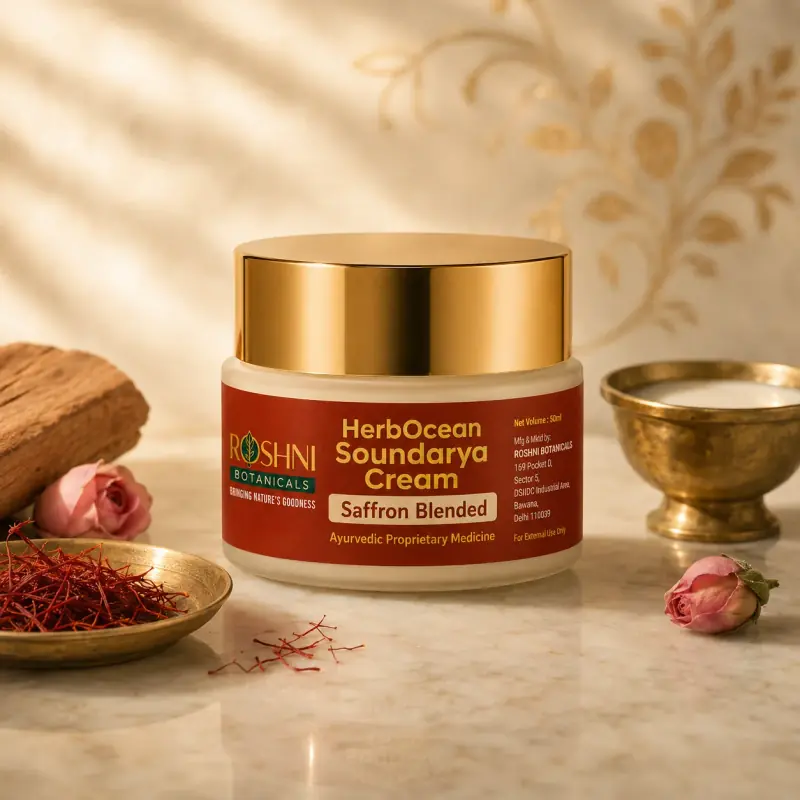
Soundarya Cream
A rich saffron brightening and repair cream with bargad (Vatt) bark on a goat-milk and coconut base, with shea and kokum butters, traditionally used in the care of skin where post-acne marks (PIH) linger.
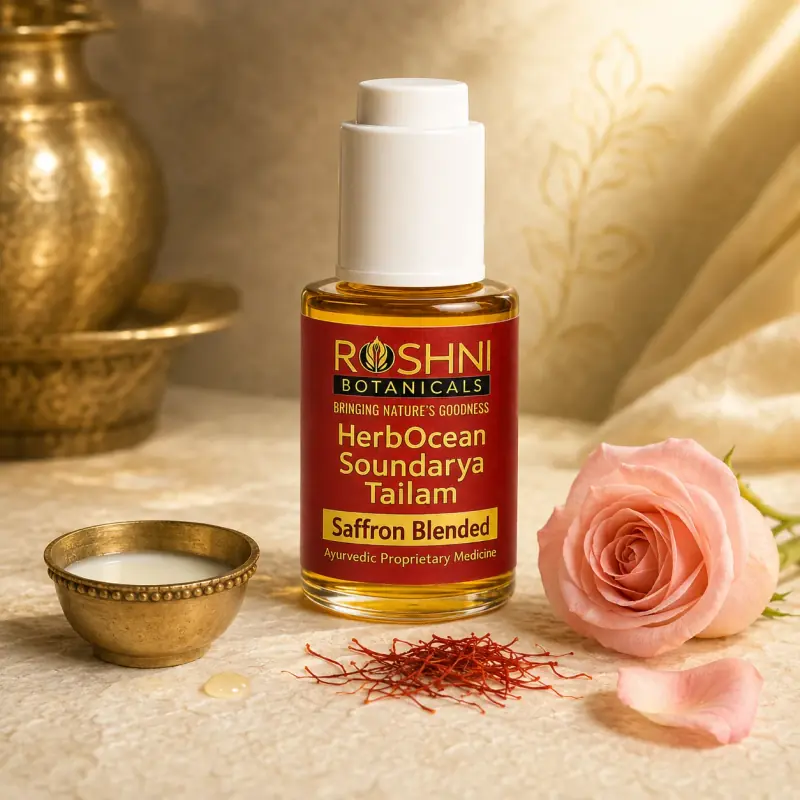
Soundarya Tailam
A saffron-infused facial Taila prepared in the goat-milk Kshira-paka tradition, with Manjistha, Mulethi and Kesar. For soft, bright, even skin.