Saffron for Ageing Skin: An Ayurvedic Age-Care Guide for India
Kesar reached Indian faces long before it reached a carton. A classical reading of ageing skin, the night routine, and what is fair to expect.
Most of us meet saffron in a kitchen long before we meet it in a skincare aisle. A few threads in kheer. A pinch stirred into warm milk the night before a wedding. That move from the kitchen shelf to the face is not something a marketing team invented last year. Saffron (Kesar) sat in the classical Ayurvedic skin texts centuries before anyone printed it on a carton, and it sat there for reasons that can be stated plainly.
Picture one reader. Somewhere in her mid-thirties. Her skin feels drier by nine in the evening than it used to, the creases at the outer corner of her eyes stay a moment longer after she smiles, and the glow a Sunday face pack used to give her now lasts a day instead of three. None of it is making her panic. She would just like to know what is worth doing and what is noise.
So, the plain question first. What can a saffron preparation contribute to skin that is ageing, and what belongs to a dermatologist instead? Both halves get answered here in the classical lens.
Key takeaways
- Classical Ayurveda names the concerns of ageing skin as wrinkles (Vali) and tissue depletion (dhatu kshaya), and reads the later years of life as Vata-predominant (one of the three doshas, the biological energies in Ayurveda): drier skin and slower repair.
- Saffron (Kesar, Crocus sativus) is the hand-picked dried stigma of a crocus flower, which is why a kitchen rations it by the pinch and a formulation room by the gram.
- On melanin-rich skin, ageing tends to show first as pigment and texture change rather than as lines, partly because more epidermal melanin marks more readily and partly because a thicker, more compact dermis makes fine lines less visible.
- A steady nightly routine is judged by hydration, comfort and lustre across a season, not by a transformation in a couple of weeks.
- Sun cover is a daytime job of its own: a broad-spectrum sunscreen, a cap or a scarf, and shade through the harshest hours.
What Ayurveda Says About Skin That Is Ageing
The classical texts have no single phrase for the modern skincare category. They have something better: a vocabulary for what is actually changing, more precise than the marketing language that replaced it. Wrinkles have a classical name, Vali, the folding and slackening that shows up first where the skin moves most. Tissue depletion, dhatu kshaya, is the quiet thinning of everything beneath the surface that holds it up. Neither word carries any shame. Both describe a stage, written down by physicians who expected their patients to reach it.
That stage is described as Vata-predominant. Vata governs movement, dryness and lightness, and the later years of a life are read as its season. Dryness, rukshata, is the signature the texts keep returning to, alongside a loss of unctuousness and a general slowing of repair. If you spent your twenties blotting shine off your nose and now find your cheeks tight by bedtime, you have felt that description from the inside, years before reading it anywhere.
Lustre has its own seat in this system. Bhrajaka Pitta is the aspect of Pitta (the dosha that governs transformation and heat) that classical authors place in the skin itself, and it is named for bhrajana, the giving back of light. Disturb that aspect and the classical language turns to dullness and roughness, never to disease. Tired-looking skin already has a classical address, then, and ageing here is a stage to move through well, not a defect to apologise for.
Then there is Rasayana, the classical category of restorative practice, covering food, conduct, preparations and the discipline that holds them together across years. Care is needed with that word, because it gets borrowed as a benefit line. Rasayana is a category of practice in the texts, and it stays a category here. The line that holds from here on is simple: classical age-care aims at comfort, lustre and softness, judged across a season.
Why Indian Skin Ages the Way It Does
Melanin-rich skin carries a different load from the skin in the literature most global brands quote, and the sun here is unrelenting: the exposure is cumulative across decades of school runs, scooter commutes, terrace work and late-afternoon markets. The visible result usually arrives as pigment and texture change, well before deep lines, and that pattern is widely described in dermatology writing on melanin-rich skin.
Melanin-rich skin also marks more readily, and the marks last longer. Post-inflammatory hyperpigmentation (PIH) is the technical name for the brown shadow left behind once inflammation has settled: an old breakout, an inflamed patch after threading, a scratch that was picked at. Months later, the event is forgotten and the mark is still legible, reading in a mirror as ageing when it is nothing of the sort. If patchy pigment worries you more than texture does, the handbook on melasma for Indian skin will serve you better than this one.
Two further variables belong in any Indian account. Urban particulate exposure belongs in any account of city skin: in a study of older German women, traffic particle exposure tracked with more pigment spots on the forehead and cheeks. Indian data are beginning to arrive, in a cohort of about fifteen hundred women scored with the same skin-ageing instrument and with particulate exposure in the model, though not as a measurement of Delhi, so the finding is offered as a pointer. The seasonal swing is the second, sharper than most routines allow for. As the monsoon pulls back in North India the air dries out fast. Skin that was slick through the rains can feel tight within a couple of weeks, and a routine built for humid months starts to feel thin right around the time the wedding invitations arrive.
Hard water is the last piece, and most Delhi households know it intimately. High mineral content works against the skin barrier when it meets soap: in a UK washing study, skin washed in hard water held on to more surfactant residue, lost more water and was more easily irritated. A strained barrier loses water faster and tends to look duller. None of this is exotic or hard to act on. It just means a routine designed elsewhere, for softer water, gentler sun and a flatter seasonal curve, will underperform here for reasons that have nothing to do with the ingredients inside it.
The Place of Saffron in Classical Age-Care
Saffron is the dried stigma of the Crocus sativus flower, picked by hand in a short harvest window each year, and a great many flowers go into a single gram. That arithmetic explains the price. It also explains something readers find odd on a formulation sheet: the saffron in a litre of medicated oil is a small measure, and small on purpose. Kesar is rationed by the pinch in a kitchen for the same reason it is rationed by the gram in a formulation room.
Classical Ayurveda groups saffron with the herbs valued for the natural lustre of the skin (Prabha, Kanti) and its general good condition, and it lends its name to the kumkumadi tradition of facial oils that has carried it for centuries. The modern literature usually cited alongside saffron concerns crocin, one of its pigment compounds, which has been tested in a laboratory radical-scavenging assay. That work is genuinely interesting, and also narrow. It is work on an isolated compound in a dish, and it is not evidence about a finished oil or cream on a face. For the broader ingredient picture, including how to tell decent threads from dyed ones at the counter, read what Kesar is used for, and how to buy it. If you are weighing it against a modern active instead, saffron compared with vitamin C sets out how each is understood to work without declaring a winner.
One formulation detail almost never makes it onto an ingredient page. In the HerbOcean Tailams the saffron (Kesar) is added by cold maceration, a slow room-temperature infusion once the oil is off the heat, rather than being simmered with the other herbs.
What Age-Care Offers, and How to Judge It
A medicated oil or a cream is not a structural repair, and it is worth knowing that before you buy anything. Prescription retinoids are the other conversation entirely: in a controlled trial on photodamaged skin, topical tretinoin increased collagen formation. Whether that route suits you is a decision for a dermatologist who can examine your skin.
Age-care results are slow, cumulative and partly invisible, and that last word is the awkward one. The real comparison is not your face tonight against your face three months from now. It is your face three months from now against the face you would have had without the routine, and nobody gets to see that second photograph. Which is why steadiness beats intensity here, and why a sensible practice looks rather boring from the outside.
What a good nightly routine does offer is still worth having. Skin that is better hydrated reads as plumper. Fine lines look softer when the skin holding them is not dehydrated, a difference you can see even though the lines themselves have gone nowhere. Comfort through a dry Delhi winter is no small thing when your cheeks sting after a wash. Lustre, the quality the classical authors cared about most, is the third thing to watch for, and it is the one a steady routine shows first.
The preparations named below are Ayurvedic medicines for external use, described by their classical indications. Reactive skin? Our calm, patch-test-first routine for sensitive skin is a better starting point than this one, and if you arrived from the glass-skin conversation, the Ayurvedic reading of glass skin covers what that trend is really describing.
A Night Routine for Mature Indian Skin
The architecture is four steps, and the order matters. Cleanse with warm water; very hot water leaves skin feeling tighter afterwards. Pat the skin so it is damp, not dry. Then the oil. At night, on clean, slightly damp skin, press three to four drops between the palms and pat over the face and neck. Slow, upward, unhurried, for as long as it takes the oil to spread properly and no longer, because a routine you will actually repeat every night beats a longer one you will abandon. Our note on a night skincare routine with Soundarya Tailam sets out the same sequence.
HerbOcean Soundarya Tailam is a saffron Taila (medicated oil) prepared in the goat-milk Kshira-paka tradition, the classical milk-and-oil method, in which the herbs are simmered with goat milk in the oil until the water has gone and only the medicated oil remains, with goat milk as its largest single ingredient. It is an Ayurvedic medicine for external use, a night oil traditionally used to support soft, even, well-nourished skin, and a goat-milk Kshira-paka Taila that dry and mature skin tends to accept well. Named in the full declaration are goat milk (Ajadugdh), bargad bark (Vatt), Indian madder (Manjistha), liquorice (Mulethi), red sandalwood (Raktchandan), flame of the forest flower (Palash), beautyberry fruit (Priyangu), lac resin (Laksha), Indian berberry (Daruhaldi) and Ceylon ironwood (Nagkesar), with saffron (Kesar), in a sesame (Til tail) base, finished with lavender, rose and mogra.
Two points matter here. Vatt is bargad, the banyan, and it is the bark that goes into the oil. And the making: the herbs are simmered with goat milk in the oil until the water has gone and only the medicated oil is left behind, so more goat milk goes in, by volume, than the finished oil that comes out; how a classical goat-milk face oil is actually made sets out the full sequence. Very oily or actively breaking-out skin may prefer a lighter option. Avoid if allergic to a listed botanical, to sesame or to goat milk, and patch-test first.
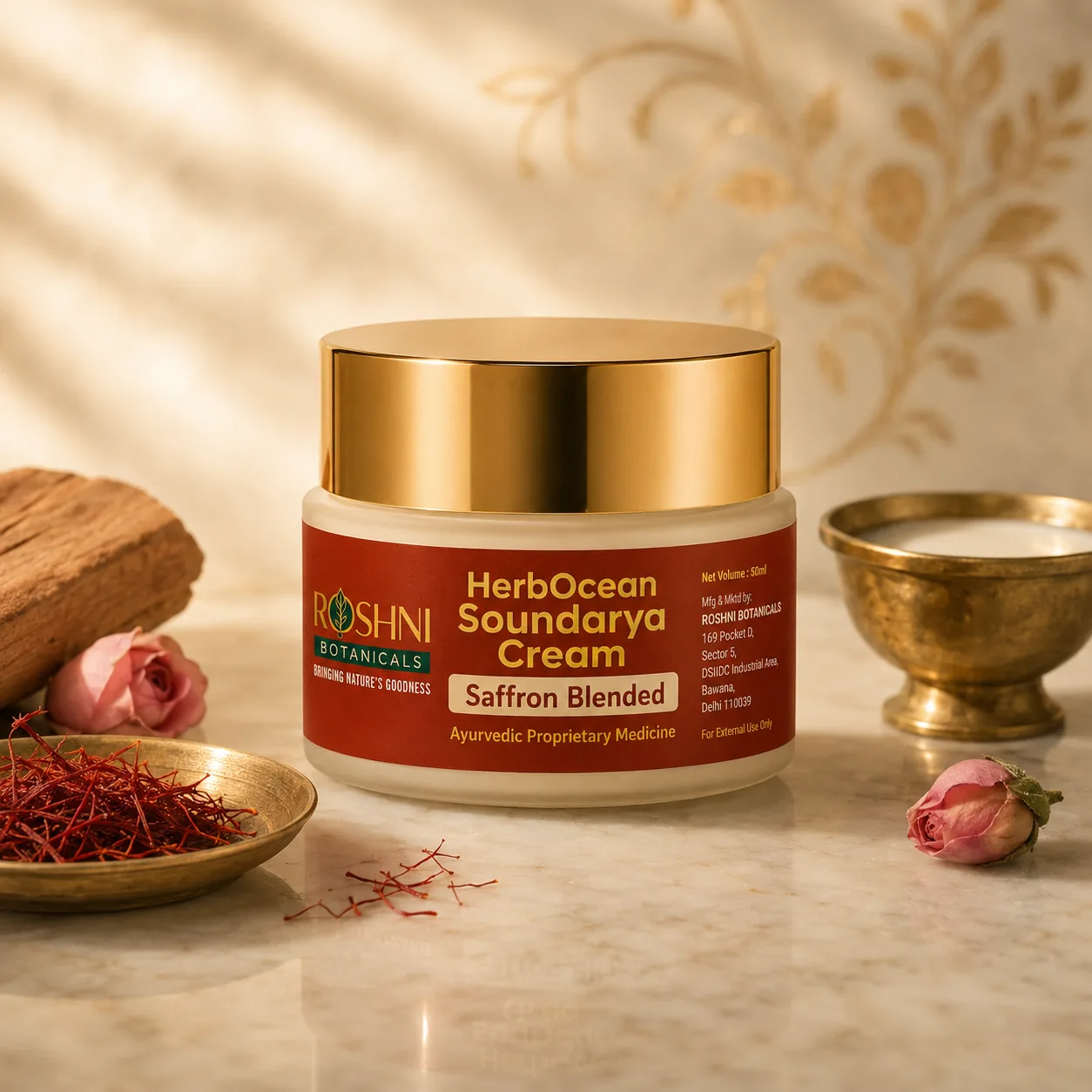
HerbOcean Soundarya Cream is its own preparation, a rich saffron repair cream with bargad (Vatt) bark on a goat-milk and coconut base, with shea and kokum butters. It shares the herb set and the goat-milk base of the Tailam, in a coconut cream, with vitamin E to round it off. It is an Ayurvedic medicine for external use, traditionally used to support soft, nourished skin, and it helps maintain comfort in dry, depleted skin. Warm a small amount and press into clean skin, morning or night. Our Tailams are light, herb-infused oils, so they go into slightly damp skin first and the cream seals them. On nights when the air has turned, that is the jar to reach for. Very oily or acne-prone skin may find it rich.
Then the cautions, which apply to both. For external use only. Patch-test on the inner forearm 24 hours before first use and discontinue if irritation occurs; avoid the eye area. If pregnant or breastfeeding, check with your doctor. Both are made in-house at our GMP-certified unit in Bawana, Delhi, under AYUSH Licence No. DL-474 A&U, and built on the 40-year Ayurvedic formulation legacy of Vaidya Shri Ram Prakash Ji.
Sun, Sleep, Stress and What You Eat
Sun exposure is the external factor most consistently linked to visible facial ageing; in one study of French women it accounted for the large majority of visible ageing signs, and the source sits in the references below. In that same study the sign most tightly tied to sun exposure was pigmentation, not sagging, which is why sun discipline matters even more on skin that pigments readily. One caveat before the guidance: HerbOcean does not manufacture a sunscreen, and nothing in the range replaces one. Stay in shade between late morning and mid-afternoon where you can. Keep a scarf or dupatta over your face on a two-wheeler. Wear a cap on the school run. And choose an actual sunscreen with your pharmacist or dermatologist, sized to your skin type and the hours you keep outdoors.
Sleep earns its reputation here, though for duller reasons than the phrase beauty sleep suggests. Skin barrier measurements vary across the day, and permeability is reported to be higher in the evening and at night than in the morning. A routine applied at a sensible hour also gets applied properly far more often than one attempted in the small hours. We have written separately on how sleep supports overnight skin repair. Stress belongs here too: under pressure people pick at their skin, wash too hot, skip nights.
Food gets discussed loudly and evidenced quietly. For ageing skin the thread with real literature behind it is sugar, through the slow reaction called glycation that stiffens proteins over years, and the link is real enough to mention and thin enough to hedge. A late, heavy dinner before bed is the one habit most Indian households could change with the least argument, though its case rests on sleep rather than on skin. Beyond that, one blind spot deserves naming: the neck and hands everyone skips, which get a fraction of the attention the face does.
Two more routes, because age-care is not one routine for one kind of person. Skin on men is generally thicker and produces more sebum, and it is shaved most days, which changes both the products and the timing; our age-care routine for men covers that properly instead of leaving it as a footnote. And if a wedding is on the way, our pre-wedding skin plan runs over twelve weeks, and its rule for the last month is the one to keep: add nothing new.
When to See a Dermatologist, and How to Read the Market
Some things do not belong in a journal page, and the sensible move is to name them. See a dermatologist for any mole or patch that changes shape, shade or size. Melasma, the commonest facial pigmentation, is symmetrical and most often sits across the centre of the face, so see a dermatologist for pigmentation that appears suddenly, or that sits on one side of the face only. A lesion that does not settle, skin that breaks or bleeds and stays that way, or any sudden change you cannot account for belongs in a clinic too. Questions about procedures, lasers, peels and prescription retinoids such as tretinoin are decisions for a qualified practitioner who can examine your skin, not for a page reached through a search box.
It also helps to read the market without being sold to. Broadly, three approaches sit on the shelf and in the clinic. Actives-led formulations work through isolated molecules at set concentrations, with a dose-response logic and often an adjustment period. Classical Ayurvedic preparations such as ours work through whole-plant formulations in a lipid or milk base, given by classical indication and judged across a season, not a couple of weeks. In-clinic procedures work mechanically or chemically under supervision. Each has its own logic and its own place, and anyone weighing the commercial options may want our page on what Ayurveda recommends for mature skin in India alongside this one.
Where to Begin Tonight
Age-care in Ayurveda is a long, quiet practice, and the measure of it is how comfortable and well-nourished your skin feels through a dry Delhi winter, not a dramatic transformation story. Begin with one step tonight. Warm water, damp skin, three to four drops of Soundarya Tailam pressed in and patted over the face and neck. Add Soundarya Cream when the air turns and your skin wants a richer seal.
The caution above applies tonight as well: Patch-test on the inner forearm 24 hours before first use and discontinue if irritation occurs; avoid the eye area. See a dermatologist for any sudden, one-sided or changing pigmentation. Still deciding between jars? Our comparison of Soundarya Cream or Radiance Cream, chosen by concern is the next read, and the full Ayurvedic skincare range sits one click away.
References: Classical: Charaka Samhita, Sutrasthana 17 (dhatu kshaya, with rough, lustreless skin among the signs of depletion); Charaka Samhita, Chikitsa Sthana 1 (Rasayana as a classical category of practice); Ashtanga Hridaya, Sutrasthana 1 (the last stage of life read as Vata-predominant); Ashtanga Hridaya, Sutrasthana 12 (Bhrajaka Pitta seated in the skin, named for bhrajana, lustre); Ashtanga Hridaya, Uttarasthana 32 (the Kumkumadi taila of the classical facial-oil tradition); Sharngadhara Samhita, Madhyama Khanda 9, Sneha Kalpana (the oil-making chapter, in which milk may serve as the liquid medium). Modern: Vashi NA, de Castro Maymone MB and Kundu RV, Aging differences in ethnic skin, Journal of Clinical and Aesthetic Dermatology, 2016; review, United States. Rawlings AV, Ethnic skin types: are there differences in skin structure and function?, International Journal of Cosmetic Science, 2006; review. Davis EC and Callender VD, on post-inflammatory hyperpigmentation in skin of colour, Journal of Clinical and Aesthetic Dermatology, 2010; review drawing on clinics in the United States, Singapore, Kuwait and Korea, Indian participants included. Singh N, Wigmann C, Vijay P and colleagues, Combined effect of ambient temperature and relative humidity on skin ageing phenotypes in the era of climate change: results from an Indian cohort study, Dermatitis, 2025; cohort study, about 1,510 Indian women, with fine particulate matter in the model. Verma SB, Eyebrow threading: a popular hair-removal procedure and its seldom-discussed complications, Clinical and Experimental Dermatology, 2009; clinical report, India. Flament F, Bazin R, Laquieze S and colleagues, Effect of the sun on visible clinical signs of aging in Caucasian skin, Clinical, Cosmetic and Investigational Dermatology, 2013; observational study, 298 Caucasian women aged 30 to 78, France. Vierkotter A, Schikowski T, Ranft U and colleagues, Airborne particle exposure and extrinsic skin aging, Journal of Investigative Dermatology, 2010; cohort study, 400 women aged 70 to 80, Germany. Danby SG, Brown K, Wigley AM and colleagues, The effect of water hardness on surfactant deposition after washing and subsequent skin irritation, Journal of Investigative Dermatology, 2018; controlled washing study, 80 participants, United Kingdom. Yosipovitch G, Xiong GL, Haus E and colleagues, Time-dependent variations of the skin barrier function in humans, Journal of Investigative Dermatology, 1998; 16 healthy volunteers, Israel. Danby FW, Nutrition and aging skin: sugar and glycation, Clinics in Dermatology, 2010; review. Assimopoulou AN, Sinakos Z and Papageorgiou VP, Radical scavenging activity of Crocus sativus L. extract and its bioactive constituents, Phytotherapy Research, 2005; in-vitro assay on an isolated compound, not evidence for any finished preparation. Griffiths CE, Russman AN, Majmudar G and colleagues, Restoration of collagen formation in photodamaged human skin by tretinoin, New England Journal of Medicine, 1993; controlled trial, 29 patients, 15 on tretinoin and 14 on vehicle, United States. Achar A and Rathi SK, Melasma: a clinico-epidemiological study of 312 cases, Indian Journal of Dermatology, 2011; 312 patients, India. Rahrovan S, Fanian F, Mehryan P and colleagues, Male versus female skin, International Journal of Womens Dermatology, 2018; review of 57 studies. Educational, not medical advice.
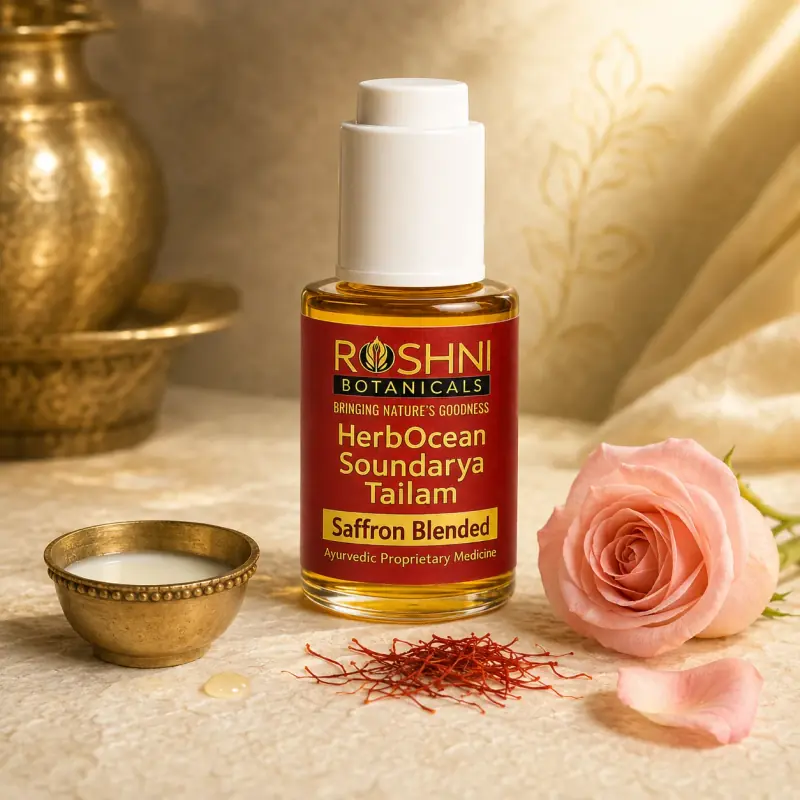
Soundarya Tailam
A saffron facial oil (Taila) in the goat-milk Kshira-paka tradition: an Ayurvedic medicine traditionally used in the care of dry, dull skin.
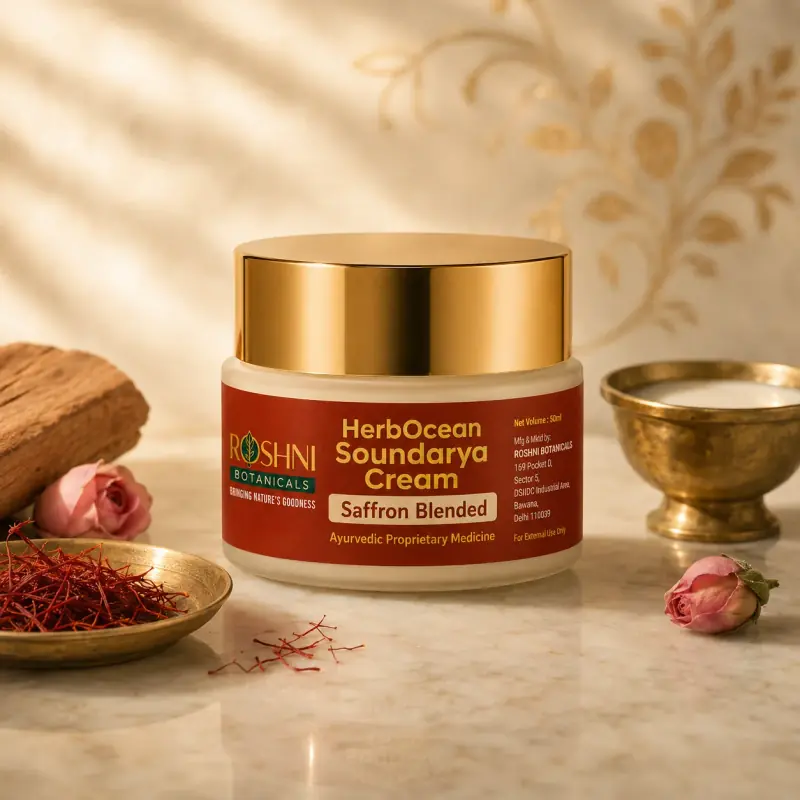
Soundarya Cream
A rich saffron cream for brightening and repair, with bargad (Vatt) bark on a goat-milk and coconut base. Made for dry, rough-feeling skin, it is an Ayurvedic medicine traditionally used in the care of skin where post-acne marks (PIH) linger.
Frequently asked
This article is general educational content about Ayurvedic skin and hair care. HerbOcean products are classical Ayurvedic preparations for external use, made under AYUSH Licence DL-474 A&U and traditionally used to support healthy skin and hair. This is educational and not a substitute for professional medical advice; for persistent or worsening concerns, please consult a qualified dermatologist.