
Saffron Benefits for Skin: What Kesar Is Used For, and How to Buy It
Kesar is the costliest thing in your kitchen and the easiest to fake. What it is traditionally used for, and how to buy it well.
Long before anybody in an Indian home thinks about skincare, saffron (Kesar, Crocus sativus) is already working. A few strands steep in warm milk for the kheer. A pinch waits in the tilak katori beside the thali. Hand-picked stigmas, the same ones classical Ayurveda has always reached for in skin preparations, as much at home in an Indian kitchen as in a classical formulation.
This page takes the spice itself seriously: what kesar actually is, why it costs what it does, how to tell a real thread from a dyed one, where the classical texts place it, and how it is carried in a facial oil. The claims stay small on purpose. The sourcing advice is the part most pages skip, and it is the part that decides everything else.
Key takeaways
- Saffron is the hand-picked stigma of the Crocus sativus flower. Each flower carries a single style that splits into three threads, which is the plainest explanation for what real kesar costs.
- Classical Ayurveda groups saffron with the herbs valued for the skin’s natural lustre (Prabha, Kanti) and its general good condition, not for its colour. This page makes no skin-tone claim for saffron or for any HerbOcean product.
- Much of what sells as kesar is dyed plant material. Dropped into a glass of water, genuine threads give up their colour slowly while holding their own red; dyed material bleeds at once and goes pale.
- Pampore in Kashmir is the traditional centre of Indian saffron cultivation, and Kashmir Saffron was registered as a Geographical Indication in 2020, tying the name to the place.
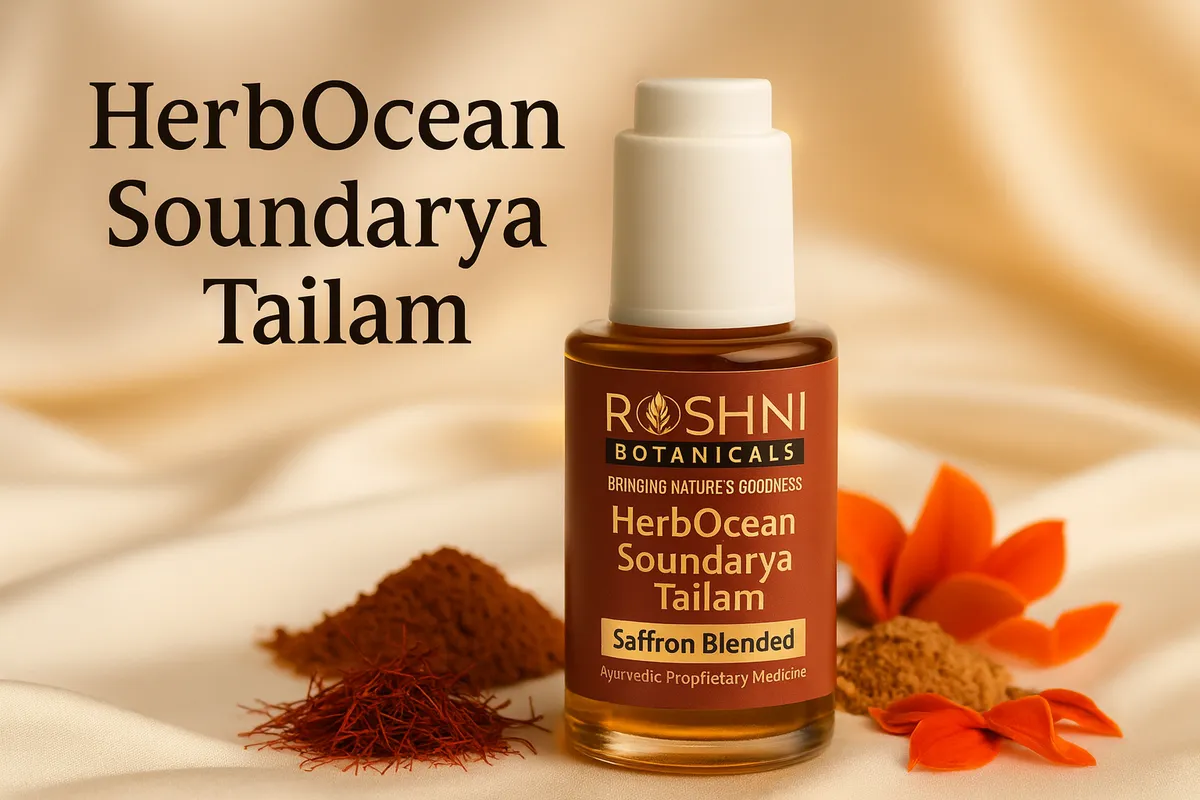
- In HerbOcean Soundarya Tailam, an AYUSH-licensed Ayurvedic medicine (Licence No. DL-474 A&U), the saffron is cold-macerated, a slow room-temperature infusion, into a base made in the goat-milk (Kshira-paka) tradition.
One Flower, Three Stigmas: Why Kesar Costs What It Does
Start with the flower, because the flower explains the price. Saffron is the stigma of Crocus sativus, a small autumn-flowering crocus, and each flower carries a single style that splits into three threads. Pickers work by hand, usually at dawn, inside a harvest window of a few weeks at most. Nothing about that scales. Dried, graded and sold by the gram, saffron is widely described as the costliest spice by weight. Anyone who has bought a one-gram box and felt how little sits inside it worked out the arithmetic long ago, without being told.
India’s saffron story sits in one small stretch of Kashmir. Pampore, on the karewa uplands near Srinagar, is the traditional centre of cultivation, and Kashmir Saffron was registered as a Geographical Indication in 2020, tying the name to the place it comes from. A GI is not a quality certificate in the way a laboratory report is. It makes provenance legally meaningful, so a claim about origin can be checked instead of merely asserted, and it gives a shopper one printed thing worth looking for: the registered name, Kashmir Saffron, rather than an adjective. For a buyer in Delhi or Chennai, that beats anything else on the packet.
There is a reason kesar reads as a festival ingredient before it reads as a skincare one. It turns up in the kheer, in the sherbet, in the tilak pressed onto a forehead on the mornings that matter. Kesar appears when something is being marked as important. Useful, that familiarity: most Indian readers already know how real saffron smells and how stubbornly a few strands colour a pan of milk. Trust those instincts when a packet looks suspiciously generous for its price. Festival weeks bring the stalls out, and the boxes stacked at the front are rarely the ones worth buying.
Those same economics explain why so much of what sells as kesar in India is not kesar at all. Domestic production is small, demand spikes hard around festivals and weddings, and the packet in a shopper’s hand gets judged by colour alone. A thread that expensive to grow is trivially easy to imitate. That gap is where the fakes live.
Real Kesar or Dyed Safflower: A Practical Household Check
Most fakes are cheap plant material dyed to look like kesar: safflower petals sold loose, corn silk and dried maize-cob tendrils, flower stamens, even paper strips (adulterants documented in Husaini and colleagues, Frontiers in Plant Science, 2022). Adulteration here is economic, not accidental. Filler that costs a fraction of saffron is sold as saffron, and the buyer pays saffron money for it, so price is a weak filter. None of this needs naming a seller or a marketplace. It needs a reader who checks.
A genuine thread is a stigma, not a petal. It widens into a small trumpet at one end, narrows at the other, and has thickness to it, where safflower and dyed petals lie flat and read the same colour end to end. The smell of real kesar is hay-like and honeyed, with something faintly metallic behind it; the famous bitterness belongs to the tongue, not the nose, and comes from picrocrocin, one of the constituents that give saffron its character (Aissa and colleagues, Journal of Medicine and Life, 2023).
The kitchen test is the one the food regulator itself teaches in its household test series: drop a few threads into a plain glass of water and wait. Genuine kesar gives up its colour slowly, over several minutes, turning the water a clear golden yellow while the threads hold their red through that window. Dyed material bleeds its colour at once and goes pale. Take it as a strong kitchen-table signal rather than laboratory proof, and remember what it cannot catch: a wholly fake thread carries no crocin, picrocrocin or safranal at all, only dye, but much real-world adulteration is a mixture, genuine kesar cut with dyed filler, or spent stigmas coloured back to life. Whatever saffron contributes to a preparation, it contributes as saffron, which is why sourcing is the first skincare decision in this whole story.
Buying and Storing Kesar Well
Buying for the kitchen and for skin at once? Buy small and buy dated. A gram or two from a seller willing to name the origin, with the registered name Kashmir Saffron where it genuinely applies, beats a bulk box picked up cheap at a stall. A sealed tin or dark glass holds the aroma far longer than a clear pouch, because light and air are what age a thread fastest. Store it airtight and opaque, somewhere cool and dark, out of the masala dabba, where it takes on everything around it. Saffron that has lost its smell has lost most of what you paid for. The pinch that goes into the kheer and the strands that go on your face need not share a tin, but they need the same quality of source. The check is identical either way.
Lustre, Not Shade: Where Kumkuma Sits in the Classical Texts
No skin-tone claim is made here for saffron or for any HerbOcean product. What classical Ayurveda groups saffron with are the herbs used for the skin’s natural lustre (Prabha, Kanti, the classical words for skin that looks well) and its general good condition, not for its colour. Lustre, in that register, means skin that looks well and feels comfortable to the person who owns it. It has never meant moving anybody along a scale, and nothing on this site is written to suggest otherwise.
In the classical literature saffron appears under its Sanskrit name (Kumkuma), and it lends that name to a whole family of medicated oils (Taila) built around it. Those preparations deserve their own reading, and they get it in the kumkumadi tradition and saffron glow oils post. This page stays with the spice as it comes out of the flower.
Marks are the live concern for melanin-rich Indian skin, which takes them readily and keeps them longer. Post-inflammatory hyperpigmentation, PIH, is the brown shadow left behind once a pimple, an insect bite or a patch of irritation has settled, and on deeper skin it can linger for months. Humid weeks make the ordinary aggravations worse: sweat, heat and long hours of heavy makeup all end the same way, in more rubbing and more wiping, and it is the rubbing that inflames skin and feeds the mark. Where post-acne marks are the actual question, HerbOcean Soundarya Cream is the more relevant preparation: a rich saffron repair cream with bargad (Vatt) bark on a goat-milk and coconut base, with shea and kokum butters.
The kesar-in-milk ritual deserves taking seriously. It is a real practice, handed down through households, and there is nothing foolish about soaking a few strands and patting the milk on before a wedding or a festival. Two practical notes, though. Raw milk is unpasteurised, so use it fresh, keep it off broken or actively inflamed skin, and rinse it off rather than letting it dry on the face; a milk film sits heavily in humid weather. And where the tap runs hard, remember that hard water works through your cleanser rather than on its own, so a gentle wash and a light moisturiser afterwards beat scrubbing at the residue. The classical register asks for less drama than the internet offers: a routine used consistently rather than swapped every fortnight, applied at night, skin that feels comfortable rather than tight, and marks noticed early rather than picked at. Ageing-skin ground is covered separately in our shorter post on saffron and ageing skin.
How the Saffron Is Handled in Our Own Facial Oil
HerbOcean Soundarya Tailam is an AYUSH-licensed Ayurvedic medicine (Licence No. DL-474 A&U) for external use, traditionally used in the care of dull, dry and marked facial skin. Its base is made in the goat-milk (Kshira-paka) tradition: herbs including Manjistha, liquorice (Mulethi), Raktchandan, Palash, bargad bark (Vatt), beautyberry (Priyangu), lac resin (Laksha), Daruhaldi and Nagkesar (Mesua ferrea) are simmered with goat milk (Ajadugdh) in a sesame base until the water has gone and only the medicated oil remains. What comes out of that pan is a medicated oil, a Taila, not a water extract; how the goat-milk Kshira-paka method actually works has its own page.
The saffron goes in by a separate route. Kesar is added by cold maceration, a slow room-temperature infusion once the oil is off the heat, and that is simply how the formulation desk works it alongside the goat-milk base. Lavender, rose and mogra finishing oils go in last.
The formulation carries the 40-year Ayurvedic formulation legacy of Vaidya Shri Ram Prakash Ji, and the oil is made in-house at our GMP-certified unit in Bawana, Delhi. For external use only. Patch-test on the inner forearm twenty-four hours before the first facial application, keep it away from the eyes, and stop if stinging, itching or a rash appears.
Some pigmentation asks for an assessment rather than a routine. Pigmentation that arrives suddenly or spreads quickly, a patch that itches, scales or changes texture, a mark that keeps darkening despite daily sun protection, and pigmentation that appears within weeks of starting a new medicine all deserve a dermatologist’s opinion first. Melasma that deepens in pregnancy is different: it is common, it often eases after delivery, and an antenatal visit is the right place to mention it, with a dermatologist if it distresses you or keeps spreading. Nothing in this article, and no oil, stands in for that visit. One boundary in plain words as well: HerbOcean does not manufacture a sunscreen, and nothing in the range replaces one, so daily sun protection stays a separate decision, and on melanin-rich skin it is the one that matters most.
What the Evening Actually Asks For
The kesar in the kheer and the tilak has an evening counterpart, and it is a quieter one. Once the plates are cleared and the house settles, the face in the mirror wants the same three things it wanted last week: to be clean, to be comfortable, to be left alone long enough to settle. The saffron in your kheer is doing its own job, and doing it well. Saffron for the skin is a different job: it has to be carried in a base that holds it and stays on the skin overnight, which is what a preparation like Soundarya Tailam is built to do. A bottle that gets used makes a better gift than one that gets admired. And if you arrived here about dark patches, the guide to ayurvedic care for melasma on Indian skin is the better door.
References: Aissa R and colleagues. Journal of Medicine and Life. 2023;16(6):822-836 (review of Crocus sativus phytochemistry; crocin, picrocrocin and safranal as characteristic constituents). Husaini AM and colleagues. Frontiers in Plant Science. 2022 (review; trumpet-shaped stigma morphology and documented adulterants including corn silk and dyed paper). Food Safety and Standards Authority of India, DART consumer test series (the household water test for saffron and the detection of coloured maize-cob tendrils). Geographical Indications Registry, Government of India: Kashmir Saffron, registered 2020.
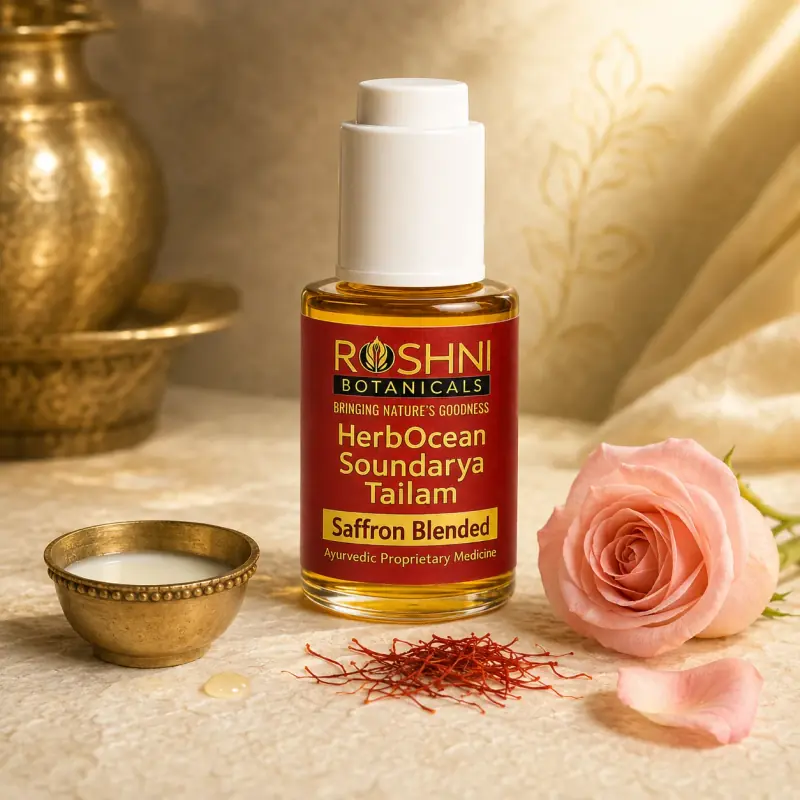
Soundarya Tailam
A saffron-infused facial Taila prepared in the goat-milk Kshira-paka tradition, with Manjistha, Mulethi and Kesar. For soft, bright, even skin.
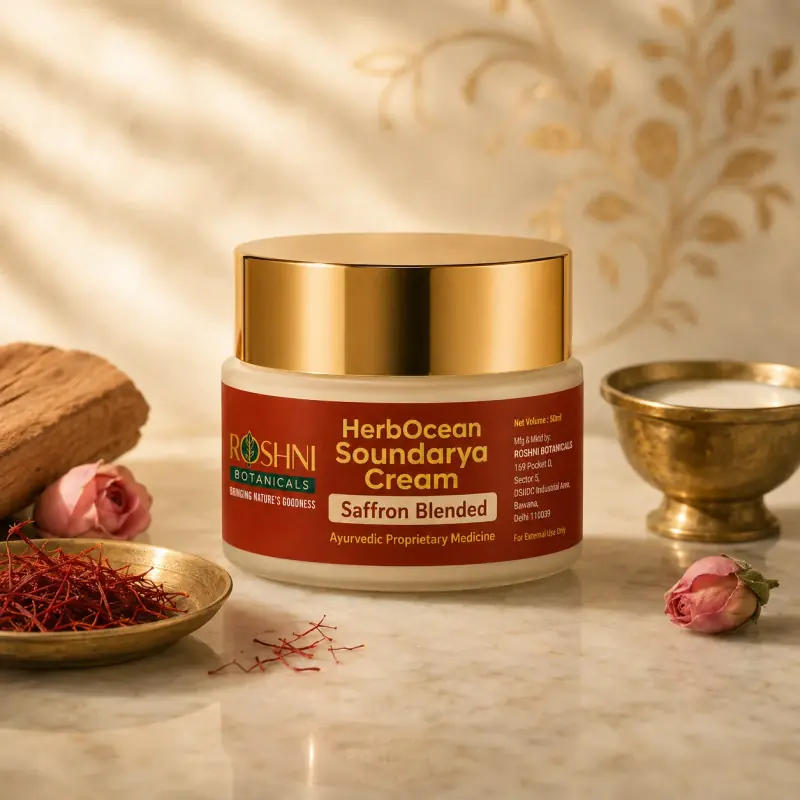
Soundarya Cream
A rich saffron brightening and repair cream with bargad (Vatt) bark on a goat-milk and coconut base, with shea and kokum butters, traditionally used in the care of skin where post-acne marks (PIH) linger.