Goat-Milk Kshira-paka: How a Classical Ayurvedic Face Oil Is Actually Made
Two bottles can both say goat milk and mean completely different things. Here is what the classical milk-and-oil method involves, why it takes so long, and how to read a label honestly.
Read the back of enough facial oils and you will notice that goat milk turns up in two quite different roles.
In the first, a milk powder or a milk extract is stirred into a base that is already finished. The oil was made, and then the milk went in. That is a faster process and a perfectly legitimate product, and it puts the word on the front of the pack.
In the second, the milk is not added to the oil at all. It is the liquid the herbs are cooked in. By the time the oil is bottled the milk has been cooked away, and what remains is what the milk carried out of the herbs.
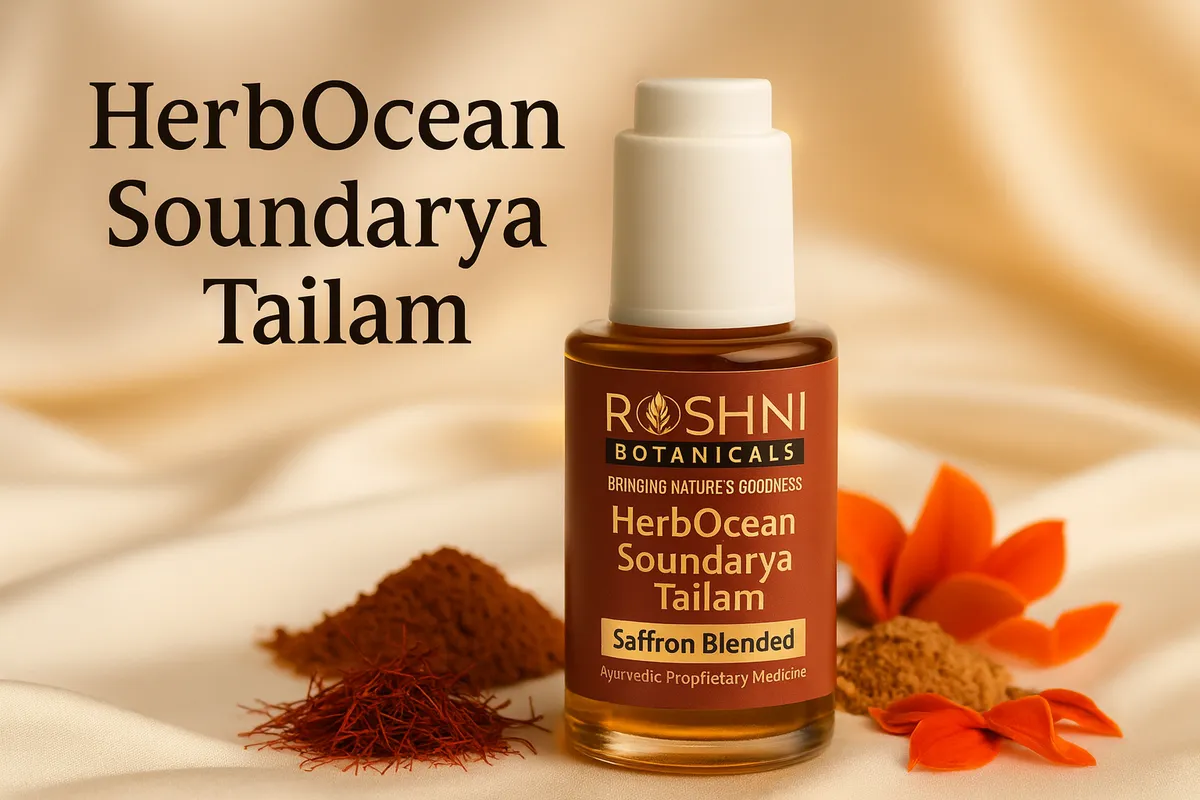
Same two words on a label. Two completely different manufactures. Soundarya Tailam is made the second way, and this piece is about what that involves, because the method is not decoration.
What Kshira-paka actually names
Kshira-paka (the classical milk-and-oil method) is worth taking apart, because the classical literature uses milk in more than one place and those places are not interchangeable.
Sharngadhara Samhita describes a preparation called Ksheerapaka, where a herb is simmered with milk and water until the water has gone and the milk remains. It sits in the decoction group of chapters, in Madhyama Khanda 2. What comes out of it is a medicated milk, given internally. Not an oil. No amount of careful cooking will turn it into one.
The chapter that governs a medicated oil is a different one. Sneha Kalpana, the oil and ghee chapter, is Madhyama Khanda 9 of the same text. There the formulator cooks a fat together with a herb paste and a liquid. That liquid, the drava dravya, may be water. It may be a kashaya (water-based herbal decoction). It may be a juice, curd or buttermilk. And it may be milk.
So when we say goat-milk Kshira-paka, this is what we mean: a Sneha Kalpana oil in which the liquid is goat milk, Ajadugdh, rather than water. The name has attached itself to the practice in ordinary usage, and it describes the vessel accurately. Anyone who wants the strict textual reference for a facial Taila (medicated oil) should be sent to the Sneha Kalpana chapter, not to the Ksheerapaka section.
Which has one consequence worth stating plainly, because it is got wrong often. A Kshira-paka facial oil is not a decoction. What comes off this stove is a Taila, a fat rather than a water extract, and that difference is the whole point of the chapter.
The method, step by step
Three things go into the vessel for the cooking, and all three go in together.
The kalka is the herb paste. In Soundarya Tailam that is nine ingredients: Manjistha (Indian madder), Mulethi (liquorice), Raktchandan (red sandalwood), Palash (flame of the forest), Vatt (bargad bark), Priyangu (beautyberry), Laksha (lac, a resin of insect origin), Daruhaldi (Indian berberry) and Nagkesar (Mesua ferrea). Equal weights, deliberately. No single herb leads this formula.
The sneha is the fat. Here it is Til tail, sesame oil.
The drava dravya is the liquid, and here it is goat milk.
Then it is cooked. Not milk first and oil afterwards. Together, over a low fire, slowly.
What the maker is waiting for is the water to leave, and the texts describe how to know. A pinch of the herb paste dropped into the flame crackles while moisture is still in it, and burns silently once the water has gone. Froth rises on the surface as a Taila finishes, which catches people out, because for a ghee preparation the sign runs the other way and the froth settles instead. And the herb paste, pressed between two fingers, rolls into a wick rather than smearing. Read those signs early and moisture stays in the bottle, which is a spoilage problem rather than a philosophical one. Read them late and the herbs scorch.
Then the oil is strained off, and only the oil goes forward. The bulk of the milk is not in the bottle. Its job was transport.
This is a description of manufacture, by the way, and not a home recipe. An under-cooked oil keeps its water and spoils.
More milk goes in than oil comes out
Our formulation sheet for Soundarya Tailam specifies more goat milk, by volume, than the finished oil it yields. Goat milk is the single largest input in the formula, larger than any herb in it, and nearly all of it leaves during the cooking. That proportion is a house choice, incidentally, and not a figure lifted from a text. The classical rule sets the liquid higher again.
The point is not the volume. It is what the volume is for.
Milk is not simply water. It is an emulsion, a watery phase carrying fat and milk proteins, so the vessel holds more than one kind of solvent while the cooking runs. A plant does not hand everything over to a single solvent either. Some of what sits inside Manjistha or Raktchandan is happier in fat and some of it in water, and a long slow cook gives the transfer time to happen.
That is the modern pharmaceutical reading of why a milk drava is worth the trouble, and it is worth saying that it is a modern reading. The texts permit milk. They do not explain themselves in the language of solubility.
That much milk for every litre of finished oil is also a real cost, and it sits in the bottle rather than on the label.
What goes in hot, and what does not
Not every ingredient belongs in the hot part of the process.
Saffron is the clearest case. In our preparation the Kesar is cold-macerated rather than boiled, which means it is steeped into the finished oil once the cooking is over rather than simmered along with the herbs. The classical saffron oils are made that way, and Kumkumadi Tailam belongs to the same lineage.
Which is to say that sequence matters as much as the ingredient list does. Two oils can carry word-for-word identical labels and be quite different bottles, purely on the question of when each thing went in.
Why this method suits dry Indian skin
Three reasons, none of them romantic.
Melanin-rich skin marks easily. Post-inflammatory hyperpigmentation, the brown mark left behind once inflammation has settled, is routine on Indian skin rather than a rare complication. In a 2016 study of 324 acne patients across seven Asian countries, 58 per cent had it, and for more than half of those it had already lasted a year or longer. That changes the arithmetic of any aggressive approach. Scrubbing hard buys a few days of smoothness and can leave a mark that outlasts it by months. A slow, oil-based, leave-on preparation sits at the gentle end of the range, which matters when the skin in question punishes over-handling.
The dry North Indian winter, and the water it is washed with. Cold air and room heaters pull moisture out of the skin steadily, and the season is long. Delhi adds a second problem. In a 2018 survey of fifty groundwater samples from South West Delhi, 82 per cent fell in the very hard band, above 300 mg per litre. The BIS figure for acceptable drinking water is 200. If your building draws on a borewell, that is the water your face meets every evening. Hard water also leaves more cleanser behind after rinsing, and in a UK study that residue raised water loss through the skin and caused irritation, most in people already prone to a leaky barrier (Danby and colleagues, 2018, 80 adults). A richer night oil is one of the gentler ways to put back what a day of that removes. Our guide to goat milk for dry skin goes further into the seasonal side.
Milk and oil in one bowl is not a new idea in an Indian house. The ubtan, the weekly hair oiling, abhyanga (classical full-body oil massage), a spoon of milk in a besan paste. None of this needs explaining to the reader of this page. What the classical method does is take the same two materials and give them hours instead of minutes. It is the household practice done slowly and at scale, not a foreign technique.
How to read a label without guessing
You cannot see manufacture from the outside of a bottle. So ask.
Ask whether the milk is an ingredient or a process. Ask when the saffron went in, because anyone who cooks their own oils answers immediately and anyone who does not will hesitate. Ask what the liquid was, in the sense the classical chapter means: water, decoction, juice or milk. A brand that prepares its own oils can answer all three without going away to check.
And ask the boring question too, which is whether the preparation is licensed as an Ayurvedic medicine at all. Ours is made in our own unit in Delhi under AYUSH Licence No. DL-474 A&U. That is a fair thing to ask of anybody selling a Taila. If you are weighing one oil against another, our comparison of the two HerbOcean facial Tailams sets them side by side.
What the method does not promise
The method is a manufacturing fact. It is not a results claim, and it would be dishonest to let one stand in for the other.
Cooking herbs into oil with goat milk over a low fire says something true and checkable about how an oil was made, and about what it costs to make it that way. It does not, on its own, tell you what any oil will do on your face. Skin varies. Causes vary.
Soundarya Tailam is an Ayurvedic medicine for external use, traditionally used in the care of dry and mature Twak (skin). Use it at night on clean, slightly damp skin, a few drops pressed in with the palms, pouring into your hand rather than dipping fingers into the bottle, and follow the directions printed on your pack. If your skin is very oily or actively breaking out, this is not the preparation for you.
A few specifics before you start. Sesame oil is the base here, so if you are allergic to sesame, do not use it. Goat milk is used in the manufacture and we cannot tell you the finished oil is free of milk protein, so a diagnosed milk allergy calls for the same caution. The preparation is fragranced, and if you already know you react to fragrance, it is not for you either. Everyone else should patch-test: a little on the inner forearm, left alone, checked at 24 hours, at 48, and again at four days, because allergic reactions are often delayed. Redness, itching, burning or small bumps mean wash it off and keep it off your face. Keep it off the eyelids and out of the eyes, and rinse with clean water if it gets in. Keep it off broken skin and off weeping breakouts, and take skin that is weeping, crusting or spreading to a doctor rather than treating it with an oil. In pregnancy and while breastfeeding this remains a preparation for external use. Skin is often more reactive then, so repeat the patch test, and mention the oil to any doctor who has prescribed something for your face.
Two things are urgent rather than routine. Swelling of the lips, face, tongue or throat, difficulty breathing, or hives spreading beyond where you applied the oil is a medical emergency, so stop and get help immediately. And if a patch of skin is thickening, changing shape or colour, growing, itching persistently, bleeding, or is a sore that has not healed in a few weeks, that is a question for a dermatologist and not for a face oil. The same goes for a new mole, or an old one that has started to change.
What the method buys you is a preparation made by the method the texts describe, with the slow steps left in. That is at least something you can now ask about in specific terms, rather than by reading the front of a pack.
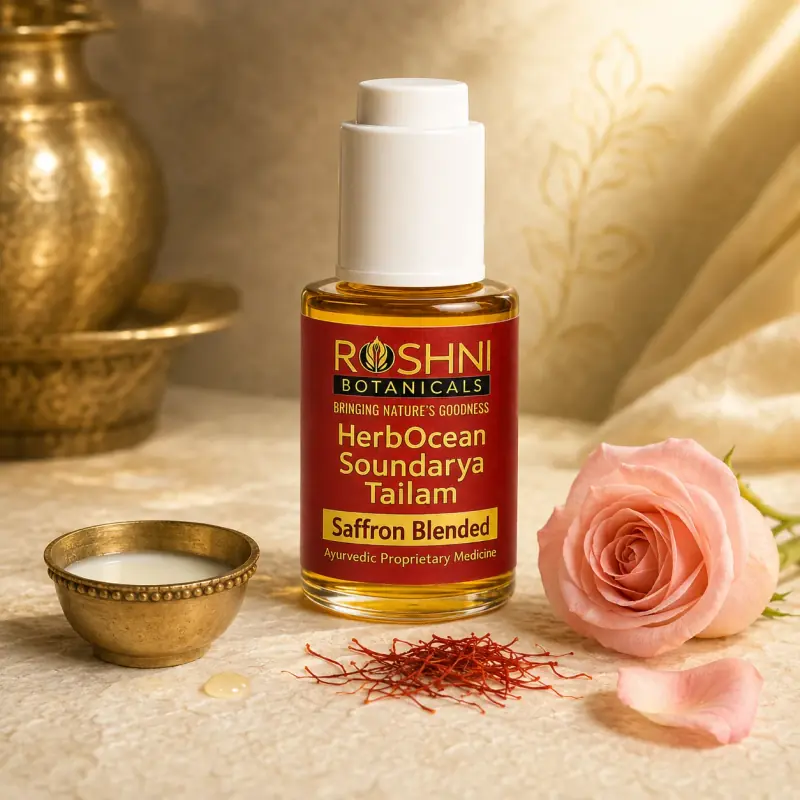
Soundarya Tailam
A saffron-infused facial Taila prepared in the goat-milk Kshira-paka tradition, with Manjistha, Mulethi and Kesar. For soft, bright, even skin.