Soundarya Tailam or Radiance Tailam? Choosing the Best Ayurvedic Face Oil for Your Skin
Soundarya Tailam for dry, dull or mature skin, Radiance Tailam for melasma, dark spots and uneven tone, and a 10 ml trial bottle if you want to start small.
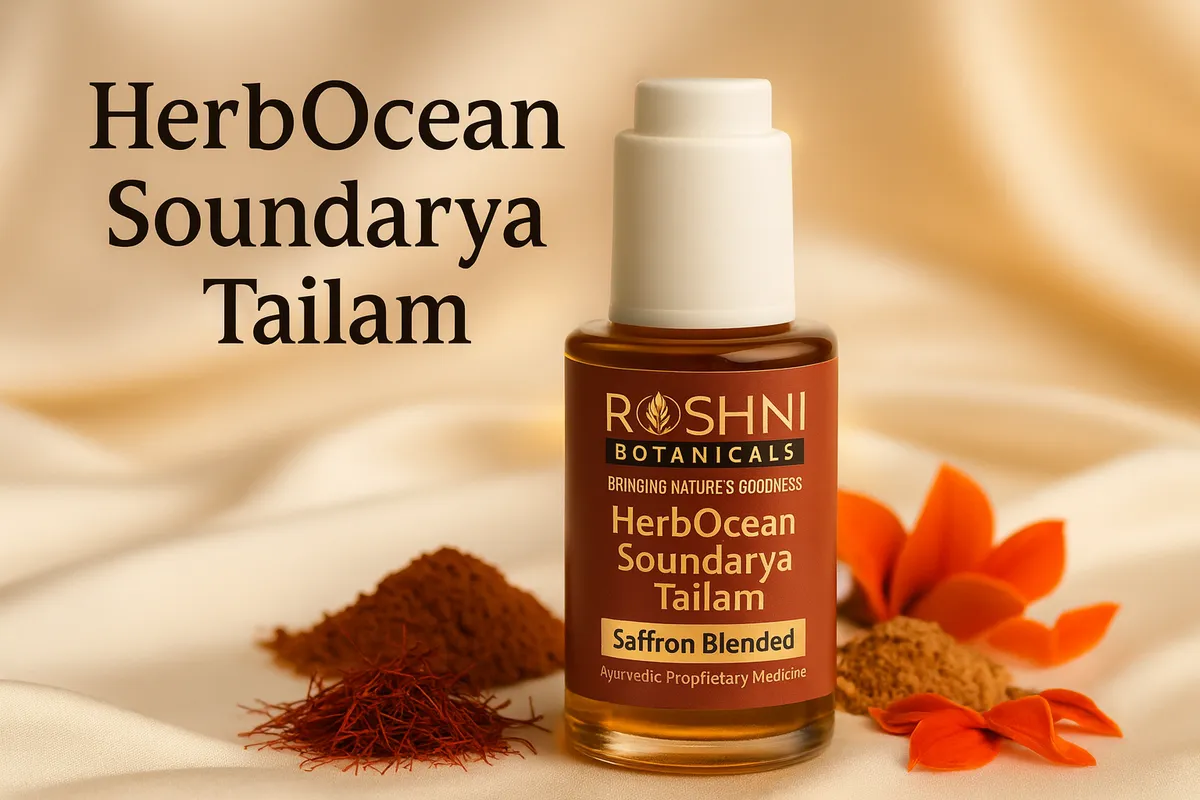
The best Ayurvedic face oil for you is the one matched to your main skin concern. An Ayurvedic face oil is a Taila (medicated oil), made by cooking classical herbs into a plant oil so that their qualities pass into the oil itself. Of our two face oils, Soundarya Tailam, a goat-milk saffron oil, is for dry, dull or mature skin, and Radiance Tailam, a saffron and sandalwood oil, is for melasma, dark spots and uneven tone.
If you are not sure how your skin will take to either, start small. Both come in a 10 ml trial bottle, the same oil in a smaller bottle, so you can patch-test first and let your own skin decide.
Key takeaways
- Soundarya Tailam is the goat-milk saffron oil for skin that feels dry, looks dull or is maturing, made the classical milk-and-oil way in a sesame base.
- Of the two, Radiance Tailam is the one for melasma (Vyanga), dark spots, uneven tone and the brown marks that breakouts leave behind on melanin-rich skin.
- Each oil also comes in a 10 ml trial bottle, the same oil in a smaller bottle, so the full size can wait until your skin has tried it after a patch test.
- Both concerns at once? You can keep both bottles, as long as you use one oil on a given night and never layer the two together.
Two Oils, Two Jobs: What Each One Is Made For
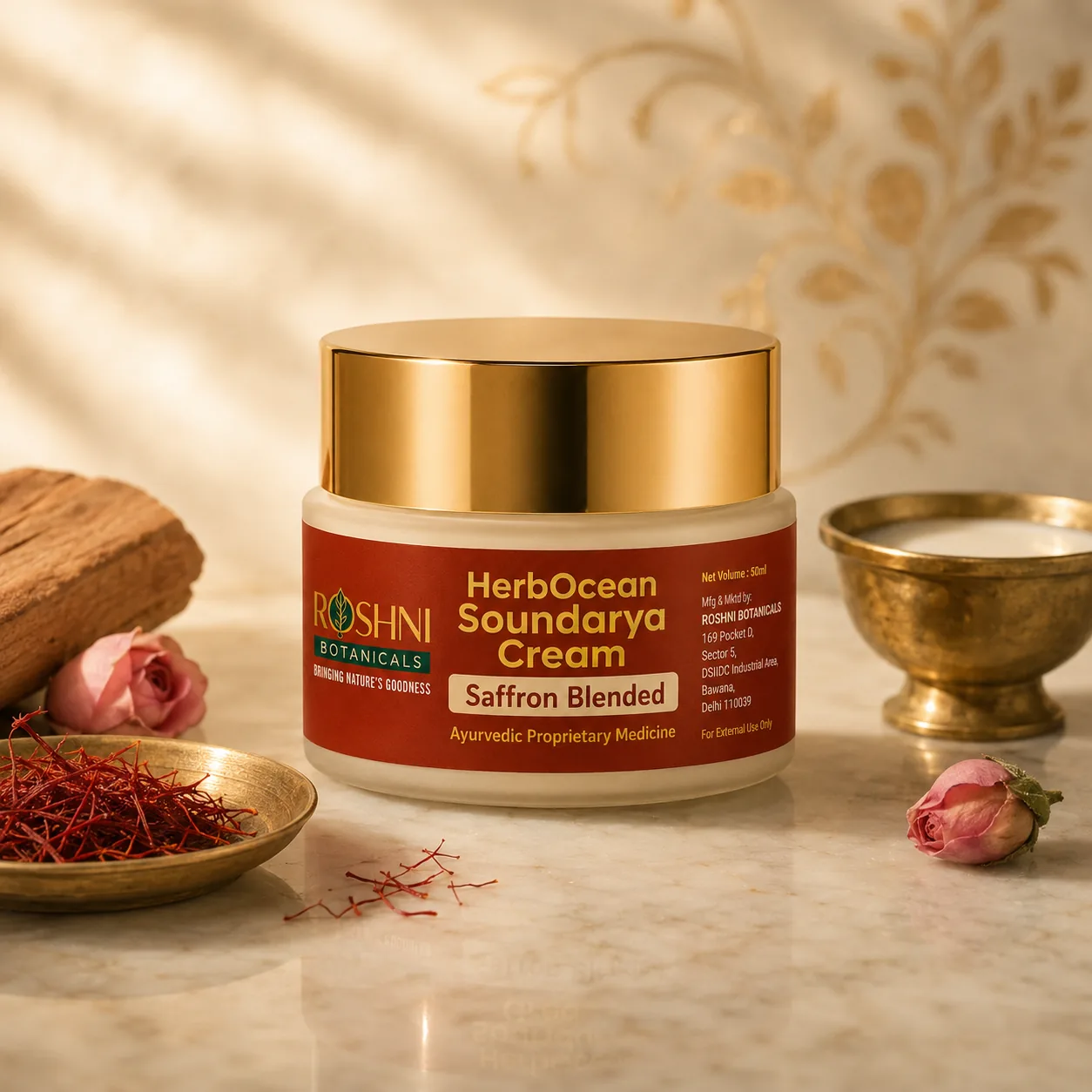
The first oil is HerbOcean Soundarya Tailam, an AYUSH-licensed Ayurvedic medicine for external use, traditionally used to support healthy, comfortable, even-looking skin, and one that dry and mature skin tends to accept well. It is made by the goat-milk Kshira-paka method (the classical milk-and-oil method), in which the herbs are simmered with goat milk in a sesame base until the water has evaporated and only the medicated oil remains.
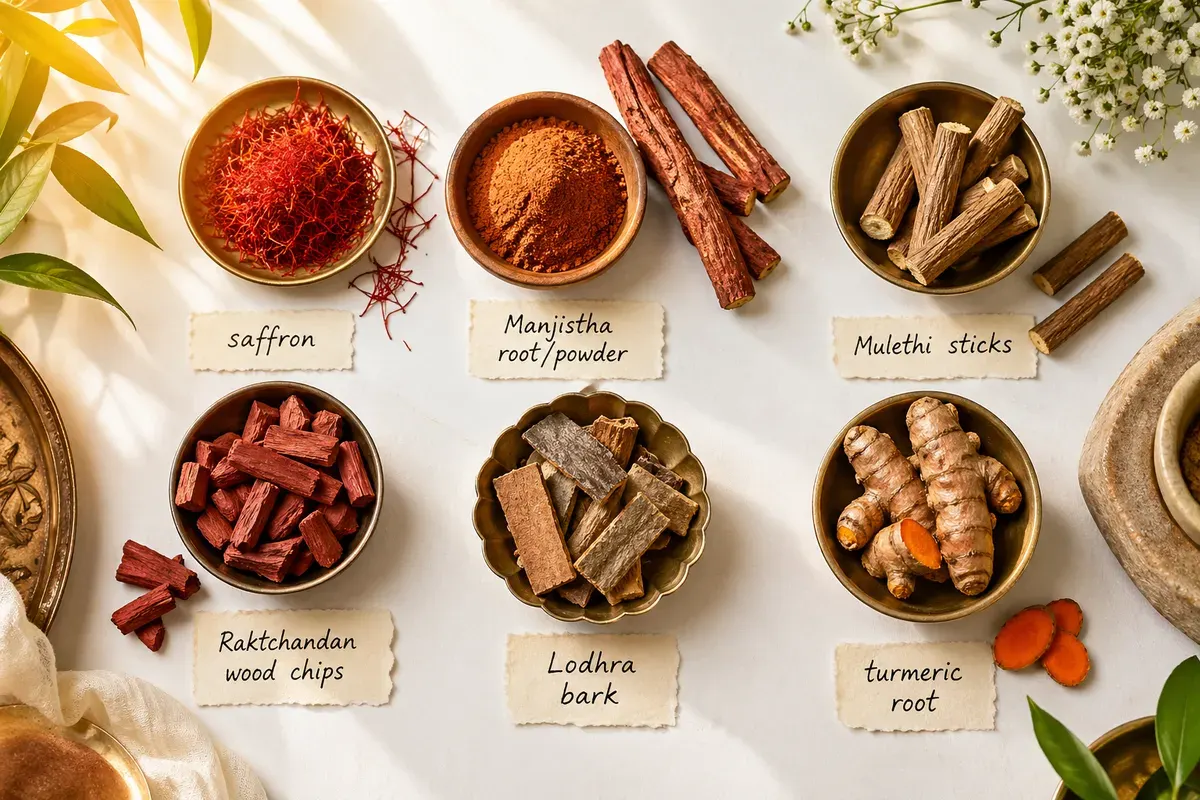
The method is a classical one. In the Sharngadhara Samhita, chapter 9 of the Madhyama Khanda, the chapter on medicated oils and ghee, allows milk to be the liquid in which an oil is cooked. Cooked into this oil are Manjistha, Mulethi, Raktchandan, Palash flower, bargad (Vatt) bark, Priyangu fruit, Laksha (lac, an insect resin), Daruhaldi and Nagkesar, and the finished oil also carries lavender, rose and mogra oils and Kesar (saffron). The Kesar is added once the cooking has finished and left to steep in the oil, and our saffron guide explains how the saffron goes into the oil.
The second oil has a different job. HerbOcean Radiance Tailam is an AYUSH-licensed Ayurvedic medicine for external use, classically indicated for melasma (Vyanga) and traditionally used to support even tone where dark spots and post-inflammatory hyperpigmentation (PIH) show on melanin-rich Indian skin. Its herbs are Amla, Baheda, Harad, Chandan, Raktchandan, Haldi, Manjistha, Kuth, Kamal, Padmaakh bark, Kakoli and Palash flower in a sesame base, with lavender, rose and mogra oils and Kesar.
So the two share a sesame base and saffron, and each is matched to a concern of its own. Both are made in-house at our GMP-certified unit in Bawana, Delhi, under AYUSH Licence No. DL-474 A&U, and built on the 40-year Ayurvedic formulation legacy of Vaidya Shri Ram Prakash Ji.
Match the Oil to Your Concern
Put in Hinglish, the question is raat ko chehre par kaun sa tel lagaye: which oil goes on the face at night? Think of the one concern you would put first if you could pick only one, and the oil follows from it. If your skin feels dry, looks dull or is maturing, Soundarya Tailam is your oil. Very oily or actively breaking-out skin may prefer a lighter option.
If melasma, dark spots or uneven tone is what you see first in the mirror, Radiance Tailam is your oil. Melasma, jhaiyaan in Hindi, is the concern Ayurveda calls Vyanga: the Sushruta Samhita lists it among the minor diseases (Kshudra Roga) in Nidana Sthana 13, as a thin, painless patch on the face that Bhishagratna, in his translation, describes as brown. Between these two oils, the brown marks that breakouts leave behind (PIH) belong with Radiance Tailam too.
If breakouts have left marks, first tell a mark apart from a scar. A flat brown patch where a spot used to be is a mark, and our skincare FAQ explains why a pimple leaves a brown mark. A pitted or raised scar is a different matter, and one to take to a dermatologist.
Buying just one bottle? Go with the concern you mind more and let the other wait, which is the idea behind our one concern, one product routine. The same routine covers concerns beyond these two oils, active breakouts among them, and points each one to its own product.
Why Indian Skin Makes This a Real Choice
Skin colour is part of the reason. A review of skin typing in an Indian dermatology journal reports Fitzpatrick type V as the commonest Indian skin type, followed by type IV. Those are darker skin types, and on darker skin a breakout can leave a patch of post-inflammatory hyperpigmentation once it settles, a flat mark that is still there after the spot has healed.
Such marks can stay a long time. A study of acne patients seen by dermatologists in seven Asian countries found such marks in more than half of them, and for more than half of the patients the marks had lasted a year or more. Patients in that study also described the marks as quite bothersome, sometimes more of a problem than the acne itself. Harsh shortcuts are a poor bet on the same skin. Strong peels and scrubs at home are best left alone if your skin is darker or if dark spots follow your breakouts, because aggressive exfoliation can leave more pigment behind, as the American Academy of Dermatology explains in its advice on exfoliating at home.
The air around you can add to dryness too. Skin dries out more easily when there is little moisture in the air, and dry, uncomfortable skin is the concern you would choose Soundarya Tailam for.
Melasma has a pattern of its own. In a study of 312 patients at Midnapore Medical College in West Bengal, women outnumbered men about four to one, and pregnancy and the contraceptive pill were among the triggers the women named. More than half of all the patients said time in the sun made their melasma worse. The authors write that the cause is not known, but that genetic or hormonal influences, together with ultraviolet light, are important, and sunlight is on the American Academy of Dermatology list of triggers too.
Trying One First: The Trial Bottle and a Patch Test
A trial bottle is the easy first step. The Soundarya Tailam 10 ml trial and the Radiance Tailam 10 ml trial are each the same oil as the full size, only in a smaller bottle, so you can try one before you buy the 30 ml bottle.
Before either one goes on your face, read the caution for both. Patch-test on the inner forearm 24 hours before first use and discontinue if irritation occurs; avoid the eye area. For external use only. Avoid both oils if you are allergic to sesame, Soundarya Tailam if you are allergic to goat milk, and either if you are allergic to a listed botanical. If pregnant or breastfeeding, check with your doctor. If you have never patch-tested before, our sensitive-skin guide sets out the inner-forearm patch test, step by step.
Then start with one oil on its own. A few drops is the place to begin, and the right amount differs from person to person. Because only one thing in your routine is new, you will know which bottle it was if your skin does react, and you can stop that one without guessing.
Can You Use Both Oils?
Yes, if both concerns are yours. Dryness and dark spots can turn up on the same face, and you can keep both bottles on the shelf. The one rule is simple: use one oil on a given night, and never layer the two together.
Bring each one in on its own, after its own patch test, so that a reaction points to one bottle and not two. Once both suit you, your skin can settle the order between them, one oil at a time.
How to Use Either Oil Well
If oiling has been part of home life for you, on your hair or in a baby massage, using either one will feel familiar. With Soundarya Tailam, the product page instruction comes down to this. At night, on clean, slightly damp skin, press a few drops between the palms and pat over the face and neck. With Radiance Tailam, the product page starts with this line. At night, press a few drops over clean skin, concentrating on areas of uneven tone.
Daytime is about the sun. HerbOcean does not manufacture a sunscreen, and nothing in the range replaces one, so your sun protection stays a separate step. The American Academy of Dermatology asks people with melasma to protect their skin from the sun every day, cloudy days included. Using a cream as well? Our routine guide sets out the morning and night order, with the oil and the cream in their places.
When to See a Dermatologist First
A diagnosis comes first, and then the oil has its place. If patches have appeared on your cheeks or forehead and you are not sure what they are, show them to a dermatologist, so you know it is melasma and not something that only looks like it. See a dermatologist, too, when pigmentation is sudden, spreading or persistent.
Two more signs are worth a doctor visit. Pigmentation that appeared during a pregnancy, or after you started the contraceptive pill or another new medicine, may be linked to hormones or to the medicine itself. And any spot or patch that is changing in shape or colour, that itches, or whose border looks irregular should be shown to a doctor without waiting.
Two Oils, One Clear Choice
So the choice comes back to one question: is dryness your main worry, or are dark spots and uneven tone? Dryness points to Soundarya Tailam, dark spots and uneven tone to Radiance Tailam. If both describe you, or you are still unsure, begin with one, the Soundarya Tailam 10 ml trial or the Radiance Tailam 10 ml trial, after a patch test, and take it from there.
For the fuller picture on pigmentation, from what switches it on to how it is cared for, turn to our longer handbook, Ayurvedic treatment for melasma on Indian skin. Whichever bottle you choose, the aim stays the same: healthy, comfortable skin, looked after well.
References: Sharngadhara Samhita, Madhyama Khanda 9 (Sneha Kalpana), Tripathi edition: the oil and ghee chapter; milk as the liquid an oil is cooked in. Sushruta Samhita, Nidana Sthana 13 (Kshudra Roga Nidana), Bhishagratna translation, 1911: Vyanga among the forty four minor diseases. Abad-Casintahan F and colleagues, Asian Acne Board. Frequency and characteristics of acne-related post-inflammatory hyperpigmentation. Journal of Dermatology, 2016, 43(7):826 to 828: 324 acne patients seen by dermatologists in seven Asian countries; marks in more than half, lasting a year or more in more than half. Sachdeva S. Fitzpatrick skin typing: Applications in dermatology. Indian Journal of Dermatology, Venereology and Leprology, 2009, 75(1):93 to 96: review; commonest Indian type V, then IV. Achar A, Rathi SK. Melasma: a clinico-epidemiological study of 312 cases. Indian Journal of Dermatology, 2011, 56(4):380 to 382: Midnapore Medical College, West Bengal; women outnumbered men about four to one; pregnancy and the pill among the triggers; sun made it worse for more than half. American Academy of Dermatology. Melasma: Causes. aad.org, updated 2022: sunlight, pregnancy hormones and some medicines, the pill included, as triggers. American Academy of Dermatology. Melasma: Self-care. aad.org, updated 2023: sun protection every day, cloudy days included. American Academy of Dermatology. How to safely exfoliate at home. aad.org, updated 2026: strong peels and scrubs a poor bet on darker skin or where dark spots follow breakouts. American Academy of Dermatology. What to look for: ABCDEs of melanoma. aad.org: spots that change in shape or colour, itch or have an irregular border. Educational, not medical advice.
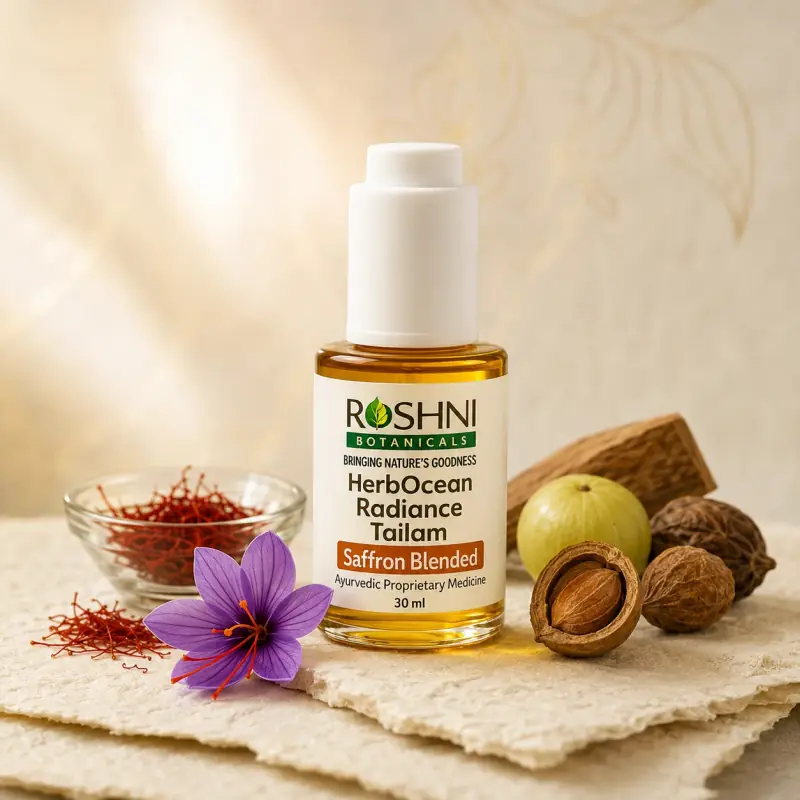
Radiance Tailam
A saffron brightening facial Taila with Manjistha and red sandalwood, traditionally used to support even tone where melasma, dark spots and PIH show.
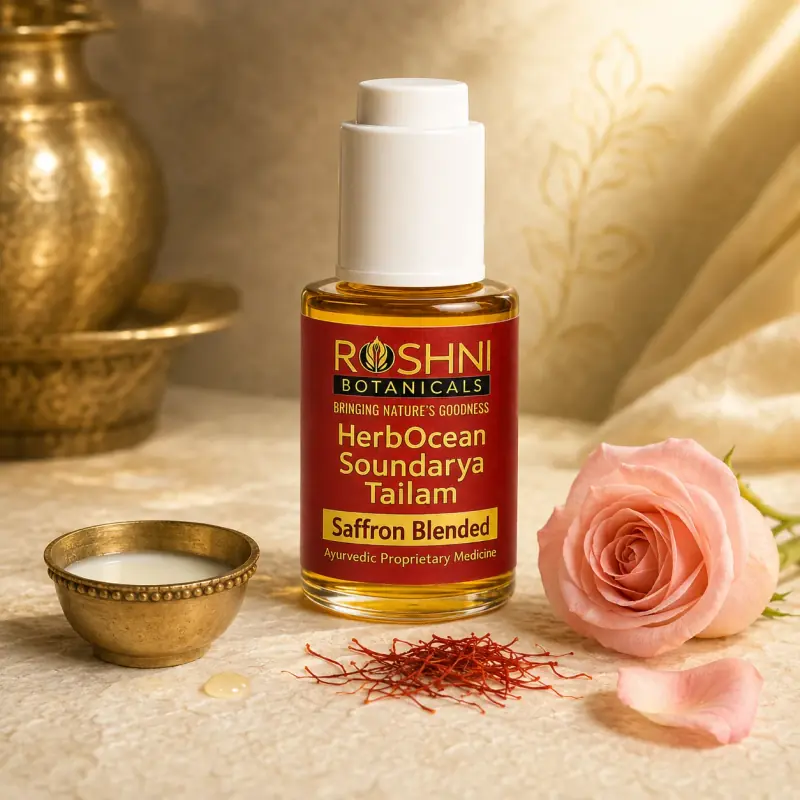
Soundarya Tailam
A saffron-infused facial Taila prepared in the goat-milk Kshira-paka tradition, with Manjistha, Mulethi and Kesar. For soft, bright, even skin.
Part of our guide: Ayurvedic treatment for melasma on Indian skin.