Monsoon Acne Breakouts: Why Humid Weather Makes Pimples Worse, and a Simple Ayurvedic Care Plan
Humid monsoon air keeps sweat and oil on the skin for longer, and acne flares. Why it happens, what Sushruta saw in Yuvanpidika, and a calm morning-and-evening Ayurvedic care plan for Indian skin.
By the first week of July, most Indian cities are sticky by 8 am, and your skin knows it before you do. Sweat sits longer, oil turns tacky, and the pimples you had under control through summer come back in clusters. Monsoon humidity genuinely changes how acne (Yuvanpidika, the classical Ayurvedic term meaning “youthful eruption”) behaves on Indian skin. Here is why, and a calm plan that works with the season instead of fighting it.
Key takeaways
- Monsoon acne comes from trapped sweat, sticky sebum and friction, not dirt. Washing your face more than twice a day usually makes it worse, especially in hard-water cities.
- Monsoon humidity in most Indian metros stays very high, commonly around 80 per cent or more, which slows sweat evaporation, so oil and dead cells sit in pore openings for longer.
- The Sushruta Samhita (Nidana Sthana 13) reads acne (Yuvanpidika) as eruptions arising when aggravated Kapha and Vata (two of the three doshas, the body’s governing energies in Ayurveda) act on rakta (blood), which is why the classical response is built on blood-purifying herbs such as Manjistha.
- Pimples cluster where sweat gets held against the skin and rubbed: helmet straps, dupatta and mask edges, phone screens and bag straps. Move the friction and you often move the breakout.
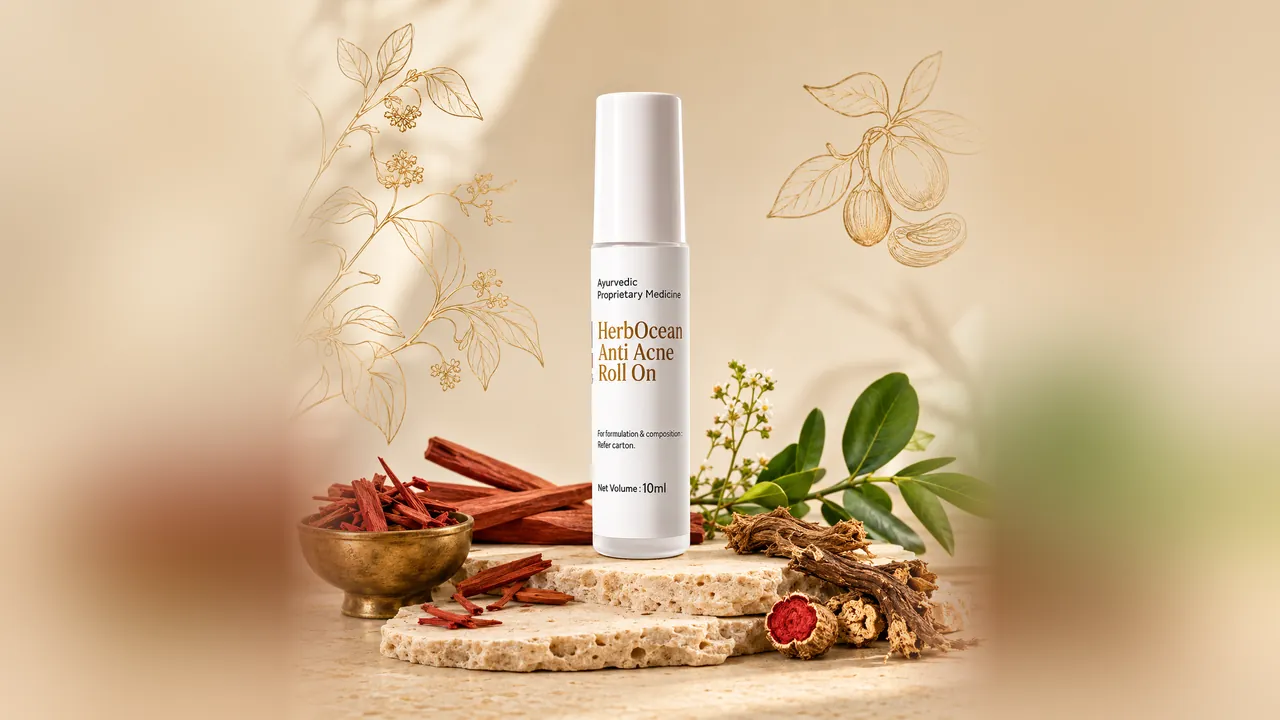
- The HerbOcean Anti-Acne Roll-On, an AYUSH-licensed Ayurvedic medicine classically indicated for acne and pimples, keeps herb doses fixed and puts them on the pimple only, not across the whole face.
Why Breakouts Spike When the Rains Arrive
Humid air slows evaporation. Sweat that would have dried in minutes on a dry June afternoon now sits on your skin for hours, mixing with sebum into a tacky film. That film softens the top layer of skin, and pore openings swell slightly with the extra moisture. Oil and dead cells that would normally clear get held in place, and the bacteria already living in every pore suddenly have a blocked, airless pocket to multiply in. First come the small congested bumps, then the angry red pimples a few days later.
Where those pimples show up is rarely random. Look at the geography of your own breakouts and there is usually a pressure point underneath: the line of a helmet strap along the jaw, the edge of a dupatta or mask against the cheek, the phone screen pressed to one side of the face through long calls, a bag strap crossing the back. Dermatologists call these friction-triggered breakouts acne mechanica, and monsoon is its favourite season, because damp fabric and sweaty plastic rubbing against skin that is already congested is a near-perfect setup for it.
Oily and combination skin feels this hardest, which covers most Indian skin for four humid months. Commute through Mumbai, Delhi or any city where the July air runs thick and humid, and your skin spends the whole day in conditions built to provoke congestion.
The Classical Lens: What Sushruta Saw in Yuvanpidika
Classical Ayurveda watched this pattern long before weather apps existed. The Sushruta Samhita lists acne (Yuvanpidika) among the kshudra rogas (the so-called minor conditions), and the classical reading is that the eruptions arise when aggravated Kapha and Vata act on rakta, the blood. Kapha is the heavy, moist, sticky dosha, and its qualities map almost exactly onto what monsoon skin feels like: heaviness, oiliness, cling.
Season matters in this reading too. In the classical seasonal framework (Ritucharya), the rains are when Vata rises and digestive fire (Agni) runs low, so the body handles heavy, oily and late food poorly, and its channels clog more easily. A monsoon diet of fried pakoras and delayed dinners, familiar to anyone who loves the rains, feeds the same stickiness the humidity is already building on the surface.
Rakta shodhana (blood purification) is the classical response: cooling, cleansing herbs that work on the inflammation beneath the eruption, paired with lighter food and a steadier routine. Manjistha above all is the herb Ayurveda reaches for here, a blood-purifier first and foremost. That logic is worth holding onto; it is what separates honest Ayurvedic spot care from everything else on the shelf.
The Advice That Backfires: Washing Your Face More
Open any monsoon skincare article and the first tip is almost always the same: wash your face several times a day. For most Indian households, that advice quietly backfires. Tap water in the majority of our cities is hard, carrying enough dissolved calcium and magnesium to leave the same chalky film on your face that it leaves on the bathroom tap. Every extra wash with a foaming cleanser and hard water strips a little more of the skin’s thin protective acid layer.
Stripped skin panics rather than staying matte. Within a couple of hours the oil glands compensate with more sebum than before, a rebound that leaves you shinier by evening than the skin you scrubbed at noon. Repeat that through a week and this over-washing cycle produces exactly the greasy, reactive, breakout-prone surface it was meant to prevent.
Two proper washes a day, morning and evening, with a gentle cleanser and lukewarm water, plus a thorough final rinse so no cleanser or mineral residue dries on the skin, holds up far better. Through the sticky hours in between, skip the third wash. Press the sweat off with a clean cotton handkerchief instead: press, lift, never drag it across the face.
A Simple Morning and Evening Monsoon Care Plan
Morning: a gentle cleanse, a light gel moisturiser rather than a heavy cream, and an oil-free sunscreen. Moisturiser and sunscreen both still matter in the rains: humid skin can still be barrier-damaged skin, and the ultraviolet light that deepens marks travels straight through cloud cover.
Evening: an unhurried cleanse to take the day off your face, targeted spot care on active pimples only, and light hydration everywhere else. Spot care goes on clean, dry skin: roll it over the pimple and the skin just around it, then give it a minute to absorb fully before anything else touches your face.
Weekly, in humid weeks, a thin multani mitti pack for acne-prone skin still earns its place. Your household has probably trusted this classical medicated paste (Lepa) tradition for generations, and it genuinely helps absorb excess oil, provided you use it the way your grandmother actually meant. A thin layer, rinsed off before it fully cracks and tugs, followed by moisturiser, once a week and no more. Used daily, a clay pack over-dries the skin and triggers the same oil rebound as over-washing.
A few habits do a surprising amount of quiet work alongside the routine itself:
- Change the pillow cover twice a week through the monsoon; damp cotton holds the night’s sweat and oil against your cheek.
- Dry the helmet liner, and wash dupattas and masks often; damp fabric against the jawline is where clusters begin.
- Wipe the phone screen daily, and switch to earphones for long calls in July and August.
- Shower promptly after getting drenched or after a workout, so sweat does not sit trapped under wet clothes.
The HerbOcean Approach: Measured Herbs on the Spot, Not All Over the Face
A monsoon breakout is a local event, and it deserves a local answer. Smearing strong actives across the whole face punishes the ninety per cent of skin that did nothing wrong, and in a humid month that skin is already coping with enough. This is where a targeted, dose-controlled preparation earns its place in an Ayurvedic routine.
The HerbOcean Anti-Acne Roll-On is an AYUSH-licensed Ayurvedic medicine (Licence No. DL-474 A&U), classically indicated for acne and pimples (Yuvanpidika) and traditionally used in the care of the post-acne marks and pigmentation they leave behind. Vaidya Shri Ram Prakash Ji, the master vaidya whose 40-year formulation legacy the HerbOcean line is built on, formulated it, and it is made in-house at Roshni Botanicals’ GMP-certified (Schedule-T) unit in Bawana, Delhi. Six classical herbs do the work, each at a fixed dose:
- Manjistha (Rubia cordifolia): the lead herb, Ayurveda’s foremost rakta shodhana (blood-purifying) botanical, traditionally used for precisely the inflamed, congested eruptions Sushruta described.
- Lodhra (Symplocos racemosa): an astringent bark, classically paired with Manjistha in skin-eruption care to support tightening and settling.
- Jaiphal (Myristica fragrans): the kitchen nutmeg of the dadi-ka-nuskha, warming with a scraping (lekhana) quality, here in a measured dose instead of a stone-ground guess.
- Raktchandan (Pterocarpus santalinus): red sandalwood, cooling by nature, traditionally applied to angry, heated skin.
- Daruhaldi (Berberis aristata): a bitter bark traditionally used on eruption-prone skin; its berberine content is the subject of modern antimicrobial research.
- Kuth (Saussurea lappa): a classical root that appears across Ayurvedic skin-care formulations for troubled skin.
The herbs sit in a light glycerine and purified-water base with gluconolactone, a gentle polyhydroxy acid, and a trace of lavender oil, so the roll-on dries quickly and sits weightlessly on humid skin. Use it morning and night on clean, dry skin, on the spot only. It is for external use; patch-test on the inner arm before first use. For the full classical framework this preparation belongs to, our complete guide to the Ayurvedic treatment of acne walks through it in detail.
Do Not Pick: Marks Cost More Than Pimples on Indian Skin
On melanin-rich Indian skin, the most expensive thing you can do to a monsoon pimple is squeeze it. Our skin responds to inflammation by producing pigment, so a pimple that would otherwise have settled on its own can leave behind a flat brown mark: post-inflammatory hyperpigmentation (PIH), which can linger for months, and on melanin-rich skin sometimes far longer. Monsoon makes this worse: sweat, friction and the occasional picking keep the mark provoked just when it is trying to fade.
Keep hands off, let targeted care do its work, and give marks time. If older marks are the bigger concern, HerbOcean Soundarya Cream is traditionally used in the care of post-acne marks, and our monsoon guide to pigmentation covers the season’s effect on uneven tone in more detail.
When a Monsoon Breakout Is Not Acne, and When to See a Dermatologist
One monsoon eruption deserves special suspicion. A sudden spread of small, itchy bumps of the same size across the forehead, chest or back, worse after sweating, could be fungal folliculitis rather than acne: an overgrowth of the Malassezia yeast that thrives in humid skin folds. Usual acne care does not touch it, heavy creams and oils tend to make it worse, and it calls for a dermatologist’s diagnosis rather than a stronger home remedy.
A few signs are worth taking seriously enough to book that visit:
- Itchy, uniform bumps spreading across forehead, chest or back that flare after sweating.
- Painful, deep, cystic or nodular pimples, or breakouts that scar.
- Acne appearing suddenly in adulthood, or jawline breakouts that track with irregular cycles.
- Breakouts that have not settled after about three months of consistent, gentle care.
Any of these is worth a dermatologist visit. Ayurvedic and clinical care work well together here; a correct diagnosis just makes every later step, classical or modern, land better.
A Calmer Monsoon, One Spot at a Time
The rains reward restraint over force: two gentle washes, light layers, a weekly clay ritual done properly, clean fabric where skin meets friction, and patience with marks. If monsoon pimples keep returning to the same spots on your chin or forehead, there is no need to overhaul your whole routine. One targeted spot-care step is often enough, and the HerbOcean Anti-Acne Roll-On was formulated for exactly that job. The rest, as Sushruta might have said, is letting the season pass through your skin without leaving a mark.
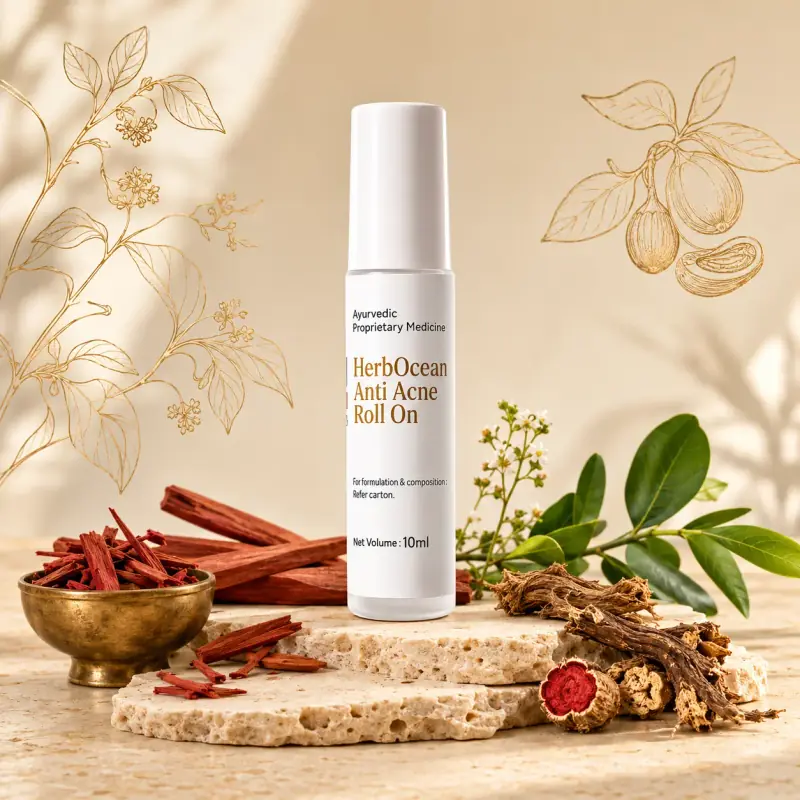
Anti-Acne Roll-On
Ayurvedic spot care for active pimples and post-acne marks (PIH) — a herbal roll-on classically indicated for acne (Yuvanpidika). Made in-house in Delhi.
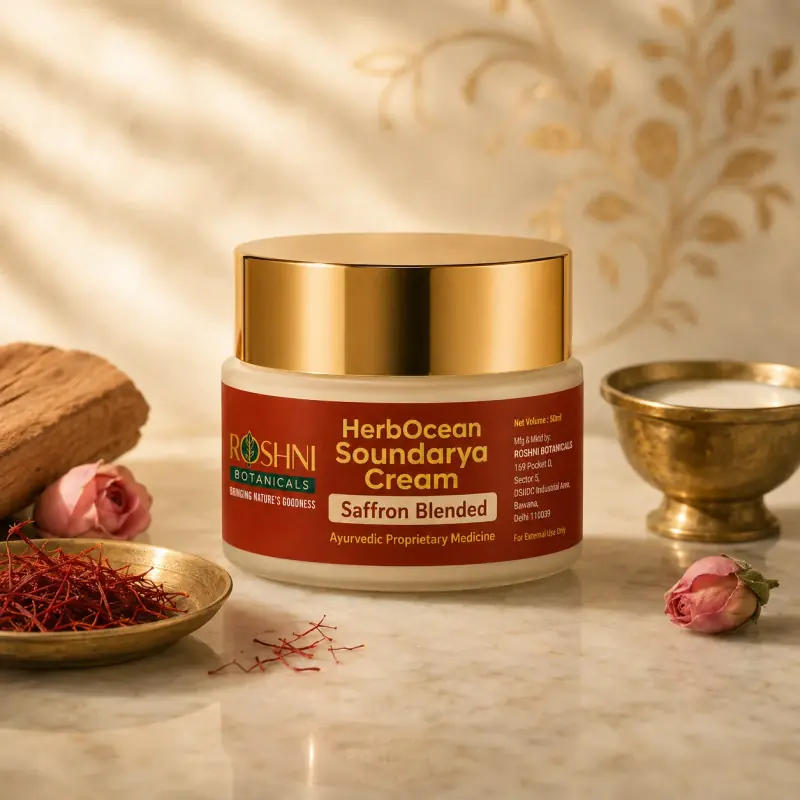
Soundarya Cream
A rich saffron brightening and repair cream with bargad (Vatt) bark on a goat-milk and coconut base, with shea and kokum butters — often reached for where post-acne marks (PIH) linger.
Part of our guide: Ayurvedic treatment for acne: the complete guide.