Ayurvedic Treatment for Acne: The Complete Indian Guide
Acne read as a pattern rather than an event: the classical reading, the version of it you are living with, and the marks it leaves on Indian skin.
You have probably tried four things already. A foaming wash that left your cheeks tight by noon. A spot gel that dried one pimple and handed you a flake. If your shelf looks like a graveyard of things that almost worked, the fault may not lie with the products at all. Look instead at the question every one of them was answering. Most acne routines ask what to put on the spot in front of you. The classical reading asks a harder one: why does the skin keep making them?
There is a second question here, and it is the part almost every page skips. Why does one face behave one way at fifteen and quite another at thirty-four? Why does it break out along the hairline after a workout, under a helmet strap on a humid commute, and again through a run of humid weeks? Acne and pimples (Yuvanpidika, the classical Ayurvedic term) are read here as a pattern rather than an event. Each section below hands you off to the dedicated guide for the version of that pattern you are actually living with.
Key takeaways
- Classical Ayurveda calls acne Yuvanpidika, and Sushruta attributes it to Kapha, Vata and Rakta (the blood tissue) acting together. Later Ayurvedic review writing sorts the presentations four ways, adding a Pittaja reading alongside Vataja, Kaphaja and Raktaja. Rakta is the thread that connects the breakout to the mark it leaves behind.
- On melanin-rich Indian skin the pimple usually settles long before the brown or slate-grey patch it leaves, so post-inflammatory hyperpigmentation (PIH) needs its own slower timeline and its own preparation rather than more of whatever was used on the spot.
- A mark is pigment and answers to patience. Changed texture, a pit or a raised ridge, belongs with a dermatologist, usually needing in-clinic work, and no jar of any tradition stands in for that.
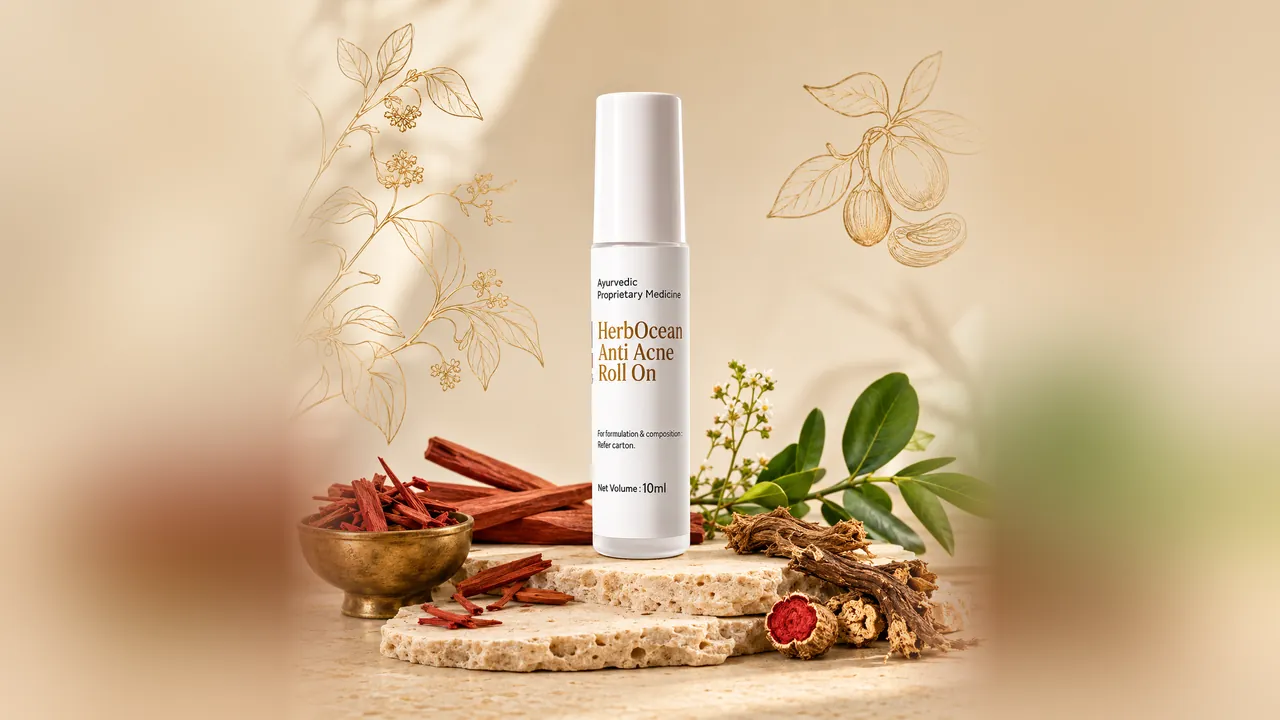
- The HerbOcean Anti-Acne Roll-On carries six classical botanicals in equal measure, the same dose for every one: Manjistha, Lodhra, nutmeg (Jaiphal), red sandalwood (Raktchandan), Indian berberry (Daruhaldi) and costus root (Kuth), carried in a glycerine and purified-water base, with lavender for aroma. No single herb leads the formula. There is no neem in it and no tea tree.
- Book a dermatologist for deep painful nodules, acne that starts suddenly in adulthood, anything leaving a dent or ridge behind, marks that keep darkening or spreading despite daily sun protection, jaw and chin breakouts that track an irregular cycle, and any routine that is clearly worse than when you started.
What Ayurveda Calls Acne: Yuvanpidika and Its Classical Readings
In the classical texts acne is Yuvanpidika, described elsewhere as Mukhadushika and Tarunya Pidika. Sushruta places it among the kshudra roga (the minor disorders) in Nidana Sthana 13, where the eruptions are attributed to vitiated Kapha, Vata and Rakta acting together. Surface bacteria alone? Not in that reading. Congestion, movement and heated blood meet at the follicle, and the spot on your jaw is the last visible step of a much longer sequence.
Which is why classical management runs three tracks at the same time. You step away from whatever is aggravating the skin. Rakta shodhana (blood purification) does its work from the inside. Calming herbs go on the spot itself.
Later Ayurvedic writing sorts the picture four ways, as a presentation guide rather than a quotation from the verse.
The dry, scattered reading (Vataja)
A Vataja reading runs dry and scattered, with itching, scaling and a darker looking lesion, and it tends to flare in weeks of poor sleep and skipped meals. The rituals that steady that pattern are set out in calming care for stress acne.
The hot, red reading (Pittaja)
A Pittaja reading runs hot, red, tender and quick to turn, on skin that flushes easily and runs warm.
The congested reading (Kaphaja)
Kaphaja skin is thick and oily, with whiteheads and those slow congested lumps along the chin and jaw.
The blood reading (Raktaja)
Then comes Raktaja, where the blood tissue sits in the foreground, presenting close to the Pittaja picture. Rakta is not an afterthought in this reading: it is one of the three factors Sushruta names, which is why it bridges to the pigment section further down this page. Rakta is precisely where the classical logic and the story of the mark meet.
How far does a dosha reading actually go? Think of it as a pattern language, a way of describing how one person’s skin behaves across a season, a cycle and a bad run of weeks. A reading is not a diagnosis and does not stand in for one. Two people who both look Pittaja can still need different things, and most readers are a blend anyway. Direction matters more than the label. Is your skin running hot, running congested, or running irregular?
Six classical botanicals sit at the centre of this preparation. Manjistha (Rubia cordifolia) is the backbone of the blood-purifying tradition, the herb reached for whenever heat is showing in the skin. Lodhra (Symplocos racemosa) is the classical astringent bark used where pores and oiliness dominate. Kuth (Saussurea lappa), jaiphal (Myristica fragrans), Daruhaldi (Berberis aristata) and red sandalwood (Raktchandan, Pterocarpus santalinus) sit with them in the same classical skin group. Two of the six are argued properly in Manjistha and Lodhra as a classical pair.
The Same Skin at Fifteen, at Thirty-Four, and Across a Cycle
Teenage acne usually arrives with oil, across the forehead, nose and chin, and it arrives fast. Restraint is the classical instinct here, which is difficult advice to follow at fifteen when a wash promising squeaky skin is sitting right there. Scrubs, alcohol-heavy toners and three actives layered at night leave the barrier uncomfortable, and uncomfortable skin reacts to more things. On melanin-rich skin every extra bout of irritation is a bet on a longer mark.
A parent reading over a shoulder can take one thing away: fewer steps, held for longer, beat a crowded shelf. The school-morning version of that is set out in a calm routine for teenage skin.
Acne that starts in the thirties and forties follows different rules and rewards a different plan. It sits lower on the face, along the jaw, chin and upper neck. Fewer spots, but deeper, more tender and slower, and they arrive on skin that is drier and thinner-feeling than it was at twenty. Teenage tactics fail here. A drying routine that a fifteen year old could absorb leaves a thirty-four year old raw, and adult skin carries a longer pigment history, so the marks stack. The fuller account of that decade of skin sits in acne that begins in your thirties and forties.
Then there is the pattern that tracks the calendar rather than the years. Breakouts clustered on the chin and jawline in the week before a period, easing after it, then returning on schedule: that is the commonest version of it. Classical care leans harder on the internal tracks here, on digestion, sleep and the food that steadies both, because the surface is reporting something the surface cannot settle alone. If the cycle itself has changed, or breakouts arrive with new hair growth or with sudden weight changes, that deserves a hormonal work-up, PCOS included, rather than a routine. Start with chin and jawline breakouts that track your cycle.
Life stage is the first fork in this guide, and it is worth taking before you buy anything. The herbs do not change much between fifteen and forty-five. What changes is the pacing, the number of steps a barrier will tolerate, and how much of the work belongs to the plate and the pillow rather than to the shelf.
Situations That Change the Skin: Sweat, Straps, Hairline and Humid Weeks
After a workout
Acne after a workout is easy to blame on sweat left sitting, and the one trial that tested exactly that found no difference between showering soon after and waiting hours (Short and colleagues, 2008). What is left is friction and comfort, not a countdown: a damp collar, a phone pressed to a jaw, a cap band drying against the forehead, warmth and friction together landing wherever the fabric sat. Get out of the wet layer because it is more comfortable, not because a clock is running. If your breakouts map onto gym days, read pimples that start after a workout.
Hairline, back and straps
Two neighbouring patterns get misread. Bumps along the hairline and into the scalp sit at a border where friction and residue collect, which is why they are so often read as facial acne when the rubbing is really happening at the hair line. Spots across the back and shoulders answer to straps, bag lines and shirts that stay damp on a commute. Scrubbing harder helps neither. Both settle when friction and residue come down. The detail sits in pimples along the scalp and hairline and in back and shoulder acne under straps.
Makeup
Long-wear makeup gets blamed for a breakout that usually traces to the hours it stayed on and the cleansing that never quite finished. Sleeping in a full face. A sponge unwashed for a month. Heavy layers pressed over an active spot, then cleansing hard enough to leave the skin stinging. Those are the parts that show up a week later. Wearing makeup on acne-prone skin is not the problem it is made out to be. The habit audit is in makeup habits on acne-prone skin.
Season
Season is the last situational variable. Skin that runs congested and slick through humid weeks often turns tight and touchy once the air turns dry, and a routine tuned for humidity becomes too much. Classical practice has always adjusted with Ritucharya (seasonal routine) rather than holding one regimen all year. The humid half of that handover is covered in acne in humid monsoon weather.
The Mark Outlasts the Pimple: Pigment, Texture, and the Honest Check
Here is the distinction that matters most on Indian skin, and it is a physical one. A mark is pigment: flat, brown, slate-grey or red, sitting level with the skin around it, which is why it answers only to time and to gentleness. A scar is changed texture, a pit or a raised ridge. No topical preparation from any system, Ayurvedic or modern, has been shown to restore lost tissue to normal skin. Texture belongs with a dermatologist, whose in-clinic options work on the skin architecture in ways no over-the-counter preparation reaches. The two-minute home check, done in side light and with the honest limits on what it can and cannot tell you, is set out in acne scars versus acne marks.
Colour tells you something as well. A brown or grey patch is post-inflammatory hyperpigmentation (PIH), pigment left behind after inflammation, and it is a common outcome on melanin-rich skin. A flat red or pink patch is usually the vascular version, which behaves differently and generally settles on its own schedule. Aggressive routines backfire so specifically here for the same reason: every extra bout of irritation is another deposit of pigment on skin that already deposits it readily. The two colours are compared properly in brown marks and red marks after a pimple.
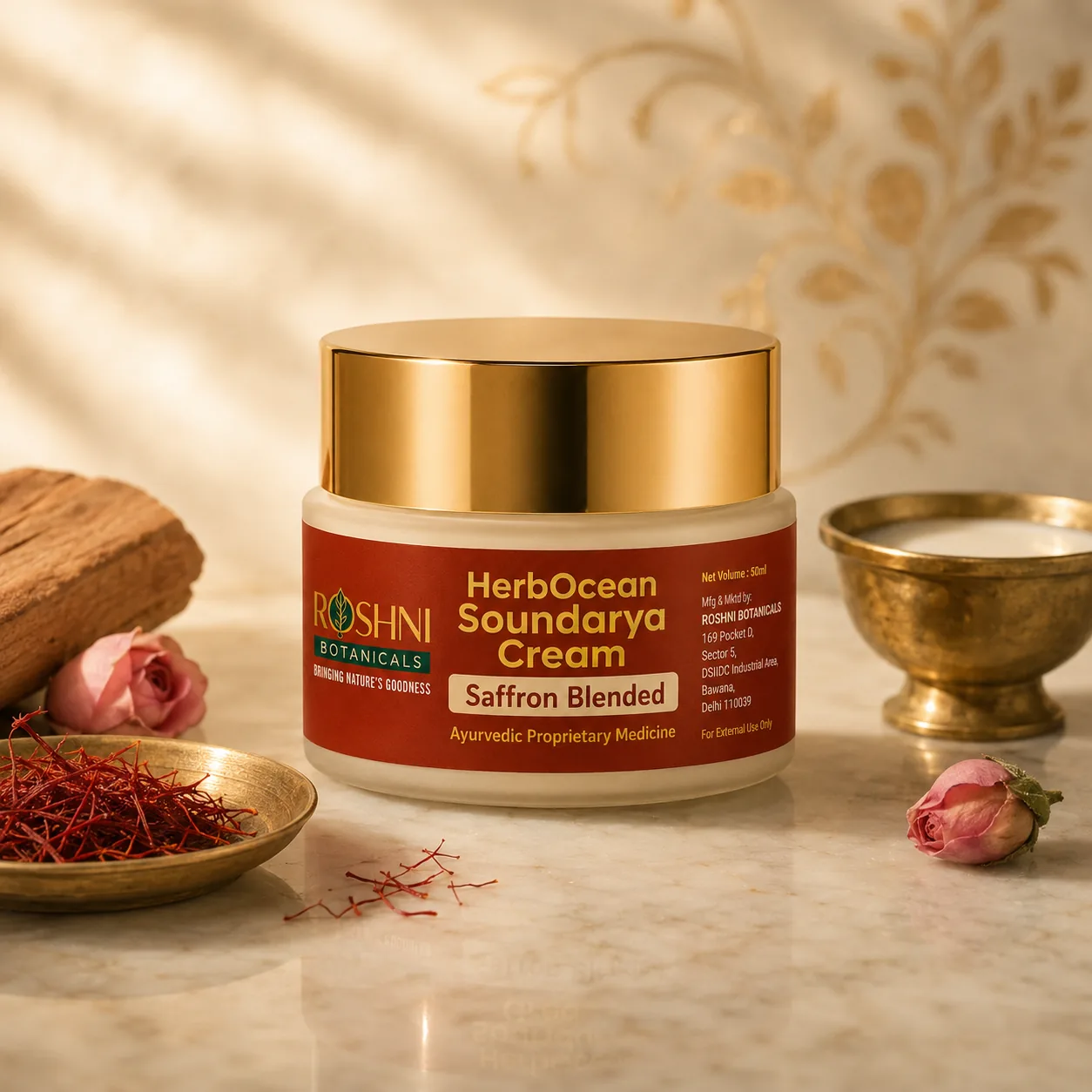
For the mark phase, once active spots have settled and only on settled skin, HerbOcean Soundarya Cream is an Ayurvedic medicine for external use, traditionally used in the care of post-acne marks (PIH): a rich saffron repair cream with bargad (Vatt) bark on a goat-milk and coconut base, with shea and kokum butters, best paired with daily sun protection. It makes no claim about skin tone or shade, and no claim of any kind on textural scarring; the aim is calm, settled, comfortable skin. Very oily or acne-prone skin may find it rich during an active phase. Its job differs from the spot preparation: press a small amount into clean skin, morning or night, across the affected area rather than dotting it onto a rising pimple.
Give this phase a realistic horizon. Pigment settles over months, not evenings, and sun exposure keeps an old mark visible for longer. Nobody serious will give you a date. What the classical approach offers is a low-irritation route through those months, which is why restraint during the active breakout is the most useful thing you can do for the mark. Our handbook on pigmentation and melanin-rich skin goes further into why pigment settles on that timescale.
What the HerbOcean Anti-Acne Roll-On Is, and What It Is Not
What follows is about a licensed medicine, and it is a separate question from the patterns and habits above. The formula is fixed and worth reading before you buy. It carries six classical botanicals in equal measure, the same dose for every one: Manjistha, Lodhra, nutmeg (Jaiphal), red sandalwood (Raktchandan), Indian berberry (Daruhaldi) and costus root (Kuth), carried in a glycerine and purified-water base, with lavender for aroma. No single herb leads the formula. It is built on the 40-year Ayurvedic formulation legacy of Vaidya Shri Ram Prakash Ji.
One point of difference, since most competing guides open with it. There is no neem in this preparation and no tea tree either. Neem sits in the HerbOcean Hair Oil instead, among its sixteen botanicals. The six botanicals above were chosen as a classical group for hot, reactive skin, and swapping a famous name into the list would make it a different formula.
The credentials and the cautions belong together. It is an AYUSH-licensed Ayurvedic medicine for external use under Licence No. DL-474 A&U, classically indicated for acne and pimples (Yuvanpidika) and traditionally used in the care of post-acne marks. For external use only. Cleanse and pat dry, then roll a thin layer directly over the pimple, morning and night, and follow with your moisturiser. It is spot care, not a full-face application, and not something to layer under makeup. Keep it away from the eyes and lips and off broken skin, and anyone allergic to a listed botanical should avoid it. Patch-test on the inner forearm before a first full application. If you are pregnant or nursing, ask your Ayurvedic physician before use. Judge it across weeks rather than across nights, and keep the rest of the routine unchanged while you do, or you will not know what did what. Full details sit on the HerbOcean Anti-Acne Roll-On page, and where a roll-on fits an everyday routine is set out separately.
Food, Water, Routine, and the Myths Worth Dropping
The kitchen end of this is where classical advice and modern dermatology drift closest together, though the two halves do not rest on the same strength of evidence. Glycaemic load has been tested in a randomised trial: 43 young men on a low-glycaemic-load diet for twelve weeks came out with fewer lesions than the control group (Smith and colleagues, 2007, Australia). In most Indian kitchens that pattern means refined flour, sugary tea through the day and late fried snacking. Dairy is the weaker case, an association pooled from observational studies rather than a trial, and plenty of people eat both and stay calm-skinned.
The classical counterweight is unglamorous and familiar. Bitter greens, cooling vegetables, haldi (turmeric) and amla, enough water, and a lighter dinner eaten early enough for digestion to finish before you sleep. The longer version is in what Ayurveda says about food and pigmentation.
Once or twice a week the older practice still earns its place. A classical Lepa (medicated paste) or an ubtan-style mask does the slow work on the terrain rather than on any single spot, which is the honest division of labour set out in multani mitti for acne. Indian skincare has done it this way for a very long time, and the reason it lasted is that it asks little of a barrier that is already under strain.
A workable routine is shorter than the internet suggests. Cleanse gently morning and night, keeping the wash mild enough that your face does not feel tight afterwards, since a comfortable barrier tolerates everything else better. Moisturise even if you are oily. Wear sun protection daily. HerbOcean does not manufacture a sunscreen, and nothing in the range replaces one. Hard water is the variable nobody accounts for, and Delhi groundwater is the case that has actually been measured. If your skin feels tight and faintly filmy after every wash, the tap is part of the picture rather than the fifth active you have not tried yet.
Three myths are worth putting down. First, that washing more often will sort it. Over-washing mostly buys you a stripped, uncomfortable barrier, and uncomfortable skin is more reactive, not less. Washing less is not automatically safer either: the one small trial on face-washing frequency in young men found no significant difference between its groups overall, but within them twice daily was a sensible middle, four times daily no better, and once daily the only arm where acne actually worsened (Choi and colleagues, 2006). Twice a day suits most people. The five surfaces that actually press against a face every day are worked through in the acne hygiene routine. Second, that all oils cause breakouts: the wrong heavy ones on the wrong skin can congest, while classical preparations are used precisely on reactive skin. Third, that acne means someone is unclean, which is both untrue and unkind, and which keeps far too many people scrubbing at a face that needed less handling, or reaching for the desi quick fixes that do more harm than good. If you would rather start from your own pattern than from a myth, work through reading your own acne pattern by dosha.
The comparison question comes up constantly, so here it is without a winner attached. Salicylic acid exfoliates and helps unclog the follicle. Benzoyl peroxide acts on surface bacteria. Both can be drying, and on melanin-rich skin irritation carries that pigment cost we have already discussed. Classical botanicals come at the same problem from the other side, aiming to calm the skin while food, sleep and digestion are addressed alongside. Each approach has a mechanism, each has a cost, and the choice is yours to make. We have set both mechanisms out side by side in how salicylic acid and classical herbs differ.
When to Stop Self-Managing and See a Dermatologist
Some presentations need a doctor rather than a routine, and the triggers are specific. Deep, painful nodules or cysts that sit under the skin for weeks. Acne that appears suddenly in adulthood on skin that was previously settled. Anything that leaves a dent, a ridge or a pit behind, because texture change asks for in-clinic work. Marks that keep darkening or spreading despite daily sun protection. Acne along the jaw and chin that tracks an irregular cycle, especially alongside new hair growth or weight change, which deserves a hormonal work-up, PCOS included. And any routine, ours included, that is clearly worse than when you started.
None of that makes classical care and medical care rivals. For stubborn cases the sensible path is usually both, running together, with the dermatologist handling what needs a prescription and the classical routine handling the daily terrain of food, sleep and gentle external application. Ayurvedic care supports calm skin and helps maintain it. It does not stand in for medical care, and this guide is educational rather than a substitute for a consultation about your own face.
The Short Version
Read your pattern before you buy anything. Settle the system, eat and sleep in a way your Agni (digestive fire) can keep up with, protect the skin from sun, and handle spots lightly, because restraint during the breakout is the part of the mark phase you actually control. Give a routine a run of consistent weeks before you judge it, give marks longer still, and keep a dermatologist’s number for the presentations named above.
The classical preparation for a rising spot is the HerbOcean Anti-Acne Roll-On, an Ayurvedic medicine made in-house at our GMP-certified unit in Bawana, Delhi, under AYUSH Licence No. DL-474 A&U. To build the wider routine around it, start from the Ayurvedic skincare range.
References: Sushruta Samhita, Nidana Sthana 13 (Kshudra Roga Nidana), on Yuvanpidika (Mukhadushika), attributed to vitiated Kapha, Vata and Rakta. Smith RN and colleagues. A low-glycaemic-load diet improves symptoms in acne vulgaris patients: a randomised controlled trial. American Journal of Clinical Nutrition, 2007 (43 male patients aged 15 to 25, 12 weeks, Australia). Juhl CR and colleagues. Dairy intake and acne vulgaris: a systematic review and meta-analysis. Nutrients, 2018 (14 observational studies, 78,529 participants aged 7 to 30, association only). Choi JM, Lew VK, Kimball AB. A single-blinded, randomised, controlled clinical trial evaluating the effect of face washing on acne vulgaris. Pediatric Dermatology, 2006 (males with mild to moderate acne, washing once, twice or four times daily for six weeks). Short RW and colleagues. A single-blinded, randomised pilot study to evaluate the effect of exercise-induced sweat on truncal acne. Pediatric Dermatology, 2008 (23 physically active males, two weeks; no difference between showering within an hour and waiting at least four hours).
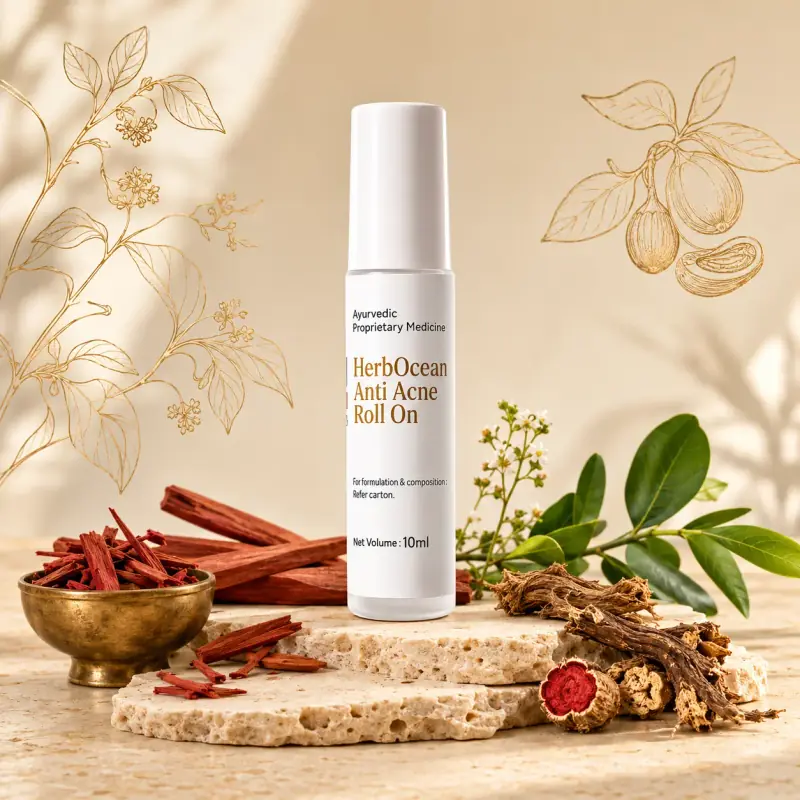
Anti-Acne Roll-On
Ayurvedic spot care for active pimples and post-acne marks (PIH) — a herbal roll-on classically indicated for acne (Yuvanpidika). Made in-house in Delhi.
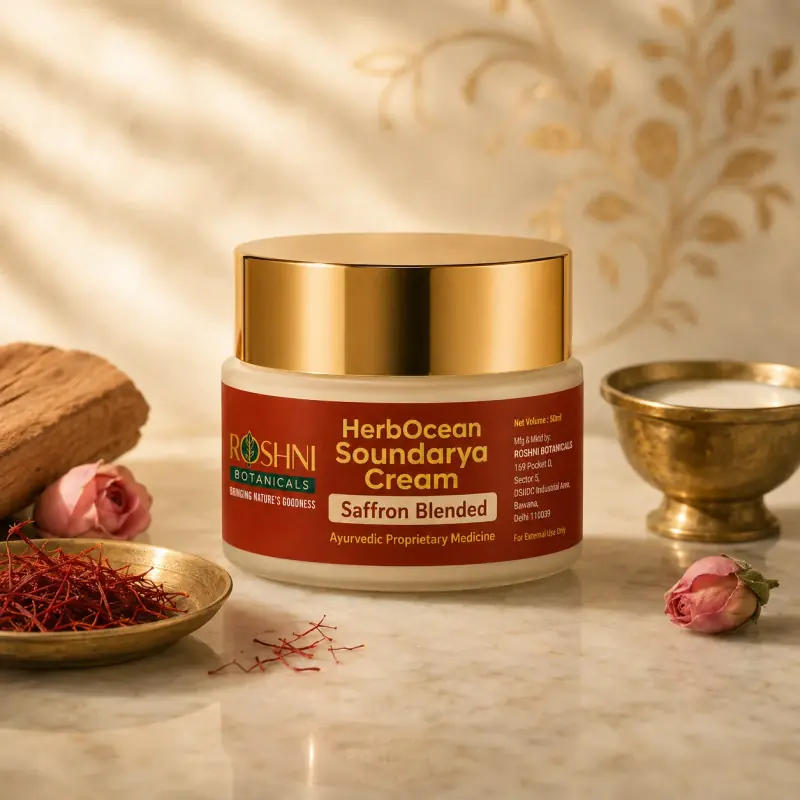
Soundarya Cream
A rich saffron brightening and repair cream with bargad (Vatt) bark on a goat-milk and coconut base, with shea and kokum butters — often reached for where post-acne marks (PIH) linger.