Ayurvedic Treatment for Melasma on Indian Skin: The Handbook
Melasma on melanin-rich Indian skin: the mirrored cheek patch, often after pregnancy, and the four questions that separate it from post-acne marks.
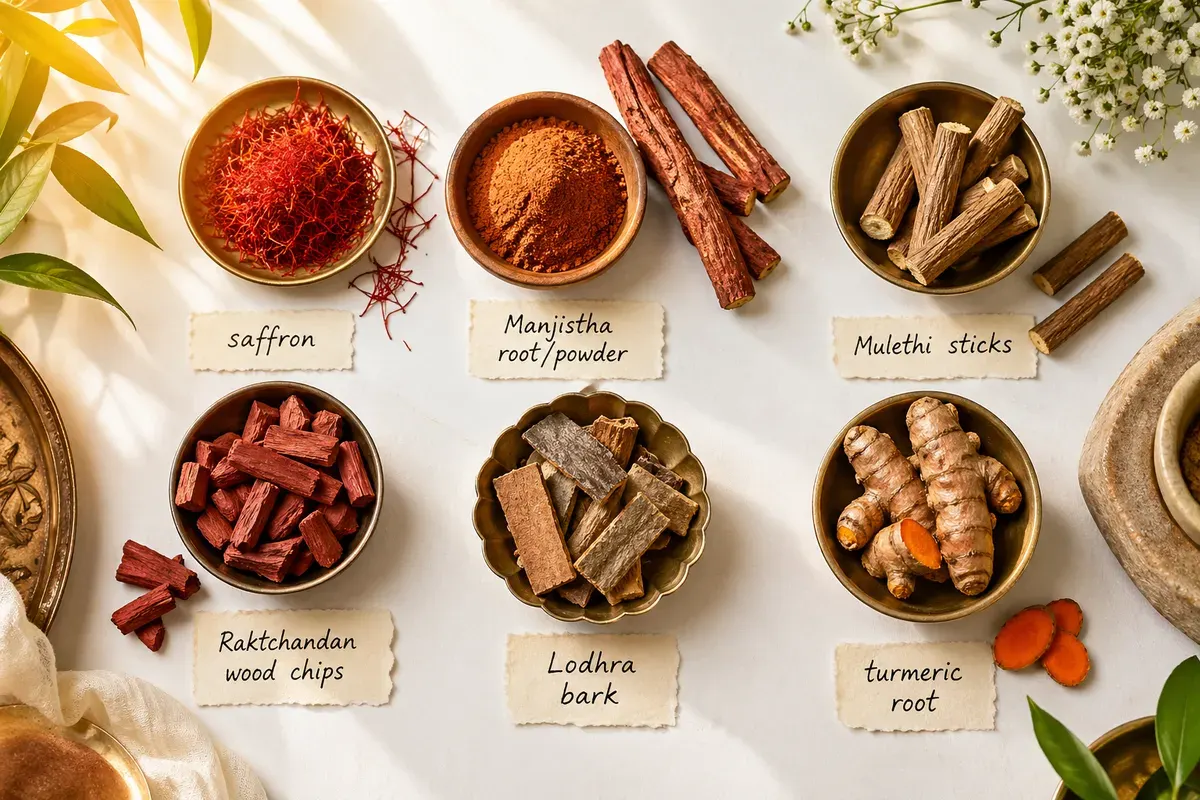
Most people meet their melasma in an unkind mirror, then spend a year buying for a different problem. The patch is symmetrical, slow and hormonally driven, so it will not answer to the routine you use on the marks a pimple leaves behind. This handbook does two jobs. It teaches you to read your own face, separating melasma from post-acne marks and from ordinary tanning, and it sets out what classical Ayurveda offers for facial pigmentation, which the classical texts call Vyanga. Melasma is managed rather than one-and-done: it responds to consistent use and returns with sun exposure, which is why the routine matters more than a result.
Key takeaways
- Melasma sits symmetrically across both cheeks, the upper lip and the forehead. Post-inflammatory hyperpigmentation lands exactly where an old pimple, a wax strip or an insect bite was.
- Melasma falls disproportionately on Fitzpatrick types III to V, where pigment cells are quicker and more reactive, which is why melasma and post-acne marks so often share the same Indian face.
- A broad-spectrum sunscreen, physical shade and a wide cap sit separately in the routine, every single day, and no oil or cream is sun cover.
- Classical Ayurveda reads the patch as Vyanga and works on the Vata-with-Pitta pattern the texts place behind it, using external Varnya preparations, the classical complexion-care group of herbs: a Lepa (medicated paste applied externally) or a Taila (medicated oil).
- Judge this over months rather than weeks of steady, sun-disciplined care, and expect that a settled patch can return after one unprotected stretch of sun or one hormonal shift.
Reading Your Own Face: Melasma, PIH and Ordinary Tanning
Shape gives melasma away before anything else. Brown to greyish, with irregular, uneven borders and a fairly even colour right across the patch, and usually symmetrical: the same territory on the left cheek as on the right, often a band above the upper lip, across the bridge of the nose and a spread over the forehead, and sometimes along the jawline. Some people carry that band alone and read it as shadow. What matters is the mirroring. Cover one half of your face; if the other half looks like a rough copy, the pattern is pointing at melasma rather than a scatter of unrelated marks, though other symmetrical patterns exist and a doctor is the one who separates them.
Post-inflammatory hyperpigmentation behaves in the opposite way. It maps one to one onto an injury: where a pimple sat, where a wax strip pulled, where an insect bit. Discrete marks, edges you can trace, arriving in the weeks after the event rather than over a season. If your pigmentation is one-sided, or you can point at each mark and name the pimple behind it, read the difference between dark spots and pigmentation, then brown marks versus red marks, PIH and PIE, since a red mark is an earlier stage of the same story. Where acne is still active, start instead with the complete guide to Ayurvedic acne care.
Two look-alikes are worth separating. Tanning is diffuse rather than patchy, follows whatever meets the sun, and settles once exposure drops. Freckling is small, scattered, sun-driven and often runs in families. Plenty of people arrive certain they have facial melasma when what they have is dark circles under the eyes, three different causes, or dark skin around the mouth, or milia, white bumps that are not pimples. Pigment down the throat belongs with neck and decolletage pigmentation care, where the skin is thinner.
The Four-Question Self-Check
A self-check you can run in daylight, no special lamp needed. Mirrored pattern, or scattered? Even colour across one irregular territory, or separate marks you can outline one by one? What came first, a hormonal change or an injury? Did it take a season to appear, or a couple of weeks? Mirrored, evenly coloured, hormonal and slow points to melasma. Scattered, separately outlined, injury-led and quick points to post-acne pigmentation. Both can sit on one face at once, which is the ordinary Indian case. If the same pattern runs on the arms or back, body pigmentation beyond the face covers that ground, and a quick routine for men keeps the shaving-related version short.
Why Indian Skin Holds Pigment, and What Vyanga Means
Melasma falls disproportionately on Fitzpatrick types III to V, a range a great many Indian faces sit in, where pigment cells respond faster and produce more generously. That reactivity is not a defect. It is sun tolerance, and it is why the same beach afternoon that reddens paler skin leaves ours darker. The cost is that any inflammation, however small, gets recorded in pigment. A shaving nick. One night of scratching. A badly done threading session. Each deposits colour that then sits for months. Pigment goes down fast on melanin-rich skin and comes up slowly.
Classical Ayurveda has been describing this patch for a very long time. The Sushruta Samhita places it in Nidana Sthana 13, among the Kshudra Roga (the minor conditions), under the name Vyanga. The reading there is precise: Vata is aggravated first, by anger and by overexertion, and then joins with Pitta (two of the three doshas, the biological energies of Ayurveda) and rises to the face, leaving a thin, painless, brownish patch. No itching, no scaling, no discomfort, just colour where colour was not. That last detail is diagnostically useful even now. A pigmented patch that itches, flakes or burns is telling you something else is going on, and it belongs with a doctor rather than in a routine.
Read plainly, that is a classical account of heat, inflammation and pigment travelling together. The classical response is the Varnya group, ten drugs in the classical list, and Manjistha is one of them. Manjistha for skin covers the herb on its own terms.
What Switches the Pigment On: Hormones, Sun and Heat
Hormonal shifts are the trigger most people can name, and the link is well recognised without being fully mapped. Pregnancy is the classic one. Combined oral contraception is another, and so is hormone replacement therapy. None of that is something a skincare routine can settle, and none of it should be self-diagnosed. If your pigmentation arrived with a pregnancy, a new pill or a change in your cycle, that conversation belongs with your doctor. Read hormonal pigmentation and calmer flare ups for what a routine can do around it.
Sun is the trigger that never takes a break, and it is more than ultraviolet. Visible light, including ordinary daylight through a window, and plain heat are separate provocations for pigment on melanin-rich skin. Which is why melasma flares through the hot months, and again in a sticky late-monsoon week when the sky looks harmless. A long two-wheeler commute matters. So does standing over a hot tawa, which is why heat triggered pigmentation deserves its own reading. Heat need not burn you. It only needs to be steady.
Inflammation is the trigger you control most directly, and where people lose ground. Aggressive scrubs. Strong actives stacked without guidance. Weekly threading over the same skin, and picking at anything. On reactive skin, each lays fresh pigment on top of the pigment you already have. Over-washing belongs in the same bracket, though not for the reason usually given. Stripping the skin teaches it nothing. It leaves the barrier tight and easier to irritate, and skin that already makes pigment readily darkens when it is irritated. Gentler hands are the mechanism, not the soft option.
Hard Water and a Tight Barrier
Hard water belongs in the same conversation across much of North India. Mineral-heavy water makes cleansers lather poorly and can leave a tight, filmy feeling that people then answer by washing harder, and every extra wash is one more small irritation on skin that records irritation as colour. The fix is dull. One gentle cleanse at night, a splash in the morning, a light moisturiser after each, and stored soft water for the face where the tap runs hard. Softer handling, not a stronger wash, is what a tight barrier needs.
Sleep, stress and digestion get named constantly in Ayurvedic writing on Vyanga, and they deserve a careful sentence rather than a confident one. Classical thinking connects poor Agni (digestive fire) and accumulated Ama (undigested metabolic residue) with dull skin and uneven tone, and advises Ritucharya (seasonal routine) to keep Pitta from running hot through the warm months. Practically, that is unremarkable. Eat at sane hours, sleep enough, keep very hot and very sour food modest while the weather is heavy.
The One Habit That Decides Everything: Sun Discipline
Say this part plainly, because everything below rests on it. HerbOcean does not manufacture a sunscreen, and nothing in the range replaces one. Sun discipline is a separate item in your routine, it is non-negotiable where melasma is concerned, and without it sun exposure keeps darkening the patch faster than any topical care can help.
The practical version for Indian conditions runs like this. A broad-spectrum sunscreen every single morning, including on days you do not step out, because window glass passes plenty of what provokes pigment, and including overcast monsoon days when the light feels soft. Reapply through the hours of actual daylight exposure, and again after sweating hard or towelling your face. Most people under-apply. Measure by the clock rather than by feel, and keep a second tube in your bag. Cloud cover is not sun cover, and why cloud cover is not sun protection sets that out in more detail.
Then add the free half of the routine, which costs nothing. A wide cap or a hat with a real brim. Sunglasses that actually cover the orbital area, which also looks after the thin skin under the eyes. An umbrella in peak hours, which is ordinary practice across much of India and never worth being self-conscious about. If you ride, a full-face helmet or a scarf does more for your cheeks than any serum. Physical shade is unglamorous and it is the most reliable tool you own.
One note on the turn of the seasons. As the monsoon pulls back across much of North India the light sharpens even as the air cools, and people relax their sun routine in exactly that stretch, because the mornings feel kind. It is the wrong stretch for it. The second half of the same habit is gentle handling: no scrubbing, no stacking of strong actives on a whim, no picking, and a pause on threading or waxing over an actively inflamed patch.
The Classical Approach: Shamana, Lepa and Taila
Classical management here is shamana, palliative care that calms a pattern rather than purging it, working through two external dosage forms. A Lepa is mixed, spread on the face, left a short while and washed off: periodic, surface-level. A Taila is left on, its herbs carried in a fat rather than in water, which is how classical pharmacy prepares them for external use. Both formats are old and legitimate. The two steps most people sustain are the Taila and the cream.
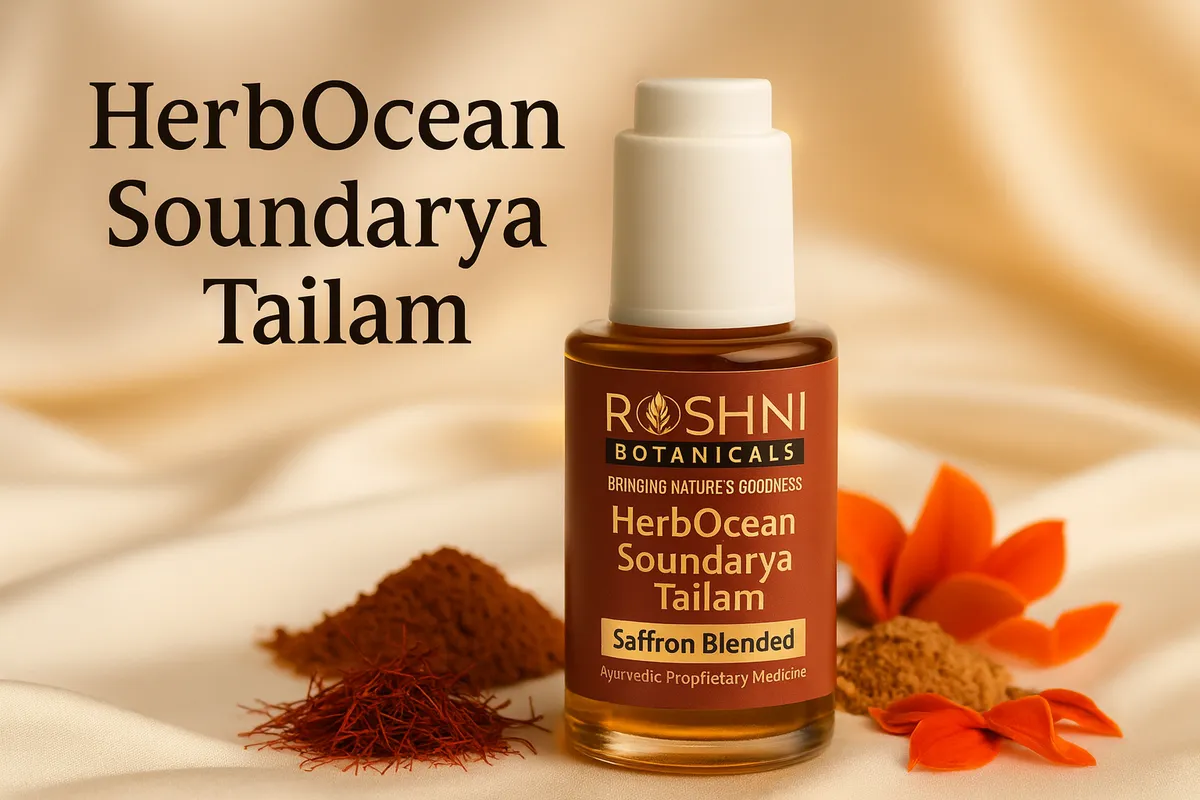
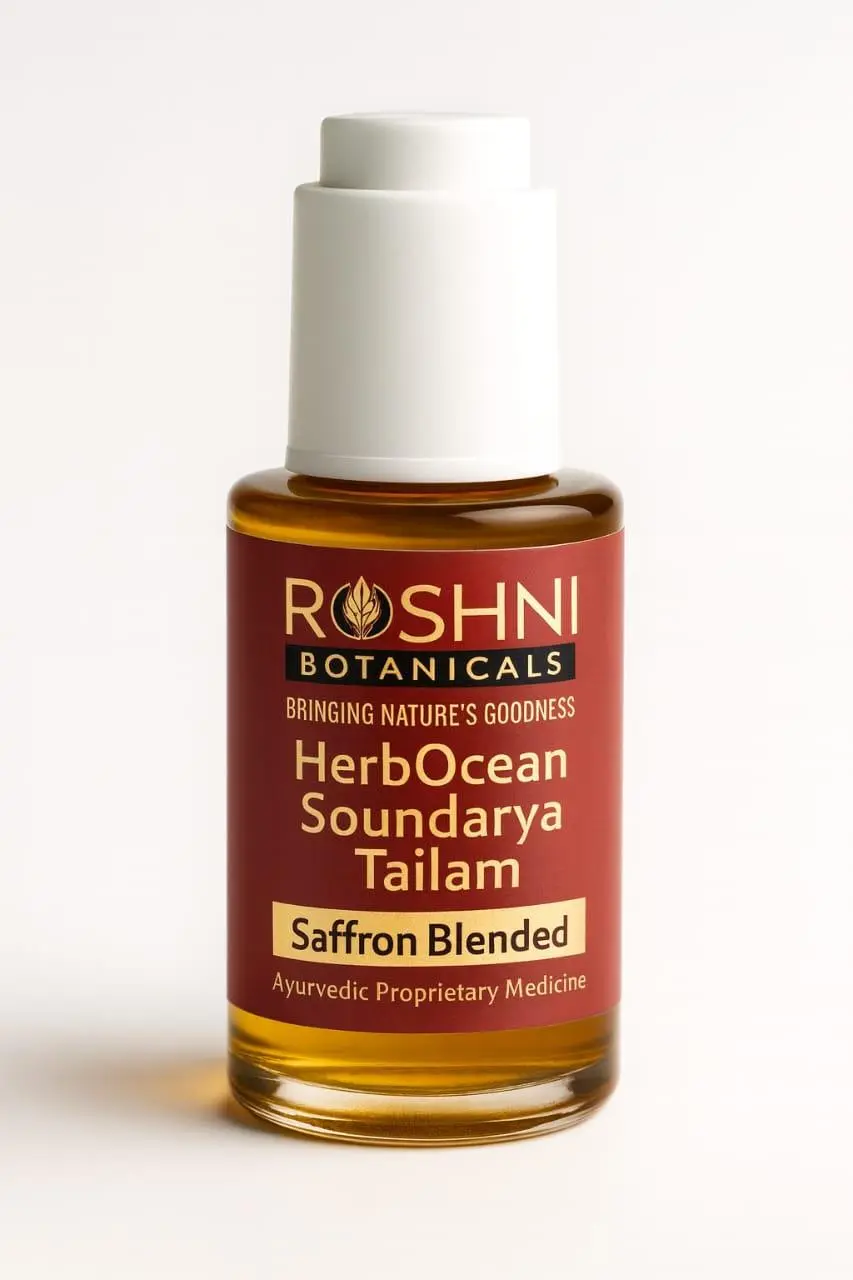
HerbOcean Radiance Tailam is an AYUSH-licensed Ayurvedic medicine for external use, classically indicated in the care of melasma (Vyanga) and traditionally used in the care of post-inflammatory hyperpigmentation (PIH), dark spots and dullness. Inside it sit saffron (Kesar), sandalwood (Chandan), red sandalwood (Raktchandan), Indian madder (Manjistha), turmeric (Haldi), costus root (Kuth), lotus (Kamal), wild Himalayan cherry (Padmaakh), Kakoli, Palash and the Triphala fruits, Amla, Baheda and Harad, in a sesame oil (Til tail) base.
An aggressive brightening treatment works by stripping or irritating, and on this skin the irritation is itself a fresh source of pigment. Gentle support works the other way round, keeping the skin calm while sun protection holds the line. Radiance Tailam sits in the second group, a brightening Taila in the classical tradition rather than a peel.
No herb changes the colour you were born with. The aim is calm, settled, comfortable skin and an even-looking tone, and nothing beyond it.
A word on what those herbs are doing. Three of them, Chandan, Manjistha and Padmaakh, sit in the Varnya group, used for the appearance of the skin rather than for any promised outcome. Want the herbs at length? Read Chandan for skin, two woods under one name, then Raktchandan versus Chandan for pigmentation, then Manjistha and turmeric for pigmentation, and what the Triphala trio does for skin. Licorice (Mulethi) for hyperpigmentation covers the other name that comes up here, though Mulethi belongs to the Soundarya formulations rather than the Radiance ones.
Two production details worth stating. Our saffron is cold-macerated rather than boiled, because the active compounds in Kesar are heat-sensitive and cold maceration helps protect them, and saffron for skin covers the ingredient on its own terms. The formulations are made in-house at our GMP-certified unit in Bawana, Delhi, under AYUSH Licence No. DL-474 A&U, built on the 40-year Ayurvedic formulation legacy of Vaidya Shri Ram Prakash Ji. Radiance Tailam and uneven tone, at length covers the preparation in more depth.
Cream or Taila, and a Routine You Can Hold
A question worth settling: oil, or cream? The answer is not about strength. Pick by how your skin behaves, and by the season. The Taila suits drier skin, cooler months and a night step, where it has hours to sit undisturbed.
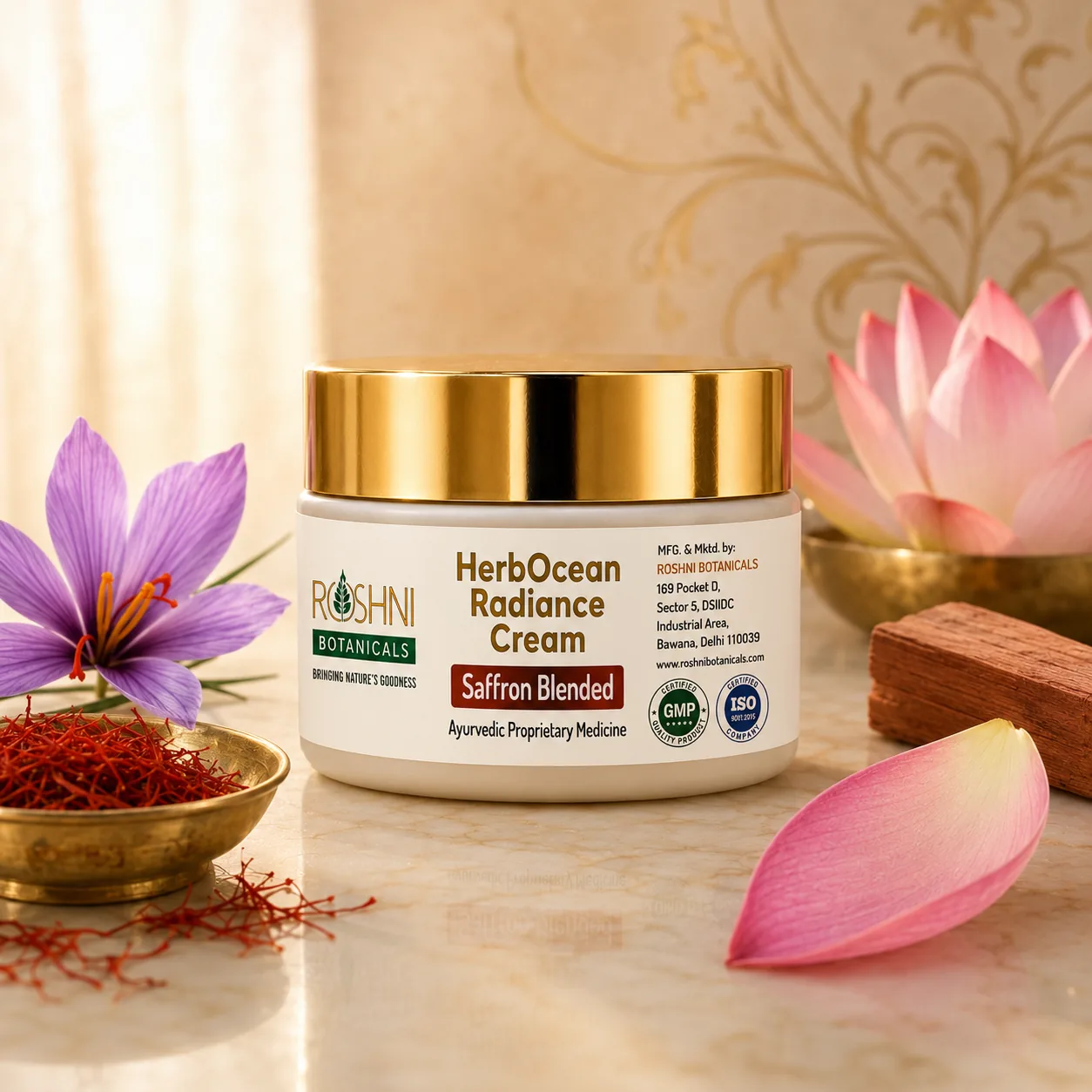
HerbOcean Radiance Cream is an Ayurvedic medicine for external use, classically indicated for facial pigmentation (Vyanga, the patches Hindi homes call jhaiyaan) and traditionally used in the care of dark spots and uneven tone. It suits humid weeks, oilier skin and mornings, layered under sunscreen. Smooth it over clean skin morning and night, and by day always follow with a broad-spectrum sunscreen. Rotating the two across the year is sensible rather than indecisive. If you are choosing between face oils in general, Soundarya Tailam or Radiance Tailam, choosing your face oil lays the decision out.
A workable sequence. Morning: a mild cleanse, your cream if you are using one, then sunscreen as the last skincare step, reapplied through the day. Night: cleanse properly, then press a few drops of the Taila into clean skin with flat palms rather than rubbing, concentrated on areas of uneven tone. That is the whole thing. A night routine for dark spots covers the evening in more detail, and if you already run an actives schedule, Ayurvedic skin cycling shows where a Taila fits.
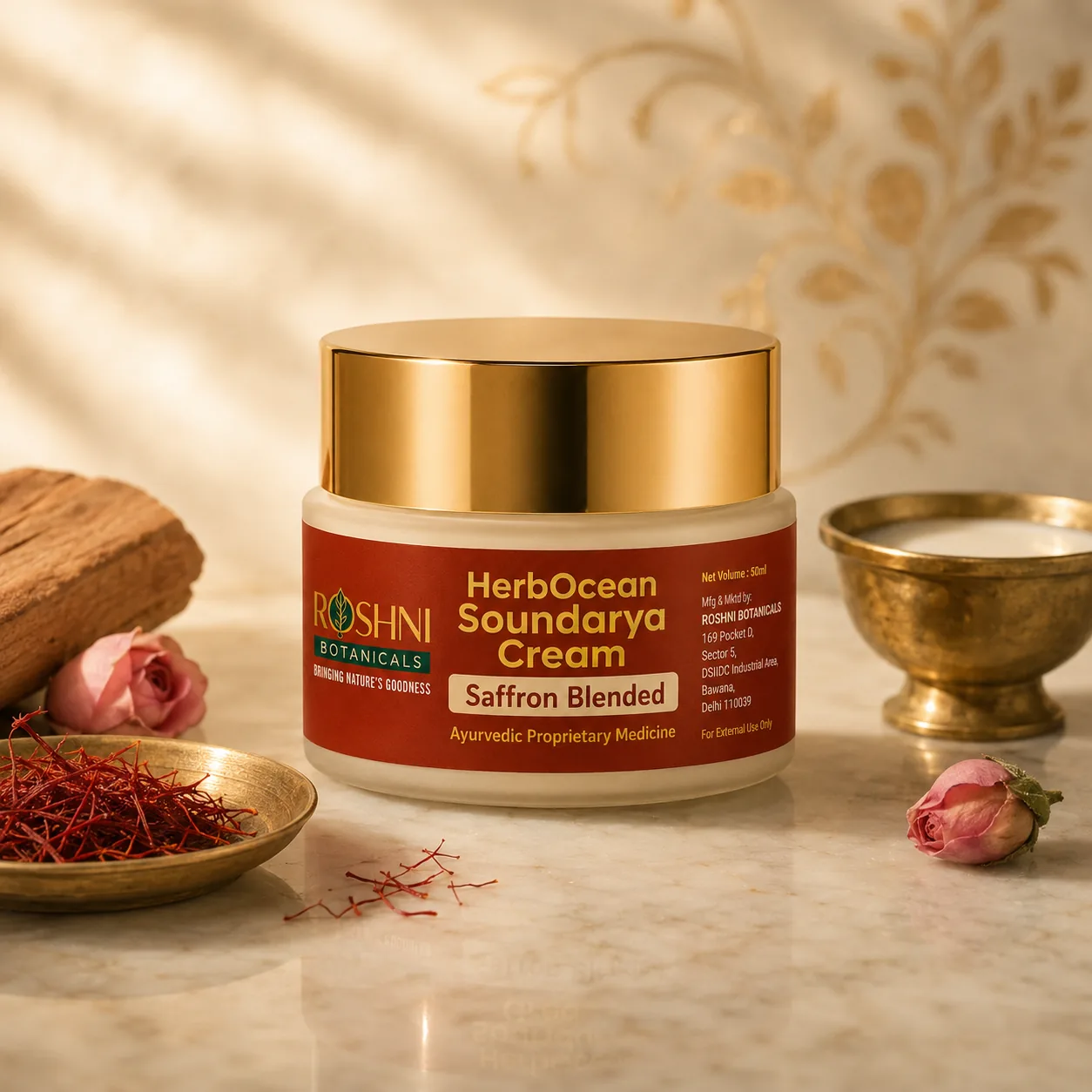
Where old post-acne marks are the bigger share of what you see, the Soundarya line is the more logical pick. For the mark phase, once active spots have settled and only on settled skin, HerbOcean Soundarya Cream is an Ayurvedic medicine for external use, traditionally used in the care of post-acne marks (PIH): a rich saffron repair cream with bargad (Vatt) bark on a goat-milk and coconut base, with shea and kokum butters, best paired with daily sun protection. It makes no claim about skin tone or shade, and no claim of any kind on textural scarring; the aim is calm, settled, comfortable skin. Very oily or acne-prone skin may find it rich during an active phase. Plenty of people run the Radiance line over the melasma territory and the Soundarya line where the marks sit.
Worth saying once: a single classical preparation is part of a plan, not the plan. Sun discipline is the plan. Gentle handling is the plan. The Taila is the part you enjoy, and the part that keeps the routine alive, because the routine that helps is the one still running months later.
Timelines, Home Remedies, Safety and When to See a Dermatologist
Now the part nobody likes to hear. Pigmentation is slow to shift, and the sorting of melasma into surface and deeper kinds is a working shorthand rather than a reliable forecast, least of all on brown skin. Judge it over months rather than weeks, and only where sun cover is worn every single day. Post-acne marks are usually quicker. Set your review point at the end of a season, not a couple of weeks. Understand also that a settled patch can come back after one unprotected holiday or one hormonal shift, and that this is the ordinary course of the condition rather than a failure of your routine.
Home Practice, and What to Leave Out
Home practice deserves respect, not a lecture, so let us be specific. Ubtan, multani mitti and a haldi paste are part of how this country has looked after skin for generations, and used gently they are fine. Neat lemon on the face is the one to leave alone. Lemons and limes carry furocoumarins, and skin carrying them that then meets sunlight can react, which on brown skin can show up as fresh pigmentation exactly where you applied it, with no sting to warn you first. It is one of the commonest self-inflicted setbacks. Baking soda, toothpaste and kitchen scrubs belong in the same bin. If a home remedy stings, that sting is not the remedy working.
You will also be weighing pharmaceutical routes, and they deserve description rather than dismissal. Hydroquinone acts on the enzyme step in pigment production and is used under medical supervision, because chronic use can lead to exogenous ochronosis, a paradoxical darkening, and because of pregnancy considerations. Kojic acid, azelaic acid and vitamin C act on related steps in the same pathway, each with its own tolerability profile. Chemical peels and laser work are done in a clinic, and Indian expert consensus places lasers as an adjuvant in resistant melasma rather than a first-line option, with patient selection and counselling done carefully. A classical Taila works differently and slowly, across months. Different roads, and the choice belongs with you and your doctor.
Safety, briefly and completely. These are medicines for external use only. Patch-test on the inner forearm 24 hours before first use. Keep any oil out of the eye area itself. Please check with your doctor before use if you are pregnant or breastfeeding. Pigmentation in pregnancy, which you may see called melasma or chloasma, is hormone-driven and often settles afterwards, so gentle care and sun protection are the sensible first steps.
When to See a Dermatologist
See a dermatologist, not a routine, if the patch is spreading quickly, if one patch behaves differently from the rest, if it began after a new medicine, or if it comes with itching, redness or scaling. A dermatologist is also the right call if you are considering oral agents or in-clinic procedures. Ayurvedic care and medical care can run alongside each other; tell each practitioner what the other has advised.
Where to Start Tomorrow Morning
If you take one thing from this handbook, take the order of operations. Sun cover every morning, without exception, reapplied. Hands off the face. Then one classical preparation, used steadily through a whole season before you judge it. Unglamorous by design. The HerbOcean Radiance Tailam page carries the full ingredient declaration and usage guidance, and the face-oil chooser above will settle the oil question faster than another month of guessing. If long desk days and air conditioning are part of the picture, a reset for tired office skin is a sensible companion read, and the full Ayurvedic skincare range sits one click away.
References: Sushruta Samhita, Nidana Sthana 13 (Kshudra Roga), on Vyanga: Vata aggravated by anger and overexertion, joining with Pitta and rising to the face, leaving a thin, painless patch, rendered brown in the Bhishagratna translation. Charaka Samhita, Sutrasthana 4, on the Varnya group of ten complexion-care drugs, of which Chandana, Manjishtha and Padmaka sit in this formula. Ashtanga Hridaya, Uttara Sthana 31 and 32, on Vyanga among the Kshudra Roga and on the external Lepa applications used for it. Adalatkhah H and Sadeghi Bazargani H, The association between melasma and postinflammatory hyperpigmentation in acne patients, Iranian Red Crescent Medical Journal, 2013: a comparative study of 400 participants in Ardabil, Iran, 200 with melasma and inflammatory acne and 200 with inflammatory acne alone. Sarkar R and colleagues, Clinical and epidemiologic features of melasma: a multicentric cross-sectional study from India, International Journal of Dermatology, 2019: a cross-sectional study at ten centres across four regions of India, 1,001 patients with melasma, mean age thirty-eight, mostly women, which reported a positive correlation between the duration of cooking-fire or occupational heat exposure and the severity of melasma. Ogbechie-Godec OA and Elbuluk N, Melasma: an up-to-date comprehensive review, Dermatology and Therapy, 2017: a narrative review, on hormonal and visible-light triggers and on exogenous ochronosis with chronic hydroquinone use. Sarkar R and colleagues, Lasers in melasma: a review with consensus recommendations by Indian Pigmentary Expert Group, Indian Journal of Dermatology, 2017: a consensus statement from sixteen Indian dermatologists, which places lasers as an adjuvant in resistant melasma rather than a first-line option. Sarkar R, Chugh S, Garg VK, Newer and upcoming therapies for melasma, Indian Journal of Dermatology, Venereology and Leprology, 2012: a review article. Educational, not medical advice.
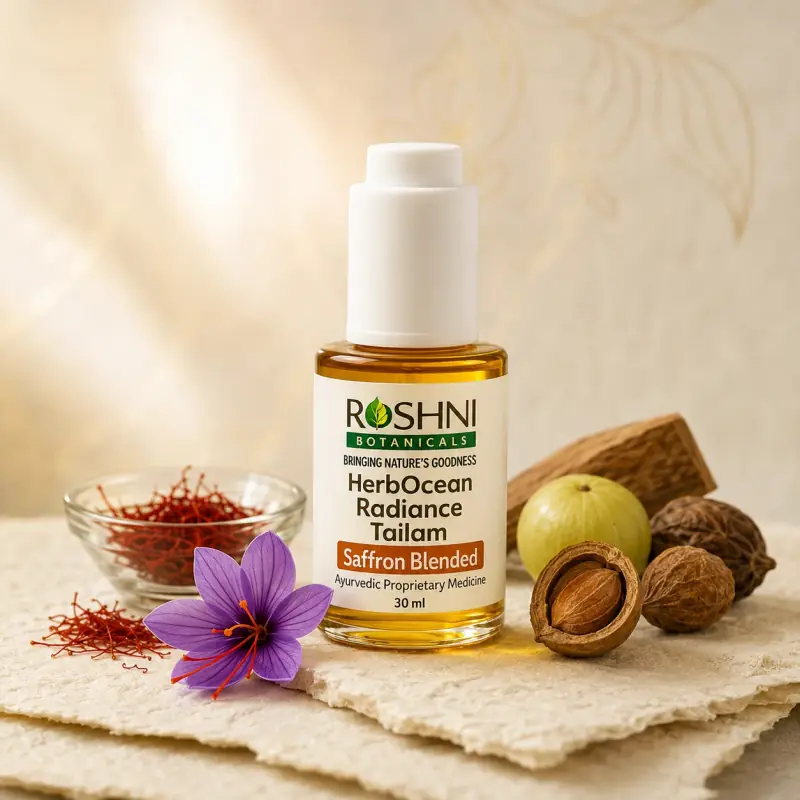
Radiance Tailam
A saffron brightening facial Taila with Manjistha and red sandalwood, traditionally used to support even tone where melasma, dark spots and PIH show.
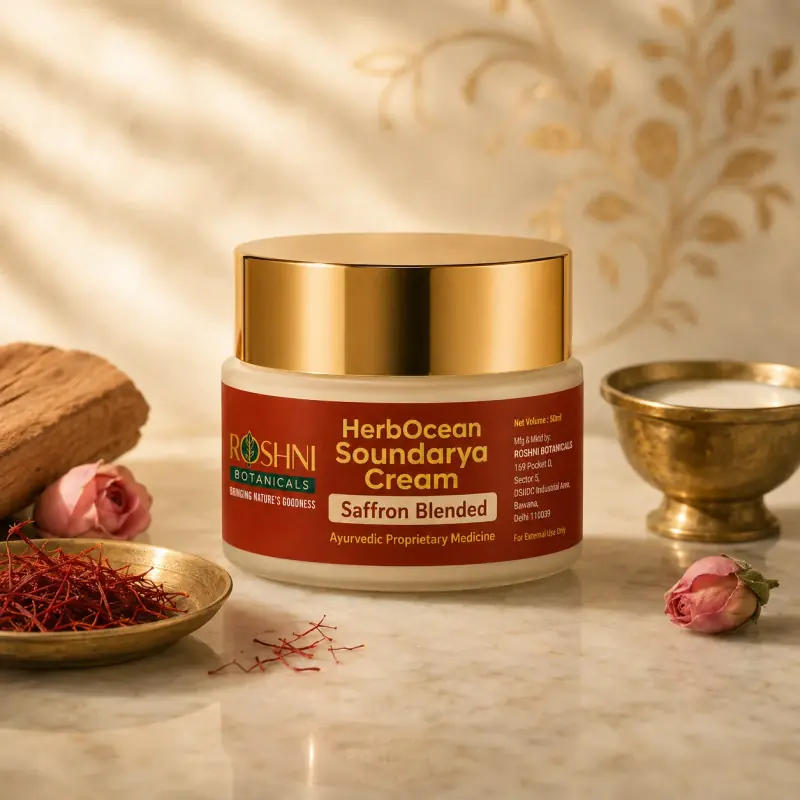
Soundarya Cream
A rich saffron brightening and repair cream with bargad (Vatt) bark on a goat-milk and coconut base, with shea and kokum butters — often reached for where post-acne marks (PIH) linger.