
Stress Acne: Ayurvedic Rituals for Calm, Comfortable Skin
A hard week often shows on the jaw and forehead. What an evening routine can and cannot do, and how to handle the mark a picked spot leaves behind.
Some breakouts can be dated off your calendar. Submission week. The week before results. The month the appraisal landed. Your jaw and forehead keep a decent record of the last few weeks, whether you want one or not. So here is what sits between a hard week and a sore spot, what an evening routine can and cannot do, and how to handle the mark it leaves on Indian skin. Stress ke daane is how this gets typed into a search box.
Stress is better understood as an amplifier of acne (Yuvanpidika, the classical Ayurvedic term for acne) than as its origin. The association turns up in study after study, but the route is not settled, and the most direct test of the obvious explanation went against it: when ninety-four school students in Singapore were assessed before their mid-year examinations and again in the holidays, acne severity tracked their stress scores while the amount of oil their skin produced did not change at all. A review of the field puts the link in the nerve signalling of the skin itself rather than in any single hormone, which is why nobody can put a number on it for one person.
On melanin-rich Indian skin, the bigger cost is usually what the spot leaves behind. A picked breakout tends to leave post-inflammatory hyperpigmentation (PIH), a brown mark that outlasts the pimple by months. Hence the practical answer: a calmer evening, steadier sleep, hands off the spot.
Key takeaways
- Stress is best read as an amplifier of acne, not its origin; the association is reported repeatedly, but the route from a hard week to a spot is not settled, and the one study that measured sebum under exam pressure found it unchanged.
- On melanin-rich Indian skin the lasting cost is usually the mark, not the pimple, since picked spots often leave post-inflammatory hyperpigmentation for months afterwards.
- A ten-minute wind-down, a fixed sleep window, an earlier lighter dinner and warm oil on the feet are the classical Dinacharya (daily routine) steps.
- The HerbOcean Anti-Acne Roll-On is an Ayurvedic medicine for external use under AYUSH Licence No. DL-474 A&U, carrying six classical botanicals in equal measure, with no neem and no tea tree.
- Deep painful nodules, sudden adult-onset acne or spots that keep scarring belong with a dermatologist, and daytime sun protection stays a separate step while a mark settles.
How a hard week reaches the skin
Dermatology research keeps returning an association, not a mechanism proven end to end. A cross-sectional survey of 1,032 school students in Chandigarh, published in the Indian Journal of Paediatric Dermatology in 2017, found acne in nearly three students out of four, mild in most cases, with a statistically significant association between acne and stress and none at all between acne and diet. Because it is cross-sectional, and because the students named the causes themselves, it cannot say which came first, and it cannot say how much of your own breakout belongs to your deadline. The picture repeats in other settings: twenty-two university students in the United States were graded worse during examinations, and the ninety-four Singapore students above showed the same correlation.
The classical reading sits beside that one. Sushruta groups Yuvanpidika among the Kshudra Roga (the minor conditions) in Nidana Sthana 13: eruptions shaped like the thorn of the shalmali tree, on the face of the young, arising from vitiated Rakta (blood), Vata and Kapha (two of the three doshas, the biological energies in Ayurveda) acting together. Vagbhata carries the same condition in the Ashtanga Hridaya at Uttara Sthana 31, under the name mukhadushika. Pitta belongs to a different entry in that same Sushruta chapter, Vyanga, the brown patch, which is why heat and pigmentation are so often discussed together and why the two get confused. Want the constitutional picture before the routine? Start with reading your own acne pattern by dosha; the full ayurvedic treatment for acne guide sets out the wider cluster.
Season plays its part. As the monsoon pulls back, skin that felt slick for weeks starts to feel tight, and washing habits change in response. Stress rarely arrives alone. It brings the screen at one in the morning, the dinner at eleven, the fourth cup of chai. Lived context rather than cause, and the evidence pulls both ways: the Chandigarh survey found no link between acne and diet, while a randomised trial in Australia put forty-three young men on a low glycaemic load diet for twelve weeks and counted a larger fall in lesion counts than in the control group. Neither result settles what any one late dinner does to any one face. The same pressure shows up above the hairline, which is why we have a companion piece on whether stress can cause hair fall, and where Brahmi fits.
The pick, the mark, and why Indian skin pays twice
There is a plainer link between a hard week and a lasting mark, and it is behavioural. Under pressure you check the mirror more often, press at a sore spot during a call, squeeze something that would have settled on its own. Each of those adds inflammation, and melanin-rich skin answers inflammation with pigment.
Two marks get left behind. Flat pink or red ones are post-inflammatory erythema, a vascular after-effect rather than pigment. Flat brown or grey-brown ones are post-inflammatory hyperpigmentation, and how deep the pigment sits decides how long it takes: pigment held in the upper layers clears as those layers renew, while pigment driven deeper by heavier or repeated inflammation takes far longer to settle. The difference is set out at length in the piece on brown marks and red marks after a pimple. Marks are measured in months, not days, and any routine that puts a date on that is selling you something. Ultraviolet and visible light both keep a settling mark looking darker for longer, so sun protection is the part worth being strict about. HerbOcean does not manufacture a sunscreen, and nothing in the range replaces one.
For the mark phase, once active spots have settled and only on settled skin, HerbOcean Soundarya Cream is an Ayurvedic medicine for external use, traditionally used in the care of post-acne marks (PIH): a rich saffron repair cream with bargad (Vatt) bark on a goat-milk and coconut base, with shea and kokum butters, best paired with daily sun protection. It makes no claim about skin tone or shade, and no claim of any kind on textural scarring; the aim is calm, settled, comfortable skin. Very oily or acne-prone skin may find it rich during an active phase. For the active spot itself, the HerbOcean Anti-Acne Roll-On, set out below, is the preparation, and leaving the spot alone remains the most useful thing you can do.
Unwinding rituals that survive a bad week
In the classical texts, Dinacharya is structural, the part of the system that runs whether or not anything is wrong. The trouble with most evening routines written for Indian readers? They assume you have an evening. A ten-minute wind-down that survives a genuinely bad week works in a shared bathroom, and it is dull enough that you will still do it at eleven fifty on a Thursday.
Roughly: a fixed sleep window you keep on weekends too, screens down before it and not in bed, dinner earlier and lighter where the day allows, one simple cleanse, warm oil on the feet or scalp, and a few minutes of slow, unhurried breathing.
Oil is the classical calming step here. The Ashtanga Hridaya sets daily oil massage inside Dinacharya at Sutrasthana 2, and singles out the head, the ears and the feet. Oil worked into the soles and a slow scalp oiling are the two forms that fit into a normal night; Abhyanga (classical full-body oil massage) is the fuller practice and takes longer. Settling the system before sleep is what they are traditionally used for. A finished routine will not have done anything to a pimple by morning.
Two lived versions. The class 12 or competitive-exam student runs this in a hostel bathroom on a schedule somebody else set, often with hard water, which makes cleansers lather poorly and can leave a tight, filmy feeling that people then answer by washing harder. Over-cleansing here is a comfort and barrier problem: skin that feels stripped stings under everything you put on afterwards.
So: one gentle wash in the morning and one at night, each followed by a light moisturiser, and stored soft water for the face if hard water is the issue. Frequency itself is barely studied, and the one small trial in young men found no difference between the groups overall, with the once-daily arm the only one where acne got worse. Breakouts are not a hygiene failure, and extra scrubbing does not argue with a deadline.
The office reader has a different problem. A humid morning commute leaves skin with a film on it by the time it reaches the desk, and then it sits under air conditioning all day. Blot; do not rewash. Keep the evening ritual on the far side of the commute home so it marks the end of the working day. On a brutal week, do the sleep window and the foot oiling and drop the rest.
Spot care, honest cautions and when to see a dermatologist
What follows is about a licensed medicine, and it is a separate question from the evening routine above.
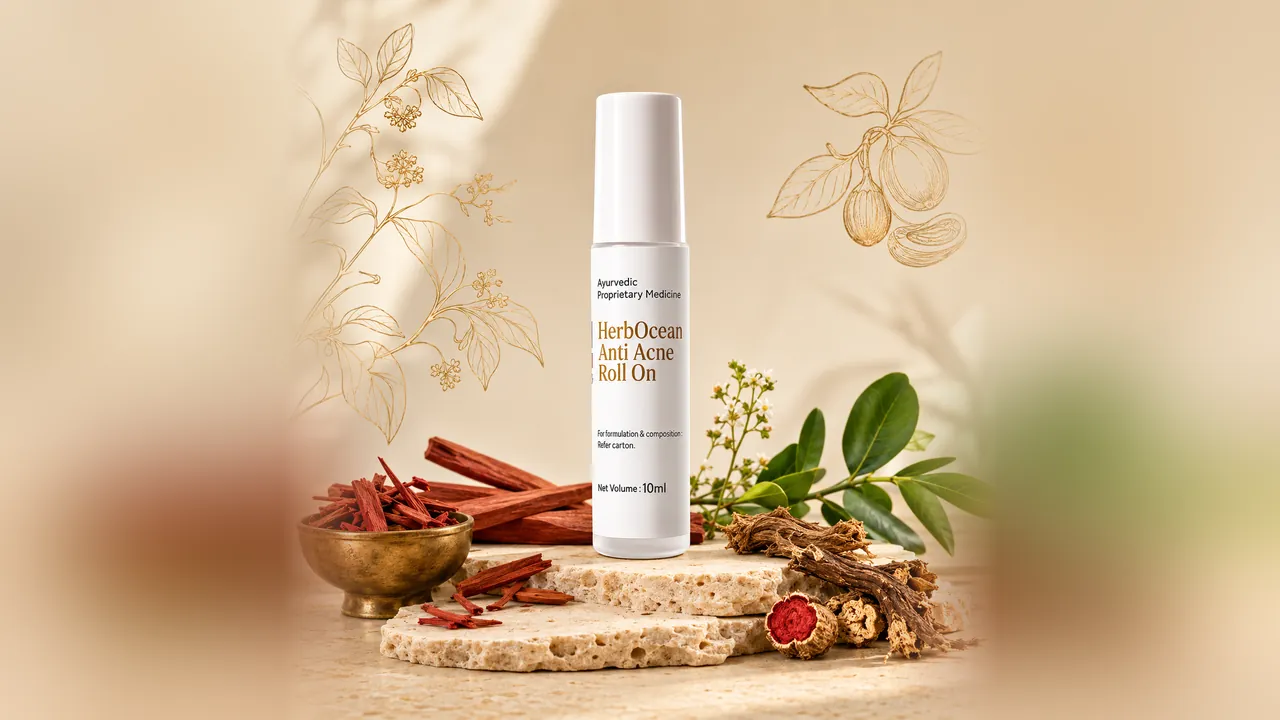
The HerbOcean Anti-Acne Roll-On is an Ayurvedic medicine for external use, classically indicated for acne and pimples (Yuvanpidika) and traditionally used in the care of post-acne marks (PIH), made in-house at our GMP-certified unit in Bawana, Delhi, under AYUSH Licence No. DL-474 A&U. It carries six classical botanicals in equal measure, the same dose for every one: Manjistha, Lodhra, nutmeg (Jaiphal), red sandalwood (Raktchandan), Indian berberry (Daruhaldi) and costus root (Kuth), carried in a glycerine and purified-water base, with lavender for aroma. There is no neem in it and no tea tree. Neem sits in the HerbOcean Hair Oil instead, among its sixteen botanicals. It is built on the 40-year Ayurvedic formulation legacy of Vaidya Shri Ram Prakash Ji.
Lodhra is not a modern choice here. Vagbhata lists a paste of Lodhra first among the applications for mukhadushika in the Ashtanga Hridaya, and names Lodhra with Daruhaldi again among the face applications for the same eruption.
Cautions, because a medicine deserves them. Cleanse and pat dry, then roll a thin layer directly over the pimple, morning and night, and follow with your moisturiser. It is spot care, not a full-face application. Patch-test on the inner forearm 24 hours before first use. For external use only, away from broken skin and the eye and lip area, and stop if irritation does not settle. If you are pregnant or nursing, ask your Ayurvedic physician before use. If a dermatologist has you on a prescribed active, ask them before adding anything to the same routine. Judge it across weeks rather than across nights, and judge it on how your skin feels as much as on how it looks.
Some things belong with a dermatologist from the start rather than after a patient stretch of any routine. Deep painful nodules or cysts under the skin. Acne arriving suddenly in adulthood after years without it. Breakouts alongside irregular cycles or unusual hair growth on the face and body. Spots that keep leaving scars or pitted texture. And low mood or sleep loss carried well beyond the skin, which deserves its own appointment.
Where this leaves you
A calmer evening is worth building for reasons that have nothing to do with your face. For the spot itself, the HerbOcean Anti-Acne Roll-On is classical spot care small enough to carry in a bag through a long week. Keep your hands off it, give a routine a run of consistent weeks before you judge it, give marks longer still, and book a dermatologist appointment if breakouts are deep, painful, sudden in adulthood, or leaving texture behind.
References: Sharma RK, Dogra S, Singh A, Kanwar AJ. Indian Journal of Paediatric Dermatology. 2017;18(3):196-201 (cross-sectional school survey; 1,032 school students, Chandigarh, India; acne in nearly three students out of four, significant association with self-reported stress, no association with diet). Yosipovitch G, Tang M, Dawn AG, and colleagues. Acta Dermato-Venereologica. 2007;87(2):135-139 (prospective cohort; 94 secondary school students, Singapore; acne severity correlated with stress while measured sebum did not change). Chiu A, Chon SY, Kimball AB. Archives of Dermatology. 2003;139(7):897-900 (prospective cohort; 22 university students, United States; acne severity rose with perceived stress during examinations). Jovic A, Marinovic B, Kostovic K, and colleagues. Acta Dermatovenerologica Croatica. 2017;25(2):133-141 (review of psychological stress and acne). Silpa-Archa N, Kohli I, Chaowattanapanit S, and colleagues. Journal of the American Academy of Dermatology. 2017;77(4):591-605 (review of post-inflammatory hyperpigmentation; the depth of the pigment shapes the outlook, with epidermal pigment clearing faster than dermal). Ekore RI, Ekore JO. International Journal of Dermatology. 2021;60(12):1488-1493 (review of skin picking in adolescents and young adults with acne-related marks; no primary population). Fatima S, Braunberger T, Mohammad TF, and colleagues. Indian Journal of Dermatology. 2020;65(1):5-10 (review; ultraviolet and visible light exacerbate post-inflammatory hyperpigmentation in skin of colour). Smith RN, Mann NJ, Braue A, and colleagues. American Journal of Clinical Nutrition. 2007;86(1):107-115 (randomised controlled trial; 43 men aged 15 to 25, Australia, 12 weeks; low glycaemic load diet reduced total lesion counts more than the control diet). Choi JM, Lew VK, Kimball AB. Pediatric Dermatology. 2006;23(5):421-427 (single-blinded randomised trial of face-washing frequency, young men, United States; no significant difference between groups, with worsening in the once-daily arm). Sushruta Samhita, Nidana Sthana 13 (Kshudra Roga), on Yuvanpidika as vitiated Rakta, Vata and Kapha. Ashtanga Hridaya, Uttara Sthana 31, on the same condition as mukhadushika, Uttara Sthana 32 on the Lodhra paste, and Sutrasthana 2 (Dinacharya), on daily oil massage with the head, the ears and the feet singled out.
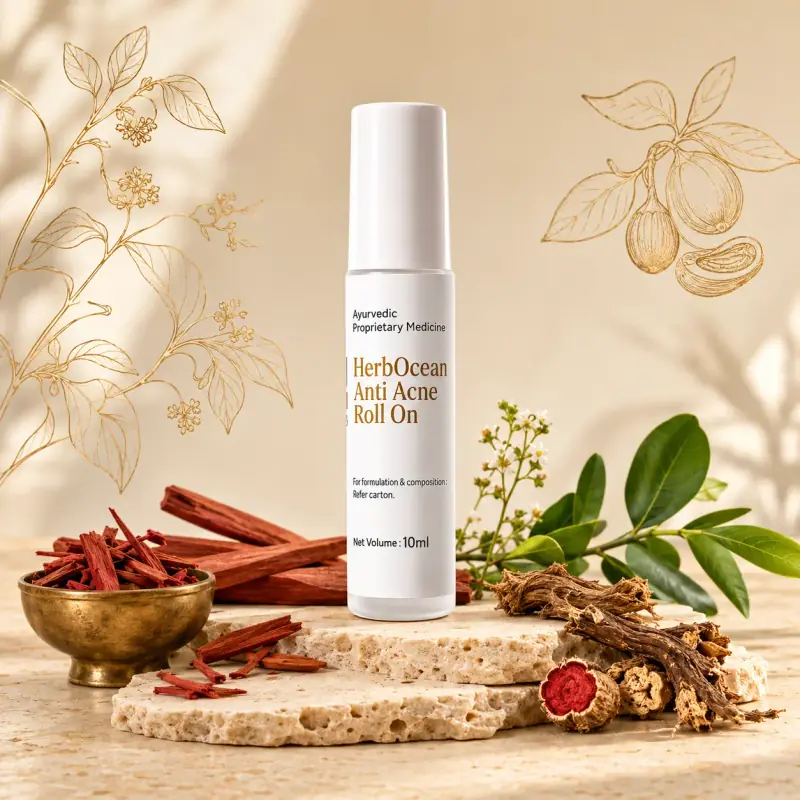
Anti-Acne Roll-On
Ayurvedic spot care for active pimples and post-acne marks (PIH) — a herbal roll-on classically indicated for acne (Yuvanpidika). Made in-house in Delhi.
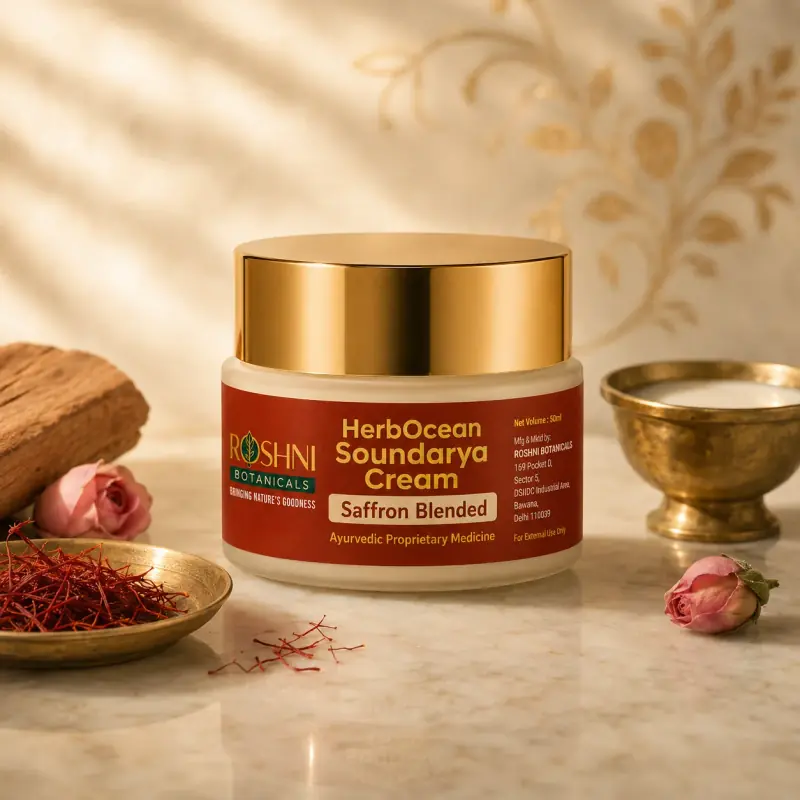
Soundarya Cream
A rich saffron brightening and repair cream with bargad (Vatt) bark on a goat-milk and coconut base, with shea and kokum butters, traditionally used in the care of skin where post-acne marks (PIH) linger.
Part of our guide: Ayurvedic treatment for acne: the complete guide.