Hormonal Acne on the Chin and Jawline: An Ayurvedic Guide for Indian Women
Breakouts that cluster on the chin and jawline and track your cycle are usually hormonal. An honest, India-aware look at what classical Ayurveda — and external care — can and cannot do.
If your breakouts cluster along the chin and jawline, arrive almost on schedule before your period, and sit deep and sore rather than on the surface, you are most likely dealing with hormonal acne. It is one of the most common, and most misunderstood, patterns Indian women bring to us. Ayurveda has described this picture for centuries, and it holds a clear, honest view of what skin care can do and what it cannot.
Key takeaways
- Hormonal acne in women typically appears on the lower face, the chin and jawline, and flares cyclically, often in the week before menstruation.
- In Ayurveda, acne is Yuvanpidika; the deep, inflamed hormonal type reflects aggravated Pitta with Kapha, and vitiated Rakta (blood).
- Hormonal drivers such as PCOS are internal and medical. They belong with your doctor, not with a face product.
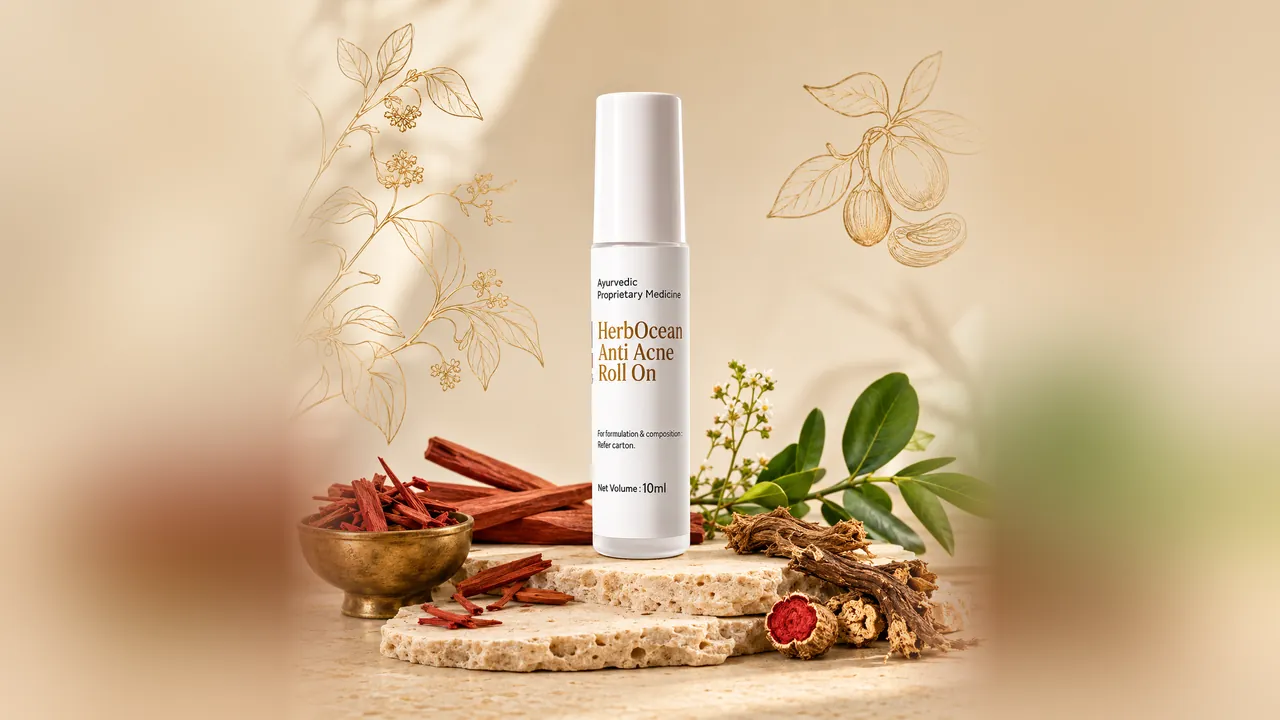
- Classical external care, such as the HerbOcean Anti-Acne Roll-On, works on the visible lesion and on calming the skin, not on your hormones.
- On melanin-rich Indian skin, the lasting problem is often the brown post-inflammatory mark a picked cyst leaves behind.
The classical Ayurvedic lens
Classical Ayurveda calls acne Yuvanpidika (literally ‘youthful eruption’, the classical term for acne). Sushruta described it among the Kshudraroga, the minor skin disorders, as facial eruptions driven by aggravated Pitta, Kapha and Rakta (the blood tissue). That three-part picture maps surprisingly well onto what is seen in hormonal acne today.
Pitta (one of the three doshas, governing heat and transformation) drives the inflammation: the redness, the warmth, the soreness of a deep cyst. Kapha governs density and oil; when it joins aggravated Pitta, the result is the thick, walled, slow lesions that sit under the skin along the jaw rather than coming quickly to a head. Rakta carries this disturbance, which is why classical care leans so heavily on Rakta shodhana (blood purification): calm the blood, and the skin tends to follow.
A quieter thread runs underneath: Ama (undigested metabolic residue) and weak Agni (digestive fire). When digestion is sluggish and the diet is heavy, Ama is said to circulate and feed skin eruptions. This is the classical reasoning behind the familiar advice to settle the gut before chasing the spot.
What matters for hormonal acne is that the texts already separate the surface picture from the systemic one. The eruption is addressed externally with lepa (medicated paste) and medicated oils, while the deeper disturbance of Pitta, Agni and the cycle is handled through diet, routine and internal measures under guidance. If you are unsure which dosha pattern your skin reflects, our guide to your acne dosha is a useful starting point.
Why Indian skin needs an India-aware approach
Generic hormonal-acne advice, written for fair, temperate-climate skin, misses several things that matter a great deal here.
Post-inflammatory hyperpigmentation (PIH)
On melanin-rich Indian skin the cyst is rarely the end of the story. Once it heals it tends to leave a brown or slate-grey mark that can linger for months, often longer than the spot itself lasted. This is why ‘do not pick’ is not mere vanity but the single most useful habit for Indian skin, and why post-acne marks deserve their own gentle care with something like HerbOcean Soundarya Cream rather than harsh fading.
Diet, in an Indian kitchen
Modern evidence and the classical Pitta-Kapha view agree on one point: a high glycaemic load and dairy can worsen hormonal acne. In an Indian kitchen that translates concretely, sugar in several cups of chai a day, festival mithai, and generous amounts of paneer and milk, rather than an abstract ‘sugar and dairy’. You need not give these up; easing the daily glycaemic spikes is usually enough to notice a difference.
Hard water and friction
Much of urban India runs on hard borewell or municipal water that leaves a residue and roughens the skin barrier. Add the very Indian friction points along the jaw, a helmet strap on a two-wheeler, a dupatta drawn across the face, a phone pressed to the cheek through long calls, and you have mechanical irritation layered exactly where hormonal acne already concentrates.
Working with tradition, not against it
The haldi-besan ubtan most Indian families know is a reasonable, gentle adjunct for oily, eruption-prone skin, used as an occasional cleanser rather than a daily scrub. Ayurveda here is not exotic; it is the routine many readers grew up with, applied with a little more precision.
What “hormonal acne Ayurvedic care” actually means
When people search for hormonal acne Ayurvedic care, they usually hope for one thing that fixes everything. The honest answer is more useful than that, and it begins with reading your own face.
Read the face map
The lower third of the face, the chin, jawline and the area down towards the neck, carries a high density of oil glands that are unusually responsive to androgens, the hormones that rise and fall across your cycle. That is why hormonal breakouts concentrate here, why they often flare in the week before a period, and why they feel deep and tender rather than superficial. Acne scattered across the forehead and nose in the teens is a different pattern. Acne that appears in your late twenties or thirties, settles along the jaw, and tracks your cycle is, more often than not, hormonal. If yours also comes with irregular periods, unusual hair growth or unexplained weight changes, that combination is worth taking to a doctor, because it can point to PCOS.
Split the work, honestly
Here Ayurveda’s old division of labour becomes genuinely practical. Your hormones are internal. They are shaped by your cycle, stress, sleep, weight and, in some women, by PCOS, and they are the domain of your gynaecologist or physician, supported by diet and lifestyle. No face oil, balm or roll-on can or should claim to change them. What classical external care can do is work on the skin: help calm the visible, inflamed Yuvanpidika lesion, support the Pitta-Rakta picture at skin level, and help limit the marks that follow. Stress is a large and under-rated driver of cyclical flares, which is why our piece on stress and acne rituals pairs naturally with this one.
Hold both of these at once and the frustration eases. You stop asking a topical to do a hormone’s job, and you start giving the skin the steady, gentle external care it actually responds to, while the real driver is addressed where it lives.
The HerbOcean approach
This is the thinking behind the HerbOcean Anti-Acne Roll-On: a focused, external, classical preparation for the visible spot, formulated by Vaidya Shri Ram Prakash Ji, the master vaidya whose forty-year formulation legacy the HerbOcean line is built on. It is an AYUSH-licensed Ayurvedic medicine for external use, classically indicated for Yuvanpidika. It is not a treatment for your hormones, and it does not pretend to be.
The roll-on applicator matters for hormonal acne in particular: it lets you place the preparation on a specific chin or jawline lesion without spreading it across the whole face, and without fingers touching the skin. The herbal actives are led by Manjistha (Rubia cordifolia), the classical Rakta-shodhana herb traditionally used to calm the blood-level heat behind inflammatory eruptions.
The herbs, and what they traditionally do
- Manjistha (Manjith): the lead herb, traditionally used for Rakta shodhana and an even complexion.
- Lodhra (Lodhr): classically astringent, traditionally used to tighten and calm irritated, oily skin.
- Raktchandan (red sandalwood): cooling, traditionally used to soothe Pitta heat and visible redness.
- Daruhaldi (Berberis aristata): traditionally valued for keeping eruption-prone skin clean.
- Kuth and Jaiphal (nutmeg): traditionally used to support clear, calm skin, finished with a little lavender oil in a glycerine base.
Used simply: cleanse, pat dry, and roll a thin layer onto the active spot once or twice a day. It is for external use only; patch-test on the inner forearm first, and avoid broken skin. Like any single step, it sits inside the larger picture of diet, stress, sleep and, where relevant, medical management, rather than replacing it. For the full classical view, our complete guide to ayurvedic treatment for acne goes deeper.
When to see a dermatologist (and when a gynaecologist)
Skin care has limits, and hormonal acne is exactly the situation where knowing them protects you.
See a dermatologist promptly if:
- your acne is cystic or nodular: deep, painful lumps that do not come to a head and heal slowly;
- it is scarring, or leaving pitted marks rather than flat brown ones;
- it has appeared or worsened suddenly in adulthood;
- it is not settling after several weeks of consistent, gentle care.
See a gynaecologist or physician if your acne comes with other signs of hormonal imbalance: irregular or missed periods, unusual facial or body hair, scalp hair thinning, or unexplained weight gain. Together these can indicate PCOS, which is a medical diagnosis made by a doctor, not by a skincare routine, and not something any Ayurvedic medicine should claim to correct. Getting it assessed early is the single most useful step for cyclical jawline acne, because once the internal driver is managed the skin almost always becomes easier to care for. There is no contradiction between seeing a doctor and using classical external care; they work on different levels, and for hormonal acne you usually need both.
In closing
Hormonal acne along the chin and jawline is not a sign you are doing skincare wrong. It is a signal from your body, and it responds best to a two-track approach: address the hormonal driver where it lives, with a doctor’s help, and give the skin steady, gentle, classical care on the surface. The HerbOcean Anti-Acne Roll-On is built for that surface role, a focused external preparation classically indicated for Yuvanpidika that you can use while the bigger picture is handled. For the full classical view, start with our complete guide to ayurvedic treatment for acne, and be patient with your skin while the rest falls into place.
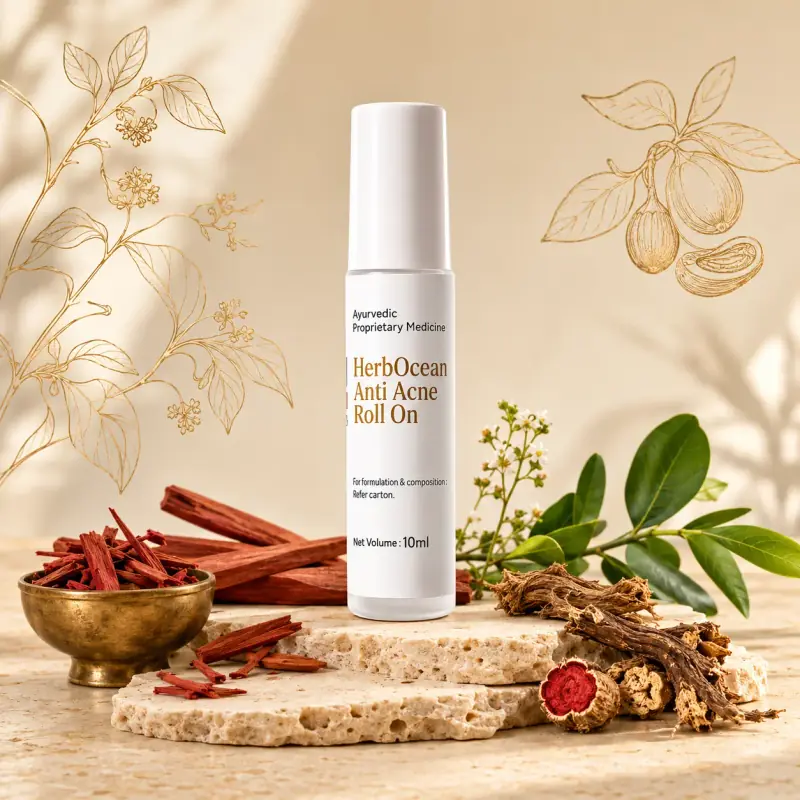
Anti-Acne Roll-On
Ayurvedic spot care for active pimples and post-acne marks (PIH) — a herbal roll-on classically indicated for acne (Yuvanpidika). Made in-house in Delhi.
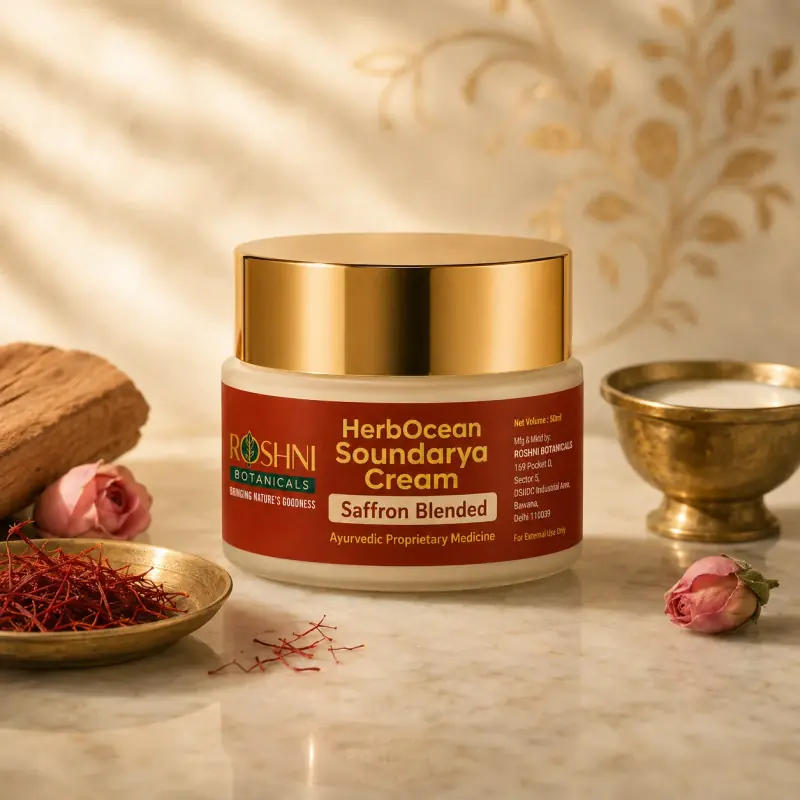
Soundarya Cream
A rich saffron brightening and repair cream with bargad (Vatt) bark on a goat-milk and coconut base, with shea and kokum butters — often reached for where post-acne marks (PIH) linger.
Part of our guide: Ayurvedic treatment for acne: the complete guide.