
Why You Get Pimples Before Your Period, and How to Care for Cycle-Linked Breakouts
The chin pimple that arrives a week before your period is a rhythm, not a failure of your routine. What the luteal phase actually does to skin, and how to meet it gently rather than harshly.
You could almost mark it on the calendar. About a week before your period, the same one or two pimples show up along your chin, right on cue, and by the time your period actually arrives, you already know what happened. Sound familiar? You are not imagining the pattern, and it is not a sign that your skincare routine failed you. There is a gentler way to meet it than buying something new every month.
Key takeaways
- Pimples before a period usually trace back to the luteal phase, the roughly two weeks between ovulation and bleeding. Rising progesterone increases skin oil, and a familiar chin or jaw flare tends to show up seven to ten days before bleeding starts.
- This cyclical pattern is common and well studied, including a 2025 analysis in Indian women, which found lesion counts highest in the days just before and during the period, easing as the cycle moves on.
- Persistent jawline acne alongside irregular periods, unusual hair growth or sudden weight change is a different picture altogether. That combination deserves a doctor's review for PCOS, not another spot treatment.
- Squeezing a cyclical chin pimple is the real risk here: on melanin-rich Indian skin it can trigger post-inflammatory hyperpigmentation (PIH), a dark mark that outlasts the pimple by weeks or months.
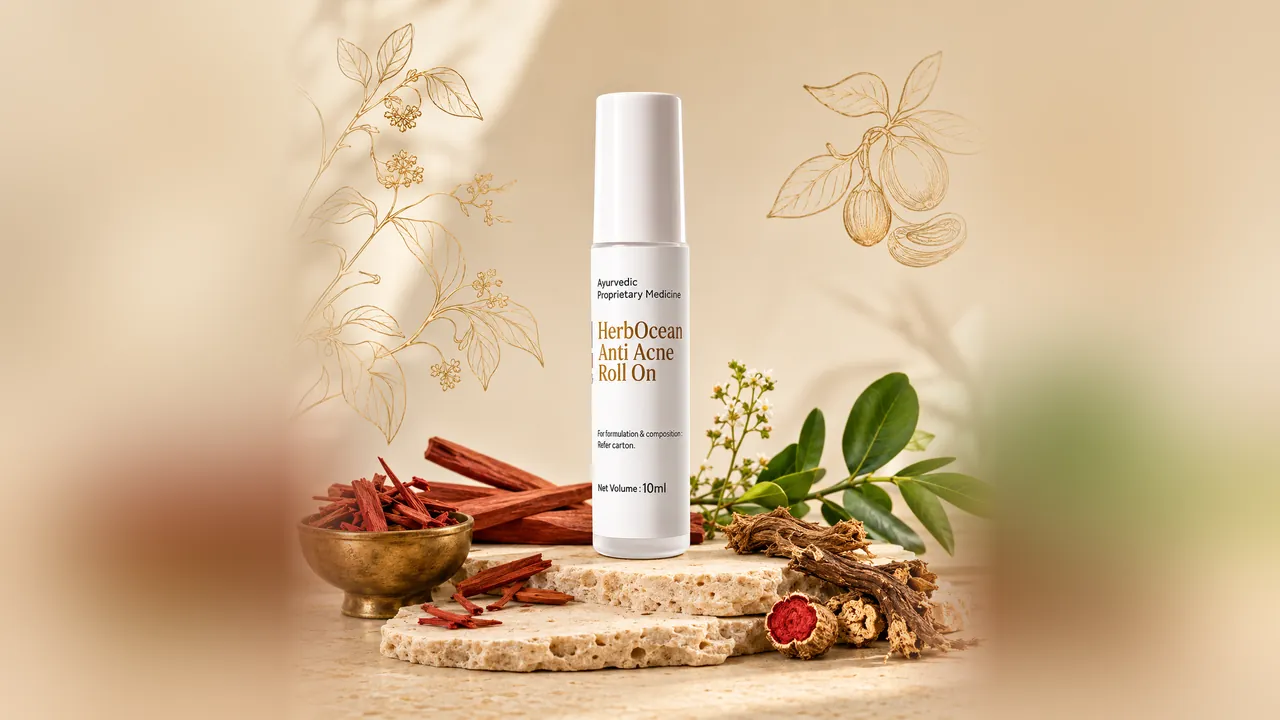
- The HerbOcean Anti-Acne Roll-On is targeted spot care for the flare itself, an Ayurvedic medicine classically indicated for acne (Yuvanpidika, the classical Ayurvedic term for acne, literally "youthful eruption"). It does not act on hormones, and it is honest about that limit.
Why the Week Before Your Period Brings a Flare
The mechanism is simple once someone lays it out for you. After ovulation you enter the luteal phase, roughly the two weeks running up to your period, and progesterone rises while oestrogen eases back. That shift pushes the skin's oil glands to work harder. At the same time, mild swelling in the skin can compress pores, so oil that would normally clear the surface backs up underneath instead. The bacteria already living on your skin get more to feed on, your immune system reacts, and a week to ten days before bleeding, the same chin or jaw pimple shows up. Same hormonal weather, every month, same result.
The research backs this up, and not only from studies done elsewhere. The most-quoted survey is Stoll and colleagues in the Journal of the American Academy of Dermatology in 2001, which interviewed 400 women aged 12 to 52 and found 177 of them, 44 per cent, reported a premenstrual flare of their acne. That was self-reported and it was not an Indian cohort, so treat it as a broad indication rather than a local figure.
Closer to home, and better measured, a 2025 retrospective analysis in the Journal of Dermatologic Science and Cosmetic Technology pooled data from two earlier trials covering 187 young Indian women with mild to moderate acne. Instead of relying on what women remembered, it used dermatologist-recorded acne counts, and it found counts significantly higher during the late luteal and early follicular phases, which is to say the premenstrual and menstrual window, averaging around five or six additional lesions. Whichever figure you hold on to, the takeaway does not change: this is ordinary, well-documented physiology, and you are not doing anything wrong.
Classical Ayurveda reads the same monthly picture through its own lens, and the two frames line up more neatly than you might expect. The classical texts divide the cycle into three phases, and the secretory phase, the stretch that corresponds to the premenstrual window, is read as governed by Pitta (one of the three doshas, the biological energies of Ayurveda), which is held to preside over the body's secretions. Acne itself the texts attribute elsewhere: the Sushruta Samhita, in its chapter on minor diseases, describes Yuvanpidika as arising from Kapha, Vata and Rakta (two of the three doshas together with the blood tissue) acting at once rather than from any one of them alone. So the classical frame here is not that acne is a Pitta disease. It is that a Pitta-governed stretch of the month meets skin the tradition already reads as congestion-prone. Take that as a description of a rhythm women have noticed for generations, not a diagnosis and certainly not a promise. What matters practically is simpler: calm, unhurried care in that window rather than anything harsh.
Why This Gets Mistaken for Something Else
Here is what makes cyclical acne so frustrating: it rarely announces itself as cyclical. A single chin pimple does not look like a hormonal pattern. It looks like a bad week, a rich meal, a missed cleanse. Most women only notice the monthly rhythm after a few cycles, usually by accident, when the same spot turns up in the same place at roughly the same point on the calendar, three months running. A rough note on your phone, just a date and a line, is enough to turn a vague suspicion into a pattern you can actually plan around.
It is also worth separating this from acne that has nothing to do with your cycle. A flare that ignores your period entirely, clusters on the forehead from a hairline or helmet issue, or reacts to a new face wash or a change in weather is a different problem with a different fix. Assume every pimple is hormonal and you will end up looking in the wrong direction. The real tell is location and timing together: cyclical acne leans toward the chin and jawline, and it keeps its date with the calendar far more reliably than diet or weather ever do.
Working with the Calendar, Not Against It
Once you know your own rhythm, the smartest move is to stop treating the pre-period week like any other week. Keep the routine simple in those seven to ten days. This is not the moment to trial a new active, a new scrub or a new device, because reactive skin under hormonal load handles novelty badly. Get your spot care ready before the flare shows up, rather than scrambling once it has, the same way you would keep an umbrella by the door once the monsoon forecast turns likely.
This is where targeted, honest spot care earns its place. The HerbOcean Anti-Acne Roll-On is built for exactly this moment, applied externally to the pimple itself: an Ayurvedic medicine classically indicated for acne and pimples, leading with Manjistha, the classical blood-purifying (rakta shodhana) herb, alongside Lodhra, Jaiphal, Raktchandan (red sandalwood), Daruhaldi and Kuth in a light glycerine and water base. It is an AYUSH-licensed Ayurvedic medicine (Licence No. DL-474 A&U) for external use, formulated by Vaidya Shri Ram Prakash Ji, the classical vaidya (a master Ayurvedic formulator) whose 40-year formulation legacy the HerbOcean line is built on, and made in-house at Roshni Botanicals' GMP-certified unit in Bawana, Delhi. Patch-test on the inner forearm first. And to be plain about what it is not: it does not act on hormones, and it will not stop next month's flare from arriving on schedule. What it offers is a measured, skin-appropriate response to the pimple that does show up. That is a realistic goal, and an honest one. Our complete guide to the Ayurvedic treatment of acne sets out the fuller routine this sits inside.
The rest of the week benefits from the same calmer instinct. A settled daily routine (Dinacharya), lighter oiling than usual, and skipping the aggressive scrub or the hot, hard face wash all protect a skin barrier that is already more reactive than usual. None of this is about doing more. It is about doing less that could aggravate an already sensitive week.
The Pre-Period Craving Window and Your Plate
Anyone who has stood in front of the fridge at 9 pm the week before their period knows the craving is real, and it usually runs toward the sweet and the milky. Be careful how much weight you put on that, though. The evidence linking dairy and high-sugar loads to breakouts is suggestive rather than settled: it rests largely on observational studies, which can show an association without establishing that one causes the other. Gentle moderation in that window tends to help more than guilt ever does. Nobody needs to swear off kheer for the month. Noticing the pattern and trimming the edges of it is usually enough.
Indian dinner timing plays its own quiet part too. A heavier, later meal in the pre-period week, common on evenings when cravings and fatigue both run high, can leave skin puffier and more reactive by morning. An earlier, lighter dinner on the nights you can manage it is a realistic tweak rather than a diet overhaul, and it sits comfortably alongside the calmer routine already described.
PIH, Picking, and When to See a Doctor
The single most damaging habit in this whole picture is squeezing the cyclical chin pimple, and it deserves a direct warning. On melanin-rich Indian skin, picking at an inflamed spot raises the risk of post-inflammatory hyperpigmentation, the dark, flat mark that settles in once the pimple has healed and can outlast it by weeks or months. The pimple lasts days; the mark can last a season. If marks are already a concern, HerbOcean Soundarya Cream, traditionally used in the care of post-acne marks, is the more considered next step, used steadily over weeks rather than reached for in a single anxious night.
Know the difference between a monthly rhythm and a signal worth a doctor's attention. A chin pimple that arrives on schedule and settles once your period starts is, for most women, ordinary physiology. Persistent jawline acne alongside irregular periods, unusual hair growth or a sudden change in weight is a different pattern altogether, and it deserves a conversation about PCOS with a doctor rather than another spot treatment. Our guide to hormonal and PCOS-linked jawline acne walks through that distinction in more depth. And see a dermatologist directly for any breakout that turns painful, cystic or prone to scarring, whatever the calendar says.
Season Changes the Picture Too
Indian summers and the monsoon months tend to make the pre-period week harder on skin that is already prone to a flare. Heat and humidity add their own oil and sweat on top of the hormonal rise, so a chin pimple that would have been mild in cooler, drier weather can show up angrier. In these months, keep the routine simpler rather than reaching for more: a gentle cleanse twice a day, a light, non-greasy layer at night, and the same rule about skipping new actives in the pre-period week. Come winter, when Indian skin tends to run drier, that same cyclical oil surge can almost feel welcome, and the emphasis shifts back to simply not disturbing the barrier while the flare passes.
A Rhythm Worth Working With
A pimple that shows up like clockwork before your period is not a flaw in your skin. It is your body running its usual monthly programme, and it responds best to a routine that expects it rather than one that panics at it. Keep the week gentle, keep the spot care ready, and keep the HerbOcean Anti-Acne Roll-On within reach for exactly these predictable flares. You already know your calendar. Now your skincare routine can know it too.
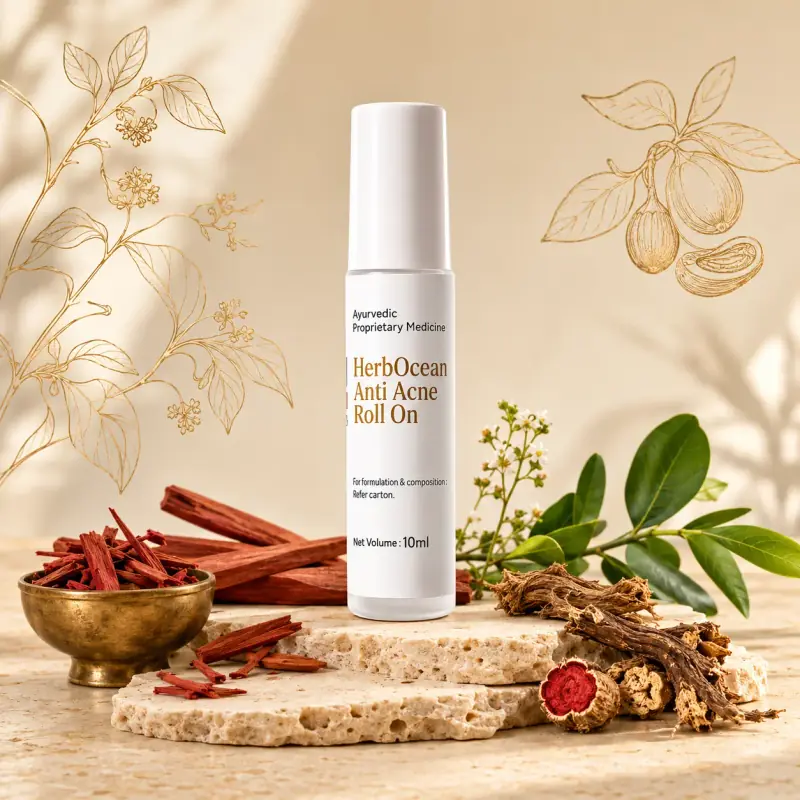
Anti-Acne Roll-On
Ayurvedic spot care for active pimples and post-acne marks (PIH) — a herbal roll-on classically indicated for acne (Yuvanpidika). Made in-house in Delhi.
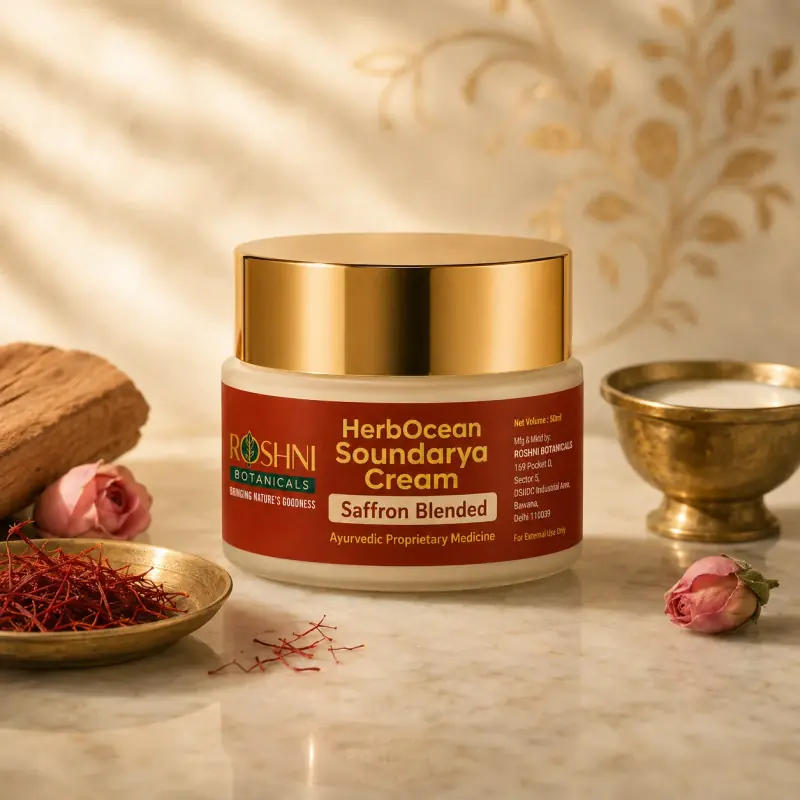
Soundarya Cream
A rich saffron brightening and repair cream with bargad (Vatt) bark on a goat-milk and coconut base, with shea and kokum butters, traditionally used in the care of skin where post-acne marks (PIH) linger.
Part of our guide: Ayurvedic treatment for acne: the complete guide.