Adult Acne in Your 30s and 40s: Why It Arrives Now and What to Do About It
Acne that begins in your thirties or forties follows different rules from teenage acne, and on Indian skin the mark often outlasts the spot.
The pimple that turns up at 34 feels like a betrayal. You did your time at 16. But acne after thirty is common enough to have its own Indian case-control literature: adults in their thirties and forties with first-time or returning acne, most often women though not only women, reaching again for the college face wash. Adult skin plays by different rules, and on melanin-rich Indian skin every spot carries a longer question about the mark it may leave.
Key takeaways
- Adult-onset acne means acne that starts after about age 25. In one Indian case-control study it clustered with menstrual irregularity, a family history of acne, a carbohydrate-rich diet, being overweight and sleeping under six hours. Hygiene was not among the factors the study looked at.
- On melanin-rich Indian skin, the mark commonly outlasts the spot: in a multi-country study of acne patients, post-inflammatory hyperpigmentation (PIH) had lasted a year or more in over half of those affected.
- Sudden onset in your thirties or forties is a medical question first. Irregular or missed periods, unusual facial or body hair growth, deep painful spots, pitted scars, or a recent new prescription all mean a dermatologist before any product change, and never stop a prescribed medicine on your own.
- The regimen the market sold us at sixteen, the strong face wash and the scrub, is the wrong tool now. It is the harshness of the cleanser, not the number of washes, that does the damage, and hard water sharpens it.
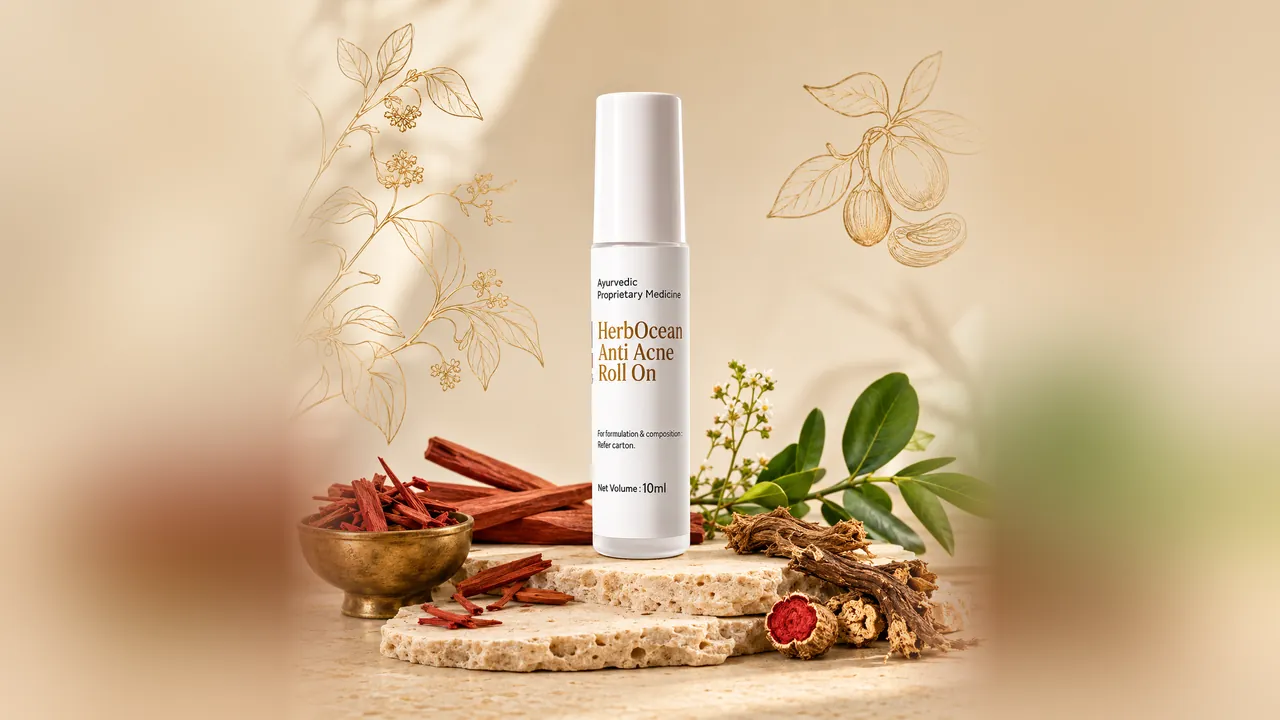
- HerbOcean Anti-Acne Roll-On is an Ayurvedic medicine classically indicated for acne and pimples (Yuvanpidika) and traditionally used in the care of post-acne marks and pigmentation (PIH). For external use. Made in-house in Delhi; patch-test before you begin.
Why acne at 35 is a different problem from acne at 16
Start with the regimen you remember, because most people restart it within a week of the first spot. Strong foaming face wash. Scrub twice a week. Drying spot gel. Repeat. That was what the market sold us at sixteen. It is the harshness of the cleanser, not the number of washes, that does the damage: harsh surfactants strip skin proteins and lipids, and that stripping is the after-wash tightness and sting (Ananthapadmanabhan and colleagues, 2004, a review). In the one controlled trial that varied washing frequency in acne, once, twice and four times a day did not differ significantly overall, though acne worsened in the once-a-day arm (Choi, Lew and Kimball, 2006, a single-blinded randomised trial in young men). Twice a day with a mild cleanser is the sensible default. This was never a hygiene failure.
The stakes are different too. On melanin-rich Indian skin the mark often outlasts the spot. In a study of 324 acne patients across seven Asian countries, India among them, more than half of those with post-inflammatory hyperpigmentation had carried it for a year or longer, and about one in five for five years or more (Abad-Casintahan and colleagues, 2016). Months after a spot goes quiet, the mark is often the thing still being looked at in the mirror. That is the whole argument for gentleness. Less picking, less scrubbing and less inflammation now means less pigment to live with later. A pit or a dent in the skin is different: that is a scar, not a mark, and scars do not fade the way marks do. That is a dermatologist conversation, and an early one.
Two Indian realities sit underneath all of this. First, the humidity: in much of India, sweat, sebum and occlusion stay in play for a good part of the year. Second, the water. Much of urban India washes in hard water, and hard water matters mainly through what it does to the cleanser. In controlled testing, skin washed in hard water held on to more surfactant residue, and that residue raised water loss through the barrier and caused irritation, most in people already prone to a leaky barrier (Danby and colleagues, 2018, 80 adults, eczema patients and healthy volunteers, United Kingdom). That work was in eczema, not acne, so read it as one more reason to keep the cleanser mild. Wash gently, not more often, and finish with a light moisturiser even on days your skin feels oily.
Hormones, stress, haircare and medication: the honest driver list
Hormones do most of the explaining, though not in the direction most articles imply. A woman’s androgen levels fall steadily from the twenties onwards. What that study found around the menopausal transition is no independent effect of menopause on androgen levels, and an ovary that appears to carry on producing testosterone afterwards (Davison and colleagues, 2005, a community study of adult women, Australia). That transition, perimenopause, begins well before periods stop, and skin often registers it before a calendar does. Two patterns already have their own pages here. Persistent chin-and-jawline acne with a PCOS picture belongs to the post on hormonal acne on the chin and jawline, which covers the lower-third pattern and when to bring in a gynaecologist. Flares that land reliably in the days before a period are handled in pimples before periods. This page owns the umbrella.
Diet is where the Indian evidence is most direct. A 2024 case-control study compared 70 adults with adult-onset acne against 70 controls at a tertiary care centre in Bhubaneswar, and the factors that separated patients from controls were a diet heavy in carbohydrates, oil and salt, menstrual irregularity, a family history of acne, an overweight BMI and sleep under six hours (Kashyap, Besra and Kar, Cureus, 2024). Small, single-centre, and association is not causation. So read it as a prompt for a gentle experiment, a fortnight with an earlier dinner and less refined sugar, rather than a rulebook.
Stress belongs on this list, without blame attached. Someone running a job, a household and a two-hour commute does not need their skin read as a character report. Note which weeks were heaviest, and check whether the spots tracked them.
One driver almost nobody checks is what sits in your hair. Heavy leave-in serums, styling creams and thick hair oils leave residue along the hairline and the temples, the distribution dermatologists call pomade acne (Plewig, Fulton and Kligman, 1970), a rim that follows where your hair falls rather than the chin-and-jawline cluster of the hormonal pattern above. The residue reaches skin in two ordinary ways, rinsing down the face in the shower and transferring from the pillowcase. This is not an argument against oiling. Champi is one of the better things Indian households have held on to, and the habit to watch is the leave-in instead: oil applied and left in for days, or a styling product used daily near the hairline. Tie your hair back at night, wash your face after washing your hair rather than before, and watch over the next few weeks whether the spots roughly follow where your hair falls.
Medication belongs here as a real category, not a footnote. The best-established trigger is corticosteroids, whether taken by mouth or applied to the skin. Others with recognised associations include androgenic hormones and some progestin-dominant contraceptives (other combined pills are actually used to settle acne), lithium, and isoniazid, used in tuberculosis treatment; a few more are reported less firmly (Momin, Peterson and Del Rosso, 2010, a review). The association varies a great deal by drug and by person, so no list should be read as a verdict on your prescription. Started something new in the weeks before the spots appeared? Raise it at your next review. Do not stop or change any prescribed medicine on your own, and never because a blog post suggested it. That call belongs to the doctor who wrote the prescription.
See a doctor first: when adult acne is a medical question
If acne has arrived suddenly in your thirties or forties, book the appointment before you start anything new. Stopping something harsh, the scrub or the stripping wash, need not wait. Starting something new can. The triggers are worth naming, because vagueness here helps nobody. Irregular or missed periods. Unusual facial or body hair growth, and if that change has been rapid, or has come with a deepening voice or thinning at the crown, ask for the appointment soon rather than at the next convenient slot. Spots that are painful, deep and nodular rather than surface bumps. Spots that are leaving pitted or indented scars. Spots that arrive alongside fever, joint pain or simply feeling unwell. Acne that appeared within weeks of a new prescription. Any one of those turns a skincare question into a medical one, and the order matters: diagnosis first, routine second. And some adult breakouts turn out not to be acne at all, which is one more reason the diagnosis comes before the shopping.
Go in with the conversation prepared, because a dermatology appointment in a busy Indian OPD is short. Carry a written list of every medicine and supplement you have started, changed or stopped in the last six months to a year, including hormonal contraception, an IUD, and anything a gynaecologist advised. Note how regular your cycles have been over the past year. Say whether you are pregnant, trying to conceive, or breastfeeding; it changes what can be prescribed. Mention hair growth changes and any thinning. List what you have already been using on your face, including anything bought without a prescription. Add family history if a parent or sibling carried acne into adulthood. Six short lines. They shape everything that follows, and they usually save you a second visit.
Classical Ayurveda has a name for this condition, Yuvanpidika (the classical Ayurvedic term for acne), and a long tradition of external care for it. It has no quarrel with a modern diagnostic work-up either, and adult-onset patterns are exactly where that work-up comes first. Classical external care sits after the diagnosis, alongside whatever your doctor advises, not instead of it. For the full classical framework, the pillar guide to ayurvedic treatment for acne sets out the classical reasoning, the herb families and the routine in detail.
A measured adult routine, and where spot care fits
The routine that suits adult acne is smaller than the one you are probably running. Cleanse twice a day with a mild cleanser and lukewarm water, no scrub and no brush, and pat dry rather than rubbing; add a plain-water rinse after heavy sweat. If your water is hard, the answer is not a gadget: keep the cleanser mild and rinse well. Moisturise lightly, something light and non-greasy, even on days skin feels oily; a rich repair cream is not what this step means. Use sun protection through daylight hours, including on overcast days. Prevention is where the trial evidence sits: a 2025 systematic review in skin of colour found that only sunscreen consistently prevented post-inflammatory hyperpigmentation, though nearly all the cases reviewed followed laser treatment rather than acne (Mar and colleagues, 2025). One boundary in plain words: HerbOcean does not manufacture a sunscreen, and nothing in the range replaces one. Then apply targeted care to individual spots instead of coating the whole face in actives.
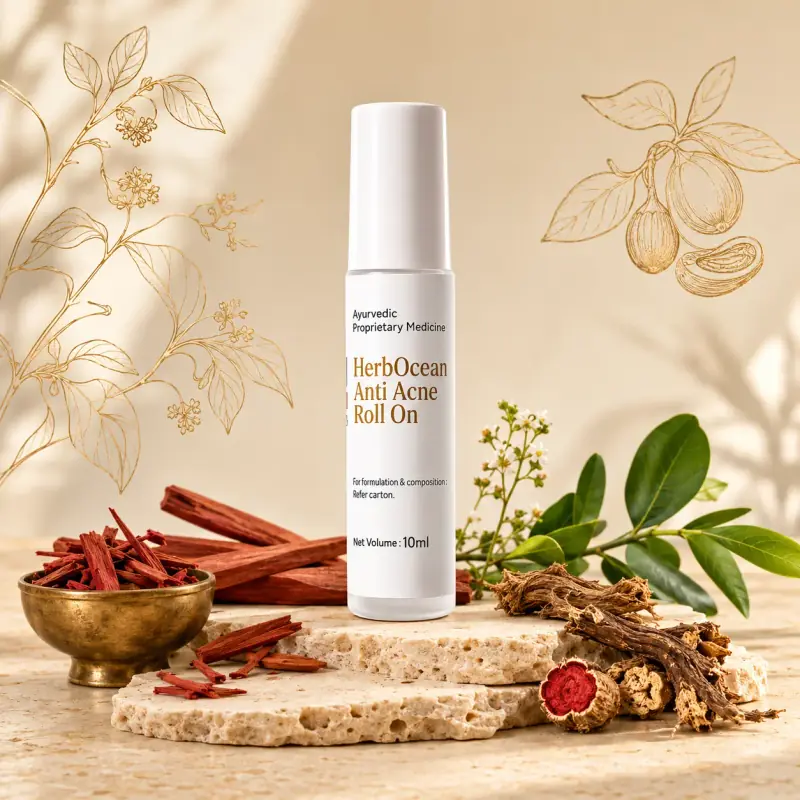
HerbOcean Anti-Acne Roll-On is an Ayurvedic medicine classically indicated for acne and pimples (Yuvanpidika) and traditionally used in the care of post-acne marks and pigmentation (PIH). Six classical botanicals sit in it in equal measure, the same dose for every one: Manjistha, Lodhra, nutmeg (Jaiphal), red sandalwood (Raktchandan), Indian barberry (Daruhaldi) and costus root (Kuth), in a glycerine and DM-water base finished with lavender oil. No single herb leads the formula. No neem, no tea tree.
The formulations draw on the 40-year Ayurvedic formulation legacy of Vaidya Shri Ram Prakash Ji, and are made in-house at our GMP-certified unit in Bawana, Delhi, under AYUSH Licence No. DL-474 A&U. The Roll-On is for external use. Patch-test on the inner forearm twenty-four hours before first use, keep it away from the eyes and lips, and use it the way the product page says: on clean, dry skin, a thin layer rolled directly over the pimple, morning and night, on the spots rather than across the whole face.
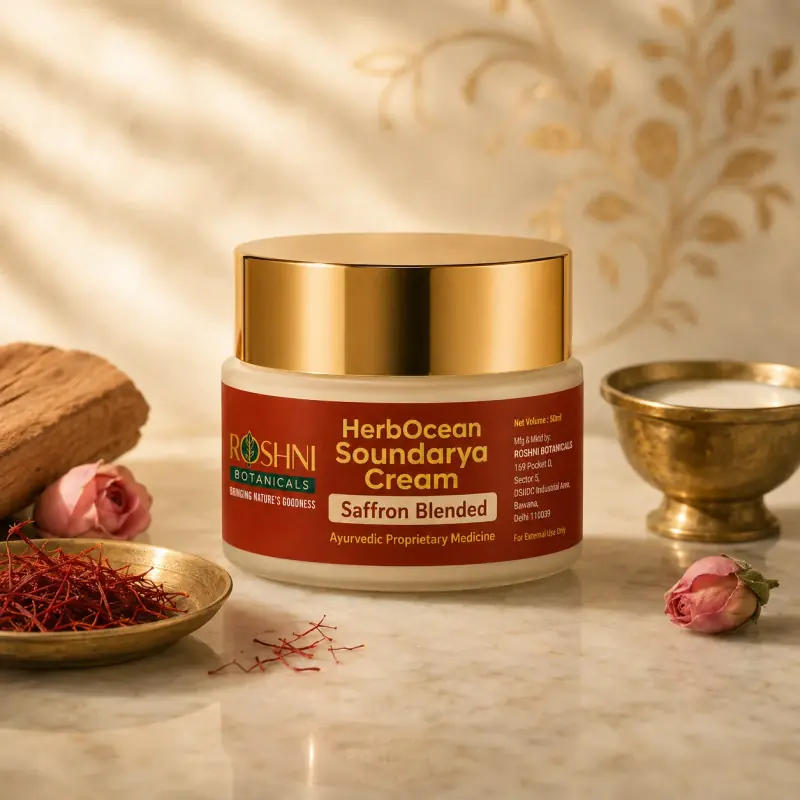
Marks are what adult readers ask about most, and they need their own patience. Wait until spots are genuinely settled: no new ones coming, nothing red or tender, the surface unbroken. Then care can shift towards the marks, which is where Soundarya Cream for post-acne marks sits: a rich saffron repair cream with bargad (Vatt) bark on a goat-milk and coconut base, with shea and kokum butters. It is a rich texture, so it belongs on settled skin rather than on an active breakout, and if new spots return, go back to the lighter routine and let it wait. One boundary in plain words, since saffron, Manjistha and red sandalwood carry a long folk history that is not ours to trade on: this cream is not offered for changing your skin’s tone or shade, and nothing on this page promises that. The goal is calm, settled and comfortable skin, and nothing beyond that.
Review first, then simplify
Adult acne is not an adolescence relapse, and it is no verdict on your hygiene. It is a signal, usually hormonal, sometimes a product or a prescription, and it answers better to review and simplification than to escalation. See a doctor first if the onset was sudden, if your cycles are irregular, if hair growth has changed, or if a new prescription came just before the spots, and do not stop a prescribed medicine on your own. After that, the pillar guide to ayurvedic treatment for acne carries the full classical picture, and the HerbOcean Anti-Acne Roll-On page carries the full formulation detail if measured spot care is what you are after.
References: Kashyap S, Besra L, Kar HK. Evaluation of Risk Factors Associated With Adult-Onset Acne in Patients Attending a Tertiary Care Center in East India: A Case-Control Study. Cureus. 2024;16(1):e53296 (case-control; 70 adult-onset acne patients versus 70 healthy controls, aged 26 to 50; Kalinga Institute of Medical Sciences, Bhubaneswar, Odisha; Indian population). Kaur S, Verma P, Sangwan A, Dayal S, Jain VK. Etiopathogenesis and Therapeutic Approach to Adult Onset Acne. Indian Journal of Dermatology. 2016;61(4):403-407 (review; the after-25 convention). Abad-Casintahan F et al. Frequency and characteristics of acne-related post-inflammatory hyperpigmentation. Journal of Dermatology. 2016;43(7):826-828 (preliminary evaluation of sequential acne subjects; 324 acne patients across seven Asian countries including India). Ananthapadmanabhan KP et al. Dermatologic Therapy. 2004;17 Suppl 1:16-25 (review; surfactant effects on the skin barrier). Choi JM, Lew VK, Kimball AB. Pediatric Dermatology. 2006 (single-blinded randomised controlled trial of face-washing frequency in acne; United States). Danby SG et al. Journal of Investigative Dermatology. 2018;138(1):68-77 (80 adults, eczema patients and healthy volunteers, United Kingdom; surfactant deposition in hard water). Davis EC, Callender VD. Journal of Clinical and Aesthetic Dermatology. 2010;3(7):20-31 (review of post-inflammatory hyperpigmentation; darker racial and ethnic groups, United States). Mar K et al. Prevention of Post-Inflammatory Hyperpigmentation in Skin of Colour: A Systematic Review. Australasian Journal of Dermatology. 2025;66(3):119-126 (systematic review; 14 studies, 369 cases, nearly all of them PIH following laser treatment). Momin SB, Peterson A, Del Rosso JQ. A status report on drug-associated acne and acneiform eruptions. Journal of Drugs in Dermatology. 2010;9(6):627-636 (review). Davison SL et al. Androgen levels in adult females: changes with age, menopause, and oophorectomy. Journal of Clinical Endocrinology and Metabolism. 2005;90(7):3847-3853 (community study of adult women, Australia). Plewig G, Fulton JE, Kligman AM. Pomade acne. Archives of Dermatology. 1970 (the classic description; United States).
Anti-Acne Roll-On
Ayurvedic spot care for active pimples and post-acne marks (PIH) — a herbal roll-on classically indicated for acne (Yuvanpidika). Made in-house in Delhi.
Soundarya Cream
A rich saffron brightening and repair cream with bargad (Vatt) bark on a goat-milk and coconut base, with shea and kokum butters, traditionally used in the care of skin where post-acne marks (PIH) linger.
Part of our guide: Ayurvedic treatment for acne: the complete guide.