
Natural vs Chemical Acne Care: An Honest Comparison
No villains here, just trade-offs. How conventional actives and Ayurvedic herbs each work on acne, so you can choose well.
The internet loves a fight, and "natural versus chemical" is a popular one. It is also a false one. Both approaches to acne can work, both have trade-offs, and the useful thing is not to crown a winner but to understand how each behaves so you can choose what fits your skin and your patience. Here is the honest version, without the tribalism.
How conventional actives work
The familiar over-the-counter actives, benzoyl peroxide, salicylic acid and the retinoids, are well studied and often effective. Benzoyl peroxide reduces acne-causing bacteria. Salicylic acid is an oil-soluble exfoliant that helps unclog pores. Retinoids speed up skin-cell turnover. Their strength is speed and evidence; their common cost is irritation, dryness, peeling and, for some, sun sensitivity, which on melanin-rich skin can itself trigger the marks people were trying to avoid. Used carefully, they have a real place.
How the Ayurvedic approach works
Classical herbal care comes at acne from a different direction. Instead of stripping or exfoliating hard, it leans on cooling, calming, blood-supporting herbs to settle the inflammation and the tendency to over-react. The strength here is gentleness and a focus on the underlying pattern; the trade-off is patience, because herbal care is gradual and asks for consistency rather than promising overnight results. Neither is magic; they simply work on different timelines and in different ways.
Where HerbOcean Anti-Acne Roll-On sits
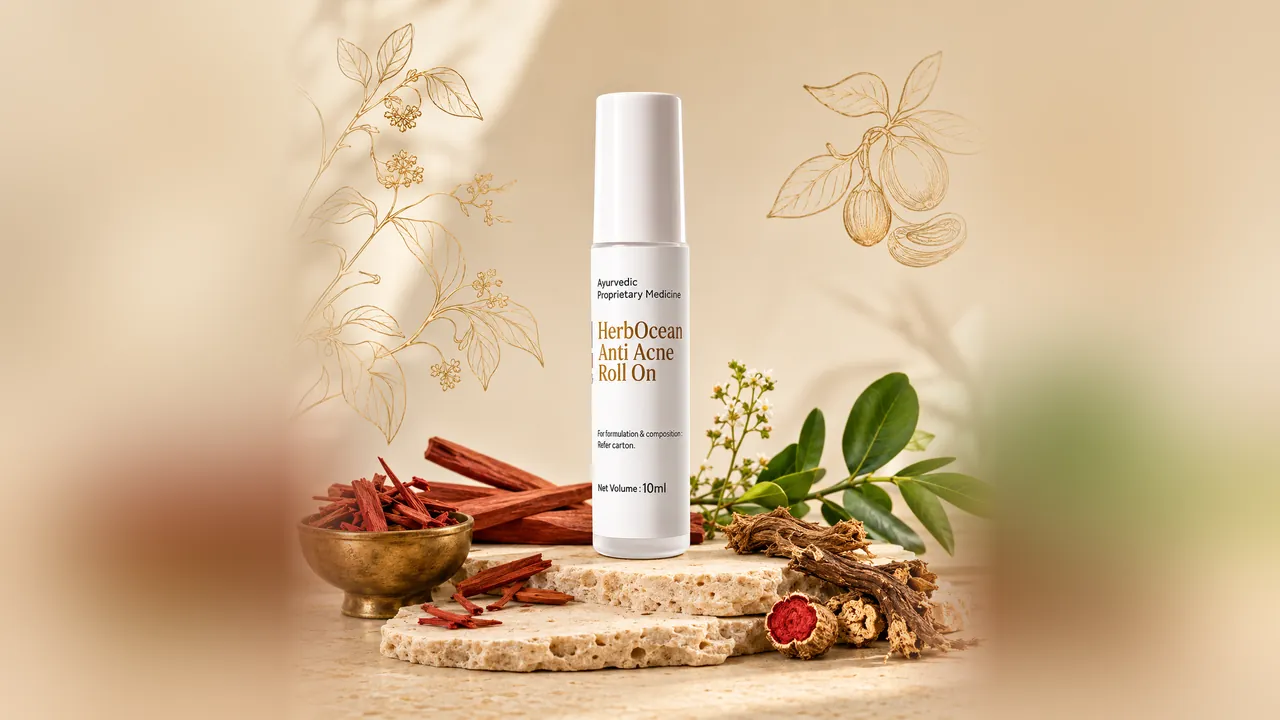
HerbOcean Anti-Acne Roll-On is the Ayurvedic option in this comparison: Manjistha, Lodhra, Daruhaldi and Kuth with lavender oil, dabbed onto spots twice daily, classically indicated for the care of Yuvanpidika. It will not act as fast as a strong active, and it does not pretend to. What it offers is gentler, barrier-respecting support for skin that reacts badly to harsher routines.
Side by side: speed, gentleness and upkeep
Put plainly: conventional actives are faster, herbal care is kinder, and both ask for maintenance. Benzoyl peroxide can calm a crop of spots inside a fortnight, but on melanin-rich Indian skin its dryness and irritation carry a real cost, because irritated brown skin pigments, and the treatment can leave its own shadow behind. The classical route moves in weeks rather than days, yet it respects the barrier, which matters enormously if your skin is reactive or already marked. Upkeep is the part nobody advertises: stop either approach abruptly and acne-prone skin tends to drift back to its old habits, so the honest question is not “which works” but “which can you sustain without collateral damage”.
The marks question
For many Indian readers the marks are the larger half of the problem; the pimple is gone in a week, the brown stamp it leaves stays for a season. Here the two philosophies genuinely diverge. Strong actives fade marks by accelerating exfoliation, effective but easy to overdo, and over-exfoliated skin on deeper tones frequently answers back with fresh pigmentation. The classical approach works lower in the process, using rakta-shodhana herbs to settle the over-reaction that creates the mark in the first place. Manjistha appears on both sides of that story, calming active spots and supporting an even tone afterwards, which is why our Radiance Tailam leads with it for the slow, gentle fading of post-acne marks. Whichever route you take for the active breakout, handle the marks gently and wear sunscreen; UV is the great preserver of pigmentation. For the marks that stay behind, HerbOcean Soundarya Cream is traditionally used in the care of post-acne marks as a gentle daily step.
Can you run both together?
Quietly, many people do, and done sensibly it is reasonable. The workable pattern is separation: a conventional active at night, the herbal spot step by day, or alternating evenings, rather than stacking everything onto the same patch of skin in one sitting. Watch for the warning signs of an over-worked barrier, tightness, stinging at the cleanser stage, flaking around the spots, and drop back to the gentler half of your routine for a week when they appear. If you are under a dermatologist’s care, tell them what else your routine carries; classical preparations are medicines in their own right and deserve the same disclosure as anything else on your shelf.
Cost, habit and the long run
One more axis matters over years rather than weeks: what the routine does to the skin you will have at thirty. Repeated cycles of strip-and-recover age the barrier, and barrier-weakened skin is more reactive to everything, including the next round of treatment. The unhurried route, gentle cleansing, targeted herbal care, food and sleep doing their share, builds in the opposite direction, which is much of why Ayurveda frames skin care as Dinacharya (the daily routine) rather than a rescue mission. Whichever side of this comparison you lean toward, borrow that frame: small, repeatable care beats heroic intervention, on every skin type this country produces.
Choosing well
Some people do best on a conventional active, some on the gentler herbal route, and many use a sensible combination under guidance. The right choice depends on how severe the acne is, how reactive your skin is, and how much patience you have. For the full method, read our ayurvedic treatment for acne, and to understand the marks acne leaves, read your acne by dosha. Severe or cystic acne should be assessed by a dermatologist, whichever route you lean toward.
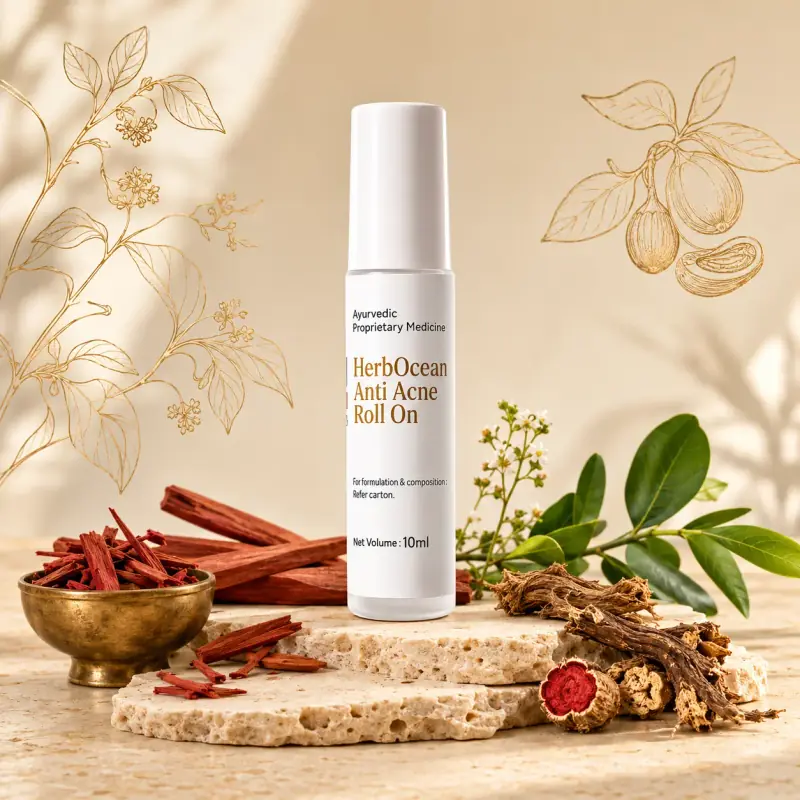
Anti-Acne Roll-On
Ayurvedic spot care for active pimples and post-acne marks (PIH) — a herbal roll-on classically indicated for acne (Yuvanpidika). Made in-house in Delhi.
Part of our guide: Ayurvedic treatment for acne: the complete guide.