Multani Mitti for Acne: What the Classic Ubtan Ingredient Does Well, and Where Spot Care Fits
Multani mitti absorbs oil and cools the skin, but it cannot reach an active pimple. The honest division of labour: a weekly clay pack for the terrain, targeted herbs for the event.
If you grew up in an Indian home, someone has almost certainly mixed you a multani mitti pack, whether for a wedding, a heatwave, or a bad breakout week. That instinct is sound: the clay genuinely absorbs excess oil and cools the skin, and it has earned its jar on the shelf across a few centuries of ubtans. But an active pimple needs something a clay pack cannot give, and knowing where each one fits will save your skin from both over-drying and disappointment. This is the honest division of labour.
Key takeaways
- Multani mitti (Fuller’s earth) genuinely absorbs excess sebum and cools the skin, which supports acne-prone skin through oily, humid weeks; its home is the weekly pack, within the classical medicated-paste (Lepa) tradition.
- The clay has no targeted herb action on the inflammation inside an active pimple; it manages the oil economy around breakouts rather than answering the breakout itself.
- Once a week suits most acne-prone skin, twice at most in peak monsoon; rinse the pack off while it is still slightly tacky, before it fully cracks, and moisturise after.
- Daily packs over-dry the barrier, and on melanin-rich Indian skin the resulting irritation and picking often settle into post-inflammatory hyperpigmentation (PIH), the mark that outlasts the pimple.
- The HerbOcean Anti-Acne Roll-On is the other half of the routine: an Ayurvedic medicine classically indicated for acne and pimples (Yuvanpidika) and traditionally used in the care of post-acne marks and pigmentation (PIH), applied daily on the spot itself.
What Multani Mitti Genuinely Does Well
Respect first, because the tradition has earned it. Multani mitti, the fuller’s earth named for Multan, is a household staple across India: mixed into bridal ubtans, patted onto prickly-heat summers, offered by mothers to teenagers in breakout weeks. Its genuine talent is absorption. The clay’s fine mineral structure soaks up excess sebum and surface grime and pulls gentle heat out of the skin as it dries, which is exactly why it feels so right in May heat and sticky monsoon weeks, and why oily-skinned readers swear their T-zone behaves for days after a good pack.
The classical frame for this practice is the medicated paste (Lepa): external pastes are one of Ayurveda’s oldest dosage forms for the skin, described in the classical surgical texts, and the ubtan is that tradition’s household descendant. Within the classical reading of acne (Yuvanpidika, the classical term), where heavy Kapha (one of the three doshas, the biological energies in Ayurveda) congestion and heat both play their part, a cooling, oil-absorbing pack addresses the terrain: the oily, congested field on which pimples grow. Hold that word, terrain; it is the key to this whole post.
The clay also has a skin type and a season, and honesty about both saves disappointment. Oily and combination skin in warm, humid months is multani mitti’s natural constituency, and that is most Indian skin for half the year. Dry or sensitive skin should halve the wearing time, thin the layer further, or sit the ritual out entirely, and everyone should hold the packs lightly through the dry northern winter, when the air is already doing the clay’s drying work for free. A tool this good deserves to be used where it works, not everywhere it is loved.
Where the Clay Falls Short for Acne-Prone Skin
Because the pimple itself is not terrain; it is an event. By the time a spot is red and risen, the pore is already blocked and inflamed, and a surface layer of drying clay does not reach the process inside it. Multani mitti manages the oil economy around breakouts; it has no targeted herb action on the breakout itself. Expecting the pack to answer an angry pimple is like expecting the gardener to also be the doctor, and most disappointment with the clay begins exactly there.
The second shortfall arrives through enthusiasm. A pack used daily, or left on until it fully cracks and pulls, strips the skin’s barrier, and stripped skin answers within days by producing more oil than before, the rebound that leaves you oilier on Friday than the Monday you started. The tell is a face that feels tight and squeaky right after rinsing and turns slick again by afternoon; that is over-stripping, not deep cleaning, and the answer is fewer packs, never stronger ones. Hard water sharpens this: the mineral-heavy supply in most Indian cities rinses clay incompletely and leaves the skin tighter still, so the pack’s exit matters as much as its stay. And two kitchen habits deserve gentle retirement: mixing lemon into the pack, which much of the internet still recommends and which adds an acidic, photosensitising sting this skin does not need, and storing leftover wet paste for next time, which turns a clean mineral into a warm, damp microbial experiment. Mix fresh, mix small, keep it bland.
None of this is an argument against the clay. It is an argument for a job description, and for what melanin-rich skin already knows: anything that leaves this skin provoked, over-dried, stinging or picked-at tends to collect its fee in pigment. The marks question gets its own section below, because on Indian skin it is half the story.
The Answer: Both, Used Right
Here is the routine, stated plainly for everyone who came with the question. Keep the clay, weekly. One multani mitti pack a week for oil balance, stretched to twice a week only in peak monsoon oiliness, mixed fresh with plain water or rose water, worn thin, and rinsed off while it is still slightly tacky, before the full crack-and-pull stage; follow it with a light moisturiser, always. Add targeted spot care, daily. On active pimples, morning and night, a measured herbal preparation goes on the spot itself, the event the clay cannot reach. And never layer the two: the pack and the spot care work different shifts, the clay on wash-day evenings, the roll-on on clean, dry skin every day. Same shelf, different jobs, no rivalry.
The pack evening itself runs like this. After the evening cleanse, mix a small fresh batch to a smooth, spreadable paste and apply a thin, even veil, coverage rather than thickness, avoiding the eye area and the lips. Wait for the tacky stage: touch a fingertip to your cheek, and when the clay no longer transfers but has not yet turned pale and cracked, it is done. Rinse with lukewarm water and soft hands, pat dry, moisturise while the skin is still slightly damp, and once the moisturiser has settled, the roll-on goes onto any active spots as its own final step. Twenty minutes, once a week, and both tools have done their shift.
Set expectations the hedged, honest way. A weekly pack supports calmer, less oily weeks within a few cycles, provided the rest of the routine, gentle cleansing, no picking, clean pillow covers, keeps pace; no clay delivers a countable result on a promised date, and any page offering you one is selling the jar, not the outcome. Judge the pairing over a month of consistency, the same patient standard this Journal asks of every routine it recommends.
The Other Half: Measured Herbs on the Pimple Itself
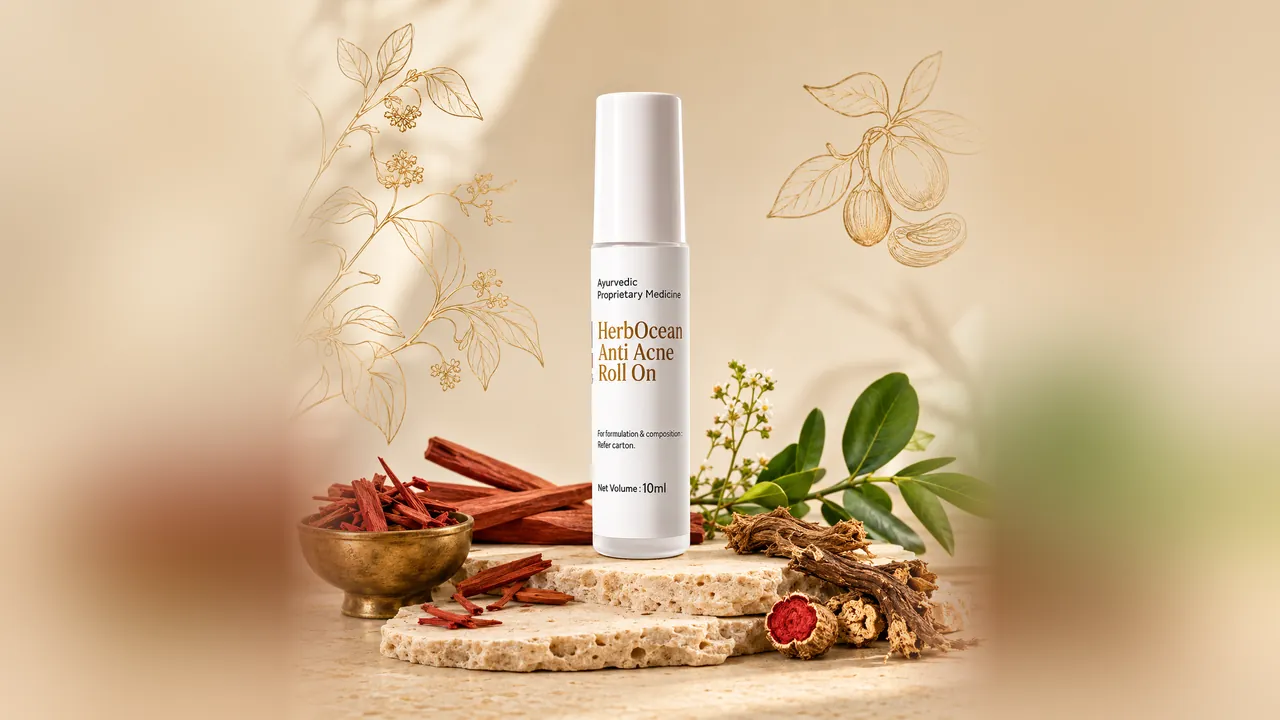
The HerbOcean Anti-Acne Roll-On is built for the exact job the clay leaves open. It is an AYUSH-licensed Ayurvedic medicine (Licence No. DL-474 A&U), classically indicated for acne and pimples (Yuvanpidika) and traditionally used in the care of post-acne marks and pigmentation (PIH), delivering six classical herbs at fixed doses through a rollerball that never asks your fingers to touch the spot. Manjistha leads, Ayurveda’s foremost blood-purifying (rakta shodhana) herb, the classical answer to eruptions read as disturbed blood; astringent Lodhra tightens and settles alongside it; warming Jaiphal brings its scraping (lekhana) character to the congested pore; cooling Raktchandan (red sandalwood) calms the heat; bitter Daruhaldi contributes the berberine that modern antimicrobial research keeps returning to; and Kuth completes the classical six, all in a light glycerine base with gluconolactone and a trace of lavender oil.
It was formulated by Vaidya Shri Ram Prakash Ji, the master vaidya (a classical Ayurvedic physician and formulator) whose 40-year formulation legacy the HerbOcean line is built on, and made in-house at Roshni Botanicals’ GMP-certified unit in Bawana, Delhi. Use it after cleansing, on the pimple and the skin just around it, and let it dry fully; on pack evenings, it goes on after the clay is rinsed and the moisturiser has settled, never mixed into the pack itself. For external use only; patch-test on the inner forearm before first use. Readers weighing this whole approach against modern chemical actives will find the calm comparison in our guide to natural versus chemical acne care, and the full classical framework lives in our complete guide to the Ayurvedic treatment of acne.
The Marks Question: What Over-Drying Costs Indian Skin
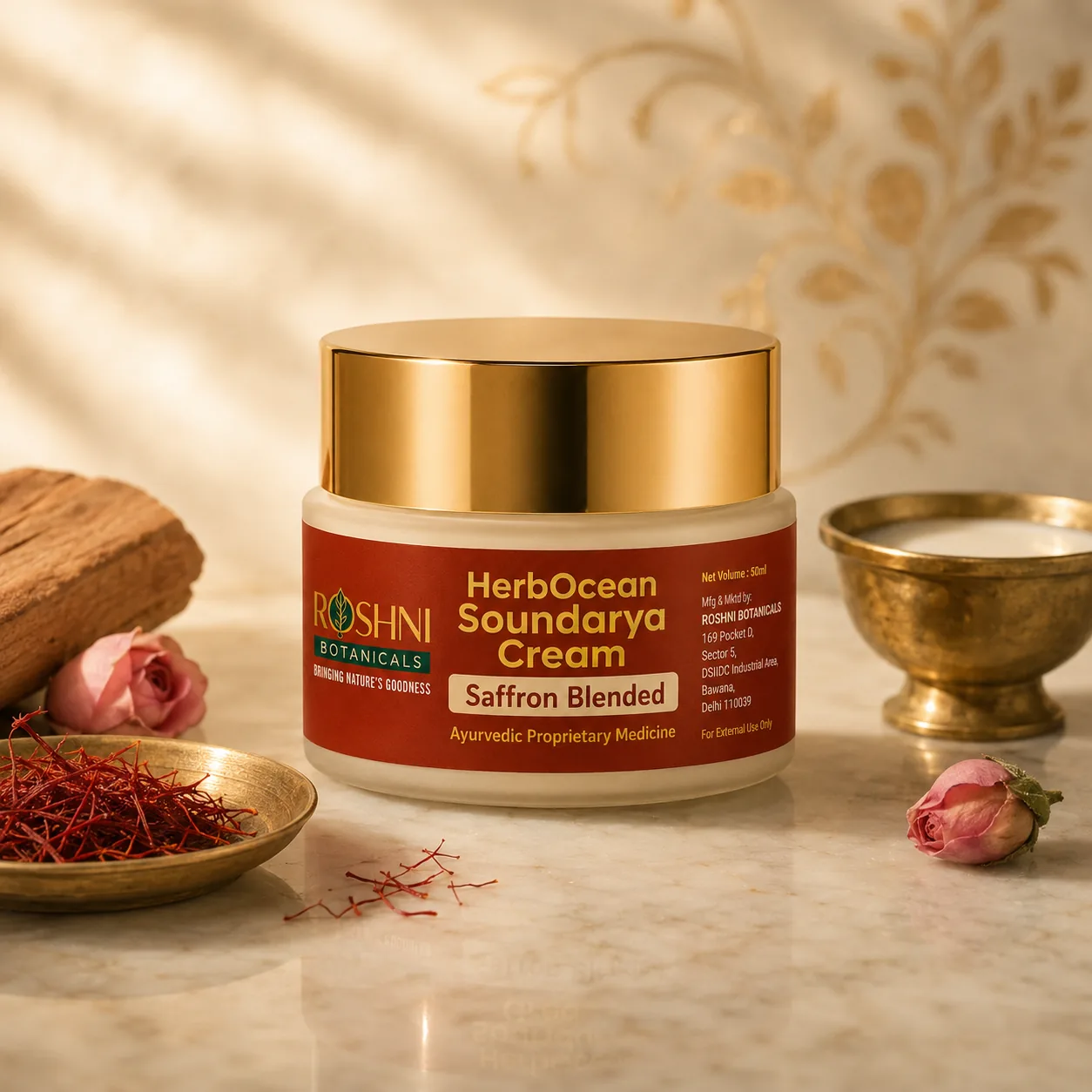
Melanin-rich skin keeps accounts. Every over-dried week, every pack worn to full crack, every pimple squeezed in frustration when the clay alone did not answer it, tends to get recorded as post-inflammatory hyperpigmentation: the flat brown mark that stays for months after the pimple is forgotten. This is the quiet reason the both-used-right routine matters beyond convenience; a clay-only approach that leaves active pimples unanswered invites exactly the picking that marks this skin. Keep packs short and weekly, keep hands off, let the spot care do the spot’s work, and for the marks already settled, HerbOcean Soundarya Cream is traditionally used in the care of post-acne pigmentation while time does the rest.
When Home Care Is Not Enough
Some breakouts outrank both the clay and the roll-on, and honesty about that line is part of caring for your skin. See a dermatologist for painful, deep, cystic or nodular acne; for breakouts that arrive suddenly in adulthood after years of settled skin; for jawline acne that tracks with irregular cycles, which deserves a hormonal work-up; and for any early signs of scarring, the pitted or raised kind rather than flat marks, where early clinical care makes the greatest difference. A correctly named problem is half solved, and the routine in this post works best in partnership with that naming, never as a substitute for it.
Same Shelf, Different Jobs
Your grandmother’s clay jar was never wrong; it was just never meant to work alone. Let the weekly multani mitti pack look after the oily weeks, rinsed before it cracks and followed by moisturiser, and let targeted herbs look after the pimple itself. If you want that second job done the classical way, with Manjistha and Lodhra measured by a vaidya rather than guessed at a kitchen counter, explore the HerbOcean Anti-Acne Roll-On, and keep both tools where they belong: the pack for the terrain, the roll-on for the event, and your hands, gently, off everything in between.
References: Sushruta Samhita, Sutra Sthana 18 (Vrana-lepana), on medicated pastes (Lepa) for external application, and Nidana Sthana 13 (Kshudra Roga) on Yuvanpidika. Zhang X, Zhang Z, Tao H, et al. Comprehensive Assessment of the Efficacy and Safety of a Clay Mask in Oily and Acne Skin. Skin Research and Technology. 2023;29(11):e13513 (n = 60, China; a kaolin-and-bentonite clay mask measurably reduced skin-surface oil in oily and combination skin). Davis EC, Callender VD. Postinflammatory Hyperpigmentation: A Review of the Epidemiology, Clinical Features, and Treatment Options in Skin of Color. Journal of Clinical and Aesthetic Dermatology. 2010;3(7):20–31 (a review of post-inflammatory hyperpigmentation in skin of colour).
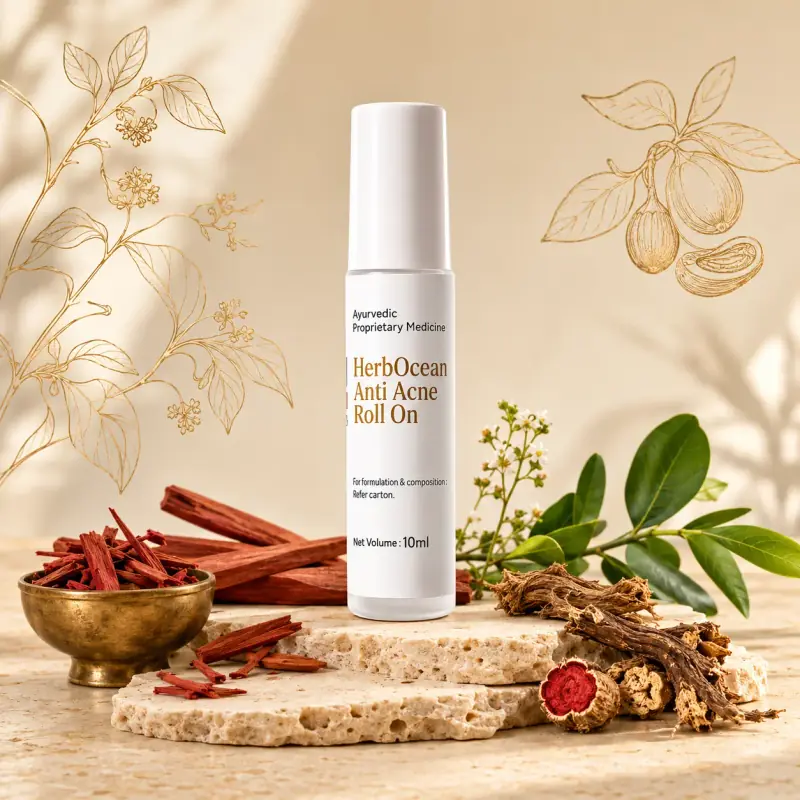
Anti-Acne Roll-On
Ayurvedic spot care for active pimples and post-acne marks (PIH) — a herbal roll-on classically indicated for acne (Yuvanpidika). Made in-house in Delhi.
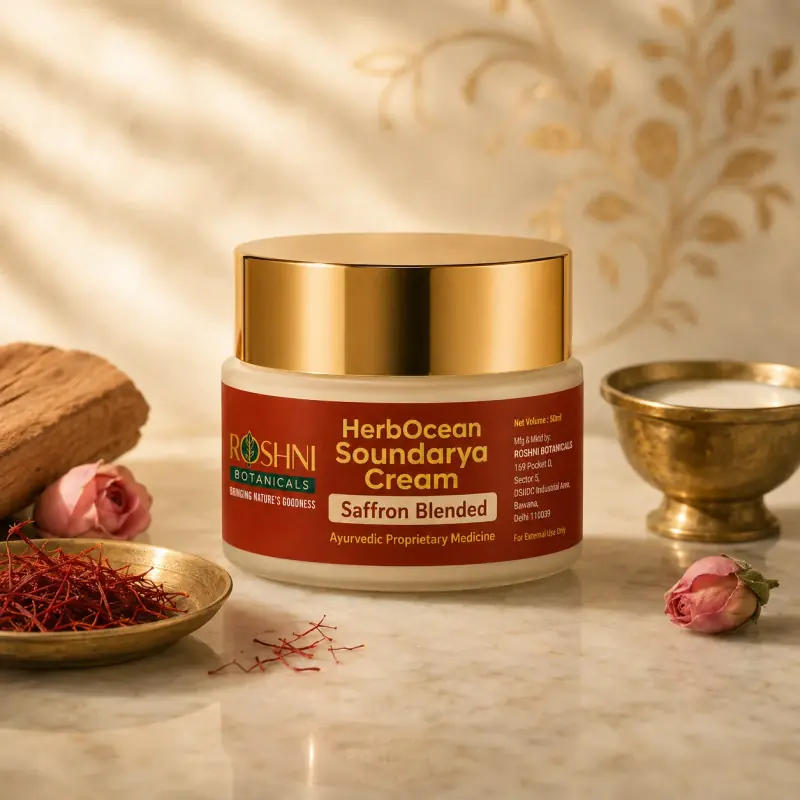
Soundarya Cream
A rich saffron brightening and repair cream with bargad (Vatt) bark on a goat-milk and coconut base, with shea and kokum butters, traditionally used in the care of skin where post-acne marks (PIH) linger.
Part of our guide: Ayurvedic treatment for acne: the complete guide.