
Lodhra Benefits for Skin: What This Classical Astringent Bark Actually Does
Lodhra is the astringent stem bark of Symplocos racemosa. What the Ayurvedic Pharmacopoeia records, where the classical record actually places it, and its measured dose in the Anti-Acne Roll-On.
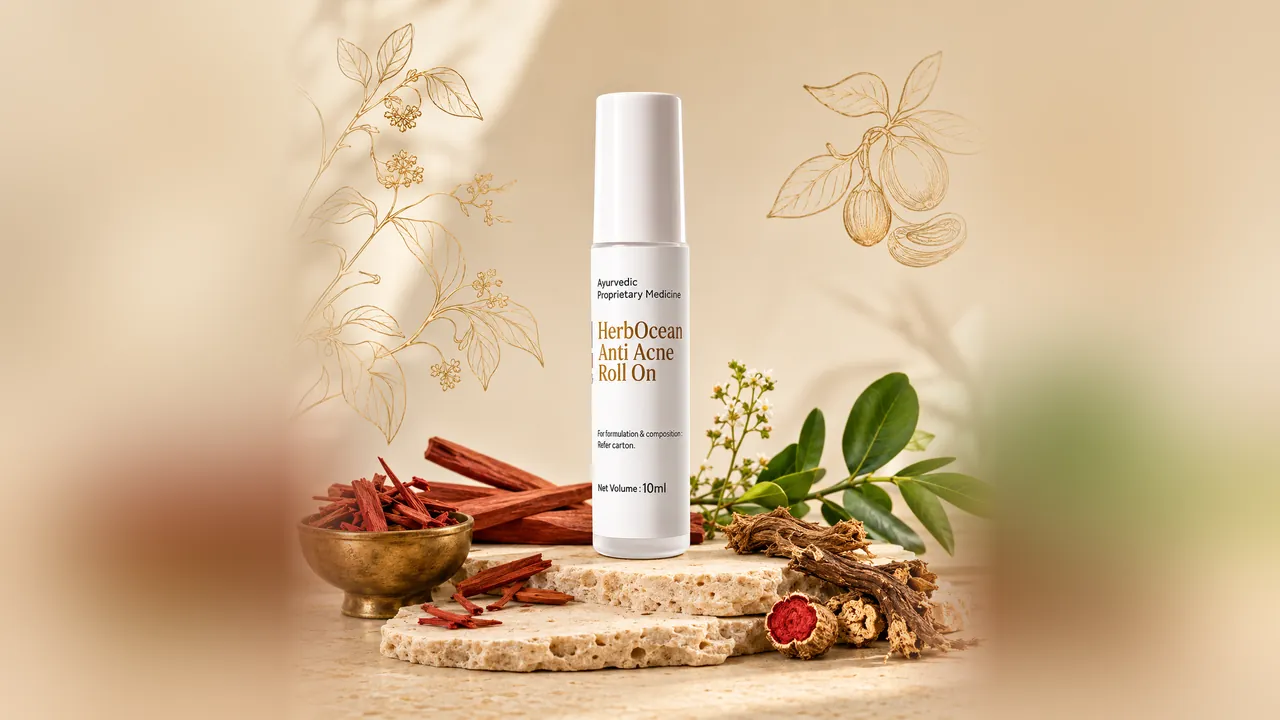
Somewhere on most Indian bathroom shelves there is a powder or paste with lodh bark listed in small print, read past and ignored. Lodhra has been in Indian skin formulation for centuries, and it is one of the six botanicals in our Anti-Acne Roll-On. Here is what the classical record actually says about it, what the pharmacopoeia measures, and where the popular claims run past both.
Key takeaways
- Lodhra is the stem bark of Symplocos racemosa, an evergreen tree, sold by the pansari as lodh or lodh pathani.
- The Ayurvedic Pharmacopoeia of India records it as astringent in taste, light in quality and cooling in potency. Astringency is its whole character.
- It is a formulation herb, not a stand-alone remedy. It appears by name inside classical medicated pastes, and its principal pharmacopoeial uses are internal rather than facial.
- In the HerbOcean Anti-Acne Roll-On it sits at a fixed, declared weight, the same as each of the five botanicals beside it.
- This page makes no claim that Lodhra, or any HerbOcean product containing it, lightens, brightens or changes the natural colour of your skin.
What Lodhra Actually Is: The Bark, the Tree, and the Taste
Before any Ayurvedic vocabulary, the plant. Lodhra is the stem bark of Symplocos racemosa, an evergreen tree of roughly six to eight and a half metres. The Ayurvedic Pharmacopoeia of India records it through the plains and lower hills of much of the country. At the pansari's counter, the herb seller most Indian families still know by name, it is sold as a greyish-brown, faintly fibrous powder that gives very little away by sight. One thing worth knowing before you buy any: the classical name covers more than one bark, and the nighantus describe a second lodhra alongside it.
What defines it in classical pharmacology is taste and potency. The Pharmacopoeia, which is the statutory standard rather than anyone's opinion, records the stem bark as kashaya (astringent) in rasa, laghu (light) in guna, shita (cooling) in virya and katu in vipaka, and describes the taste plainly as astringent and feebly bitter. That cooling potency is worth pausing on, because it is not a safe assumption for barks generally. Daruhaldi and Nagkesar are both described loosely as cooling in consumer writing, and the same Pharmacopoeia gives both of them ushna, a hot potency. Lodhra genuinely is the cooling one. Astringency here means a drawing-together quality, which is why the texts reach for it where skin feels loose, damp or congested rather than dry and tight.
That second bark is worth a moment, because it is the sort of thing that decides whether a home purchase is any good. The classical literature does not treat lodhra as one single drug. The nighantus describe a pair of them, and the Pharmacopoeia monograph is written for Symplocos racemosa specifically. At a shop counter, loose bark powder is sold by common name and by weight, and nobody at the counter is going to volunteer which species is in the sack. That is not a reason to distrust your pansari. It is a reason to understand what you are actually buying, and it is the practical argument for a licensed formulation over a loose powder: on a licence, the botanical is named, the species is fixed and the quantity is declared, which is three questions you do not have to ask at the counter.
Modern screening has looked at the bark and detects tannins in it, alongside flavonoids, saponins, triterpenes and phytosterols. The Pharmacopoeia sets no tannin limit for the bark, naming the constituents as alkaloids and red colouring matter. So treat tannins as present rather than as the headline. They are the chemistry most people have already met without knowing it, the family of compounds that makes strong tea feel drying in the mouth or an unripe banana feel chalky. That is the unglamorous version of what astringency is.
A boundary, stated once and plainly, because the pages competing for this search do not state it at all. This page makes no claim that Lodhra, or any HerbOcean product containing it, lightens, brightens or changes the natural colour of your skin. What we are after is calm, settled, comfortable skin.
Where Lodhra Sits in Classical Formulation, Honestly
Lodhra is a formulation herb rather than something you reach for alone, and it is worth being straight about where its classical weight actually lies. The Pharmacopoeia lists its therapeutic uses as shotha (swelling), atisara (diarrhoea), netraroga (eye disorders), raktapitta (bleeding disorders) and pradara, and the classical formulations it names for the bark are internal preparations. The facial use is real, and it is textual rather than invented, but it is a secondary line in the record and not the main one. Anyone presenting Lodhra as first and foremost a face herb is tidying the tradition to suit a product page.
Where it does appear for the face, it appears inside a Lepa (medicated paste applied externally). Vagbhata sets out the eruption we now call acne in the Ashtanga Hridaya, Uttarasthana 31, and gives a pralepa containing Lodhra in the chapter that follows. We are citing those at chapter level deliberately. Verse numbering for this material drifts between editions, and quoting a precise verse we have not read in a printed edition would be exactly the false precision this page is arguing against.
How Lodhra and Manjistha behave specifically as a pair is its own subject, and how Manjistha and Lodhra work together in one formulation covers it. Everything here is about Lodhra on its own.
Congested Skin and Marks on Melanin-Rich Indian Faces
Readers commonly report more congestion around the nose, chin and jawline through humid weeks, with the skin surface feeling filmy for longer than it does in a dry season. We are putting that as what people notice rather than as a mechanism, because the humidity-and-sebum link is a proposed explanation rather than settled physiology. If humid-season breakouts are the immediate problem, how acne behaves differently during the Indian monsoon covers the routine properly.
On melanin-rich Indian skin there is a specific cost to letting a spot become inflamed. Once it settles it commonly leaves a flat brown mark behind, post-inflammatory hyperpigmentation (PIH), which can persist well after the spot itself has gone. We are not going to attach a number of months to that, because we could not find an Indian dermatology paper that supports one. Calm, unpicked, uninflamed skin is the whole objective. Where those marks are the main concern rather than active spots, the saffron-led Soundarya Cream is traditionally used in the care of post-acne marks.
Before you blame a product, check your tap. If your household runs on hard water, and Delhi's groundwater is the measured case, mineral residue commonly leaves a tight, filmy feeling after washing, and readers frequently misread that as their skincare being too astringent. Notice which it is before changing anything: water-related tightness arrives right after the rinse, whether or not you applied a product. And a plain caution regardless, since astringency is this herb's whole character: astringent botanicals suit oily and combination skin considerably better than dry, already-tight skin.
How Lodhra Is Dosed in the HerbOcean Anti-Acne Roll-On
The HerbOcean Anti-Acne Roll-On is an AYUSH-licensed Ayurvedic medicine classically indicated for acne (Yuvanpidika, the classical term for a youthful eruption) and traditionally used in the care of post-acne marks and pigmentation. Its approved composition declares six botanicals at equal measured weights: Lodhra alongside Manjistha, Jaiphal (nutmeg), Raktchandan (red sandalwood), Daruhaldi and Kuth. Lodhra is the astringent in that six, carrying the same declared weight as every herb beside it. They are carried in a glycerine and DM-water base with gluconolactone and sodium benzoate, and lavender oil as the aromatic. There is no neem in this formulation.
The declared quantity is the interesting part, and it is a formulation point rather than a trust badge. A label reading only contains Lodhra leaves you guessing whether that means a meaningful inclusion or a pinch for the ingredient list. A fixed quantity, registered on a licence, does not.
The roll-on is manufactured in-house at Bawana, Delhi under AYUSH Licence No. DL-474 A&U. Roshni Botanicals holds a Schedule-T GMP certificate from the Directorate of AYUSH, Government of NCT of Delhi, and is ISO 9001:2015 certified across the manufacture of the HerbOcean range. The formulation is built on the forty-year Ayurvedic formulation legacy of Vaidya Shri Ram Prakash Ji.
It is worth saying what astringency actually feels like, because it is the reason this is a spot preparation rather than an all-over one. An astringent does not sting and it is not an acid. What it does is leave a slight sense of tightening as it settles, the same sensation strong tea leaves in the mouth. On an oily, congested area that is unobjectionable and often welcome. Spread across a whole face that is already dry, or across skin that is flaking after a course of actives, it is simply the wrong thing in the wrong place. If your skin runs dry, this is a formulation to use on individual spots and nowhere else.
The format follows the character of the formula. When the active nature of a preparation is astringent, a roll-on that delivers a measured amount to one spot makes more sense than something spread across the whole face. Use it on clean skin in the evening, one pass over the spot. Patch-test on the inner forearm or behind the ear first, and keep it to external use. It is meant to sit inside a routine rather than replace one, and our complete guide to ayurvedic treatment for acne sets out what that routine looks like.
Some situations need a doctor rather than another product. See a dermatologist if you have deep, painful cystic nodules anywhere on the face, jaw, chest or back; if your acne has not improved after a few months of consistent, gentle care; if it begins suddenly in your thirties or forties; if breakouts arrive alongside irregular periods or unusual hair growth; if scarring is pitted rather than flat; if it is affecting your sleep or mood; or if any spot bleeds, crusts or keeps growing. A dermatologist can also tell you whether it is acne at all, since folliculitis, perioral dermatitis and hidradenitis suppurativa are commonly mistaken for it.
A Measured Bark, Not a Shortcut
Lodhra is not a shortcut, and no single bark is. What it is, is a measured, classically grounded astringent that earns its place in a formulation where six botanicals stand at equal weight. If your skin is congested and you want that logic in a form you can apply one spot at a time, the Anti-Acne Roll-On, an AYUSH-licensed Ayurvedic medicine for external use, is where it lives.
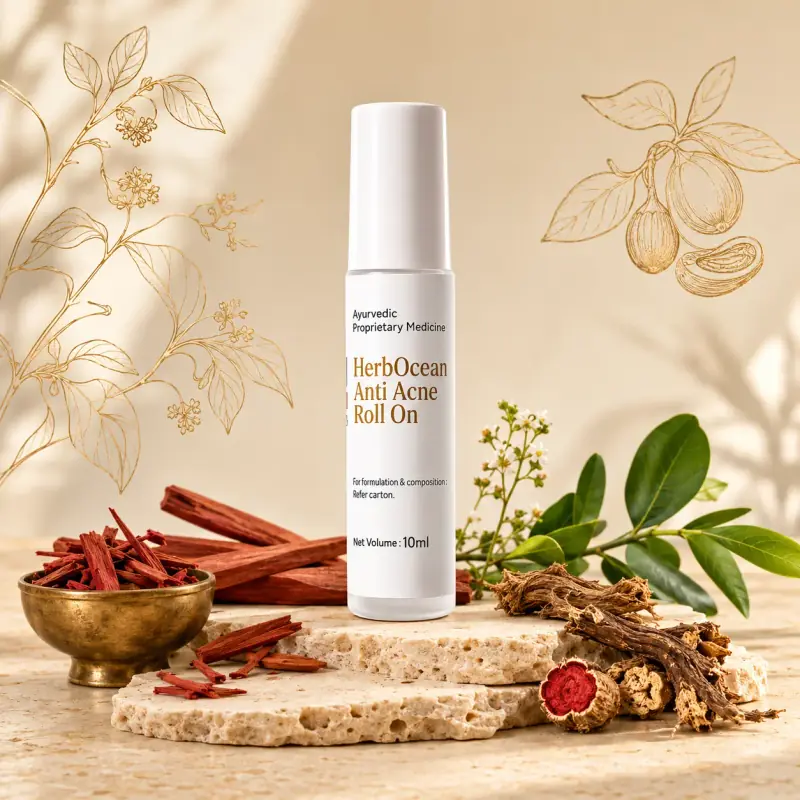
Anti-Acne Roll-On
Ayurvedic spot care for active pimples and post-acne marks (PIH) — a herbal roll-on classically indicated for acne (Yuvanpidika). Made in-house in Delhi.
Part of our guide: Ayurvedic treatment for acne: the complete guide.