Daruhaldi Benefits for Skin: The Bitter Bark Behind Classical Pimple Care
The Himalayan bark behind rasaut, why its haldi name misleads, and where it actually sits in classical Ayurvedic care for acne and pimples.
Every Indian kitchen knows haldi. Far fewer know its bitter Himalayan cousin, daruhaldi (Berberis aristata, the Indian barberry), whose golden inner bark has quietly earned its place in classical skin care. Its thickened extract, rasaut, is one of the oldest documented preparations in Indian pharmacy, and the bark itself sits inside how Ayurveda approaches acne and pimples (Yuvanpidika, the classical Ayurvedic term for acne). This piece separates the two haldis, sets out what the classical texts actually say about the bitter one, and shows where it sits in a modern formula.
Key takeaways
- Daruhaldi (Berberis aristata) is a bitter Himalayan bark, unrelated to haldi (Curcuma longa) despite the shared name and golden colour. They are different plants doing different jobs, and they are not interchangeable inside a formula.
- Rasaut, classically called rasanjana, is the thickened extract Ayurvedic pharmacy prepares by reducing a decoction of daruhaldi and combining it with milk. Published methods differ on the plant part, the water ratio and even the milk, so it is a family of related procedures rather than one fixed recipe.
- The classical warrant for its use on skin is specific: Charaka places daruhaldi among the ten herbs of the Kandughna Mahakashaya, the group gathered for their action on kandu (itching), in Sutrasthana 4.
- Daruhaldi is bitter and drying, and heating in potency (ushna virya). The Ayurvedic Pharmacopoeia of India records it that way, and it is worth knowing, because daruhaldi is often loosely described as a cooling herb. It is not one.
- In HerbOcean's Anti-Acne Roll-On, daruhaldi sits at a measured, standardised weight alongside Manjistha, Lodhra, Jaiphal, Raktchandan and Kuth, formulated by Vaidya Shri Ram Prakash Ji, with no neem and no tea tree in the formula.
Daruhaldi vs Haldi: Clearing Up the Name Confusion
The name itself causes most of the confusion. Daru-haldi translates roughly to wood turmeric, daru meaning wood, named for an inner bark that runs the same warm yellow as the spice everyone already knows. But daruhaldi is Berberis aristata, a thorny Himalayan shrub, not Curcuma longa, the rhizome that ends up in your sabzi and your ubtan. Almost every Indian reader has made this mix-up at some point, usually while reading an ingredient label, and the confusion is entirely reasonable given how deliberately the name echoes the familiar spice.
The two plants play very different roles. Haldi is the everyday culinary root, present in the kitchen, the ubtan bowl and the haldi ceremony alike, valued for a broad, gentle character. Daruhaldi is something else: a bitter medicinal bark you will rarely, if ever, see in a kitchen, reached for specifically in classical formulation rather than in cooking. A preparation built around one cannot simply substitute the other.
Hold the two side by side and the difference settles in seconds. Haldi is a soft rhizome, easy to slice, staining everything bright orange-yellow the moment it is cut, warm and only slightly bitter to taste. Daruhaldi is a woody bark and root, usually sold as chips or coarse powder rather than a fresh piece, paler and more golden than orange, and startlingly bitter, with none of haldi's warmth.
The classical texts, interestingly, did notice the kinship. Sushruta names daruhaldi in the Haridradi gana, a small group of drugs headed by haldi itself (Sushruta Samhita, Sutrasthana 38), and Vagbhata carries it into the Vacha-Haridradi group as one of the haridra-dvaya, the two haridras (Ashtanga Hridaya, Sutrasthana 15). Worth being precise about what that grouping means, though: the indications Sushruta records for it are digestive and lactational, not dermatological. The two plants were filed together for their kinship and their shared actions elsewhere in the body, not as evidence that either belongs on skin. That evidence sits somewhere else entirely, and we come to it below.
Rasaut and the Himalayan Herb-Trade Heritage
Rasaut, classically rasanjana, is the concentrated extract Ayurvedic pharmacy prepares from daruhaldi. The plant material is boiled in water, reduced to about a quarter, filtered, combined with milk and evaporated down to a dark semi-solid mass. The published procedures differ more than most popular accounts admit: one standardised method works from the stem bark in sixteen parts water, another from the root in eight, and the texts do not agree on the milk either, with cow's milk specified in one classical account and goat's milk in another, while the commercial Himalayan rasont is often reduced in water alone. It is best understood as a family of related procedures rather than a single fixed recipe.
Classical use of rasanjana runs along two separate lines, and both are worth stating accurately. On skin, Charaka names it in the chapter on kushtha, the classical group of chronic skin disorders, both taken with cow's urine and, separately, in an applied paste (Charaka Samhita, Chikitsa Sthana 7). For the eyes it appears as anjana, a collyrium applied along the lid margin with a rod, which is a rather different thing from the eye wash it is often described as. We record that as pharmacy history only: it has no bearing on a skin product, and nothing daruhaldi-based should go near your eyes.
Daruhaldi bark has moved through a genuine, living herb trade for centuries, harvested in the hill regions where the shrub grows and carried down into the formulation traditions that still use it. That supply chain is also where the honest complication lives. When Srivastava and Rawat bought ten commercial samples sold as Daruharidra from herb markets across India, from Amritsar and Delhi to Hyderabad, Bangalore and Trichur, and identified them botanically, not one turned out to be pure Berberis aristata (Evidence-Based Complementary and Alternative Medicine, 2013). Most were the related Berberis asiatica, two southern samples were a wholly different plant, and lead levels varied many times over between markets. Substitution is routine, because the species is heavily collected from the wild and is assessed as endangered across much of the Indian Himalayan region. That is precisely why a licensed manufacturer buys against a specification and tests what arrives, rather than trusting a market sack.
Why Daruhaldi Belongs in Classical Pimple Care
Here is the classical warrant, and it is more specific than the general reputation suggests. Charaka Samhita sets out fifty groups of ten drugs each in Sutrasthana 4, and daruhaldi is one of the ten in the Kandughna Mahakashaya, the group gathered for their action on kandu (itching). It sits there alongside chandana (sandalwood), nimba (neem), kutaja, madhuka and musta. That is a textual fact about where the tradition filed the herb, which is a different and more modest thing than a claim about what it will do for you.
The classical description of daruhaldi's character is worth getting right, because it is routinely got wrong. The Ayurvedic Pharmacopoeia of India records it as bitter (tikta) in taste, dry (ruksha) in quality, heating (ushna virya) in potency and pungent (katu) after digestion, and it is also described as reducing both Kapha and Pitta (the doshas, the biological energies of Ayurvedic physiology). Those two statements are not in conflict, and the reconciliation matters. It is the bitterness and the dryness that bring Pitta down, not any cooling action. Daruhaldi is not a cooling herb, and it will not do the work of chandana or ushira (khus, the vetiver root) where cooling is what you actually want. Anywhere you read that daruhaldi is shita or cooling, that is not what the pharmacopoeia records.
Modern research has taken a real, if early, interest in the bark's chief alkaloid. Berberine is the yellow isoquinoline alkaloid concentrated in daruhaldi's root and stem bark, and the marker compound against which the raw material is standardised. A 2024 study in Frontiers in Microbiology by Sun and colleagues tested purified berberine against four culture-collection strains of Cutibacterium acnes, one of the organisms implicated in inflammatory acne, and reported minimum inhibitory concentrations of 6.25 to 12.5 micrograms per millilitre, attributing the effect to damage to the bacterial cell wall and membrane. That work is preclinical: cell culture, plus a mouse model in which the berberine was injected rather than applied to skin. It is laboratory context for why a bitter, drying bark holds the place it does, and it is not evidence of what any product will do for you.
Indian seasonal reality gives the ingredient a practical reason to matter. Monsoon humidity and sweat make breakouts flare in a way drier months do not, and hard water across many Indian cities leaves the skin barrier more unsettled than it would otherwise be. On melanin-rich Indian skin, the lasting problem is often not the pimple but what it leaves behind, the post-inflammatory hyperpigmentation (PIH) that outlives the breakout by months. If that is the part you are dealing with, our post on brown marks versus red marks after acne goes into how those two kinds of marks differ and why they behave differently. For the marks themselves, HerbOcean Soundarya Cream is traditionally used in the care of post-acne marks, while the roll-on stays on the active spot. A targeted roll-on suits this pattern: a measured dose applied only where needed, rather than a full-face product layered onto skin already working overtime in the heat and damp. The verbs stay deliberately modest here, supports, helps maintain, because that is what an honest, classically indicated formula can promise.
Daruhaldi in the HerbOcean Anti-Acne Roll-On
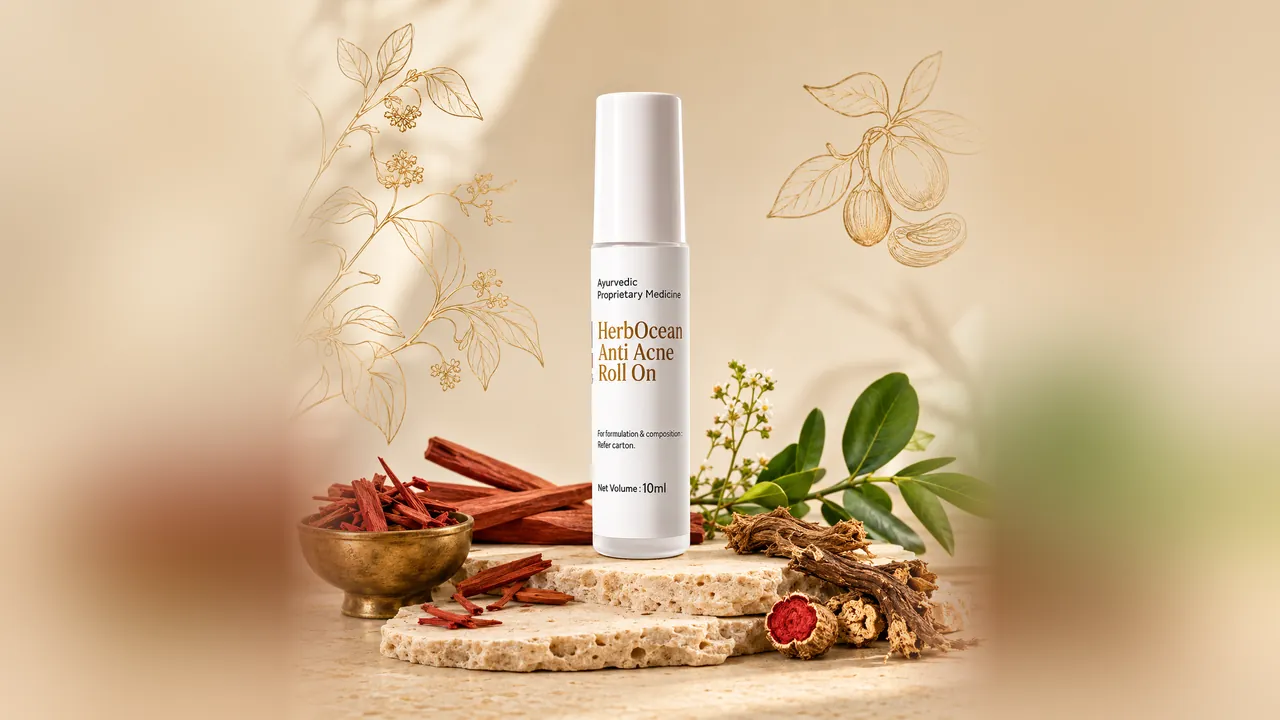
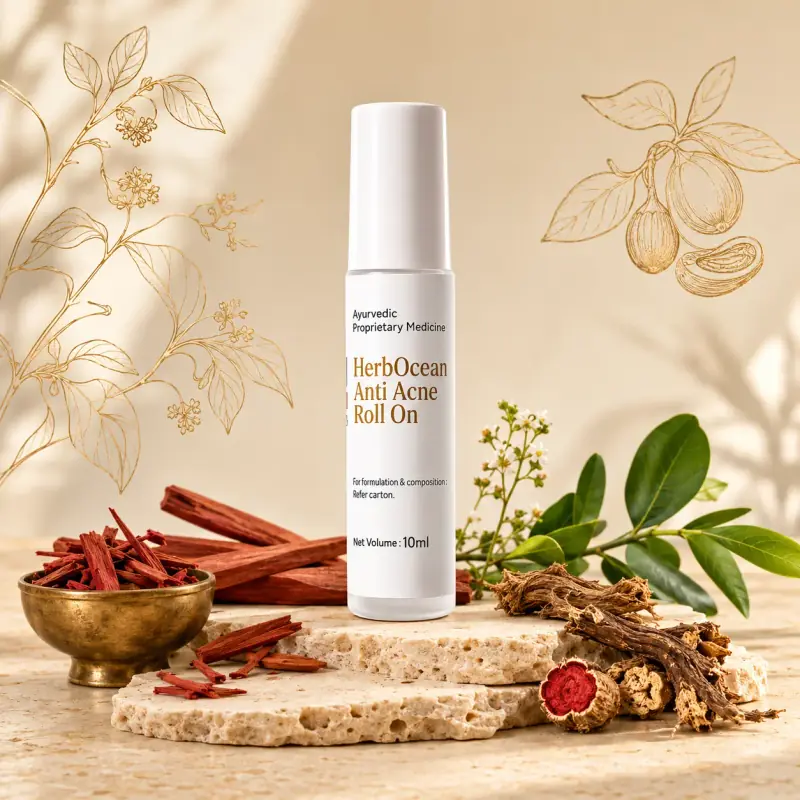
In the HerbOcean Anti-Acne Roll-On, daruhaldi holds a measured place: a fixed, standardised weight, alongside Manjistha, Lodhra, Jaiphal, Raktchandan (red sandalwood) and Kuth in a glycerine and water base. The roll-on is formulated by Vaidya Shri Ram Prakash Ji, the classical vaidya whose forty-year formulation legacy the HerbOcean line is built on: no neem, no tea tree, only the classical herbs the formulation sheet calls for, each at a set quantity rather than an approximate handful. For how daruhaldi works alongside two of those herbs specifically, our companion post on Manjistha and Lodhra for acne walks through that pairing, and our complete guide to ayurvedic treatment for acne sets the whole approach in context.
The roll-on format is what makes this measured proportion useful day to day. A rollerball delivers a small, consistent amount straight onto a rising pimple without a finger touching the spot, which matters more than it sounds, since picking at an active pimple is exactly what tends to leave a lasting mark on Indian skin. Applied at night on clean skin, it works alongside the rest of a routine rather than replacing cleansing or daytime sun protection. Consistency across a full breakout cycle, rather than a single anxious application, is what the classical proportion was designed to support.
A few honest cautions, the same way you would treat any active formula. This is an Ayurvedic medicine for external use only. Patch-test it before you use it properly: dab a little on the inner forearm, leave it 24 hours, then look again at 48 hours, because the reaction that matters most is a delayed one and a five-minute test will miss it entirely. If you know you react to fragrance, to lavender or linalool, or to plants in the Compositae family, speak to a dermatologist before starting. Keep it away from the eyes, lips and mouth, and off skin that is picked, broken or bleeding. Daruhaldi is also a strong natural yellow, the same berberine that colours the bark having long been used to dye wool and silk, so expect a faint tinge on the treated spot for a day or so. Since you are applying it at night, that colour can transfer while you sleep: use a darker or older pillowcase. Use a sunscreen through the day, because sun exposure is one of the surest ways to deepen PIH on Indian skin, which is the very thing you are trying to settle.
One word on doing it yourself, because an ingredient piece invites it. Buying loose daruhaldi powder and mixing a paste at home is tempting and inadvisable, for three reasons. You may not be getting daruhaldi at all, as that market survey above found. A paste mixed in a bowl has no preservative system and no testing behind it, and it goes onto skin that is already inflamed and often broken. And rubbing gritty root powder over active lesions is one of the more reliable ways to leave yourself with marks that outlast the pimple. Classical preparations are decocted, filtered, proportioned and preserved for a reason. Finally, no bark, however well documented, substitutes for medical care when a breakout needs it: see a dermatologist for painful, cystic acne, for sudden adult-onset breakouts, or for a case that simply is not settling with gentle, consistent care.
A Bark Worth Knowing by Name
Daruhaldi will likely never sit in your spice tin the way haldi does, and that is the point: it was never meant to. It belongs to a quieter, more deliberate tradition of classical formulation, measured by the gram rather than the fistful, carried down from Himalayan slopes through generations of rasaut-making into a modern roll-on that still keeps the original proportions. Knowing which haldi you are reading about on a label is a small piece of literacy that serves you well in an Indian skincare aisle.
Anti-Acne Roll-On
Ayurvedic spot care for active pimples and post-acne marks (PIH) — a herbal roll-on classically indicated for acne (Yuvanpidika). Made in-house in Delhi.
Part of our guide: Ayurvedic treatment for acne: the complete guide.