
Manjistha and Lodhra for Acne: Classical Use and Modern Research
Two classical herbs, each with its own place in the texts. What Manjistha and Lodhra are, what the research covers, and how they sit in one acne roll-on.
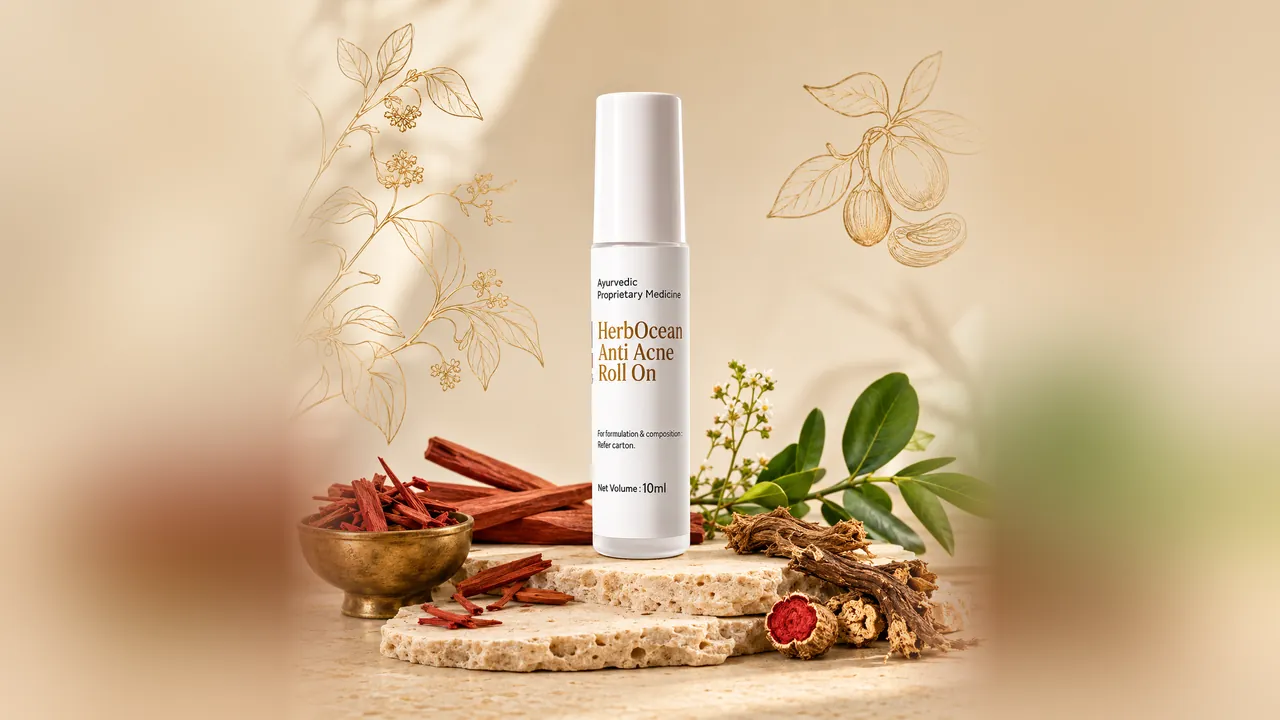
Manjistha (Rubia cordifolia, Indian madder) and Lodhra (Symplocos racemosa) are two classical Ayurvedic herbs with a long place in the care of acne and pimples. The Charaka Samhita lists Manjistha among its herbs for the colour of the skin, and the Ashtanga Hridaya names Lodhra in a classical paste for the acne eruption. Studies of either herb on its own for acne are still at the laboratory stage.
At the pansari, the two come as powders: a reddish one sold as manjith, and a brownish one sold as lodh. Both have been part of Indian skin care for generations, and both turn up on the labels of acne products today. They are different plants with different stories, so take them one at a time: what each one is, where the classical texts put it, what the research has looked at, and what to do about the mark a pimple leaves behind.
Key takeaways
- Manjistha (Rubia cordifolia) and Lodhra (Symplocos racemosa) are two separate plants, sold as manjith and as lodh.
- In Sutra Sthana 4, Charaka counts Manjistha among the ten Varnya herbs (the herbs for the colour of the skin), and the Ashtanga Hridaya, in its Uttara Sthana, gives a face paste for acne that contains Lodhra.
- The Sushruta Samhita, Nidana Sthana 13, traces acne to Kapha and Vata (two of the doshas, the biological energies Ayurveda works with) together with Rakta, the blood.
- Studies of each herb on its own for acne are at the laboratory stage, and a PubMed search found no trial in people of either herb alone.
- The flat brown mark a pimple can leave on melanin-rich skin is PIH; picking adds to it, and deep, painful or sudden adult acne belongs with a dermatologist.
What Are Manjistha and Lodhra?
Manjistha is the climbing plant botanists call Rubia cordifolia and English calls Indian madder; the bazaar sells its powder as manjith. For a long time it coloured cloth red, and the Bhavaprakasha Nighantu counts vastraranjini, literally the colourer of cloth, among its names.
Lodhra is Symplocos racemosa, a small evergreen tree of tropical and subtropical regions. Its powder is sold as lodh or lodh pathani, and the Ayurvedic Pharmacopoeia of India, the Government standard for these herbs, records its taste as astringent: the drying, puckering feel an unripe banana leaves in the mouth. The Bhavaprakasha Nighantu describes two kinds of lodhra, and with any herb powder, a packet that prints the Latin name tells you what you are buying.
Asked in Hindi, the question is manjistha muhanson ke liye (Manjistha for pimples), and the answer starts with telling the two plants apart. Each has its own classical home, and Manjistha has a second classical life in pigmentation care, covered in Manjistha for skin and dark spots.
Where the Classical Texts Place Manjistha and Lodhra
The Charaka Samhita, in its Sutra Sthana, chapter 4, sorts herbs into groups of ten and names each group for what it does. One of them is Varnya, the herbs for the colour of the skin, and Manjistha belongs to it, as do chandana (sandalwood) and madhuka, which is read as liquorice, with the wild Himalayan cherry and vetiver among the other seven.
Lodhra turns up somewhere else. The Ashtanga Hridaya of Vagbhata describes the acne eruption in Uttara Sthana 31: dense, painful pimples with a fatty core on young faces, from Kapha and Vata. The chapter that follows gives a face paste for it, Lodhra with coriander and sweet flag.
The same chapter is also where Manjistha shows its second side. Among the pastes it gives for Vyanga (the classical term for melasma) is Manjistha mixed with honey, and one verse there names Manjistha and Lodhra in a single list of herbs for Vyanga.
How Sushruta Reads Acne: Kapha, Vata and Rakta
The Sushruta Samhita takes up acne in Nidana Sthana 13, the chapter on Kshudra Roga (the minor conditions), forty-four of them in all. It describes acne under the name Yuvanpidika, eruptions on the faces of the young, and says they look like the thorns of the shalmali, the silk-cotton tree. It traces them to two doshas, Kapha and Vata, working with Rakta, the blood. Nothing in that reading blames acne on a lack of washing.
Then there is your own skin to think about. Indian skin is rich in melanin, and an inflamed pimple on it can leave a flat brown mark that dermatologists call post-inflammatory hyperpigmentation, or PIH. Davis and Callender, in a 2010 review from the United States, describe PIH as showing up more, and more strongly, on darker skin. So on Indian skin a pimple is two questions: the eruption now, and the mark it may leave.
Modern Research on Each Herb
For Manjistha, the acne study to know is laboratory work from 2003. Jain and Basal, at King George Medical College in Lucknow, exposed human white blood cells to fluid from cultures of the acne bacterium, then called Propionibacterium acnes and now Cutibacterium acnes, with and without herb extracts. They measured two things: the reactive oxygen species the white cells released, and the inflammatory cytokines from monocytes. The authors call these the two important signals of inflammation in acne. Rubia cordifolia was among the Indian herbs that lowered both. No patient took part: work like this shows what an extract does to cells in a dish, an early step before any study in people.
For Lodhra on its own, the paper to start with is a review. Acharya and colleagues, writing in the Journal of Ethnopharmacology in 2016, gathered laboratory and animal work on Symplocos racemosa and, in their conclusion, called for clinical validation; two of the five authors list industry affiliations. On the Manjistha side, a wider 2022 review of Rubia cordifolia by Wen and colleagues found that preclinical studies, which means laboratory or animal work, make up the larger part of the record.
We found no PubMed-indexed trial in people of either herb used on its own for acne, so the use of either plant by itself in acne rests on classical practice.
Manjistha and Lodhra Inside the Anti-Acne Roll-On
HerbOcean Anti-Acne Roll-On is an AYUSH-licensed Ayurvedic medicine for external use, classically indicated for acne and pimples (Yuvanpidika, the classical Ayurvedic term for acne, literally youthful eruption) and traditionally used in the care of post-acne marks and pigmentation (PIH). It carries six herbs in equal measure, Manjistha (Rubia cordifolia), Lodhra (Symplocos racemosa), Jaiphal (Myristica fragrans), Raktchandan (Pterocarpus santalinus), Daruhaldi (Berberis aristata) and Kuth (Saussurea lappa), in a glycerine and water base with lavender oil. It is made in-house at our GMP-certified unit in Bawana, Delhi, under AYUSH Licence No. DL-474 A&U, and built on the 40-year Ayurvedic formulation legacy of Vaidya Shri Ram Prakash Ji.
Cleanse and pat dry. Roll a thin layer directly over the pimple, morning and night. Follow with your moisturiser. For spot use, not full-face application.
For external use only. Patch-test on the inner forearm 24 hours before first use and discontinue if irritation occurs. Avoid it if you are allergic to a listed botanical, and keep it off broken skin and the eye and lip area. If pregnant or breastfeeding, check with your doctor. For the full steps, and what to layer with it, read how to use an Ayurvedic acne roll-on.
Humid Days, Hard Water and the Home Paste
On a humid day, sweat sits on the skin instead of drying off, and a helmet or a cap traps it along the forehead for the whole ride. Wash your face once the helmet comes off, and dry it without rubbing. Through the day, blot with a clean handkerchief rather than wiping with the back of a hand.
The water you wash in matters too. In parts of Delhi the water is hard, drawn from the ground, and a face washed in it can feel tight afterwards. In a 2018 study of 80 participants in Sheffield, Danby and colleagues washed patches of skin with sodium lauryl sulfate, a foaming agent used in cleansers, in water of different hardness. Hard water left the skin carrying more of the cleanser, and that leftover went with more irritation. Softening the water lessened the effect. It was not an acne study, but it gives one reason for that tight, drawn feeling.
Then the home paste. An ubtan, or a lodh or manjith paste mixed with water, is old household practice, and it comes with limits of its own. A home paste comes out different every time, and Manjistha can tint a pale towel. Astringent pastes suit oily skin better than dry skin, so if your face already feels drawn after washing, a lodh paste is not the one to reach for. Keep any home paste off broken or picked skin, and try a little of it on the inner forearm first.
When a Pimple Leaves a Mark
Once a pimple settles, a flat brown patch can stay behind. That is PIH, pigment left by the inflammation, and it sits flat: you can see it, but you cannot feel it. A scar is different, because it changes the surface of the skin itself, not only its pigment. Either way, keep your hands off the pimple: picking adds inflammation, and on melanin-rich skin that can mean more pigment later. Davis and Callender make the same point from the clinic side: care for PIH starts with settling the inflammation behind it.
For marks left after pimples there is a second medicine. HerbOcean Soundarya Cream is traditionally used in the care of post-acne marks: a rich saffron repair cream with bargad (Vatt) bark on a goat-milk and coconut base, with shea and kokum butters. It is rich, so very oily or acne-prone skin may not want it during an active phase.
Dark spots and melasma point to a different medicine: HerbOcean Radiance Tailam, an AYUSH-licensed Ayurvedic medicine for external use, classically indicated for melasma (Vyanga) and traditionally used to support even tone where dark spots and post-inflammatory hyperpigmentation (PIH) show on melanin-rich Indian skin. That 2010 review also puts sun protection in the first line of care for PIH. HerbOcean does not manufacture a sunscreen, and nothing in the range replaces one, so your sun protection stays a separate step.
Pimples a Dermatologist Should See
A dermatologist should see any deep, painful, cystic or nodular bump, since these can scar. The same goes for acne that begins suddenly after the teenage years, especially on the jaw and the chin alongside irregular periods, for scars that are pitted instead of flat, and for breakouts that are eating into your sleep or your mood. Pimple-like bumps in the armpits, the groin or the thighs need a dermatologist too, and painful ones that keep coming back in the same place need one soonest. If they come up only after hair removal, read bumps after waxing or threading. If a rash or a burning feeling lingers after you stop a spot product, that too needs the same visit, and a dermatologist can also say whether the bumps are acne at all.
If a dermatologist has already prescribed an acne medicine for you, check with that doctor before you put anything else on those pimples. For the wider picture, read our complete guide to ayurvedic treatment for acne.
One Pimple at a Time
If a pimple has come up today, leave it alone and keep your hands clean. Manjistha and Lodhra are two separate plants, each with its own place in the classical texts, and the modern research on each is still early. Let a dermatologist see the pimples that need one.
References: 1. Charaka Samhita, Sutra Sthana 4: the herbs set out in groups of ten, the Varnya group among them. 2. Sushruta Samhita, Nidana Sthana 13: Yuvanpidika among the forty-four minor conditions, from Kapha, Vata and Rakta. 3. Ashtanga Hridaya, Uttara Sthana 31 and 32: the acne eruption, a paste containing Lodhra for it, and the pastes for Vyanga, Manjistha with honey among them and one verse naming Manjistha and Lodhra. 4. Bhavaprakasha Nighantu, Haritakyadi Varga: the Manjishtha entry and its names, and the two kinds of lodhra. 5. The Ayurvedic Pharmacopoeia of India, Part I, Volume I: the Lodhra monograph. 6. Jain A, Basal E. Inhibition of Propionibacterium acnes-induced mediators of inflammation by Indian herbs. Phytomedicine, 2003; 10(1): 34 to 38. Laboratory study on human white blood cells, King George Medical College, Lucknow, India; no patients. 7. Acharya N, Acharya S, Shah U, Shah R, Hingorani L. A comprehensive analysis on Symplocos racemosa Roxb.: traditional uses, botany, phytochemistry and pharmacological activities. Journal of Ethnopharmacology, 2016; 181: 236 to 251. Review of laboratory and animal work; two authors list industry affiliations. 8. Wen M, Chen Q, Chen W and colleagues. A comprehensive review of Rubia cordifolia L.: traditional uses, phytochemistry, pharmacological activities, and clinical applications. Frontiers in Pharmacology, 2022; 13: 965390. Review, China; preclinical studies make up the larger part. 9. Davis EC, Callender VD. Postinflammatory hyperpigmentation: a review of the epidemiology, clinical features, and treatment options in skin of color. Journal of Clinical and Aesthetic Dermatology, 2010; 3(7): 20 to 31. Narrative review, United States. 10. Danby SG, Brown K, Wigley AM and colleagues. The effect of water hardness on surfactant deposition after washing and subsequent skin irritation in atopic dermatitis patients and healthy control subjects. Journal of Investigative Dermatology, 2018; 138(1): 68 to 77. Case control washing study, 80 participants, Sheffield, United Kingdom; funded by a water softener maker. Educational, not medical advice.
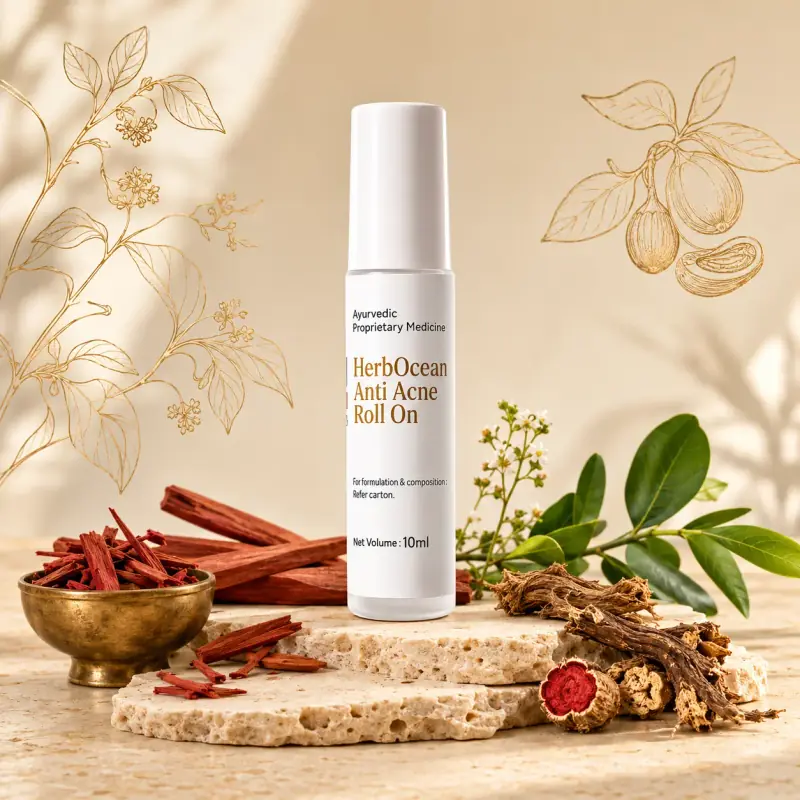
Anti-Acne Roll-On
Ayurvedic spot care for active pimples and post-acne marks (PIH) — a herbal roll-on classically indicated for acne (Yuvanpidika). Made in-house in Delhi.
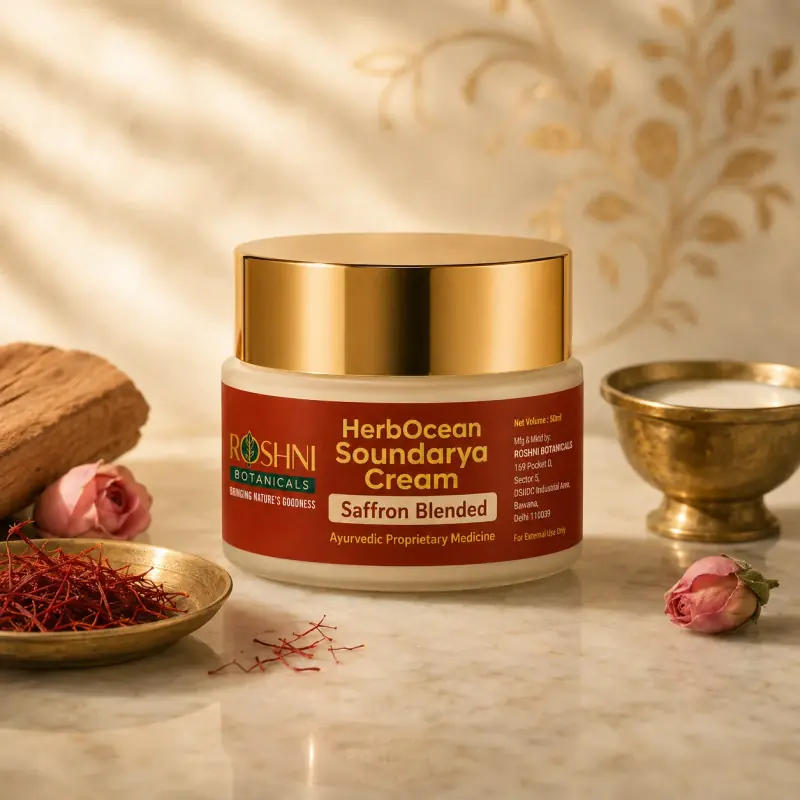
Soundarya Cream
A rich saffron brightening and repair cream with bargad (Vatt) bark on a goat-milk and coconut base, with shea and kokum butters, traditionally used in the care of skin where post-acne marks (PIH) linger.
Part of our guide: Ayurvedic treatment for acne: the complete guide.