
Does Oily Skin Need Moisturiser? Why Over-Washing Backfires in Indian Humidity
Yes, and the usual explanation for why is more contested than anyone admits. What the evidence actually supports about oily skin, washing and Indian humidity.
Ask anyone in Mumbai or Chennai in August and you will hear the same thing: the face is already shining by 11 am, so why add a moisturiser on top? It sounds logical. It is also why a lot of oily, pimple-prone Indian skin stays stuck in the same loop all season, harsh washing, that tight squeaky feeling, and even more shine by afternoon.
Key takeaways
- Yes, oily skin needs a moisturiser. Oiliness and hydration are measured separately in skin research, and a face can register as oily and low on water at the same time.
- Whether harsh cleansing makes the glands produce more oil has never actually been tested. We looked in both directions and found no controlled trial. Anyone telling you confidently that oil rebound is real, or that it is a myth, is going beyond the evidence.
- How you wash is far better evidenced than how often. Alkaline soaps and harsh surfactants measurably disturb the skin barrier; hot water makes a detergent harsher rather than doing the damage itself.
- Wash gently for the ordinary reason, not the dramatic one. Dermatology guidance says scrubbing with cloths and tools irritates skin. That scrubbing itself leaves dark marks is not something anyone has measured.
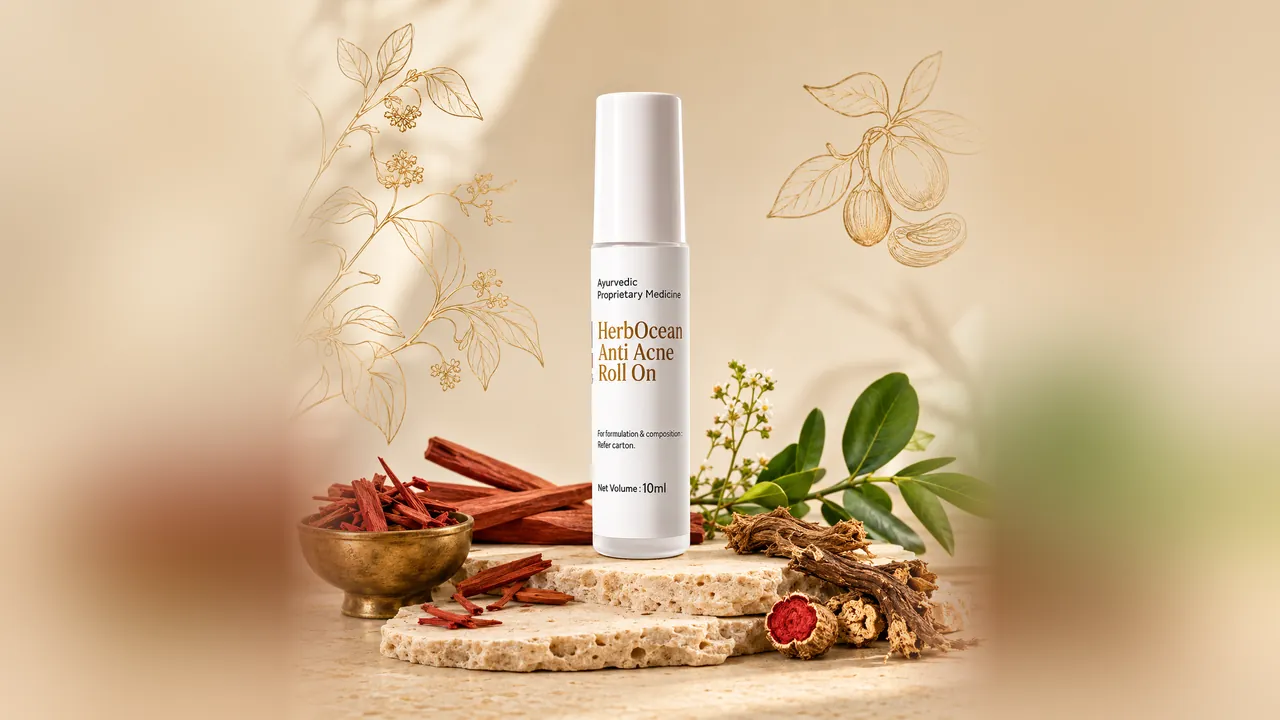
- The HerbOcean Anti-Acne Roll-On is targeted spot care, an Ayurvedic medicine classically indicated for acne. It is not a moisturiser and does not replace one.
Yes, And Here Is the Part Nobody Can Actually Tell You
Yes, oily skin needs a moisturiser. That is the whole answer, and the rest of this explains why the opposite feels so convincing, and where the usual explanation runs out of evidence.
Start with what is solid. How much oil your skin makes is largely inherited. A twin study of twenty identical and twenty non-identical like-sex pairs in the UK found identical twins had virtually indistinguishable rates of sebum excretion, while non-identical twins differed significantly (Walton, Wyatt and Cunliffe, British Journal of Dermatology, 1988). Yet those identical twins still differed significantly in how severe their acne was. Same oil, different skin. That distinction matters more here than anything a cleanser does.
Now the part where almost every article on this question overreaches. You have certainly met the claim that stripping your skin triggers the glands to produce more oil in revenge. We searched in both directions and could not find a controlled trial measuring sebum production before and after harsh versus gentle cleansing. It appears the experiment has not been done. We are not going to fill that gap with a story in either direction, and we would treat with caution anyone who tells you confidently that oil rebound is real, or that it is a myth. Neither position has a trial behind it.
What has been measured is narrower. A Danish method-development study of twelve volunteers found sebum output returned to its resting level about two hours after the skin was degreased (Rode, Ivens and Serup, Skin Research and Technology, 2000). It did not compare harsh cleansers with gentle ones and did not look for any overshoot above baseline. Oil comes back within about two hours. Whether it comes back higher than it started is a question that study did not ask.
There is one piece of real biology that probably seeded the myth, and it is worth knowing with its limits attached. When the skin barrier is damaged, the epidermis does step up its own lipid production to repair itself, making more cholesterol, free fatty acids and ceramides. That work was done in hairless mice using acetone and tape-stripping (Proksch and colleagues, British Journal of Dermatology, 1993). Real mechanism, wrong gland, and a laboratory model rather than a measurement of your face. If you came here from a breakout search rather than an oiliness one, our complete guide to ayurvedic treatment for acne covers the wider picture.
Oily and Short of Water Are Two Different Measurements
Skin research treats oiliness and hydration as two separate axes. Surface oil is read with a sebumeter; the water content of the outermost layer is read separately by corneometry. Because they are scored independently, a face can come out oily and low on water at the same time. A cross-sectional study of 62 Thai women found exactly that dissociation: the self-described oily group carried roughly twice the sebum of the dry group, yet measured lower on hydration (Skin Research and Technology, 2020). Both that study and the larger classification work behind it are East Asian, and we have not been able to cite comparable Indian facial data.
What that means in the mirror is less precise than most articles pretend. There is no published diagnostic test for skin dehydration, no questionnaire validated against corneometry, so what follows is what practitioners look for rather than a verdict. Visible flaking or a rough surface despite the oil. Skin that looks dull while still shining. A tight sensation after cleansing that does not settle quickly. We are deliberately not giving you a scoring rule or a number of minutes, because the literature does not carry one and the precise-sounding thresholds you will find elsewhere are invented.
Peak monsoon confuses people here, so plainly: humid air on your face is not the same as water held inside your skin. A sticky, shiny face can still be a dehydrated one. Do not read the stickiness as hydration.
How You Wash Matters More Than How Often
This is where the evidence is genuinely good. Alkaline soaps and cleansers built on harsh anionic surfactants disturb the barrier measurably. In a five-day forearm study of thirty adults with sensitive skin in Mexico, the irritation each cleanser produced tracked its pH (Baranda and colleagues, International Journal of Dermatology, 2002). In irritant patch testing in Germany, sodium lauryl sulfate raised water loss through the skin so persistently it was still elevated ten days later, while gentler surfactants were barely detectable (Loffler and Happle, Contact Dermatitis, 2003). And in a three-month randomised comparison of 120 young people with mild inflammatory acne, spot counts fell on an acidic syndet bar and did not on a conventional alkaline soap, with irritation reported by 40.4 per cent on soap against 1.8 per cent on the syndet (Korting and colleagues, Infection, 1995). It is the surfactant class that matters, not the lather.
Hot water is better understood as an amplifier than a separate insult. In a Danish forearm study, ten people immersed in plain water at 20 and 40 degrees showed no change at either temperature; a separate ten immersed in a detergent showed significantly more water loss at 40 degrees than at 20 (Ohlenschlaeger and colleagues, Acta Dermato-Venereologica, 1996). Warmth makes a detergent harsher. Lukewarm and a gentle cleanser is the sensible pairing, twice a day at most.
On scrubbing, the advice is right but the usual reason for it is not. Dermatology guidance is to wash gently with fingertips rather than cloths, sponges or tools, because those irritate the skin. What that guidance stops short of saying, and what we found no published study measuring, is that the scrubbing itself leaves dark marks behind. The pigment link is well established at the other end of the chain: among 324 acne patients across seven Asian countries, 58.2 per cent had post-inflammatory hyperpigmentation, lasting a year or more in over half (Journal of Dermatology, 2016), and a study of 100 consecutive acne patients at a Chennai hospital recorded post-acne pigmentation in 79 per cent. So leave spots alone and wash gently, for the ordinary reason. Where those marks are already the concern, HerbOcean Soundarya Cream is the preparation built for them.
Hard water adds a layer in the parts of Delhi that run on groundwater. In a 2018 dataset of fifty groundwater samples from South West Delhi, forty-one were very hard, above 300 mg per litre, while three sat in the soft-to-moderate band, so the picture is skewed hard rather than uniformly hard, and it describes groundwater rather than the piped supply. The mechanism is documented: calcium and magnesium react with the fatty acids in soap to leave an insoluble residue that survives rinsing. Multani mitti packs and besan-haldi ubtan belong in this conversation too, and our multani mitti post covers the practice properly. A drying clay pack used daily through the monsoon is the same stripping problem wearing different clothes. Keep them occasional, and follow with a moisturiser.
What Ayurveda Organises, and What It Does Not
Ayurveda organises care as a routine rather than a product list: a daily one, dinacharya (the daily routine), and a seasonal one, Ritucharya (the seasonal routine). The daily regimen is set out in Ashtanga Hridaya, Sutrasthana 2, with fuller procedural detail in Charaka Samhita, Sutrasthana 5, and Sushruta's chapter on preventive regimen adds a daily washing of the mouth and eyes with a decoction of amla or with plenty of cold water, alongside a daily anointing of the face (Sushruta Samhita, Chikitsasthana 24). The seasonal chapters do change what goes onto the body as the year turns, sandalwood anointing through the heat of Grishma and dry herbal rubbing, bathing and fresh clothing through the monsoon.
Two honest limits on that. Those chapters reason from strength and the season's dominant taste rather than from the skin, and they address the body rather than the face. And they give no washing counts, so anyone quoting you a classical number of face washes per day is inventing it. The instinct is still the right one, and it is the one a Delhi monsoon forces on you: a regimen should move with the season. If monsoon breakouts specifically brought you here, how acne behaves differently during the Indian monsoon is the post for that.
Where Spot Care Fits, and Where It Does Not
A moisturiser looks after the whole face. It was never designed for one angry pimple, and the logic runs the other way too: the HerbOcean Anti-Acne Roll-On is targeted spot care, not a moisturiser and not a substitute for one. Moisturising is a separate step in your routine, and this preparation does not do it. Use both, for different jobs. It is an Ayurvedic medicine classically indicated for acne and pimples (Yuvanpidika, the classical Ayurvedic term for acne, literally youthful eruption) and traditionally used in the care of post-acne marks and pigmentation.
Six classical herbs at equal inclusion make up the formula: Manjistha (Manjith), Lodhra (Lodhr), Jaiphal, Raktchandan, Daruhaldi and Kuth, carried in glycerine with DM water, gluconolactone, sodium benzoate and lavender oil. There is no neem in it. Worth noting on the classical side, since it is usually got wrong: Sushruta attributes Yuvanpidika to Kapha, Vata and Rakta (Sushruta Samhita, Nidana Sthana 13), and Vagbhata describes the same eruptions arising from Vata and Kapha. Neither text names Pitta.
Roshni Botanicals manufactures in-house at Bawana, Delhi, under AYUSH Licence No. DL-474 A&U, with a government-issued Schedule-T GMP certificate for Ayurvedic drugs and ISO 9001:2015 certification, and follows the forty-year Ayurvedic formulation legacy of Vaidya Shri Ram Prakash Ji.
Through the day, lift surface shine with blotting paper rather than reaching for another wash. That is practical routine advice rather than a research finding, and there is no trial comparing blotting against washing. One caution does come from a study: in eleven healthy volunteers at a Bangkok hospital, blotting over a chemical sunscreen applied half an hour earlier cut its measured protection by about a third (Photodermatology, Photoimmunology and Photomedicine, 2021). Mineral sunscreens were not tested. If you are blotting in daylight, reapply your sunscreen afterwards.
The order is simple: cleanse gently, moisturise across the whole face, then place the roll-on precisely on active spots. It is for external use, so patch-test on the jawline first. See a dermatologist the same day if acne comes on suddenly and severely with fever or joint pain. Book an appointment if you have deep, painful nodules, if spots are scarring, or if the marks left behind are not fading. If acne is affecting your mood or your sleep, that is reason enough to be seen regardless of how mild it looks. On timing, UK guidance is that a treatment needs a fair twelve-week run before you judge it, and that two different twelve-week courses without improvement is the point to consider a specialist rather than to keep waiting.
Moisturise, Then Aim Small
Oily skin needs moisturiser, and over-washing leaves the face tighter whichever way the rebound argument eventually settles, if it ever does. Look after the whole face first with something light enough for August, keep the cleansing gentle, and let individual pimples have their own targeted attention.
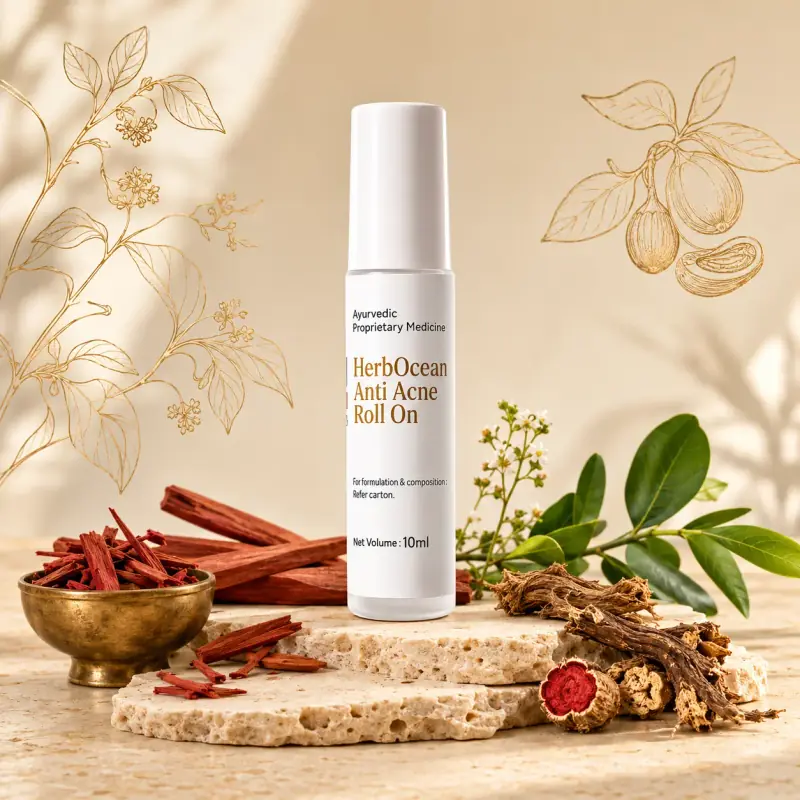
Anti-Acne Roll-On
Ayurvedic spot care for active pimples and post-acne marks (PIH) — a herbal roll-on classically indicated for acne (Yuvanpidika). Made in-house in Delhi.
Part of our guide: Ayurvedic treatment for acne: the complete guide.