Sunscreen for Oily, Acne-Prone Indian Skin: Gel or Cream, and How Much
Gel, fluid or cream on oily Indian skin, how much a face actually takes, and reapplying on a scooter commute. Plus where a spot step sits in the morning.
Scroll the comments under any Indian skincare reel and one objection keeps surfacing: my skin is already oily, sunscreen will only make it worse. The worry is earned. A thick white cream that slid off by lunch is enough to file sunscreen away as a problem for other people.
So, plainly, at the top: HerbOcean does not manufacture a sunscreen, and nothing in the range replaces one. What follows is about textures, label words and quantity, the three parts of the decision that settle whether a sunscreen gets worn at all on oily, acne-prone skin.
Key takeaways
- SPF grades protection against UVB and the PA rating grades UVA, so a carton carrying both tells you more than a high number alone.
- On melanin-rich Indian skin, sunlight on a settled pimple is what keeps the post-acne mark, or post-inflammatory hyperpigmentation (PIH), topped up long after the spot itself has gone.
- The filters decide how much ultraviolet light is stopped; the base decides whether you will wear it. The SPF number and the texture are separate choices.
- Non-comedogenic is an assessment a brand makes of its own formula. There is no standard test a brand must pass, so read it as a signal rather than a promise.
- Two finger-lengths is the usual working measure for face and neck, and comfort decides whether reapplication happens at all.
Why Acne-Prone Skin Is Exactly the Skin That Needs Sunscreen
A pimple is an inflammatory event before it is anything else. On Fitzpatrick skin types IV and V, the types most common in India (Fitzpatrick is the scale dermatologists use for how skin responds to sun), that inflammation leaves extra pigment behind, and what is left once the spot settles is a flat brown mark. Pigment, in other words. Nobody gets marks by being unclean, and no extra washing shifts one once it has arrived.
Here is where the sun walks in. Ultraviolet exposure sets off that pigment response and worsens it, so sunlight on the same patch of skin keeps the mark topped up, and a mark can sit for months, and sometimes longer. Sun protection does not speed a mark up; what it does is stop the mark being darkened again every afternoon. Picking compounds it: squeeze, inflame, darken, step out at midday. Not sure what you are looking at? The honest self-check between acne scars and marks takes two minutes.
Classical Ayurveda has its own name for this. Bhrajaka pitta is the part of pitta (one of the three doshas, the biological energies of Ayurveda) seated in the skin itself. Sushruta calls it the agni (digestive fire) of the skin at Sutra Sthana 21, the pitta that processes whatever is applied to the skin from outside, and repeated heat is traditionally described as aggravating it. The link to sunlight specifically is a modern dermatological finding, not something the classical verse says. So for acne-prone skin, sunscreen is mostly about the marks.
Gel, Fluid or Cream: What Actually Changes on Oily Skin
Two things get confused on a sunscreen carton. Filters decide how much ultraviolet light is stopped, and that is what the SPF number and the PA rating describe: SPF refers mainly to UVB, the PA grading to UVA. The base those filters ride in, gel or lotion, decides whether you are still wearing it by the middle of the afternoon. Read the carton for both, because a high SPF in a base you will not tolerate protects nobody.
Gel and aqua-gel bases are mostly water and light solvents that dry down quickly and leave a thinner film, so they sit lighter on sebum-heavy skin in Delhi, Mumbai or Chennai. Rich creams carry more emollient, lovely on dry or mature skin and heavy by noon on oily skin. Whichever base carries them, the filters do the same job; what changes is whether you keep it on all day.
Zinc oxide and titanium dioxide are mineral filters, and why cloud cover is not sun protection works through what the tinted versions are doing on deeper skin. An SPF 30 fluid you actually reapply serves you better than an SPF 50 cream abandoned by lunch.
As the monsoon pulls back in North India and the air starts to dry, some oily-skinned readers ease off moisturiser instead. They should not, and does oily skin need moisturiser sets out why. A sunscreen is not a moisturiser either, so the two stay separate steps in the morning order below.
One label word deserves a plain reading. Non-comedogenic means a product is formulated to be less likely to block pores, but the term is not strictly regulated in India, and the testing behind it is imperfect everywhere, so no label can promise a formula will suit your pores. Our guide to makeup on acne-prone skin takes the word apart properly; here it is enough to treat it as a signal rather than a promise.
The phrase does have a history. The ingredient lists behind it came from an assay run on rabbit ears, published at the end of the nineteen-seventies, on a model that reacts far more readily than human skin. When finished products built with those same ingredients were later tested on human skin, they did not necessarily turn out to be comedogenic. So look at where the heavy esters and occlusives sit in the ingredient order, buy the smallest size first, and let your own skin settle it over a few weeks; the first few days tell you almost nothing.
A sunscreen that seems to set off a breakout is worth one change rather than a walkout: a lighter texture at the same SPF, or a fragrance-free one. Patch-test it on the inner forearm before a first full application, and switch textures before you quit the category.
How Much, How Often, and the Indian Commute Problem
Quantity is the part that is easiest to get wrong. Two finger-lengths is the usual working measure, a strip of product down the index and middle fingers, for face and neck together. Indian dermatology guidance gives the same area as about a teaspoon instead, which tells you how rough both measures are. Real-world use keeps coming in well below the amount used in testing, and the protection that reaches your face falls with it, to roughly a third of the number on the carton. Two thin passes beat one heroic layer: the first over the whole face and neck, the second once it has set, with the ears, the hairline and the back of the neck included on a two-wheeler.
Reapplication is the harder half, particularly if your afternoon involves a two-wheeler. Indian dermatology guidance puts reapplication at about every two hours outdoors. An Indian sunscreen consensus is less strict when the full amount went on to begin with, but both agree on the part that matters here: sweat, water and a wiped face reset it. If your day includes two wheels or the walk back from the metro, plan for it.
Build it around the fixed points of a working day rather than around a rule. The morning layer goes on after moisturiser and before the helmet or the dupatta. The top-up that actually happens is the one you manage at your desk in the middle of the afternoon, so keep a small tube in your bag, not on the bathroom shelf. A window seat in an office or a bus counts as daytime exposure too, and the monsoon guide linked above has the glass measurements.
Over makeup, a stick or compact format beats skipping the step; the makeup guide above covers what a base is doing on a humid commute. Helmet straps and mask edges bring their own bumps, and sweat, kit and the commute covers that pattern properly, as does the acne hygiene system for the strap, the towel and the phone. Organise around the strongest hours, the two either side of midday, where the day allows. Grey afternoons are not time off, and the monsoon guide carries the figures.
Where Spot Care Fits in the Morning Order
The order is short. Cleanse, let your skin dry properly, then roll a thin layer directly over the pimple. Follow with your moisturiser, then sunscreen over the whole face as the last daytime step. The spot step goes on clean, dry skin, which is why it comes before the sunscreen and not after. At night the order is the same without the sunscreen: cleanse, dry, the spot step, then moisturiser.
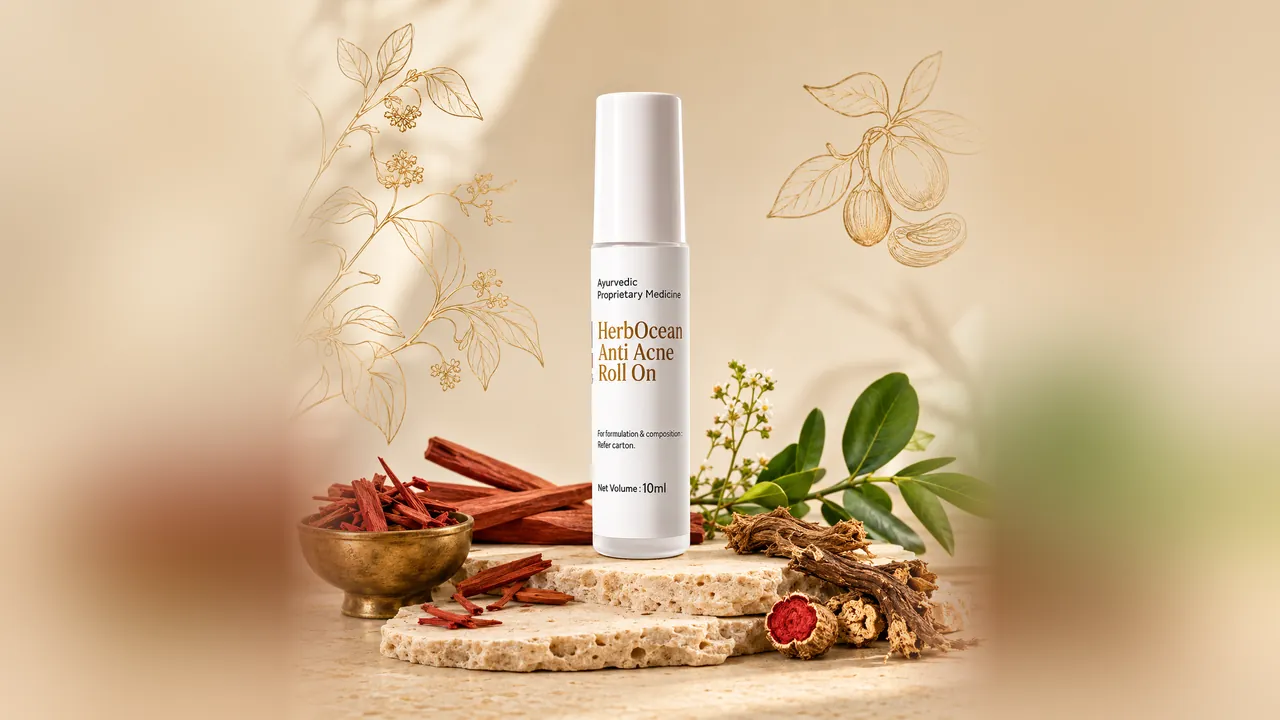
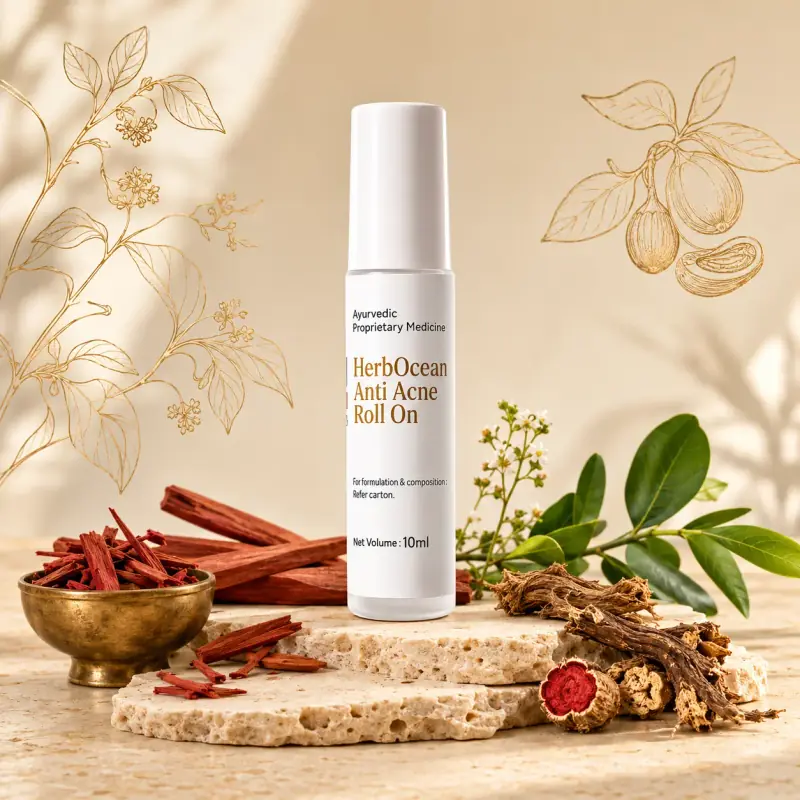
For individual spots, HerbOcean Anti-Acne Roll-On is an AYUSH-licensed Ayurvedic medicine, Licence No. DL-474 A&U, for external use, classically indicated for acne and pimples (Yuvanpidika, the classical Ayurvedic term for acne, literally youthful eruption) and traditionally used in the care of post-acne marks and pigmentation (PIH). Cleanse, pat dry, then roll a thin layer directly over the pimple, morning and night, then follow with your moisturiser. Spot use only, not across the whole face.
Six classical botanicals in equal measure, the same dose for every one: Manjistha, Lodhra, nutmeg (Jaiphal), red sandalwood (Raktchandan), Indian berberry (Daruhaldi) and costus root (Kuth), carried in a glycerine and purified-water base, with lavender for aroma. No single herb leads the formula. There is no neem in it and no tea tree.
It is built on the 40-year Ayurvedic formulation legacy of Vaidya Shri Ram Prakash Ji, and it is made in-house at our GMP-certified unit in Bawana, Delhi.
For external use. Patch-test on the inner forearm before a first full application, and keep it away from the eye area. If you are pregnant or nursing, ask your Ayurvedic physician before use. HerbOcean does not manufacture a sunscreen, and nothing in the range replaces one, so your sun protection stays a separate step.
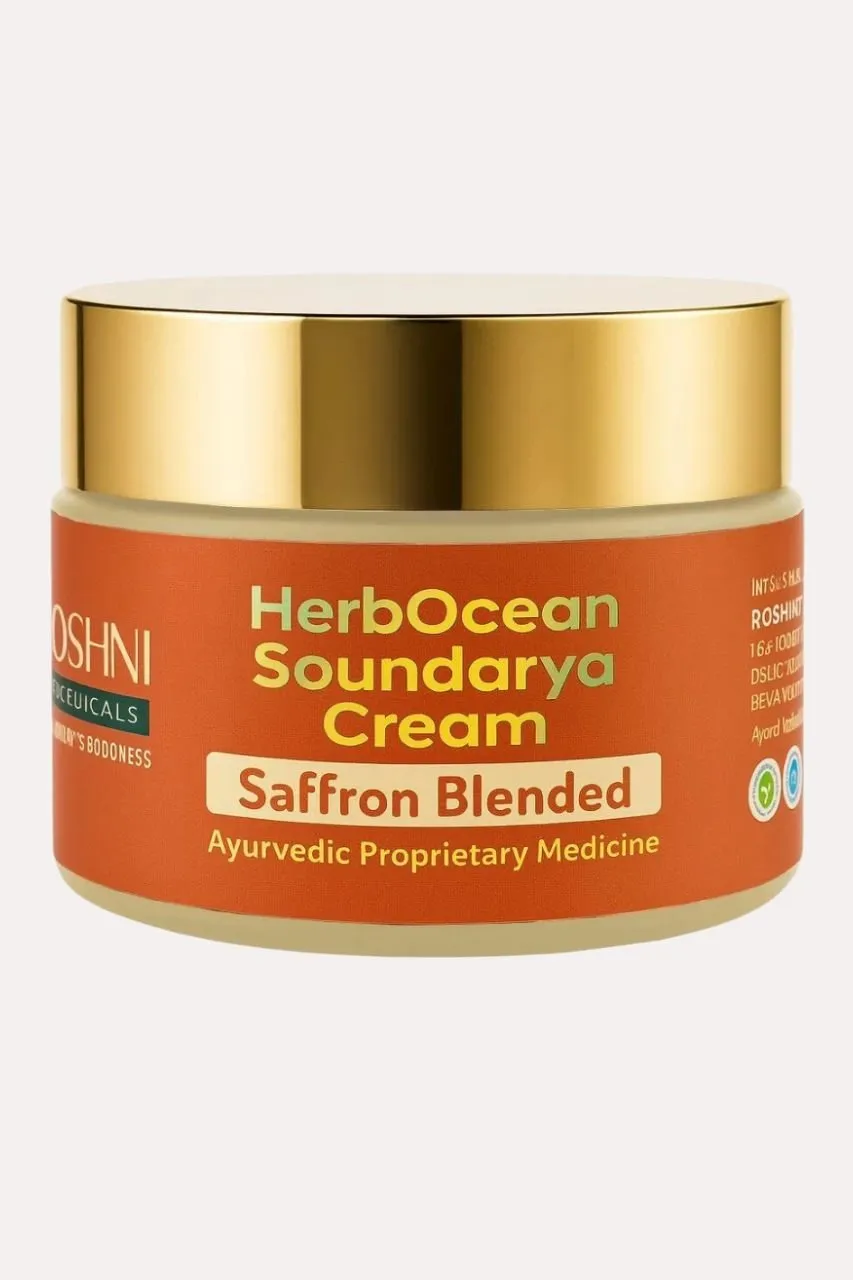
Where marks rather than active spots are the worry, Soundarya Cream is traditionally used in the care of post-acne marks: a rich saffron repair cream with bargad (Vatt) bark on a goat-milk and coconut base, with shea and kokum butters. It is rich, so very oily or acne-prone skin may not want it during an active phase. After a long day outdoors, Ayurvedic care for sun-exposed skin is the evening reading.
When the Sunscreen Is Not the Problem: See a Dermatologist
Book an appointment for deep, painful nodules or cysts along the jaw and neck; for acne that has turned up suddenly in your thirties or forties; for breakouts that arrive alongside irregular cycles or new facial hair growth, which deserve a doctor review rather than another spot product; and for pigmentation spreading symmetrically across both cheeks and the upper lip rather than sitting in old pimple spots, which is a different problem from PIH. A sunscreen reaction with stinging, swelling or a rash is a clinic visit too.
One more, because it catches people out. If you are on isotretinoin, on a tetracycline antibiotic such as doxycycline, or using a retinoid at night, your skin is more sensitive to sunlight and needs more sun care rather than less. Those routes are different from a classical preparation, and the choice between them belongs to you and someone who has seen your face.
Access is its own issue. A private dermatologist is one door. The skin OPD at a government hospital is another perfectly legitimate one, usually at a far lower cost.
Buy the One You Will Actually Wear
So: a gel or fluid you find comfortable, worn daily, grey mornings included. For sun protection you need a sunscreen, shade, clothing and a hat, and a routine that survives the commute.
If breakouts are still arriving alongside the marks, our complete guide to ayurvedic treatment for acne sets out the whole classical framework, and the HerbOcean Anti-Acne Roll-On is the spot step described above. And if the spots along your jaw are deep and painful, book the dermatologist before you browse another shelf.
References: Sushruta Samhita, Sutra Sthana 21 (the pitta seated in the skin is named Bhrajaka and described as the agni that takes in what is applied from outside). Nouveau S, Agrawal D, Kohli M, Bernerd F, Misra N, Nayak CS. Skin hyperpigmentation in Indian population: insights and best practice. Indian Journal of Dermatology. 2016;61(5):487-495 (narrative review, so no sample size and no single study population; four of its six authors employed by a skincare company; ultraviolet exposure initiates and worsens post-inflammatory hyperpigmentation, which can last from months to years). Sarkar R, Garg VK, Jain A, Agarwal D, Wagle A, Flament F, Verschoore M. Indian Journal of Dermatology, Venereology and Leprology. 2019;85(2):160-168 (randomised, uncontrolled, investigator-blinded single-centre study of 230 Indian adults comparing two sunscreens, four of its seven authors employed by the skincare company that funded it; cited for its record that Indian phototypes run from III in the north to VI in the south with the majority at IV and V). Taylor S, Diffey B. Simple dosage guide for suncreams will help users. British Medical Journal. 2002;324(7352):1526 (a letter rather than a study; two strips of product along the index and middle fingers for each area of the body, the face and neck counting as one; ordinary use delivers perhaps a third of the factor stated on the pack). Indian Association of Dermatologists, Venereologists and Leprologists, public guidance on sunscreens (about a teaspoon for face, head and neck; reapply every two hours and more often with sweating or towelling; SPF describes UVB and PA describes UVA). Kohli M, Srinivas CR, Saraswat A and colleagues. Practical recommendations for Indians on sunscreen use, a modified Delphi consensus by the Indian Sunscreen Forum. Journal of Cosmetic Dermatology. 2025;24(9):e70441 (consensus of fourteen Indian dermatologists over two voting rounds, supported by a pharmaceutical company with four of its authors employed there; gels and aqueous lotions placed first for oily and acne-prone skin; tinted inorganic filters carrying iron oxide preferred for melasma and other pigmentation disorders; reapplication within eight hours held unnecessary when the full amount went on, and always after sweating or wiping). Kligman AM, Kwong T. An improved rabbit ear model for assessing comedogenic substances. British Journal of Dermatology. 1979;100(6):699-702 (the animal assay behind the legacy ingredient lists). Draelos ZD, DiNardo JC. A re-evaluation of the comedogenicity concept. Journal of the American Academy of Dermatology. 2006;54(3):507-512 (six subjects, upper back, modified human assay, United States; finished products built with comedogenic ingredients are not necessarily comedogenic). Blakely KM, Drucker AM, Rosen CF. Drug-induced photosensitivity, an update: culprit drugs, prevention and management. Drug Safety. 2019;42(7):827-847 (review; tetracyclines among the most commonly implicated drugs, with retinoid and isotretinoin photosensitivity also covered). Educational, not medical advice.
Anti-Acne Roll-On
Ayurvedic spot care for active pimples and post-acne marks (PIH) — a herbal roll-on classically indicated for acne (Yuvanpidika). Made in-house in Delhi.
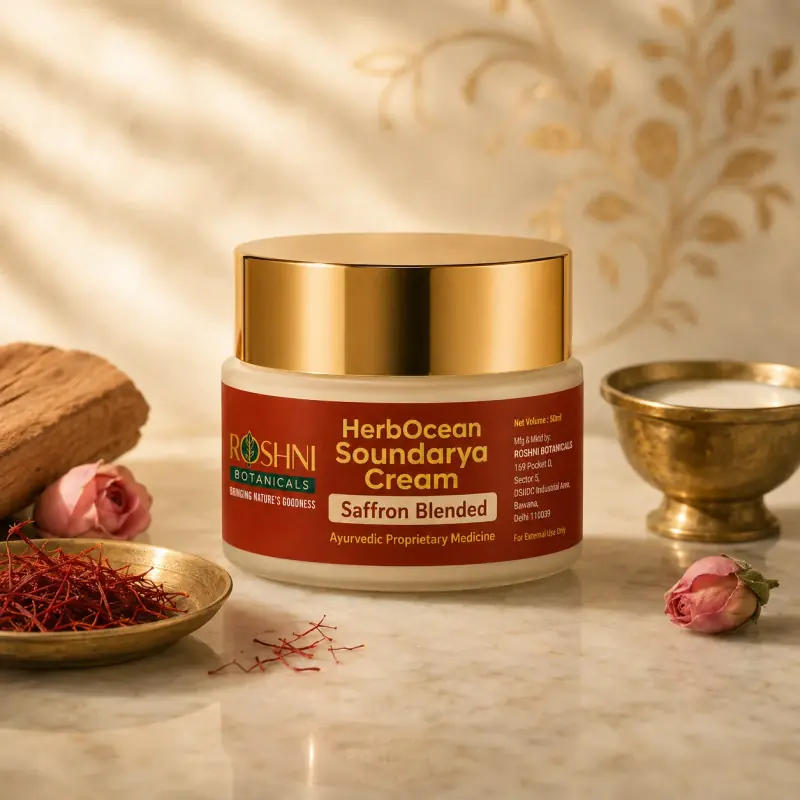
Soundarya Cream
A rich saffron brightening and repair cream with bargad (Vatt) bark on a goat-milk and coconut base, with shea and kokum butters — often reached for where post-acne marks (PIH) linger.
Part of our guide: Ayurvedic treatment for acne: the complete guide.