Sunscreen in Monsoon: Why Cloud Cover Is Not Sun Protection for Indian Skin
Cloud thins ultraviolet rather than removing it, and the warmth fades before the exposure does. What that means for pigmentation on Indian skin in August.
Some monsoon mornings in Delhi or Pune the sky stays grey till noon, and the sunscreen stays in the drawer. That one skipped step is why a lot of careful pigmentation routines quietly stall across July, August and September. Ultraviolet does not take a break for the rains, and on melanin-rich skin the marks it deepens are the slowest ones to settle.
Key takeaways
- Cloud thins ultraviolet rather than switching it off. The most-quoted figure, that up to 80 per cent gets through, comes from a WHO guide and describes light cloud specifically. That qualifier is almost always dropped in the retelling.
- Warmth reaches you as a direct beam from the sun; a large share of ultraviolet arrives as scattered skylight from the whole dome. So when cloud covers the sun the heat goes and much of the ultraviolet stays, and the sensation that normally warns you is gone before the exposure is.
- Ordinary window glass blocks sunburn-range ultraviolet almost entirely but lets roughly three-quarters of long-wave UVA through, along with visible light. A desk beside glass is a pigmentation exposure, not a sunburn one.
- Visible light darkens deeper skin tones in laboratory testing, and no SPF number describes protection against it. Tinted formulas using iron oxides are the practical answer, and they solve the grey-cast complaint at the same time.
- HerbOcean does not make a sunscreen. Radiance Cream carries no sun protection factor and is not sun protection. It belongs to the night half of a routine.
What Actually Gets Through a Grey Sky
Start with the figure everyone quotes, because it is real but routinely mangled. It comes from the World Health Organization's 2002 guide to the Global Solar UV Index, written with the WMO, UNEP and ICNIRP, in a table set up to correct the belief that you cannot burn on a cloudy day. The sentence reads that up to 80 per cent of solar ultraviolet can penetrate light cloud cover. Drop that one word, as almost every repetition does, and the claim stops being defensible. Worth knowing too that the same eighteen-page booklet says something different a few pages earlier, where an infographic puts it at over 90 per cent, and neither number is footnoted to a study or a measurement anywhere in the document. They are public-health shorthand, not readings.
There is a more specific set of numbers, and it repays reading carefully. The American Environmental Protection Agency publishes a worked description of how the US National Weather Service calculates its UV Index. Against four categories of sky it puts transmission at virtually 100 per cent under clear skies, 89 per cent under scattered cloud, 73 per cent under broken cloud, and 31 per cent under overcast. Those are not percentages of raw ultraviolet. In the worked example the calculation first weights every wavelength by how efficiently it actually burns skin, adds the weighted values up, and only then multiplies by the cloud figure. So 73 per cent means 73 per cent of sunburn-weighted ultraviolet.
Three caveats before carrying any of that into a Delhi July. It is an American description of an American calculation, published for US cities, and it is not the number your weather app shows you here. The Weather Service upgraded the model in November 2023, and we could not confirm those four multipliers survive unchanged in the current code, so read them as a published illustration of how cloud is handled rather than as today's constants. And the terms describe how much sky the cloud covers, not how thick it is: scattered means three to four eighths of the sky, broken five to seven, overcast the full eight. A thin high veil and a loaded monsoon deck both read as eight eighths. Nobody has published a figure for a north Indian monsoon sky. Take 31 per cent as an order of magnitude, not a reading for the cloud above you.
The honest version, then. A genuinely dark, unbroken storm sky really does cut your exposure substantially, and this post is not going to pretend otherwise. The trouble is that most monsoon days are not that. They are bright grey rather than black, and that is the sky people misjudge.
Why the Warning Sensation Disappears First
Two different things are happening on a grey day and it helps to separate them. Warmth arrives overwhelmingly as a direct beam from the sun's disc. Ultraviolet does not. Air molecules scatter short wavelengths far more strongly, so a large share of the ultraviolet reaching the ground comes as diffuse skylight from the whole dome, even when the sun itself is covered. Cloud droplets compound the difference, because water absorbs infrared strongly while being effectively transparent to ultraviolet, which it only scatters. So when cloud slides across the sun, the warmth largely goes and a good share of the ultraviolet stays.
One piece of folk knowledge is worth knocking on the head while we are here, because this post's earlier drafts carried it too. It is often said that cloud filters out sunburn-range UVB while waving long-wave UVA straight through. The measurements, such as they are, run the other way. When German researchers compared spectra above and below a single even cloud layer in the Alps, the layer let through 60 per cent of the UVB against 45 per cent of the UVA (Seckmeyer, Albold and Erb, Geophysical Research Letters, 1996). That is one cloud event at a European latitude, and atmospheric physics rather than a clinical study. Read it only as evidence that grey skies dim all of the ultraviolet somewhat, not one half of it a lot.
Glass is the exception where the split is real and well documented. Ordinary window glass blocks UVB essentially completely while transmitting around three-quarters of UVA, along with visible light (Duarte and colleagues, Photodermatology, Photoimmunology and Photomedicine, 2009, a bench study of glass types). Car glazing is not uniform either: laminated windscreens block far more UVA than tempered side windows do, though the published measurements are of American vehicle fleets and we have no Indian figures. The practical reading is simple. A desk beside a window, or a long commute in the passenger seat, is a pigmentation exposure rather than a sunburn one.
Visible Light, and Why Indian Skin Is the Case That Matters
Deeper skin does carry some intrinsic photoprotection. Laboratory measurements on excised human epidermis found roughly five times as much ultraviolet reaching the upper dermis in very fair skin as in deeply pigmented skin. Two things about that matter here. It compared the two extremes, and Indian skin sits between them and was never measured. And it measured ultraviolet only.
Visible light was not in that frame at all, and visible light is a large part of what darkens Indian skin. In a controlled study at Henry Ford Hospital in Detroit with the Johnson and Johnson Skin Research Center, twenty volunteers with Fitzpatrick IV to VI skin had the lower back irradiated with visible light and with long-wave UVA (Mahmoud and colleagues, Journal of Investigative Dermatology, 2010). Both produced pigmentation. The pigmentation from visible light was darker and lasted longer. Fitzpatrick II skin was irradiated in the same study and showed none at all. Two of the eight authors worked for a sunscreen manufacturer, which is worth knowing when you weigh it. The exposures were lamp doses, and nobody has published what visible light does under monsoon cloud in north India, so take this as a reason to keep sun care through the rains rather than as a measured quantity.
The pigment, in other words, does not spare you. It is the thing that responds. That is also why post-acne and post-irritation marks last so long here: across 324 acne patients in seven Asian countries, 58 per cent had post-inflammatory hyperpigmentation (PIH), and in more than half of those it had persisted a year or longer (Journal of Dermatology, 2016). The spot is days. The mark is seasons. Our night routine for dark spots goes into that distinction properly.
SPF says nothing about any of this, because the number is measured against sunburn-causing ultraviolet. That is not the same as saying untinted sunscreens are transparent to visible light. Zinc oxide and titanium dioxide are used in nanoparticle form precisely so they do not leave a white cast, and in that form they do not block it. For a sunscreen to protect against visible light it has to be visible on the skin, which is why tinted products pair iron oxides with pigmentary titanium dioxide. Two small industry-authored studies sit behind the tinted recommendation, one of ten Fitzpatrick IV women in the United States, so treat the direction as sound and the evidence base as thin. The useful part for an Indian reader is that the tint which addresses visible light is the same tint that stops plain zinc leaving a grey cast on deeper skin.
What Ayurveda Actually Says About Vyanga
Classical Ayurveda had a name for facial pigmentation: Vyanga. Sushruta places it among the kshudra roga, the minor disorders, at Nidana Sthana 13, and the description is precise: thin, painless, dusky circular patches on the face. Vagbhata gives the same picture in the Ashtanga Hridaya at Uttara Sthana 31, and names the patch appearing anywhere other than the face differently, as nilika.
Two things in those verses are usually misquoted, including in earlier versions of our own writing. The triggers the texts name are not sun. They are krodha (anger), ayasa (exertion and fatigue) and shoka (grief). Sun exposure is a modern dermatological finding about melasma, not something the classical verse says. And this is not a Pitta story on its own: Sushruta describes vata aggravating first and then joining with pitta before reaching the face, and Charaka, who does not treat Vyanga as a separate disease at all, lists it among the disorders of vitiated rakta (blood) at Sutra Sthana 28. Vata with Pitta, over vitiated Rakta, is the accurate reading.
Where Pitta does govern the skin directly is bhrajaka pitta, the pitta seated in the skin itself. Sushruta calls it the agni (digestive fire) of the skin at Sutra Sthana 21: it processes what is applied externally through oiling, bathing and pastes, and it is what reveals the skin's complexion. That is the classical basis for approaching pigmentation topically at all, and our ayurvedic care for melasma on Indian skin sets out the fuller picture.
Where Radiance Cream Fits, and Where It Does Not
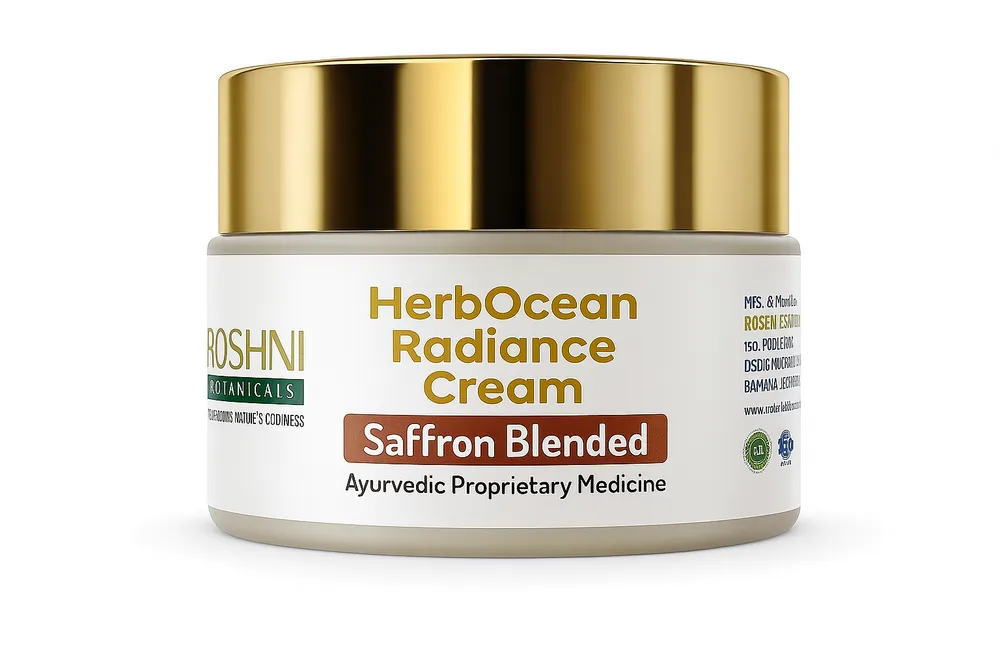
A note on what we do and do not make. HerbOcean does not manufacture a sunscreen. HerbOcean Radiance Cream carries no sun protection factor and is not sun protection. It will not stand in for sunscreen, and we would rather lose the sale than have you believe otherwise. For the daytime half of this, use a broad-spectrum sunscreen from a company that makes one.
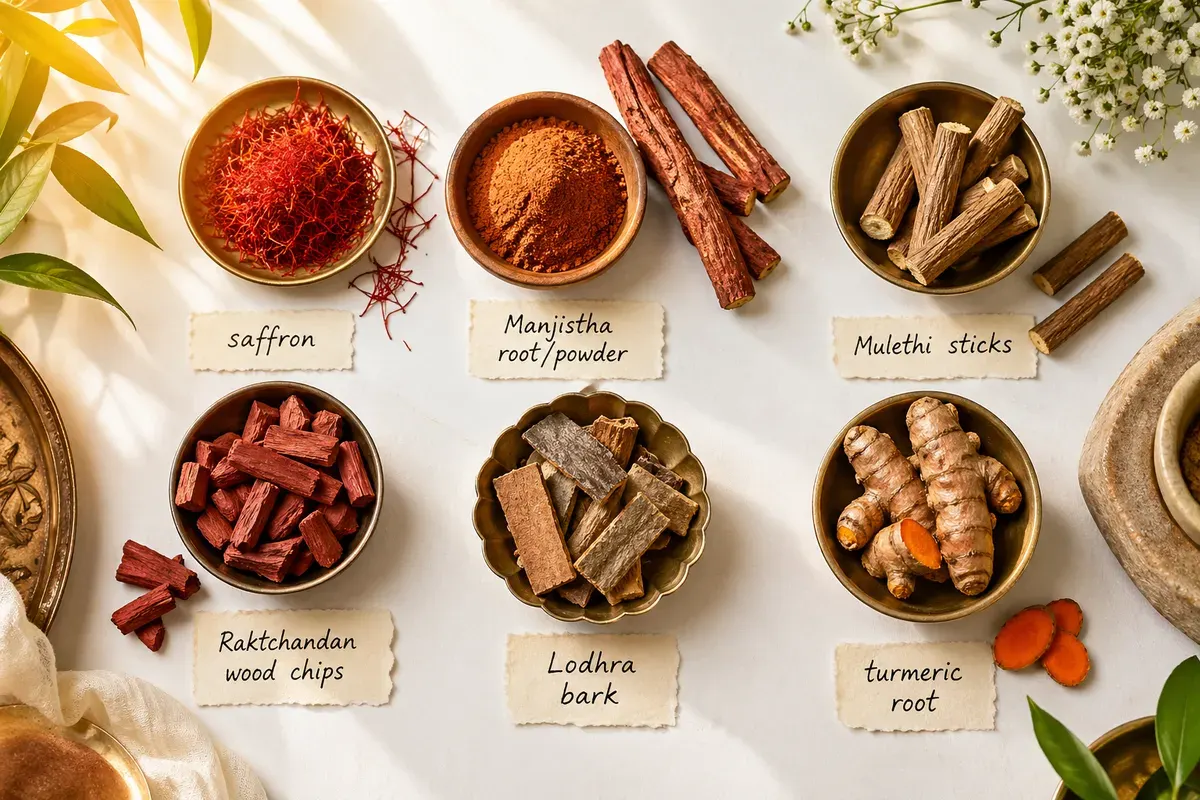
What it is: an Ayurvedic medicine for external use under AYUSH Licence No. DL-474 A&U, traditionally used in the care of facial pigmentation (Vyanga), meant for clean skin at night. Saffron (Kesar), sandalwood (Chandan), Indian madder (Manjistha), red sandalwood (Raktchandan), lotus (Kamal) and wild Himalayan cherry (Padmaakh) lead the formula. Behind them sit turmeric (Haldi), costus root (Kuth), Kakoli (Lilium polyphyllum), flame of the forest (Palash) and the three Triphala fruits, amla, baheda and harad, in a coconut oil and cream base finished with lavender, rose and mogra oils.
It is formulated by Vaidya Shri Ram Prakash Ji, on the forty-year Ayurvedic formulation legacy the HerbOcean line is built on, and made in-house at Bawana, Delhi under a Schedule-T GMP certificate for Ayurvedic drugs, with an ISO 9001:2015 quality management certificate covering the HerbOcean range. Use a pea-sized quantity at night, patch-test on the inner forearm before the first full application, and judge it over six to eight weeks rather than a few days. If the marks you are working on are the ones acne leaves behind, HerbOcean Soundarya Cream is the better-suited preparation of the two.
One more variable that quietly undoes all of this. Scrubbing sunscreen off at night with a harsh face wash leaves the barrier stripped, and a stripped, irritated barrier marks more readily than a calm one. Hard water makes that worse, and Delhi's groundwater is measurably hard: across fifty samples from South West Delhi, 82 per cent were classed very hard, above 300 mg per litre (Acharya, Sharma and Khandegar, Data in Brief, 2018). Use a gentle cleanser and lukewarm rather than hot water. The dupatta over the head and the umbrella carried for rain both genuinely help, though neither stands in for sun care.
Know when this stops being a routine question. See a dermatologist if a pigmented patch spreads noticeably over a few weeks, if a mole changes shape, colour or border, if pigmentation arrives with itching, burning or scaling, if it started after a new medicine, or if it appeared suddenly with no sun exposure behind it.
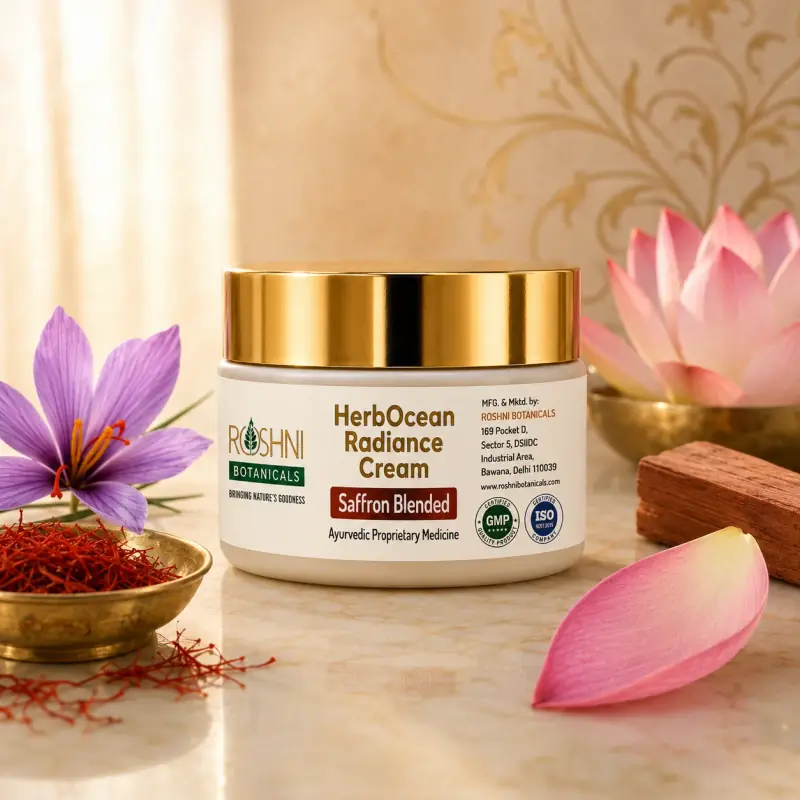
Radiance Cream
A daily saffron and sandalwood brightening cream with Manjistha, red sandalwood and lotus in a light coconut base. Supports a luminous, even-looking complexion.
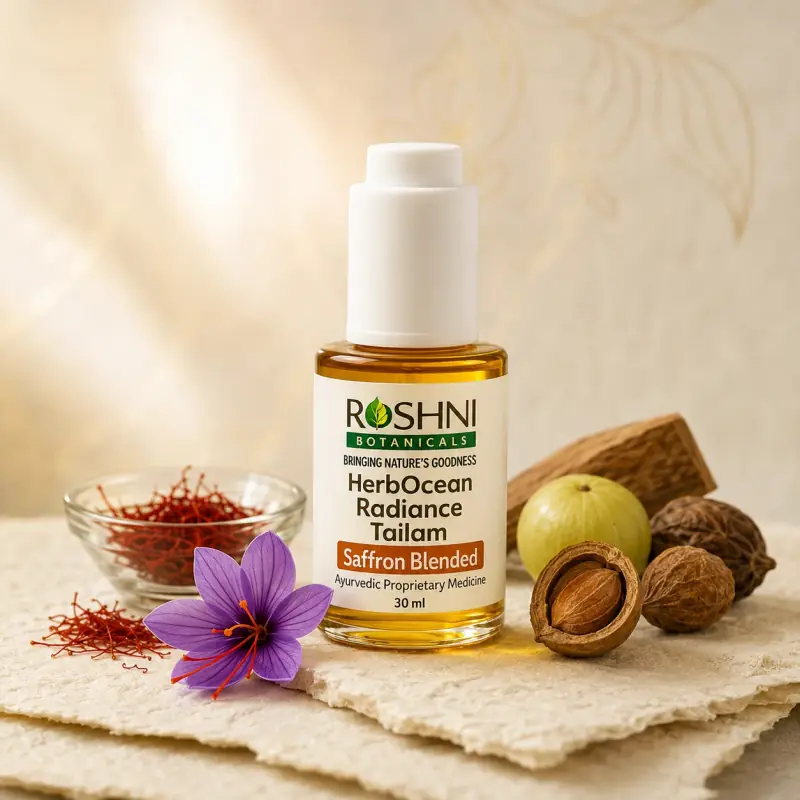
Radiance Tailam
A saffron brightening facial Taila with Manjistha and red sandalwood, traditionally used to support even tone where melasma, dark spots and PIH show.
Part of our guide: Ayurvedic treatment for melasma on Indian skin.