A Night Routine for Dark Spots: An Ayurvedic Night Ritual with Radiance Tailam
The honest version of a night routine for dark spots: a gentle cleanse, a few drops of Radiance Tailam, real sleep, and how to tell in eight weeks if it is working.

Somewhere on your feed tonight, a product will promise to sort out your dark spots overnight. Your skin runs on a different clock. The honest version of a night routine for dark spots is quieter and better: a gentle cleanse, a few drops of a classical facial oil, and sleep taken seriously, repeated until the weeks do their work. This guide lays out that ritual, why night is genuinely the right time for it, and how to tell in eight weeks whether it is working.
Key takeaways
- Skin repair has a night shift: cell renewal and barrier recovery are higher while you sleep, which is why both classical Ayurveda and modern dermatology time richer applications for bedtime.
- The most powerful step in any night routine for dark spots is the sleeping itself; a serum applied at 1 am sits on skin that never entered its proper repair window.
- Classical Ayurveda groups facial pigmentation under melasma (Vyanga, the classical term) and reads it through Bhrajaka Pitta (the Pitta sub-dosha governing skin lustre, colour and absorption).
- On melanin-rich Indian skin, honest timelines run eight to twelve weeks; judge progress with a weekly photo in the same light, not a daily mirror check.
- HerbOcean Radiance Tailam, a brightening sesame-based facial oil with Triphala, saffron and Manjistha, is traditionally used in the care of dark spots and melasma, applied as two to three drops at night; morning sunscreen is its non-negotiable daytime partner.
Why Night Is When Your Skin Repairs Itself
Your skin keeps time. Through the day it plays defence, managing sun, sweat, pollution and the rubbing of a commute; at night it switches to repair, and measured markers of skin activity, from cell renewal to barrier recovery, rise in the hours after you fall asleep. The practical meaning is simple: what you apply at night sits on skin that is actively rebuilding, and what you apply in the morning sits on skin braced for the day.
Classical Ayurveda arrived at the same architecture from observation. The daily routine (dinacharya) has an evening counterpart, the classical night regimen (Ratricharya), and the tradition timed its richer oils for the end of the day, when the body turns inward. The faculty it credited is Bhrajaka Pitta: the skin as an organ that receives and processes what is placed on it, best approached when it is quiet. Two systems, one conclusion: night is when patient skin work happens.
Which is also why the saboteurs matter. A 9:30 dinner, the last hour of reels in bed, the laptop that follows you past midnight: each pushes sleep past the window in which the repair shift does its best work. No oil compensates for a routine that never lets the night happen. If one change carries this whole post, it is a fixed, earlier lights-out, with the ritual below as the pleasant reason to keep it.
First, Name Your Mark: Not All Dark Spots Are One Thing
Before you build a routine, look closely at what you are actually working on, because different marks live on different timelines. A flat brown spot where a pimple once sat is post-inflammatory hyperpigmentation (PIH), extra pigment laid down by melanin-rich skin in response to inflammation; it responds to patience and protection. A reddish or purplish mark that never was brown is a different event, and our guide to brown marks versus red marks on Indian skin walks through telling them apart. Larger soft-edged patches across the cheeks, forehead or upper lip, often symmetrical, sit in melasma territory (Vyanga), which classical Ayurveda described among facial discolourations centuries ago (Sushruta Samhita, Nidana Sthana) and which deserves its own fuller plan in our melasma guide.
This naming step is where Indian skin needs particular honesty. Melanin-rich skin marks readily and holds pigment longer, hormonal shifts and pregnancy deepen patches in ways a spot never follows, and the DIY shortcuts that circulate on family groups, raw lemon, harsh scrubbing, mystery bleach creams, add irritation that becomes new pigment. The routine below suits spots and marks; a patch that behaves like melasma, or any mark you cannot confidently name, earns a proper look before a product does.
The season adds its own layer right now. July heat and humidity keep sweat on the face for hours, and the day-long cycle of wiping it away with a dupatta, a tissue or the back of a hand is low-grade friction landing exactly where marks already sit. Heat itself can provoke pigment on susceptible skin, which is why some patches deepen every summer and monsoon without a single new pimple. Through these months, blot rather than wipe, wash the face gently after a drenched commute, and let the night ritual be the calm end to a day that was rough on your skin in ways you did not notice.
The Ritual, Step by Step: Cleanse, Three Drops, Sleep
The whole ritual takes five unhurried minutes. Cleanse gently and pat the skin mostly dry; a trace of dampness helps the oil spread thin. Warm two to three drops of Radiance Tailam between your fingertips, and work it over the face in slow upward and outward strokes for about two minutes, the classical facial massage (Mukha Abhyanga) rhythm: forehead centre outward, cheeks upward, jaw to ear. Let it settle, put the phone away, and be asleep by around eleven. There is no rinsing, no second layer, no step two. Two to three drops is the full dose; more oil does not mean faster results.
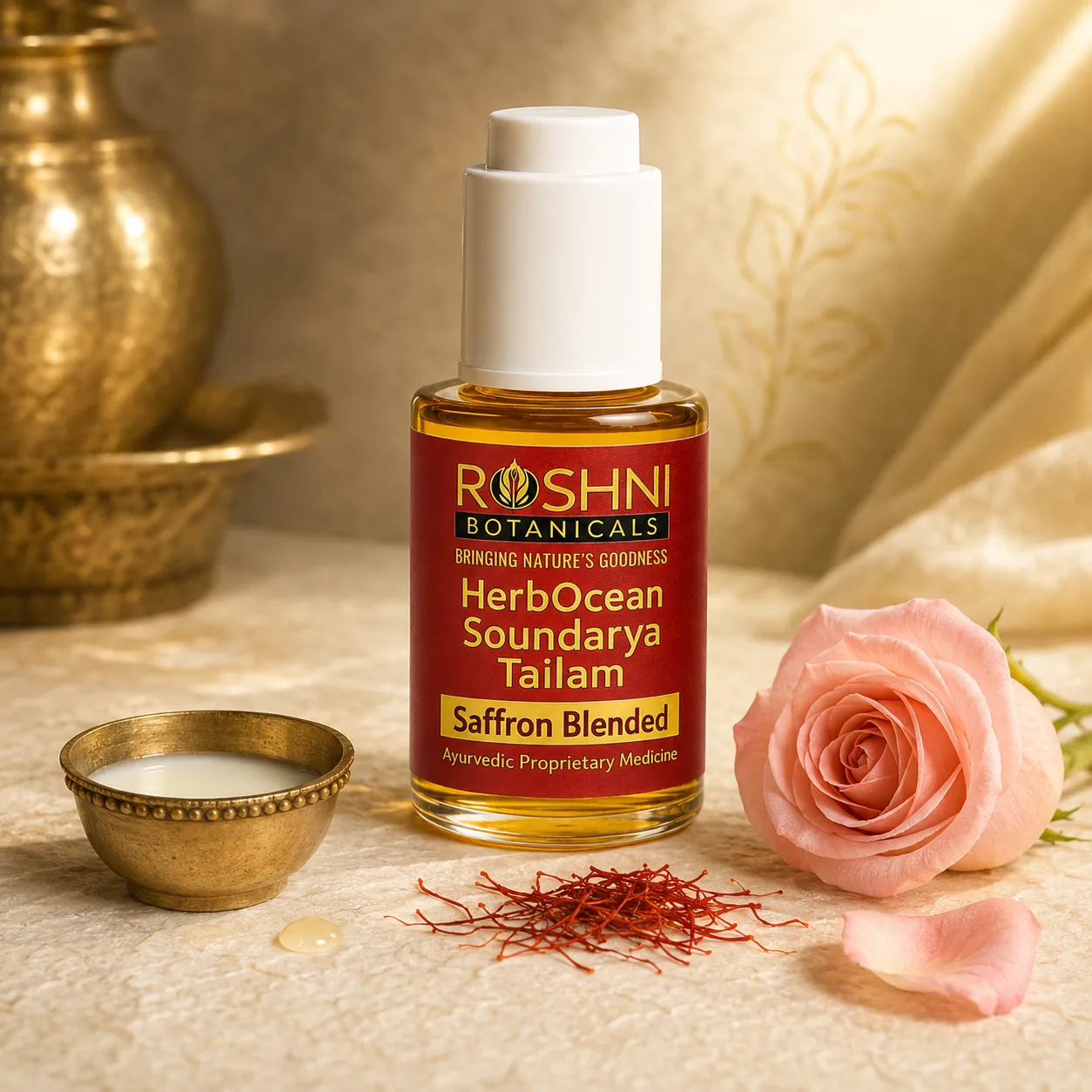
What you are applying carries the classical complexion-care (Varnya) tradition in a sesame base. Radiance Tailam pairs the Triphala fruits, Amla, Baheda and Harad, with saffron (Kesar), Manjistha, sandalwood (Chandan), red sandalwood (Raktchandan), lotus (Kamal) and turmeric (Haldi), herbs the classical texts placed in complexion care, in the classical understanding cooling the heat that Bhrajaka Pitta expresses as uneven colour. It is an AYUSH-licensed Ayurvedic medicine (Licence No. DL-474 A&U) for external use, traditionally used in the care of melasma (Vyanga), dark spots and post-inflammatory marks, formulated by Vaidya Shri Ram Prakash Ji, the master vaidya whose 40-year formulation legacy the HerbOcean line is built on, and made in-house at Roshni Botanicals’ GMP-certified unit in Bawana, Delhi.
Just as important is what the night does not need. Do not scrub pigmented skin before bed; exfoliation feels like progress and behaves like provocation, and on melanin-rich skin the irritation of an over-scrubbed evening often returns as deeper colour. Do not layer strong actives over the oil, or the oil over them, in the hope of doubling the effect; a night routine for dark spots fails more often from over-treatment than from under-treatment. And leave the kitchen out of it after dark: lemon on skin that is about to spend eight hours undisturbed is a recipe for waking up worse. One gentle cleanse, one measured oil, one early night. The restraint is the routine.
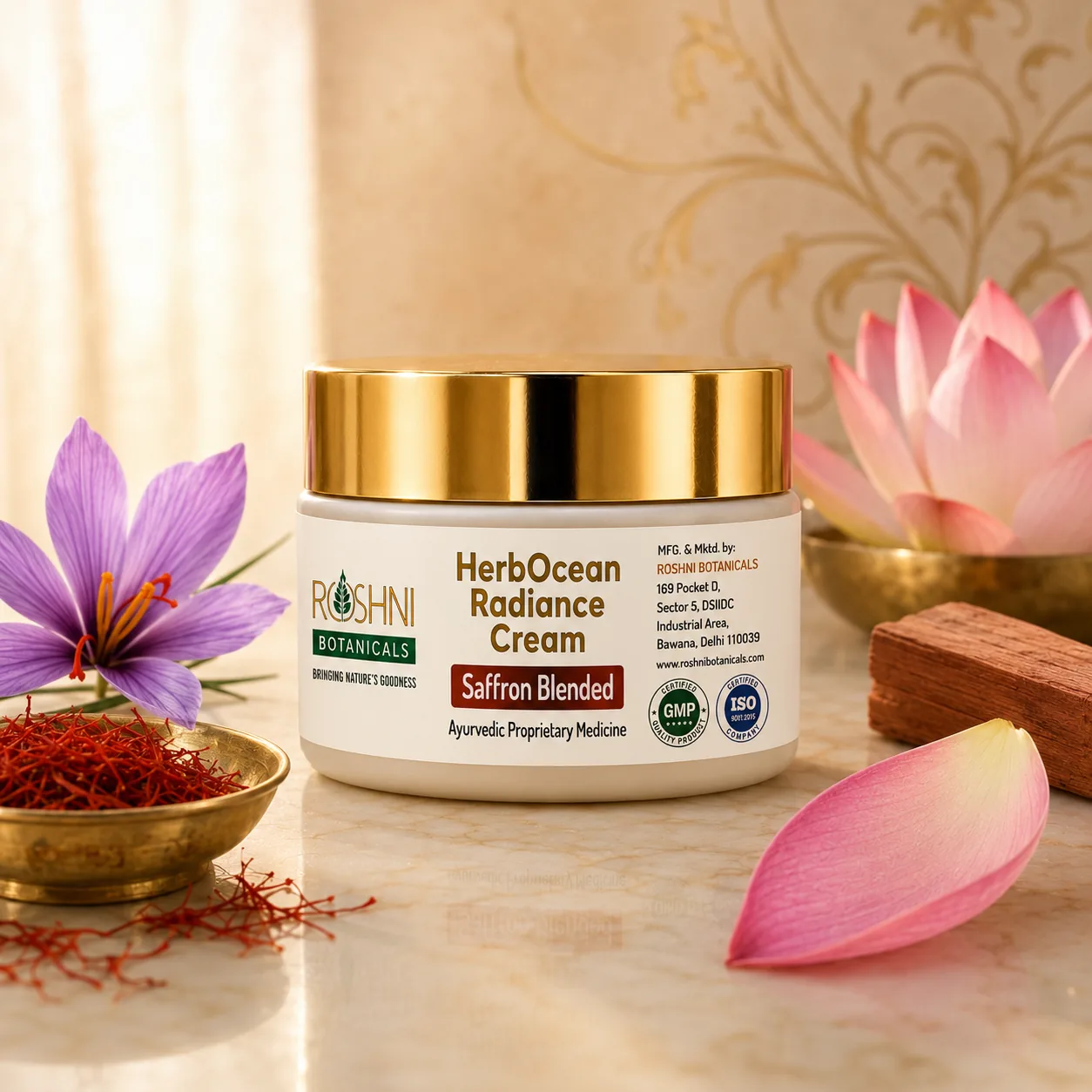
Two adjustments keep the ritual honest through an Indian year. In humid monsoon weeks, two drops on damp skin are enough, and the oil sits better after a thorough evening cleanse, since hard tap water in most metros already leaves the barrier slightly stressed; in dry northern winters the fuller three drops earn their place. And as with any preparation, patch-test on the inner forearm for 24 hours before the first facial use. Readers who prefer a cream texture to an oil have the same herb tradition in Radiance Cream; the choice is texture, not hierarchy.
Weeks, Not Days: How to Measure Without Losing Heart
Here is the honesty the overnight promises skip. Pigment in melanin-rich skin settles deep and shifts slowly; give the ritual eight to twelve weeks of consistency before you judge it, which is roughly two to three full cycles of skin renewal. Progress rarely announces itself in a mirror you check daily. Take one photo a week instead, same spot, same light, same time of day, near a window on a Sunday morning works well, and compare across a month. What improvement genuinely looks like is edges softening and the gap between the mark and the surrounding skin narrowing, not a mark vanishing between Tuesday and Friday. Consistency of the ritual matters more than intensity, and the sleep is doing as much work as the oil.
The timeline has a mechanism, which makes it easier to trust. Skin renews itself on a cycle of roughly four weeks, and the pigment in a mark sits through several of those cycles before the difference shows at the surface, which is why eight to twelve weeks is biology rather than a brand being cautious. The inputs beyond the bottle count across those weeks too: steady sleep, earlier dinners and less refined sugar are habits many people find reflected in their skin, and Ayurveda always read the complexion as a report on the whole routine, not the shelf alone. Feed the weeks well and the weeks repay it.
Morning Sunscreen: The Half of the Routine That Happens at 8 AM
A pigmentation night routine without daytime sun protection is a bucket filled under an open tap. Indian latitudes deliver pigment-deepening light all year, through cloud, through the car window, on the two-wheeler commute and at the office window seat, and every unprotected hour asks the night to redo its work. A broad-spectrum sunscreen of SPF 30 or higher every morning, reapplied before the evening commute home, is the single strongest ally your marks have. If you adopt only two habits from this post, make them the early lights-out and the morning sunscreen; the drops in between simply get to do their job.
When Dark Spots Deserve a Dermatologist First
Some marks should be examined before any routine, classical or modern. See a dermatologist promptly for a spot that grows, darkens quickly, bleeds, itches or has irregular borders; for pigmentation that appears suddenly or spreads across the cheeks in weeks; for patches that surfaced after starting a new medicine, including hormonal contraception; and for marks that have not budged after about three months of consistent, gentle care with sun protection. None of this is alarmism; it is sequencing. A correctly named mark makes every later step work better, and a dermatologist and a vaidya are allies more often than alternatives.
Give Your Nights the Job
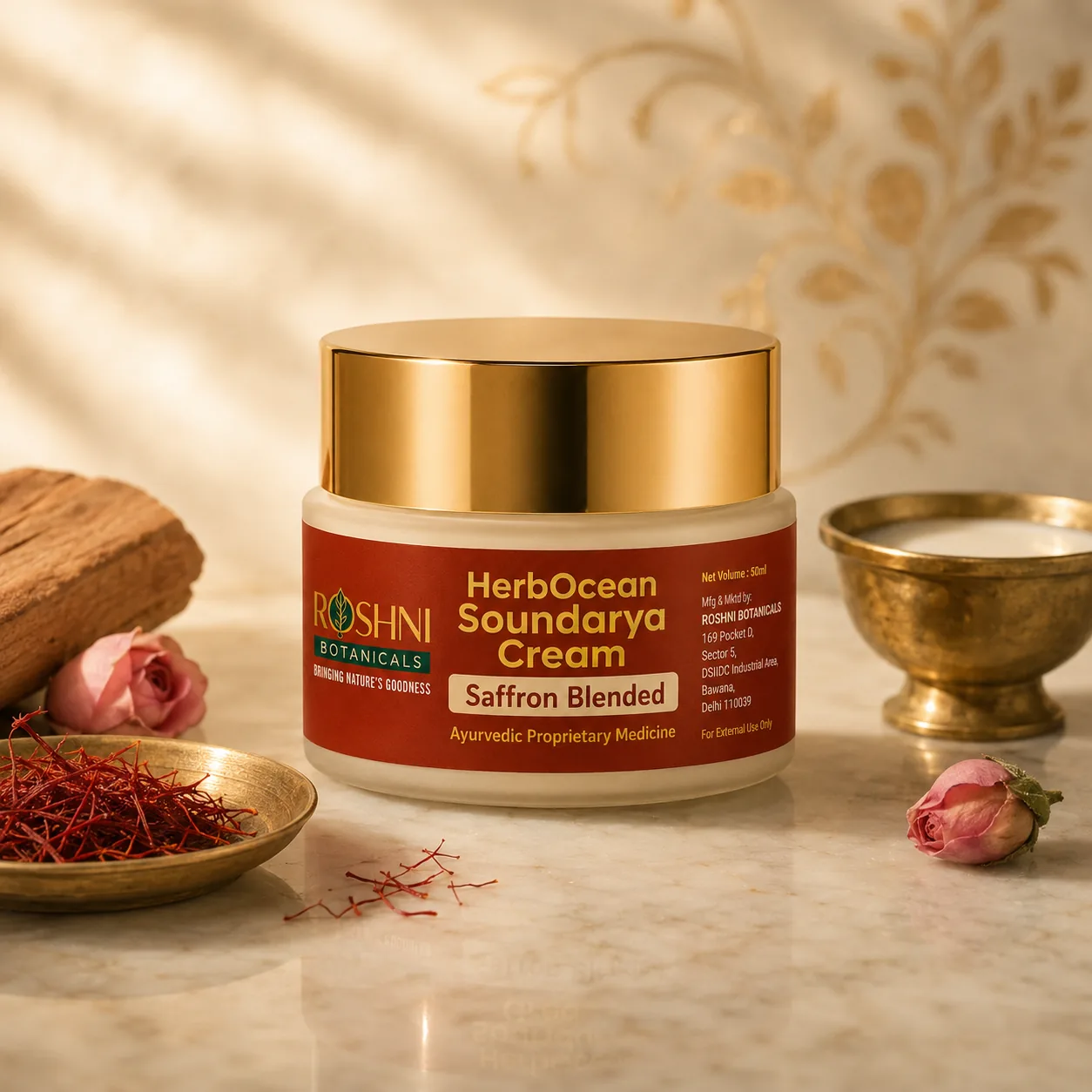
The overnight promise sells speed; the night itself offers something better, which is repair on schedule, every single day, free. Set the earlier lights-out, keep the morning sunscreen, and let the ritual carry the weeks: cleanse, two to three drops of HerbOcean Radiance Tailam massaged upward, sleep by eleven. For the fuller picture of how classical Ayurveda approaches pigmentation, our guide to the Ayurvedic treatment for melasma sits one click away, and if fine lines rather than spots are your evening concern, the anti-ageing night routine with Soundarya Tailam is the sibling ritual. Your nights are already working for your skin; give them the right two minutes.
References: Sushruta Samhita, Nidana Sthana (on Vyanga among the classical facial discolourations). Lyons AB, Moy L, Moy R, Tung R. Circadian Rhythm and the Skin: A Review of the Literature. Journal of Clinical and Aesthetic Dermatology. 2019;12(9):42–45.

Radiance Tailam
A saffron brightening facial Taila with Manjistha and red sandalwood, traditionally used to support even tone where melasma, dark spots and PIH show.
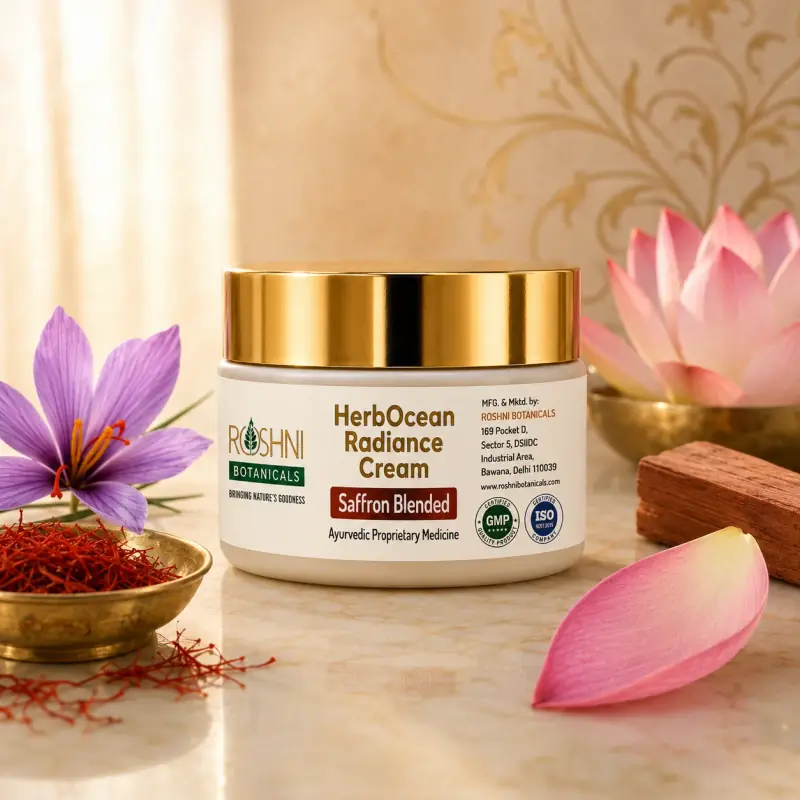
Radiance Cream
A daily saffron and sandalwood brightening cream with Manjistha, red sandalwood and lotus in a light coconut base. Supports a luminous, even-looking skin tone.
Part of our guide: Ayurvedic treatment for melasma on Indian skin.